Second Term Update #1 (Dec. 22-Feb. 16)-Fredericksburg’s Engineering/Rocket Program

Technically, the fall term didn’t end until January 19, so we have a minor bit of finishing up to do on that semester, but at this point, January  is past and February is better than half through as well.  The spring program is  already building, therefore, we will finish off and shoot straight into the new semester and the new year, as there are big goals and events  for each class group.

This second semester puts the Engineering Program students’ learning to the test as they build rockets and prepare to launch them for Rockets 2018 and their end of class projects. There are still four class groups this semester as freshman through seniors continue course study and  strive  to complete their section of the program.

Both Freshman and Sophomore groups are new for this semester. Last semester’s groups will not return to the program until next fall. This will mean that the progress reports will seem a bit familiar as these new groups will be doing the same projects and learning tasks that last semester’s group did since they too are at the beginning point of the Freshman and Sophomore programs.

Freshmen comprise a group of 13, pictured below. In the front row: Davis Englert, Roan Hagel, Hayle Mayer, Michael Flores, Gerry Balderas, and Daisuke Kyan.

In the back row: Tyler Smedley, Karson Hager, Cade Terry, Sam O’Leary, Kris Ersch, Travis Klokker, and Carlotta Wilkinson.

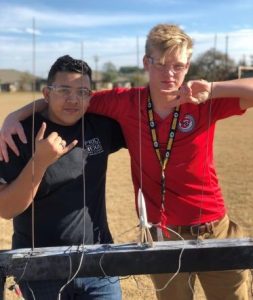
 This was for fun, and is freshman doing something wacky!

The new Freshmen group is once again testing structures which they are building from cardboard and tape. They watched an engineering video on I-Beams after their first testing session. This enlightened their understanding of bending moments which they applied to their structures.  One of the groups changed their structure by rotating it 90 degrees in order to make it taller than it was wide, which resulted in the structure being the opposite of its original design as well as creating an almost 100% strength increase through the new orientation and heighth.  Mr. Matthes states that this was a “Lesson learned and applied.”

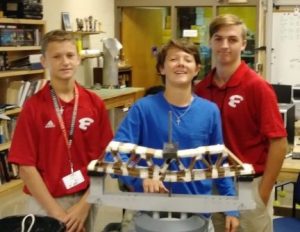
Below, the Freshmen show off their structures.

 Cade Terry, Travis Klokker,  Sam O’Leary    Hayle Mayer, Tyler Smedley, Daisuke Kyan Karson Hagel, Gerry Balderas, Roan Hager    Michael Flores, Carlotta Wilkinson, Kris Ersch, Davis Englert

Currently they are working on their post mission analysis on civil engineering, which is allowing them to  practice technical writing.

The freshmen have a field trip coming up on March 1. They will be visiting UTSA, Center for the Intrepid and Southwest Research Institute, all in San Antonio. A report and pictures will be presented in a future update.

The new sophomore group for this semester has 13 students,  11 pictured below.
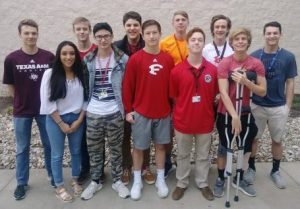
Front row: Gabi Moreno, Manuel Enciso, Jarrett Beard, Tyler Malinak, and Jacob Hinterlach. Back row: Tony Martinez, Noah Stotz, Jowad Aysheh, Jack Fox, Troy Kneese, and Jabin Gipson. Not pictured are Jessen Stableford, and Landon Sparrow.

The sophomores are moving through their course studies on a little more fast-track than last semesters class. This has been initiated in order to further their studies in 3D modeling and printing this round so that they achieve a more significant introduction in that area. They are doing well according to Mr. Matthes and are already beginning AutoCAD. In the past weeks they have successfully completed geometry, multi-view drawings, and engineering lettering.

As of January 23, the first semester studies ended for the Juniors, and opened them up to work on their second semester project in which they are now immersed. This project is to design and develop a one pound payload in a Transonic vehicle to be launched on April 26, at Rockets 2018.  This means that their rocket must must be capable of breaking the speed of sound while carrying a one pound payload and remaining under 13,000 feet. The junior group is a large group of 22 students this year so they are unique in that they have been split into two groups, each responsible for their own rocket.

Mr. Matthes had this comment about the two groups, “I am excited to see them working diligently and proudly taking the endeavor as genuine separate groups.  The ownership of their rocket and being different from each other’s groups is already evident.  They have established their problem statements and are feverishly researching with many, many, many unknowns.  As the process goes on their significant dispersion of knowledge and integration with each other slowly but surely migrates to a fully integrated and cohesive design.”

Along with their rockets, the group has another project for the semester. This entails designing and developing a teststand for Estes Motors. These are the small motors used mostly to fly their Generation 1 through 3 rockets. The objective is to create a teststand that will operate using LabVIEW programming to control and monitor ignition, measure thrust, and display and record real-time data to a file.

Seniors are a busy group with four projects still in the works, including Redbird 19, Wind Tunnel, Teststand and Baby Bird Teststand.

On February 1, Redbird 19(RB19) underwent Critical Design Reviews (CDR) with SystemsGo personnel present, and NASA flight engineers participating by Skype. RB19 did well overall.  The Redbird 17 tank is being recycled as part of  the RB19 design and was successfully tested earlier, as shown below, but will be retested on Friday, Feb.16 after which they will be required to provide documentation to SystemsGo. The team is fully immersed in the development of RB19. They have contracted machine shops and begun providing them work. These include Kager Industries, Heartland Enterprises, and SRM. Other necessary parts are in the order process.

Corbin Smajstrla, Sergio Walle, Bryce Erwin, Pierce Vasquez, Evan Knapp, and Harrison Spisak prepare to test the RB17/19 tank.

Wind Tunnel also underwent CDRs  with NASA and SystemsGo on February 1. Unfortunately it was found to have some issues to resolve. According to Mr. Matthes, the group is, “adapting well to the unexpected queries which arose and are close to having them resolved at this point. ”

Teststand has several upcoming events in March. In mid March, they will be conducting cold flow tests in order to verify the students injection system. This tests the flow rate of oxidizer through the system.  Projected live ignition tests have been set for the end of March, and students have been given some solid dates in order to keep them on task to accomplish these.

Baby Bird Teststand is currently on hold. Students have a heavy work load to complete with the other projects. PVC and polypropylene tests will need to be completed on the large Teststand before work can resume on the Baby Bird Teststand.

This article is the Third for the 2017/2018 school year in a series of monthly updates that will follow the Fredericksburg Engineering/Rocket program. This school is a participant of the SystemsGo STEM program. This series of articles is intended to support and encourage students in the program as they share their working status and accomplishments throughout the year in the program. These publications will be available for tags and re-posting.

www.systemsgo.org as always is the place for more information on this program. You may also email them at info@systemsgo.org . Take the time to get your school involved, the future of your students will be greatly benefited.

Awards Day for the Red Bird #18 2017Alumni

Today, Friday, December 22, 2017 at 10:30 in Mr. Matthes’ classroom,  FHS Engineering Class of 2017 was presented with their banner for a successful flight of the Red Bird #18 at White Sands Missile Range last summer.

They received the Goddard Level Newton Award from SystemsGo. The award was presented to them by Scott Netherland, Executive Director of SystemsGo.


Photographed (right to left): Colby Marthaller, Sterling Weatherford, Matthew Dulaney, Ian Kendrick, Hannah Boubel, Cody Pruett, Joseph Sanchez, Ricky Robles, Scott Netherland, and Payton Carroll.

The banner will be displayed at the FHS campus at a later date.

Congratulations to these students on their achievement as well as future endeavours.

www.systemsgo.org as always is the place for more information on this program. You may also email them at info@systemsgo.org . Take the time to get your school involved, the future of your students will be greatly benefited.

2017/2018 Fall Session Hi Lights Wrap Up for Fredericksburg’s Engineering/Rocket Program-(Nov. 10-Dec. 22)

Next Friday, December 22, the Fredericksburg High School Engineering/Rocket Program will dismiss for Christmas break. When they do, five weeks will have passed since the last update on their program. This is a busy group, and there is plenty to report on their learning and progress as we wrap up the fall semester.

The Freshman have been learning about  production/manufacturing engineering  and have recently completed their project which was an orange juice manufacturing factory design.  The class split into working groups of four because of the complexity of the problem. Their product goal for the plant was to take raw material and produce packaged juice in palletized product bundles ready for sale. According to Mr. Matthes, “It was a successful endeavor with lots of different results when it came to the challenging research it required.”

On Friday, December 15,  they presented their latest project over engineering fluidity.  Each student was expected to work independently to create new launch lugs for the senior level rocket. Their new lug designs need to be more aerodynamic than the current lugs.  Each student was able to show what they were capable of on their own, instead of having the co-dependency of fellow students. This solo venture challenged them to create a multiview drawing of their own new design, as well as featuring their understanding of units of measurement and how they all work together, something that will be of great significance for their final project in the future, which is to research the math and then design a hybrid rocket motor.   A  highly significant amount of math and even more units will  require their careful attention in that upcoming project . What they are learning as they work through this propulsion/aerospace problem will become relevant to them again when they begin their junior studies in 19 months. Therefore it is an important study in which to end the course.

Just to remind everyone, the Sophomore students are still working in a self paced manner in this year’s class. Therefore a good growth mark for them in their class progress  is  3D printing, which they have recently begun.  They have also shown marked achievement in their Autocad,  Dimensioning and Isometric drawing skills. In part this is due to their receptiveness to all the constructive feedback.

Luke Duderstadt working on Autocad.

“They have advanced tremendously in their attention to detail, ability to see things with greater special awareness, and pride in workmanship.  The transformation has been fun to witness,” states Mr. Matthes.

LabVIEW programming is an important focus for the juniors. At this point, Mr. Matthes says it is too early to tell their final success in this area, but so far, they are progressing well.

Fluids and aerodynamic drag have been the focus of their studies related to rockets these past five weeks. After learning these new skills, they were able to test them on the design and development of their Generation 3 rockets. In order to do this, they had to create a rocket that was stable with exactly a ‘margin’ of 1 while reaching 1800 feet in RockSim simulation and design software. Students were able to launch their actual Gen 3 rockets on Friday, Dec. 15 after they had in class rocket presentations and evaluations that morning. Additionally they were further challenged with a short deadline in which to create these rockets. They met this head on and were ready for presentations.

“It was collectively the best group of Gen 3 flights I have seen in years,” reports  Mr. Matthes.

Bradley Plaza and Carl Wilger prepare to launch their Generation 3 rocket.

Jabin Gipson and Rudy Avila model their Generation 3 rocket on launch day.

They will detail the many lessons they learned, including  results from mistakes in design, construction, evaluation process, and the significance of attention to detail in their post mission analysis (PMA). As they begin their second semester project, all these lessons will be critical learning tools in the success of this larger rocket.

Mr. Matthes reported, ” I was thoroughly impressed with all of them.  It was the kind of work ethic that will make their senior year a success if they can manage to keep up the motivation and focus.”

Critical design reviews (CDR) are the main focus for seniors on all four of their projects, which include the Red Bird #19 Rocket, a wind tunnel, the  NASA large motor test stand, and the Small HyperTek interface test stand, known as Baby Bird. Currently the group is running short on time their schedules and task lists are not reflecting all that they should. There is a possibility that they are either not aware of all that they have missed, or they are really close to being ready. Mr. Matthes is unsure at this point which one it is.

Pictured here is the seniors’ flow straightener prototype for their wind tunnel. It was 3D printed on a Makerbot.

They are scheduled to hold a preliminary design review with alumni at 10:00 on Wednesday, January 10th, here in the classroom. A full CDR will be due at the end of January.

“One potential reality is that if it becomes evident there is not enough time for everything, some project(s) may require postponing.  We are hoping for the best,”  states Mr. Matthes.

On Friday, December 22, 2017 at 10:30 in Mr. Matthes’ classroom,  last year’s alumni will be presented with their banner for flying the Red Bird #18 at White Sands Missile Range.  Seniors will have a question and answer session with alumni  to share experiences and receive advice.

At 7:00 p.m. also on Friday the 22nd, all alumni of the Fredericksburg Aeroscience/Engineering program are invited to come to Hondo’s and join Mr. Williams and Mr. Matthes for visiting over dinner and drinks.  It will be casual, come and go as you like bringing significant others and friends as desired.

Mr. Matthes reminds all program students, “In January, the spring program begins and deadlines and target dates for their projects become highly important in order to meet projected launch dates.”

NEW YOU (National Engineers Week Youth Outreach United) continues its progress in planning the 4th-8th grade engineering outreach event to be held on February 17th.  Look for more in the newspaper and students of those grades bring home flyers in January.

 This article is the Third for the 2017/2018 school year in a series of monthly updates that will follow the Fredericksburg Engineering/Rocket program. This school is a participant of the SystemsGo STEM program. This series of articles is intended to support and encourage students in the program as they share their working status and accomplishments throughout the year in the program. These publications will be available for tags and re-posting.

www.systemsgo.org as always is the place for more information on this program. You may also email them at info@systemsgo.org . Take the time to get your school involved, the future of your students will be greatly benefited.


2017/2018 Fredericksburg’s Engineering/Rocket Program-September Hi Lights

The new school year is three weeks into session and with it, the Fredericksburg High School Engineering Program has begun working toward new goals.

This year (Fall semester) there are actually classes representing each grade level. This is different from last year in that there were two classes of Freshman in the fall and two classes of Sophomores in the spring. There will be a class of 12 Freshman  in the fall and another class of 12 in the spring, and a class of 16 Sophomores in the fall and another class of 12 in the spring.

The Freshman classes began by learning about the design and development loop. This is important because it gives them an understanding on how industry approaches problems in order to develop new innovation. Leadership and teamwork have been a strong topic of class discussion as well as exercises to put these traits into practice. This week in class they are testing cardboard structures they have built as part of the structural project part of their class.

  Pictured: Kyle Kuhlman, Andrew Kendrick, and Gavin West.

   Pictured: Luke Tucker, Benji Robles, and Kolby Fryburger.

  Pictured: Paige Guzy, Emily Ma, Evertt Borton.

 Pictured: Nehemiah Cabral, Sadie Eidson, and Eli Rode.

  Here the whole class shows off their cardboard structures for testing.

Sadie Eidson with an unofficial test of her structure post ‘real’ testing while Gavin West looks on awaiting collapse without satisfaction.

Pictured here is this semester’s Freshman class: Back Row: Kolby Fryburger, Luke Tucker, Everett Borton, Gavin West, Nehemiah Cabral, Benji Robles. Front Row:  Eli Rode, Andrew Kendrick, Kyle Kuhlman, Sadie Eidson, Paige Guzy, Emily Ma.

Mr. Matthes reports, “They are doing very well.”

Sophomores are practicing drawing multi-views by hand. Students are able to work at their own pace this year, as long as they meet scheduled deadlines on assignments. This allows for those that learn at a faster pace to advance in the curriculum a little sooner. It should also allow them to have more time to become proficient on 3D modeling which will be a skill they will need as they move up in future classes. Soon they will begin the basics of drawing  on AutoCAD. Due to the individual pacing, one student was able to  begin AutoCAD yesterday.

Pictured here is this semester’s Sophomore class: Back Row: Noah Downey; Tommy Johnson, Gavin Eckert, Lane Wallendorf, Ryan Scroggie, Landon West, Clay Crouse. Front Row: Dalton Waters, Blake Boubel, Ryan Davis, Luke Duderstadt, Ryan Majors, Chad Braden, Gerry Balderas. Not Pictured here are Josephine Shaw and Alek Vasquez.

Junior  and Senior classes will encompass both semesters as one class group each. There are 22 Juniors in the program and 10 Seniors.

Due to the accelerated class schedule implemented at FHS last year, most one year courses are now accomplished in one semester. Because of this, the Junior year course study is actually two classes in one spread out over both semesters. Class time is currently split between two courses of study. In the first half of class they are beginning the basics of hybrid rocket propulsion and the book learning of the math to model it. In the second half of the class, they have researched advanced technology and dimensional analysis.

According to Mr. Matthes, “Many of them reflected afterward that they have a better understanding of math, how to work with units, what the units mean, and how the math has meaning and can be worked like a puzzle.  They are very excited and extremely sharp.  They work effectively as a group and seem to have great chemistry together.”

Pictured here is this year’s Junior class: Back Row:  Jabin Gipson, Cooper McDonald, Ander Castaneda, Gabe Voorhees, Jose Escalante, Clay Ellebracht, Dawson Harkins. Middle Row: Jana Brockmann, Robert Sanchez, Esten Cooke, Gloria Burns, Carl Wilger, Nicholas Rodriguez, Lucio Castro, Cody Blohm. Front Row:  Eduardo Memije, Robert Zowie, Brad Plaza, Ethan Scott, Deja Turkett, Rudy Avila, Josh Handley.

The Seniors are a busy and ambitious group this year. They have taken on four large endeavors including: The Red Bird #19 Rocket, a wind tunnel, the  NASA large motor test stand, and the Small HyperTek interface test stand, known as Baby Bird.

The Red Bird #19 will actually be a modified version of the Red Bird #17 from two years ago which did not leave the rail due to the injection failing. They will be rebuilding the propulsion and injection systems in order to correct the past problems with the rocket that kept it from launching in 2016.  –Small editorial comment here: As we have seen with other schools in past years at WSMR, this does not mean an easy fix. Quite often trying to correctly discern and correct another team’s issues on an unsuccessful vehicle can be harder than starting from scratch. It will be interesting to follow them and see what they find and how these new modifications affect this year’s flight test at WSMR.  FHS Engineering Project Leadership for Red Bird #19 is Chief Engineer, Harrison Spisak, and Project Manager, Bryce Erwin.

The Wind Tunnel is new for this year. This device is for testing drag on an object. To do this, the system uses a fan to create artificial wind which is forced over the object to create a drag.  FHS Engineering Project Leadership for the wind tunnel is Chief Engineer, Pierce Vasquez, and Project Manager,Rebecca Sechrist.

Testing on Baby Bird, the Hypertek test stand continues this year.  The purpose of this test stand, as highlighted in the last year’s updates, is to test a fuel grain system designed and developed by the students to interface with the hypertek injector and tank. Original plans were that three successful tests on this test stand would result in the opportunity for the seniors in the Fredericksburg Engineering Program to fly a new Hybrid student developed rocket at Willow City. This year’s team is continuing testing and development for this goal.  FHS Engineering Project Leadership for this test stand is Chief Engineer, Evan Knapp, and Project Manager, Sergio Walle.

Testing also continues on the NASA Test stand for large motors. Even though there is no new grant from NASA this year, there are plenty of materials  acquired from last year’s grant to continue testing.  FHS Engineering Project Leadership for this test stand is Chief Engineer, Joey Leal, and Project Manager, Corbin Smajstrla.

Mr. Matthes commented about this year’s seniors, “The group, already has plans set to come in this weekend to begin their endeavors.  They seem both excited about the projects and motivated to accomplish them.”

Last school year the program implemented a Senior out of class work schedule. Students signed a contract requiring them to commit to a set amount of overtime/after class work time in order to meet all deadlines and complete their rocket/projects for the year. The group is currently establishing a working schedule in order to implement these hours.  

Pictured here is this year’s Senior class: Back Row:  Harrison Spisak, Jacob Wienecke, Evan Knapp, Bryce Erwin, Sergio Walle. Front Row:  Corbin Smajstrla, Rebecca Sechrist, Pierce Vasquez, Joey Leal.  Not pictured in the seniors picture was Chris Calzada.

You may have seen the following information on a flyer your Engineering student brought home inviting you to the FHS open house  that was held on Monday, September 11. If you no longer have it or were not able to attend, Mr. Matthes has asked that you take note of the following date and time for:

FHS Engineering Night

SAVE THE DATE:

When: Monday,  SEPTEMBER 25TH, 6:00PM

Why:  Learn about the nationally recognized FHS Engineering/Rocket Program

Who:  Anyone – tell other parents and your friends, even if they aren’t in the program until next semester or aren’t a part of it yet. It is available to interested and current students as well as parents and interested community members.

Where:  Auditorium, plan on sitting up front for an “A”. Address is 1107 S. Highway 16

What:  Information/Order forms on Polos, t-shirts, decals and lanyards.

Including: Program objectives, overview of classes, media, and special guest alumni via Skype.

Follow Us, the FHS Engineering Program

You and your student are also invited to use the forms of media communication listed below to receive information and updates on all things Engineering.

The first is REMIND, (a text format) where you will find event notifications, updates, organizational coordination, and brief positive news provided on the program.

Text to 81010 the message @fhseng2021 for freshman Principles of Applied Engineering class

Text to 81010 the message @fhseng2020 for sophomores Engineering Design and Presentation 1

Text to 81010 the message @fhseng2019 junior Engineering Design and Presentation 2

Text to 81010 the message @fhseng2018 seniors Engineering Design & Problem Solving, Scientific Research and Design

Mr. Matthes sincerely hopes that students and parents will more actively follow and invest in the Engineering Program here at FHS.  One method to help with this is providing updates related to engineering and our Engineering Program through social media.  These will contain postings related to student activities as well as industry activity.  Familiarity with current events and current research in industry is a major source of inspiration and exposure to potential future endeavors.


fhseng

https://www.instagram.com/fhseng/?hl=en


The entire Engineering Program was invited to a movie night at the  engineering classroom, Wednesday evening, September 13 at 7:00 p.m. They viewed the movie the Matrix. Mr. Matthes  believed that a correlation between the students and the movie characters could be drawn and that could be beneficial to them. “It is my hope they recognize the metaphor for their own lives and begin to believe in themselves as I believe them, as Morpheus believes in Neo.” About 20 were able to attend.
 This article is the first  for the 2017/2018 school year in a series of monthly updates that will follow the Fredericksburg Engineering/Rocket program. This school is a participant of the SystemsGo STEM program. This series of articles is intended to support and encourage students in the program as they share their working status and accomplishments throughout the year in the program. These publications will be available for tags and re-posting.

www.systemsgo.org as always is the place for more information on this program. You may also email them at info@systemsgo.org . Take the time to get your school involved, the future of your students will be greatly benefited.


Fredericksburg Rockets 2017-Thursday Day 1 Report – Friday Schedule

Thursday went well. It started off a little slow due to clouds and a low ceiling. Fortunately, it burned off in the afternoon and launches started lining up with only intermittent delays. it was basically a warm, humid, and windy day, but turned out well in the end for rockets. Recovery went fairly well with only a few Transonics still in the field at the end of the day.  Hopefully they will still be recovered before the end of the weekend.

Original Fredericksburg High School STEM teacher and SystemsGo originator and program developer was on site today. He visited with folks, observed how things were working and even worked the Pad until around lunch. It was a nice treat having him on site a while again. He even said he might drop by again before the weekend is over.

We also had working guests from the new SystemsGo New Mexico. Director David Willden was helping a mission control as well as one recovery team that was from his group too.  #SystemsGoNewMexico

The original schedule listed 22 rockets, but the final total launched was 19.

Below is the launch schedule for tomorrow, Friday. There are 7 schools launching a total of 25 rockets tomorrow.

Friday, May 19, 2017
School
Name
# 1st Level
Tsiolkovsky
# 2nd Level
Oberth
Buinger CTE Academy
Michael Skrzynski
2 3
Hamilton High School
Seaborn Achby
1 1
Marble Falls High School
Leslie Alexander
2 1
RL Turner High School
Bill Richardson
2
Tom Moore (Ingram) High School
David Bunch
4
Union Grove High School
Greg Park
2 1
University High School
Dennis Oubre
4 2
7
Schools Launching
Totals 17 8
May 13th Total Rockets 25

The following is a link to the album of pictures from today’s launch. Have a look you and your school rocket just might be in there.

https://www.facebook.com/ginger.burow/media_set?set=a.1476991132322013.1073741888.100000334203350&type=3&uploaded=143

Good luck to all the schools launching on Friday. If I get a chance to do some updates during the day tomorrow , then I will but don’t count on it. It will probably just be one at the end of day. Here is the link to the live stream again.

http://livestream.com/systemsgo

Please remember that although there is no charge for the event, and these launches are open to public viewing, parking and seating is limited due to safety requirements. For this reason, SystemsGo has a provided a link for you to pre-order registration tickets for those in your party. This also provides SystemsGo with a way to monitor the number of people in attendance each year. This is in no way meant to discourage your attendance, but is instead to help them provide a great experience for students and spectators, while doing all possible to monitor safety issues and attendance numbers at any one time during the launches. These  tickets are FREE. They can be found on the SystemsGo Events page. Look for the little ticket icon that says, “Admit One”.

Event details will be available here each day of the event. Daily reports featuring schedules, school names, results, pictures and some editorial content will also be posted.

www.systemsgo.org as always is the place for more information on this program. You may also email them at info@systemsgo.org .Take the time to get your school involved, the future of your students will be greatly benefited.

#SystemsGo #Rockets2017 #FredericksburgSTEMAcademy #Launcher01 #SystemsGoNewMexico

Friday, Day 1 For Houston Rockets 2017-Recap and Saturday’s Schedule

Today, Friday was the first day of Houston rocket launches.  This is new for this year. Usually Friday is just a set up day, but do to more rocket volume to achieve launching, Friday afternoon was added.  Eight schools tested a total of 12 rockets this afternoon.

According to reports from team members at the site, all 12 rockets left the rail. That does not mean each was a perfect launch,  but then that is why they are considered test vehicles. All in all it was a good day with fabulous weather, and a great new location with good results. And they get to do it all over again Saturday.

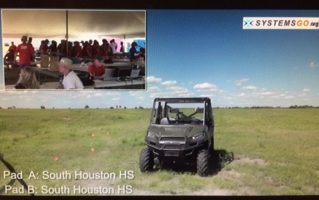
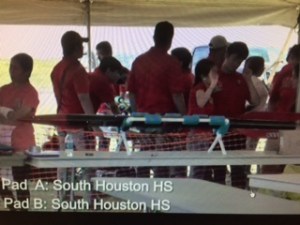
These are screen shots of the action in Houston. Quality isn’t always perfect but at least you can see some of what went on today. I will add more to Facebook and post them at some point on Saturday. The link to my page is down below these photos.


I do have more photos I grabbed from the live feed as well as some from team members that I will be posting Saturday morning. https://www.facebook.com/ginger.burow

Here is the schedule for Saturday as listed on the SystemsGo website.

Saturday, May 13, 2017
School
Name
# 1st Level
Tsiolkovsky
# 2nd Level
Oberth
Brazosport High School
Bradley Nelson
1
Brazoswood High School
Dale Hobbs
3 1
Channelview High School
Alan Stone
3
Davis High School
Hasan Johnson
2
Kingwood Park High School
Jim Brown
2
Liberty High School
Matthew Williams
2 1
SF Austin High School
Richard Hubbard
5
7
Schools Launching
Totals 18 2
May 21st Total Rockets 20

Please remember that since there is pubic access to this event this year,  there are tickets for order and those may be found on the SystemsGo website as well at this link: https://www.greateventseats.com/events.php?lID=92

Livestream is available again this year so friends and family can watch the action online. The link for that is on SystemsGo‘s website or posted here:  http://livestream.com/systemsgo

Here is Phil Houseal keeping the Livestream action going: 

Event details will be available here each day of the event. Daily reports featuring schedules, school names, results, pictures if available, and some editorial content will also be posted.

www.systemsgo.org as always is the place for more information on this program. You may also email them at info@systemsgo.org .Take the time to get your school involved, the future of your students will be greatly benefited.

SystemsGo Team Travels to Smith Point for an Early Start to Houston Rockets 2017-Friday’s Launch Schedule Included

The StsytemsGo team left today, Thursday, headed to Smith Point, near Anahuac, Texas down near Houston. This is a new location for this year. They arrived there early today,  setting up the launch site, and readying everything for an early start, as launches begin Friday afternoon. This is new for this year.

Launches will continue all day Saturday, and  half a day on Sunday with 17 schools launching a total of 39 vehicles.

The current launch schedule for Friday is shown below and may also be downloaded from SystemsGo website at the following address:  http://www.systemsgo.org/wp-content/uploads/2017/04/Flight-Schedule-Rockets-2017-Houston-4-4-17-.2.pdf


Friday, May 12, 2017
School
Name
# 1st Level
Tsiolkovsky
# 2nd Level
Oberth
Anahuac High School
Kirk Moore
1 1
Dickinson High School
Sara Malloy
1
Eisenhower High School
Jacob Arriaga
1
Pasadena Memorial High School
Katherin Melton
1
Pasadena Memorial High School
Kyle Jurek
1
South Houston High School
Kevin Herron
4
Victoria East High School
Adam Wertman
2
Victoria West High School
Cheryl Clark
1
Schools Launching    8
Totals 12 1
May 21st Total Rockets 13

This new launch site, will allow public access this year. A map to the location as well as directions are available at the SystemsGo Events page found here:

 http://www.systemsgo.org/events/

Phil Houseal  and Zach Pooser will be on site providing the Livestream up-link again this year so friends and family can watch the action online. Here is the link to the live stream for the Houston launches.

http://livestream.com/systemsgo

Zach and Phil provide a great experience for both viewers at home and the students and team on site while helping to bolster the STEM program. Allowing the public to share in the action and see what these students are accomplishing as they apply all they have learned in class, and continue to learn from their launch results, helps SystemsGo to grow interest in the future of the STEM program and the hands on approach to learning.

Please remember that since there is pubic access to this event this year,  there are tickets for order and those may be found on the SystemsGo website as well at this link: https://www.greateventseats.com/events.php

Just a note, the tickets are free of charge but are required for entrance. They are available on site at the gate as well but the preferred method is online at the link above.

Event details will be available here each day of the event. Daily reports featuring schedules, school names, results, pictures if available, and some editorial content will also be posted.

www.systemsgo.org as always is the place for more information on this program. You may also email them at info@systemsgo.org .Take the time to get your school involved, the future of your students will be greatly benefited.

Fredericksburg’s STEM Academy/Rocket Program-Spring Term Update #3 (April 1-April 30)

May is here and time is running out for the Fredericksburg STEM Academy as launch dates approach for the junior and senior groups. Juniors have a  May 18th test date at Rockets 2017 in Willow City. While the seniors are down to less than 3 weeks as Redbird 18 is scheduled for completion two weeks before school ends to allow for preliminary systems tests.Due to delays in manufacturing, testing will have to occur in the process of construction as components come in. Final testing will be the week of June 19th prior to their test at WSMR the following week. It is slated to launch at White Sands Missile Range on June 27th.

During April the seniors tested Low Density polyethylene (LDPE) three times on teststand. Data on all tests was consistent and exemplary. Currently the injector plate is being drilled again to increase the oxidizer flow rate to the correct  value to provide for complete combustion.  Due to this testing is on hold. Lately they have been experimenting with different ablative arrangements. The ablative has  burned through slightly but not enough to damage the test cell.

Below is an actual video of an engine burn test.  This one of the first video’s with HD video quality and audio.  The regularly captured video does not have audio embedded.  This is good for them too as they do these tests for NASA and this gives them something  more to show of their work.

https://goo.gl/photos/78HwtXxx8rytjxSV7

Mr. Matthes had this to say about this particular burn,  “It looks pretty good but we’re only getting about 1/3 of the oxidizer we should be getting so it is fuel rich.  It will not be as orange when we get the oxidizer flow rate correct.  The hope is that it is a really clean plume with mach diamonds in the plume.”

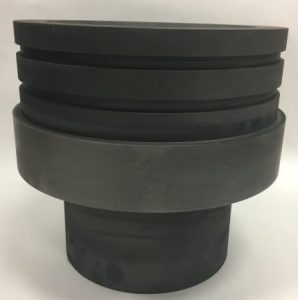
The senior’s “junior teststand” nick named “Baby Bird” is almost complete. They hope to conduct their first ever test on this new teststand possibly late this week. This teststand was created by the seniors starting last year during junior studies to test a fuel grain system designed and developed by them to interface with the hyportek injector and tank. They hope to have 3 successful tests on this teststand. If they achieve this, then they get to fly this new system at Willow City in last year’s rocket.  At this point,  they are getting fuel grains prepped.  Pictured below, are nozzles created for Baby Bird.

Redbird 18 still currently does not resemble a rocket, but they are making steady progress. The nozzle has been manufactured, seen here 

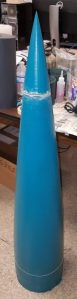
and  the nose cone mold is also back, seen here. 

Machining could only be created to within 8 inches of the tip, therefore they created the tip with 3D printing and epoxied it to the nose cone and are preparing it for fiberglass.

Other needed materials are in and have been sent out to Heartland Enterprises for machining.  Currently, Mr. Matthes says that the biggest test coming up will be next week when they pressure test the oxidizer tank.

Juniors are under pressure as the deadline for 100% completion of their rocket is May 11. Meeting this deadline will allow them time to complete their Flight Readiness Reviews (FRR) and be able to high light problems or errors that still exist. Components are coming in and weights on some are different than originally reflected in RockSim. Due to this they are updating their design to accommodate. Currently they are still on the wire between breaking the speed of sound and exceeding the 13,000 feet maximum allowable altitude. Breaking Mach means they also exceed altitude. Staying under 13,000 feet  means then they lose their shot at breaking Mach.

 Here Chris Calzada is working on RockSim trying to resolve the altitude velocity conundrum.
Meanwhile the Sophomores have been entrusted to work at their own pace to finish their last chapters and projects. Time remaining after completion of these is for 3D printing and modeling. Their learned skills in  isometric, creating section views, details and working drawing sets would now allow them to communicate effectively to a machine shop without the need for clarification.

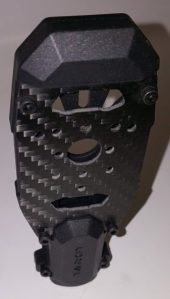
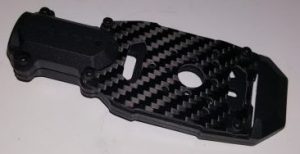
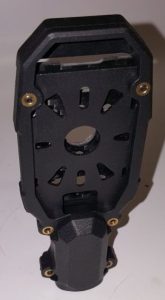
Paul Kucherka, a FISD maintenance man and school function videographer developed an issue with the quadcopter that he uses to video. A few of the sophomores are going to attempt to design and develop a new wiring harness that may provide the solution to Paul’s needs, hopefully by the end of the school year,  this would allow him to continue using this equipment for video. In order to do this, a few other sophomores have been creating the multiview of one of the quadcopter’s parts on the 3D printer. Pictured below is the original part they are attempting to recreate.

This article is the seventh in a series, new for this school year ’16/’17 of monthly updates that will follow the Fredericksburg STEM Academy/Rocket program. This school is a participant of the SystemsGo STEM program. This series of articles is intended to support, encourage, and challenge students in the program as they share their working status and accomplishments throughout the year in the program. These publications will be available for tags and re-posting.

www.systemsgo.org as always is the place for more information on this program. You may also email them at info@systemsgo.org . Take the time to get your school involved, the future of your students will be greatly benefited.

Rockets 2017 Begins Next Week With a New Venue in New Mexico

The launch of Rockets 2017 blasts skyward on April 27th from a brand new venue this year as six schools from New Mexico join the SystemsGo program. Last year instructors from these schools came to Willow City to observe, learn and participate in launches in order to implement the program at a new site in New Mexico.

SystemsGo New Mexico is headed up by David Willden and currently includes the schools of Carlsbad High School, Hobbs High School, Jal High School, Lake Arthur High School, Loving High School and Lovington High School. This is their first year in the program and they will attempt launching a total of 10 one pound/one mile rockets at a location near Jal, New Mexico.  This new site, called the Discovery Education Launch Pad,  will be open to public viewing of launches, as are all sites except White Sands Missile Range this year. A link to location information and a map link are available at http://www.systemsgo.org/events/ .

The site will be open for admittance at 8:00 a.m. and launches will commence at 8:30 a.m.

If you plan to attend Jal or any of this year’s launches please register for your attendance ticket at http://www.systemsgo.org/save-the-date-for-rockets-2017/  or they may be gotten at the gate. These are free but required for admittance to each site.  Reserving them ahead at the website is preferred to obtaining them at the gate because the latter slows entrance to the site and may result in you missing the viewing of your intended launch.

You may also view any of the launches except WSMR on Livestream. That link will be available on the SystemsGo website closer to the launch. The New SystemsGo New Mexico also has a twitter feed you can join to keep up to date on what they are doing. That link is https://twitter.com/SystemsGoNM

The schedule of launches for Jal is also available at http://www.systemsgo.org/save-the-date-for-rockets-2017/ . I will post it here for launch day next week as well. I want it to be as accurate as possible so I will refrain from posting it now in case there are any late changes.

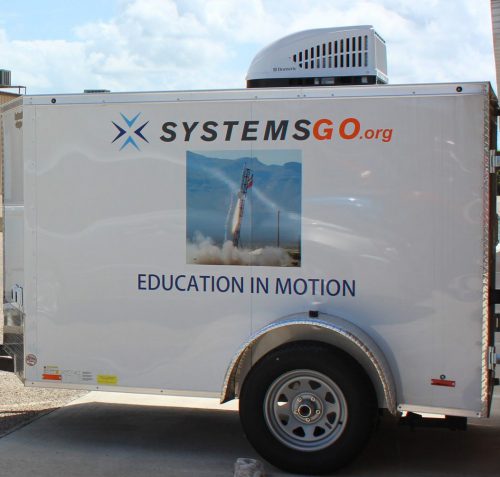
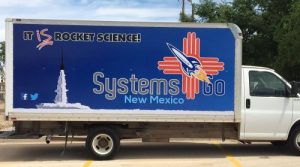
If you are in the Jal, New Mexico area, keep an eye out for this new vehicle. It just rolled out recently to support the new launch group. 

If you follow this program and like to view the launches, Rockets 2017  will continue with two  more launches in May. The first will be held in Smith Point just south of Anahuac, Texas for schools in the Houston area, on the weekend of  May 12-14, 2017. If you have been to the Houston area launches in the past you may want to check out the SystemsGo website for information because this is a new location for that area this year. Information and a map link are available.

Next the Stewart Ranch in Willow City, Texas will host the largest of the now three launch events on the weekend of May 18-21, 2017.  This testing site covers the Fredericksburg and  Hill Country area schools and all Texas schools not participating in the Houston launches.

Please watch the SystemsGo website, SystemsGo Facebook page,  SystemsGo Twitter feed: https://twitter.com/SystemsGoNews and this blog for upcoming information on theses events.

The senior groups are tentatively scheduled to launch their Goddard level rockets at White Sands Missile Range (WSMR) in New Mexico the week of June 26-30.  These are not available for public viewing or Livestream due to being tested on a military facility, but blog and SystemsGo updates will be posted online as available during that week.

More event details will be available here in upcoming days as events get closer. Daily reports featuring schedules, school names, results, pictures and some editorial content will be posted during the events.

www.systemsgo.org as always is the place for more information on this program. You may also email them at info@systemsgo.org . Take the time to get your school involved, the future of your students will be greatly benefited.

Fredericksburg’s STEM Academy/Rocket Program-Spring Term Update #2 (February 21-March 31)

April 1st is tomorrow, so time is becoming a factor for the Fredericksburg STEM Academy as launch dates approach for the junior and senior groups. There are no fools here though, just  several groups of future engineers working hard to meet their timelines. With March behind them there is only a little over 6 weeks left  for the  junior group until Rockets 2017 and their May 18th test date. The seniors have approximately 60 days as Redbird 18 is scheduled for completion two weeks before school ends to allow for preliminary systems tests.

More on these groups and their current status reports will be later in the article.

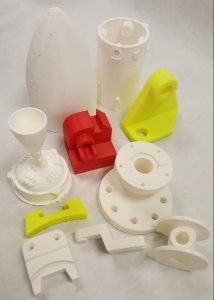
Sophomores are currently taking mid-term exams. This is due to the new schedule for classes this year which puts a full year’s curriculum into one standard semester. They have been busy using AutoCAD to create multi view drawings of objects. Dimensioning and tolerancing of these drawings will be learned next, followed by isometric drawings and 3D modeling. The students have been printing models of their multiview drawings using the newly installed 3D printer. All 3  3D printers available now are working well.

The student aide, Colby Marthaler  has also been using the 3D   printers to print all the parts necessary to create a model of the Falcon 9 Rocket SpaceX uses to transport satellites and the Dragon spacecraft into orbit.
Juniors had CDR’s (Critical Design Reviews) due for their rockets by March 30. Unfortunately they are just getting to them. Students will have to be studious in order to meet their May 18th launch date due to being behind schedule at this time. The payload for this rocket is a rapid growth slime mold. They have designed the payload in order to create a controlled experiment in which they should be able to determine how flight impacts the mold’s growth, negatively or positively.

The design criteria for their rocket is a one pound payload and breaking the speed of sound therefore achieving a transonic state. Currently neither criteria has been met so the group has more work to do to accomplish their goals by their launch date.

Their mid-term which is a LabVIEW development project has come along well. They are creating a workable program which requires specific methods and functions in order to attain a goal of designing and fabricating a micro test stand for Estes motors. They will be connecting  a (DAQ) Data Acquisition unit to a computer and registering it to that computer in order to read sensors, and programming a control and DAQ Virtual Instrument in LabView in order to run the test stand.

March began with more fuel grain tests at test stand. Two tests were completed in the first week alone, consisting of many hours of work to accomplish each. A temperature sensor indicated a high enough value in order to cause a programmed shut down on the first test that week.  After investigation, it was found that a ‘electrical noise’ caused an anomaly which gave the sensor its reading, and that it was in fact not outside normal operating parameters. The actual test did not experience any temperature concerns.

The same fuel grain was able to be used again in a 20 second burn, which allowed students to achieve a cumulative 40 second burn on one fuel grain.  The shut down was disabled for the second burn,  allowing the data to still record the temperatures caused by the ‘electrical noise’, but not to stop the burn test and it was a  full success without any further exceptions.

Mr. Matthes was very pleased with these burns and stated , “All data was processed and showed again the test stand was producing verifiable data similar to theoretical expectations.”

Students began another round of testing this week. Six new fuel grains will be tested accounting for three tests each of two different fuel types students have been working on. The  hope is that they will cycle through smoothly due to the fuel grains being prepped prior to testing.

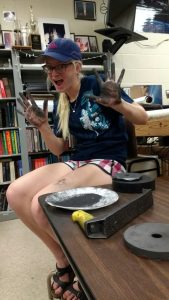
  Here Hannah Boubel is working with graphite in order to make ablative, which is a sacrificial material in the pre and post combustion chamber so the burn does not penetrate the liner and steel test cell.
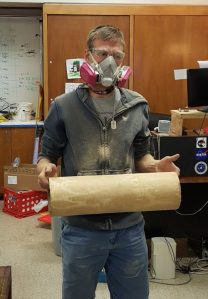
 In this photo,  Sterling Weatherford is preparing a fuel grain for installation in to the test cell.

Along with test stand work, the students have been hard at work on Rebird 18, their Goddard level rocket slated to launch at White Sands Missile Range on June 27th. Students have already contracted with Heartland  Enterprises and SRM Manufacturing for fabrications and parts have been supplied to them.

At this point in the process students are learning true cause and effect, and just how it can affect their outcomes.  The entire success of the vehicle from this point forward is contingent on the group not only working as a team as a whole, but also for each individual team to stay on top of their work and outcome. Many of the components are dependent on the progress of the others. Delays on one team’s  element directly affects the next  team creating delays down the line and strained time schedules.  Individual testing is conducted on each piece as it is finished.  Full up integration and testing of any systems that allow for ground based testing is scheduled for two weeks from the end of school when the rocket is due to be complete.

“They are well on their way to a successful vehicle.  The seniors will not have the luxury of adopting senioritis as there is still significant and mutually dependent work to be accomplished,” Mr. Matthes reported. “These next 60 days will be a true test of their team work, peer loyalty and persistence. ”

As the end of the school year approaches, these students are becoming more and more adept in their learning and knowledge as young and capable engineers. Their end of year rockets will be a testament to that learning, time and ability.

According to Mr. Matthes, “Students are becoming ‘plagued’ with knowledge and experience:  the more they know and become aware of, the more they have to take into consideration and the more challenging the process becomes.  However, it also makes for conditions more aligned with success.  Additionally, if we consider these students products of FHS and the FHS Engineering, then they should be welcomed by a market hungry for what they have to offer.”

If you follow this program and like to view the launches, Rockets 2017  will be held at the Stewart Ranch in Willow City, Texas on the weekend of May 18-21, 2017.  This testing site is open to the public. Please watch the SystemsGo website and this blog for upcoming information on the event. The FHS junior group will be testing their rockets on Thursday, May 18, 2017.

The senior group is tentatively scheduled to launch their Goddard level rocket at White Sands Missile Range (WSMR) in New Mexico the week of June 26-30. The current schedule for that event is as follows:

Sunday, Jun 25th             Travel Day

Monday, Jun 26th            T-1 and Site Set up/Rocket Prep at WC-50

Tuesday, Jun 27th            Launch Day One (Three Rockets – Fredericksburg, Union Grove, Alamo Heights)

Wednesday, Jun 28th     Launch Day Two (Three Rockets – Anahuac, Booker T. #1, Booker T. #2)

Thursday, Jun 29th          Contingency Day

Friday, Jun 30th                Travel Day

There are also launches in Houston for schools in that area the weekend of May 12-14, 2017. New for this year the Hobbs, New Mexico group of schools will launch 1/1 rockets in Jal, New Mexico on April 27, 2017, this site will also be open to public viewing.

This article is the sixth in a series, new for this school year ’16/’17 of monthly updates that will follow the Fredericksburg STEM Academy/Rocket program. This school is a participant of the SystemsGo STEM program. This series of articles is intended to support, encourage, and challenge students in the program as they share their working status and accomplishments throughout the year in the program. These publications will be available for tags and re-posting.

www.systemsgo.org as always is the place for more information on this program. You may also email them at info@systemsgo.org . Take the time to get your school involved, the future of your students will be greatly benefited.