Wednesday’s Pre-Launch Report for Rockets 2026 Contiuning at the Central Texas/Stonewall, Tomorrow, Thursday, April 30-Saturday, May 2, 2026

The Central Texas Launches sail into the skies over Stonewall, Texas starting tomorrow, April 30, 2026. This is the third in the series for the Rockets 2026 and the second in the Texas Rocket Trail lineup. This is our seventh year in Stonewall for the CTX Rockets launch.

The SystemsGo Team spent several days early this week setting up the launch site at the Sammy Segner Ranch on the Double Horn Road. This included construction of the Pad and Mission Control and testing of the rails. Stage 3 inside MC, Media, and Communications were also part of this set up.

Class A Event Rentals arrived to set up tents for Mission Control, Media and spectators. Duane Neffendorf again provided portable restrooms and wash stations to the site. Later LCRA, Bee Creek Communications and Starlink provide support for IT,  Internet WiFi and Radio communications.

Stages 1 and 2 rocket check in stations were also established at the Stonewall Chamber of Commerce building. Student Team tables were numbered for evaluations and last-minute corrections to the vehicles.

The Stonewall site covers the Fredericksburg and Hill Country area schools. Some of our North and South Texas schools still participate here,  in leu of our NTX and SETX sites. Our two out of state schools, Canon City from Colorado, and Mustang from Oklahoma also elected to test here. This year our over seas school, the American Community Schools Abu Dhahi, will also launch at Stonewall, in previous years they participated in the SETX launch at Smith  Point.

Currently there are 57 rockets scheduled for launch by 16 schools at the Stonewall location for Rockets 2026. This schedule may be updated this week with the possibility of schools adding or dropping close to launch time. 

Spectators are welcomed again this year. Teachers are encouraged to bring pop-up tents for themselves and their students. Please remember sunscreen, chairs, umbrellas, extra snacks, drinks, and food. Downtime entertainment for the students to engage in between launches may also be helpful. Rockets are subject to winds, weather, and workmanship, all of which can stall a launch, and delay schedules.

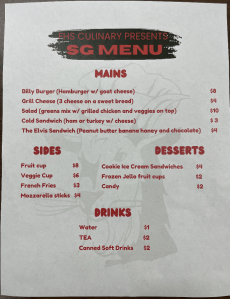
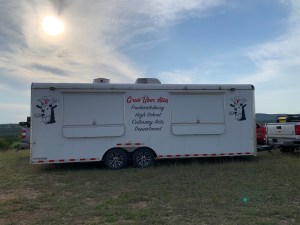
The FHS “Grub Uber Alles” Culinary Arts Trailer will set up shop and provide concessions for the weekend. The pics below are from the last time they graced the event with their food, so this menu and pricing may not be exact. Tomorrow I will update it as needed. 
Paige Findly will be handling media and live stream for the CTX Rockets event. With changes in staff happening this season, he has been instrumental in helping Rebekah and myself get media and the livestream up and running. He is testing out his equipment at this weekend’s launch event. 

The Central Texas/Stonewall launch dates, locations, and schools are listed here for your convenience or can be found at http://www.systemsgo.org

Central Texas/Stonewall:

The sites will be open to admittance for students and teachers only at 6:00 a.m. Projected start time for launches is 9:00 a.m. All is contingent on test vehicle readiness and ability to pass Stages 1 and 2. Mission Control will be ready for Stage 3 checks by 8:00 a.m.

Rockets are subject to winds, weather, and workmanship, all of which can stall a launch. Unfortunately the weather for the weekend is less than ideal with rain and thunderstorm predicted Friday and Saturday. This being said, be prepared for the possibilities of delays. But with any luck maybe the rain will hold off until the overnight hours so launching can stay on track for the daytime.

Please either join in the action on site or help cheer the students on while watching the  Livestream. The look on your students’ faces when their vehicle goes up and then is recovered is priceless. If they know you are watching and supporting them, then it is even more memorable. If you are not on site, then shoot them a text, letting them know you are watching online, or participate in the chat on YouTube Livestream page. 

A live feed for each launch will be provided here:

Rockets 2026 Live Stream

The link is available at www.systemsgo.org on the home page.

Daily reports featuring schedule links, school names, results, pictures, and editorial content will be posted during the events if information is available.

Pictures from each day are on SystemsGo Facebook page, as well as my Facebook page. They can be found here:

https://www.facebook.com/SystemsGoEducation/

https://www.facebook.com/ginger.burow


Central Texas/Stonewall:

  • Thursday, April 30- Saturday, May 2, Weather Contingency Day-Sunday, May 3
  • Launch Site: 2187 Double Horn Road, Stonewall, Texas 78671
  • Stage 1 & 2 at Stonewall Chamber of Commerce: 250 Peach Street, Stonewall, TX 78671
  • Central Texas Map Links:
    CTX Check In / Stage 1 and 2
    CTX Mission Control / Launch Site


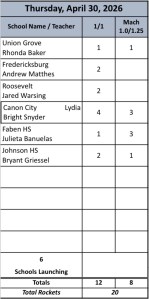
  • Central Texas-Stonewall 2026 Flight Schedule for Thursday, April 30, 2026
  • Schools participating: Fredericksburg HS, Union Grove, Roosevelt HS, Canyon City HS, Fabens HS, and Johnson HS
  • 20 expected rockets for testing

Here are a couple of things that SystemsGo requires for your attendance:

  1. Any member of the public wishing to attend a launch is required to register online and agree to Launch Day Entry Form / Waiver
    Scan or Click
    Jotform Waiver QR Code

    There is no charge, but proof of registration is required before entering the site. You will be issued arm bands as proof and you must have them on at all times.

  2. All information can be found https://www.systemsgo.org listed under each individual venue.

Questions and concerns may be directed to info@systemsgo.org.

Please watch the SystemsGo website, SystemsGo Facebook page,  SystemsGo Twitter feed: https://twitter.com/SystemsGoNews and this blog for upcoming information on these events.

www.systemsgo.org as always is the place for more information on this program. You may also email them at info@systemsgo.org . Take the time to get your school involved, the future of your students will be greatly benefited.

I hope you are as super excited about this year’s CTX launches as I am! Let’s pray the weather cooperates and we get to see a steady stream of rockets screaming into the sky. 

Hope to see you at the launches!

#RideTheSkies #TexasRocketTrail #Rockets2026 #EyesOnThe Skies #EyesToTheSkies

What’s All This About Rockets: Success Stories–Robert Deaver

In 1996 in the small town of Fredericksburg, Texas a high school Aerospace program was begun and built literally from the classroom skyward as then, teacher, Brett Williams, developed a plan to build and launch rockets in a classroom setting in order to teach and implement a STEM curriculum. This class originally known as Principles of Technology (the POT Class, as it was fondly referred too), later became the SystemsGo program of Education In Motion, teaching students all over the state and now New Mexico too how to use the principles of STEM to build a career.

In this series of Interview style articles, we will meet individuals that studied under this program and have gone on to build their futures on the skills it teaches. The first gentleman we will meet, is Robert Deaver.

When speaking with indiviuals that have been through this STEM program, especially in the beginning, one thing stands out. Most of them started out in the program because the course name/description sounded interesting, and it provided a science credit.  As years went by and the program became known for building and  launching rockets, that in itself became a big draw for the program, although most participants still did not expect it to have the impact on their career choices that it did.

Robert, when asked why he got involved in the STEM program, was no different. “The class name sounded interesting and it counted as a science credit.”

That simple approach drew in the first classes that set forth to build a rocket, launching  the much more valuable vehicle of their futures  as time and learning evolved.

Robert was in the class during its ground breaking days, working on the construction and flight of the Red Bird #1, #2 and #3 rockets. These were the very formative first two years of the program as students and teacher learned together exactly what it took to create these projects. At first this was just a really fun and new concept of hands on learning and teaching that the students enjoyed.

The original class was only a one year class, but students really took to it and then this “science credit” soon became a class that students took because they wanted to experience it again.

“The course was so much fun I asked if i could take it again and was allowed. I initially took the course because it sounded interesting. I took it a second time because it was fun and challenging,” Robert stated when asked what his reasons were for taking the course.

Robert credits the program with setting him on his career path. He earned a BS in Electrical Engineering a the University of Texas at San Antonio and a MS in Computer Engineering at the University of Tennessee. Robert worked for IBM, Dell, and  after graduation, Real Time Systems, where he spent the last four years designing embedded systems that are used world-wide. After his recent marriage he moved to Boerne, where he started a new career as a hardware engineer at Futurex in Bulverde.

“I did not go directly from high school into an engineering program in college, but being exposed to the ideas and concepts of engineering in the Principles of Technology (precursor to the StystemsGo program) led me there eventually. I learned about Real Time Systems through volunteering with SystemsGo and after I graduated applied for a job with RTS and was hired.” Robert stated.

In his time in the program he worked on 3 of the Red Bird Rocket projects, #1, #2, and #3.  On all three, Avionics and Electronics were his main team focus therefore he was instrumental in Altimeter configuration on all three. On RB#1 he also worked on the Audio/Video Recording and Transmission, and the Fill and Fire system design and construction. On RB#2 he took on the Recovery System design, and on RB#3 the Airframe and Fin design.

Live video transmission from rocket to ground is what he remembers as the worst problem that he tried to solve while working on the RB#1 rocket.

“The electronics were ‘fiddly’ and although it worked well on the  ground, we were not able to get it functional during launch.”

In spite of this, RB#1 is still what he remembers as his best success from the program.

“I watched as a rocket  that my team and I researched, designed, and built from scratch soared off the launch pad. That feeling of accomplishment is truly indescribable!”

During these years he learned that he really liked working with electronics.  He also learned how to work on large projects as a team.

“The Red Bird 1, Redbird 2, and Red Bird 3 were by far the largest projects I had participated in at that time. Each project required interaction with others on my team and with other teams to complete.”

Even with all he learned he still did not realize the impact this program would make on his career choices until he was in college.

“During engineering school, I realized how much more prepared I was due to the project and team interaction skills I learned in what later became the SystemsGo Program.”

When I asked Robert  what advice he would give to current and future students in the program, here is what he had to say, “If you even think you are interested in engineering take these classes and pay attention. The problem solving and team work skills you learn in the SystemsGo program will be invaluable once you get to college.”

Another success of this program is that students from past years come back year after year to volunteer with the program. Many take time out of school and careers to do this. Robert is no exception. He volunteers annually  for the Central Texas, South Texas, and Goddard launches. He has also been named a board member, where he is happy to be able to, “help shape the program.”

I would like to thank Robert Deaver for participating in this article series. He is only the first in what I hope to bring to you as an ongoing series of success stories. These are written in hopes that all may understand the impact that STEM can have on your students and future employees. Having a program available at the high school level to teach, encourage and support this type of learning is instrumental to getting these students into great career futures.  Encourage your students to get involved in STEM and the SystemsGo program if it is available at your child’s school. If it is not available, look into how you can bring it to your area. This program will greatly benefit your school and children.

If you know or have a student that went through the program that would like to share their story here, please contact me in the comment section on this blog or if you follow it on Facebook, Twitter, or LinkedIn contact me there, and I will send you information to participate.

www.systemsgo.org as always is the place for more information on this program. You may also email them at info@systemsgo.org .Take the time to get your school involved, the future of your students will be greatly benefited.