SystemsGo New Mexico Blasts Off Its 2nd Year of Rocket Launches Tomorrow

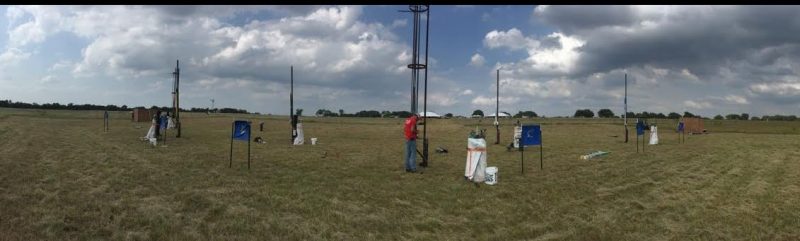
Hello Rocket Fans, are you ready to #RideTheSky, cheering on your innovative, creative, intelligent students?! Well, tomorrow is the day! Rockets will be headed into the heavens in Jal, New Mexico. This is the second year for the SystemsGo New Mexico group and they are ready and up to the challenge, as they add Transonic vehicles to their launches for the first time at this venue. Last year they only attempted 1 pound/1 mile rockets so it will be another new learning curve for the students and volunteers at the site. No worries though, they have been training for this and the group has it all in hand.

Stage 1 and Stage 2 rocket check ins start at 1:00 today and run through 5:00 p.m. at Jal Elementary School. If your school’s rocket clears stage 2 today, Friday, it must remain at the elementary school overnight. Pick up time starts at 7:00 a.m. for these rockets.

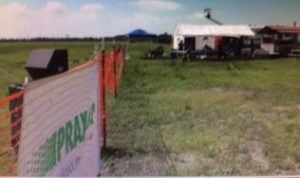
Check out the new welcome sign at the site. That is pretty amazing!

The launch site at Phillips Hill Road will open for Stage 3 for rockets cleared on Friday evening only, at 7:30 a.m.  All others report to the elementary school for Stage 1 and 2 checks and clearing. Do not bring your rocket to the launch site unless it has been cleared at Stage 2.

Please note, schools that were here last year, both the Stage 1 & 2 facility and the launch site are in different places from last year. Be sure you have correct directions and the new map link: http://www.bringonthescience.com

Recovery teams you will have a briefing at the launch site at 7:30 a.m.

General admission to the launch site begins at 8:00 a.m. Rockets are scheduled to begin launching at 8:30 but no sooner. Of course, as I mentioned yesterday, they are subject to wind, weather and workmanship all of which can delay a launch. Better put in the immortal words of Mr. Brett Williams, “A hundred things have to go right for a successful launch, but it only takes one thing going wrong to prevent it.”  With that being said, take a seat, have patience, and just have fun. Be sure to bring some sideline entertainment. Books, cards, dominoes, and games are always good, or you can join in Rocket Trivia with Joyce  Bk Abbey,the voice of rockets, who will be there to MC the event.

An important reminder to the day’s events is that you DO need admittance tickets. You can pre-register for these at the following link: https://www.greateventseats.com/SystemsGo . When you register for these, you are also signing a waiver for entrance to the launch site. These are required to get in. You can obtain them at the gate, but it is discouraged as it slows down entrance for you and anyone behind you to the site and may result in you and anyone behind you missing your intended launch. Pre-registration is preferred.

Concessions will be available for purchase at the launch site.  Portable bathrooms will also be set up. As spectators though, remember your chairs, card tables, umbrellas, sun screen, jackets, blankets, and entertainment for down time between launches.

The current schedule of launches is  shown below and is available here: http://www.systemsgo.org/events/ .

Saturday, April 21, 2018
School Name / Teacher 1/1 Transonic
Hagerman HS
Andrew Rodriguez
1
Hobbs HS
Shawna Carter
5
Jal HS
Nathan Richard
1 1
Lake Arthur HS
Steve Goluska
1 1
Loving HS
David Janzen
2 1
Lovington HS
Michael Dodson
2 1
New Tech Odessa HS
Richard Lindner
2
7 Schools Launching
Totals 14 4
Total Rockets 18

Don’t forget, all volunteers, teachers, teams and admins are invited to Jal Country Club for a hamburger and hot dog cook out from 5:00 p.m. to 7:00 p.m. Dave Willden is your gracious host for this event.

Current weather conditions for Saturday show a bit of a warm up.  40 is the predicted low and 71 is the high. That is not too bad for the desert in April. Dress is layers, you may need a light jacket in the morning.

Good luck to the seven schools participating in this year’s New Mexico event. No matter the outcome of your launch, you have successfully designed, built and delivered a rocket to the pad for testing. In doing just that, you have learned more and will take with you more than some achieve in a life time.

Parents and spectators be sure you are ready with the cameras to catch the expressions on your students’ faces for two different events. The first is when their vehicle leaves the pad headed into the sky, and the second is when Recovery hands it back to them after launch and recovery. These are the faces of joy, excitement, and fulfillment  you want to see as much as you do that rocket soaring into the blue.

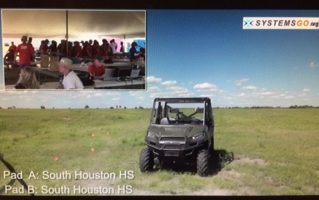
SystemsGo New Mexico has a Facebook page: https://www.facebook.com/SystemsGoNM/  , and also a twitter feed: https://twitter.com/SystemsGoNM . These are a good source of information.  Joyce Bk Abbey will be manning both and posting pictures and updates throughout the day in leu of Livestream which will not be available at this particular launch this year.

SystemsGo New Mexico is headed up by David Willden.

Please watch the SystemsGo website, SystemsGo Facebook page,  SystemsGo Twitter feed: https://twitter.com/SystemsGoNews and this blog for upcoming information on these events.

After completion another report will be posted here, featuring results, pictures and some editorial content cataloging the success of the event.

http://www.systemsgo.org as always is the place for more information on this program. You may also email them at info@systemsgo.org. Take the time to get your school involved, the future of your students will be greatly benefited.

Hope to see you at the launches! #ItISRocketScience #RideTheSky #Launcher01

Second Term Update #1 (Dec. 22-Feb. 16)-Fredericksburg’s Engineering/Rocket Program

Technically, the fall term didn’t end until January 19, so we have a minor bit of finishing up to do on that semester, but at this point, January  is past and February is better than half through as well.  The spring program is  already building, therefore, we will finish off and shoot straight into the new semester and the new year, as there are big goals and events  for each class group.

This second semester puts the Engineering Program students’ learning to the test as they build rockets and prepare to launch them for Rockets 2018 and their end of class projects. There are still four class groups this semester as freshman through seniors continue course study and  strive  to complete their section of the program.

Both Freshman and Sophomore groups are new for this semester. Last semester’s groups will not return to the program until next fall. This will mean that the progress reports will seem a bit familiar as these new groups will be doing the same projects and learning tasks that last semester’s group did since they too are at the beginning point of the Freshman and Sophomore programs.

Freshmen comprise a group of 13, pictured below. In the front row: Davis Englert, Roan Hagel, Hayle Mayer, Michael Flores, Gerry Balderas, and Daisuke Kyan.

In the back row: Tyler Smedley, Karson Hager, Cade Terry, Sam O’Leary, Kris Ersch, Travis Klokker, and Carlotta Wilkinson.

 This was for fun, and is freshman doing something wacky!

The new Freshmen group is once again testing structures which they are building from cardboard and tape. They watched an engineering video on I-Beams after their first testing session. This enlightened their understanding of bending moments which they applied to their structures.  One of the groups changed their structure by rotating it 90 degrees in order to make it taller than it was wide, which resulted in the structure being the opposite of its original design as well as creating an almost 100% strength increase through the new orientation and heighth.  Mr. Matthes states that this was a “Lesson learned and applied.”

Below, the Freshmen show off their structures.

 Cade Terry, Travis Klokker,  Sam O’Leary    Hayle Mayer, Tyler Smedley, Daisuke Kyan Karson Hagel, Gerry Balderas, Roan Hager    Michael Flores, Carlotta Wilkinson, Kris Ersch, Davis Englert

Currently they are working on their post mission analysis on civil engineering, which is allowing them to  practice technical writing.

The freshmen have a field trip coming up on March 1. They will be visiting UTSA, Center for the Intrepid and Southwest Research Institute, all in San Antonio. A report and pictures will be presented in a future update.

The new sophomore group for this semester has 13 students,  11 pictured below.

Front row: Gabi Moreno, Manuel Enciso, Jarrett Beard, Tyler Malinak, and Jacob Hinterlach. Back row: Tony Martinez, Noah Stotz, Jowad Aysheh, Jack Fox, Troy Kneese, and Jabin Gipson. Not pictured are Jessen Stableford, and Landon Sparrow.

The sophomores are moving through their course studies on a little more fast-track than last semesters class. This has been initiated in order to further their studies in 3D modeling and printing this round so that they achieve a more significant introduction in that area. They are doing well according to Mr. Matthes and are already beginning AutoCAD. In the past weeks they have successfully completed geometry, multi-view drawings, and engineering lettering.

As of January 23, the first semester studies ended for the Juniors, and opened them up to work on their second semester project in which they are now immersed. This project is to design and develop a one pound payload in a Transonic vehicle to be launched on April 26, at Rockets 2018.  This means that their rocket must must be capable of breaking the speed of sound while carrying a one pound payload and remaining under 13,000 feet. The junior group is a large group of 22 students this year so they are unique in that they have been split into two groups, each responsible for their own rocket.

Mr. Matthes had this comment about the two groups, “I am excited to see them working diligently and proudly taking the endeavor as genuine separate groups.  The ownership of their rocket and being different from each other’s groups is already evident.  They have established their problem statements and are feverishly researching with many, many, many unknowns.  As the process goes on their significant dispersion of knowledge and integration with each other slowly but surely migrates to a fully integrated and cohesive design.”

Along with their rockets, the group has another project for the semester. This entails designing and developing a teststand for Estes Motors. These are the small motors used mostly to fly their Generation 1 through 3 rockets. The objective is to create a teststand that will operate using LabVIEW programming to control and monitor ignition, measure thrust, and display and record real-time data to a file.

Seniors are a busy group with four projects still in the works, including Redbird 19, Wind Tunnel, Teststand and Baby Bird Teststand.

On February 1, Redbird 19(RB19) underwent Critical Design Reviews (CDR) with SystemsGo personnel present, and NASA flight engineers participating by Skype. RB19 did well overall.  The Redbird 17 tank is being recycled as part of  the RB19 design and was successfully tested earlier, as shown below, but will be retested on Friday, Feb.16 after which they will be required to provide documentation to SystemsGo. The team is fully immersed in the development of RB19. They have contracted machine shops and begun providing them work. These include Kager Industries, Heartland Enterprises, and SRM. Other necessary parts are in the order process.

Corbin Smajstrla, Sergio Walle, Bryce Erwin, Pierce Vasquez, Evan Knapp, and Harrison Spisak prepare to test the RB17/19 tank.

Wind Tunnel also underwent CDRs  with NASA and SystemsGo on February 1. Unfortunately it was found to have some issues to resolve. According to Mr. Matthes, the group is, “adapting well to the unexpected queries which arose and are close to having them resolved at this point. ”

Teststand has several upcoming events in March. In mid March, they will be conducting cold flow tests in order to verify the students injection system. This tests the flow rate of oxidizer through the system.  Projected live ignition tests have been set for the end of March, and students have been given some solid dates in order to keep them on task to accomplish these.

Baby Bird Teststand is currently on hold. Students have a heavy work load to complete with the other projects. PVC and polypropylene tests will need to be completed on the large Teststand before work can resume on the Baby Bird Teststand.

This article is the Third for the 2017/2018 school year in a series of monthly updates that will follow the Fredericksburg Engineering/Rocket program. This school is a participant of the SystemsGo STEM program. This series of articles is intended to support and encourage students in the program as they share their working status and accomplishments throughout the year in the program. These publications will be available for tags and re-posting.

www.systemsgo.org as always is the place for more information on this program. You may also email them at info@systemsgo.org . Take the time to get your school involved, the future of your students will be greatly benefited.

Fredericksburg Engineering Program Hosts the N.E.W.Y.O.U. Event for 4th through 8th Grade Students

The Fredericksburg Engineering Program will be hosting the N.E.W.Y.O.U (National Engineers Week Youth Outreach United) Event in participation with FISD Community Education. National Engineers Week will begin February 18th. The N.E.W.Y.O.U Event will be held the Saturday before on February 17th.
The event will be held at the Fredericksburg Middle School. This is the first time the FHS Engineering Program will host this event. The high school group has been working hard organizing this event in order to insure it will be a fun and educational time for all participants.
Join the FHS student mentors as they introduce you and your friends to engineering in fun group setting. You will learn while watching videos, playing games, completing challenges and winning prizes, including a door prize for each session.
Forth and fifth graders will attend the morning session, from 9:00 a.m. to 12:00 p.m. The cost for this session is $29 and includes snacks, drinks and a shirt.
Sixth through eighth graders will attend the afternoon/evening session from 1:30 p.m. to 9:30 p.m. The cost for this session is $49 and includes, snacks, drinks, dinner and a shirt.
***Please note that in order to receive your shirt, you must be registered by Feb. 13.

Look for more information in the newspaper and students of those grades should have brought home flyers in the past week. Look below for a copy of that flyer in case you missed it.

The Fredericksburg Engineering/Rocket Program hopes to see you there.

FLYER:

4th-5th and 6th-8th Graders!!!

Come hang out with high school engineering students while having fun playing games, completing challenges in groups with high school mentors, watching cool videos and learning about engineering.  Prizes abound with an awesome door prize for each session.  See details below!  Downloadable registration form may be found at the bottom or call Community Education at (830)997-7182.

New You Flyer JPEG.JPG

Awards Day for the Red Bird #18 2017Alumni

Today, Friday, December 22, 2017 at 10:30 in Mr. Matthes’ classroom,  FHS Engineering Class of 2017 was presented with their banner for a successful flight of the Red Bird #18 at White Sands Missile Range last summer.

They received the Goddard Level Newton Award from SystemsGo. The award was presented to them by Scott Netherland, Executive Director of SystemsGo.


Photographed (right to left): Colby Marthaller, Sterling Weatherford, Matthew Dulaney, Ian Kendrick, Hannah Boubel, Cody Pruett, Joseph Sanchez, Ricky Robles, Scott Netherland, and Payton Carroll.

The banner will be displayed at the FHS campus at a later date.

Congratulations to these students on their achievement as well as future endeavours.

www.systemsgo.org as always is the place for more information on this program. You may also email them at info@systemsgo.org . Take the time to get your school involved, the future of your students will be greatly benefited.

Fredericksburg STEM Academy-Rockets 2017-The Full Diary of Red Bird #18 (The Year in Review)

The following article is a review of the 2017 Fredericksburg STEM Academy Senior class and their Red Bird #18 rocket. Most are excerpts from the articles that followed the program this year. A few are additions to the action that weren’t written about at the time, with added pictures and special sections on the WSMR launch and it’s results.

Completely new sections will be titled in RED instead of blue. Here are the high lights of Red Bird # 18 and the Fredericksburg STEM Academy 2017 Senior class.

August 31, Two weeks into the school year:

The school year was new and the Fredericksburg High School Engineering program had begun working toward new goals.

The program was off to a “Great start,” according to Engineering instructor, Andrew Matthes.  “We received a NASA grant to continue testing and replace some older components for safety and increased fidelity in test data.”

A date of October 21, 2016 is set for Test Stand  operations to start.  A Test Stand task list and working groups have been established by the Senior group.

New to the program this year is a Senior out of class work schedule. Students signed a contract requiring them to commit to a set amount of overtime/after class work time in order to meet all deadlines and complete their rocket/project for the year. The group is currently establishing a working schedule in order to implement these hours.  As for the actual rocket, the class is currently studying the rocket history portion of the curriculum.

This year the senior class has eighteen.

*************

October 11, the seventh week of school:

Seniors are alternating between rocket history and  work on the Test Stand and Test Bed. They are currently in a break from the history but will rejoin it in a couple of weeks. Mean while they have  conducted successful CDR’s (critical design review) for Test Stand that generated positive and developmental feedback.  They have also had success updating the Test Bed. Wiring and programming issues have been corrected,  they were able to create a new tank system which will increase safety in the fill and weigh of Nitrous operating systems, as well as succeeding in making the Test Bed more frictionless.  Their senior rocket is still in the works as they continue in the design development of the vehicle.

New this year, the seniors created rocket history children’s books.  Students will be doing recordings of themselves reading the books, and both the books and the audios will be sent to the Fredericksburg Elementary School where students there will be able to read the books and hear the high school authors read the books to them.
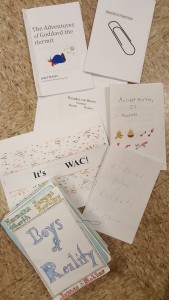
20161011_074947

According to Mr. Matthes, “Their rocket history children’s books were awesome!”

On November 7 & 8, the senior group has a chance to go to the NASA Johnson Space Center,  for flight profile reviews, grant updates, and a possible preliminary design review. Three students will go for sure, and those will be named at a later date.

Seniors, here is your challenge for the month, according to Mr Matthes, “If you complete the analysis of historic test data from the Test Stand then you will all be eligible to attend this trip. He would like to see that happen and take you all. Can you meet the challenge? Next month’s edition of this article series will publish the answer to this challenge. Now is your chance to show your readers and Mr. Matthes that you can meet the challenge.

************************

November 18,  Covering October 1 – November 18:

The  whole senior group made a trip to  NASA Johnson Space Center on Monday and Tuesday, November 7 and 8. Only two were unable to attend, one due to family complications and the other was attending State Marching Contest on Monday with the FHS Band but joined the group later.
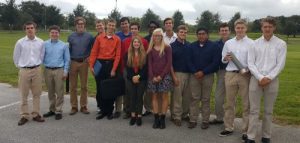
20161107_130320

On Monday they collectively made a Grant Presentation to NASA. Mr. Matthes reports that, “they did wonderfully.”
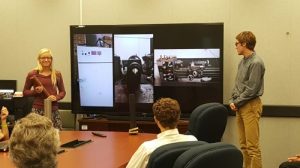
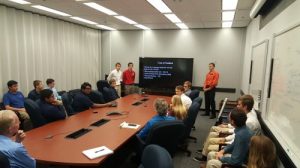
20161107_144521  20161107_133653

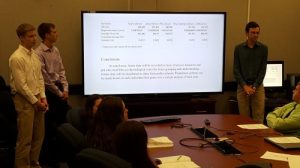
On Tuesday,  Ian  Kendrick,  Sterling Weaterford,  Nathan Bain and David Becker presented a Flight Readiness Profile. “NASA was impressed with Test Stand updates and the focus on analysis and improved data acquisition,” according to Mr. Matthes.
20161108_095221

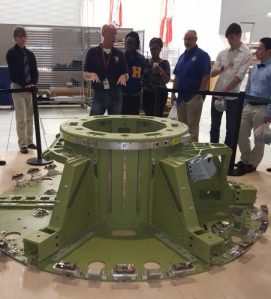
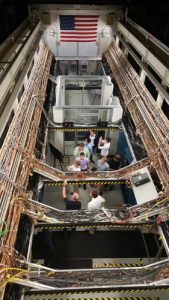
They also toured Johnson Space Center.
20161108_151017  20161108_123300

20161108_152416

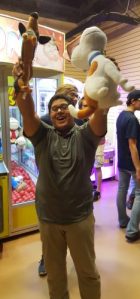
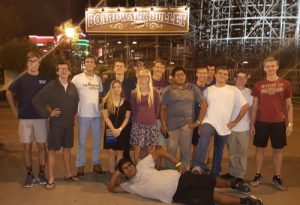
Students had time for fun while in Houston as well.  On Monday,  after dinner, students spent time at Kemah Boardwalk. Interestingly the “Crane Game” was the entertainment of the evening, pitting them against each other to see who could pluck the most stuffed animals.  Reportedly, Ricky Robles was the winner.
20161107_203459  20161107_205034  20161107_210602

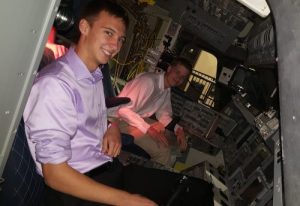
Those not involved in Tuesday’s presentation went to Space Center Houston where a good time was had by all.
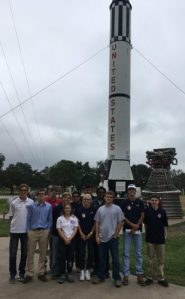
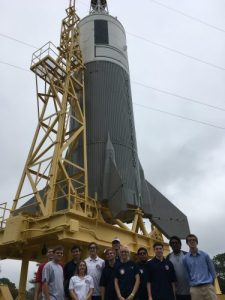
image2   image1

The STEM Academy would like to extend many thanks to Mr. Logan Minshew, FHS Counselor and CTE coordinator. He took the time to attend this field trip and drive the group.

In other senior news, even though there is still quite a bit more to be done on Test Stand, they have made good strides and are progressing forward diligently. They are back at work with rocket design as well.

************************

December 21, Covering November 19 – December 21:

Seniors have been very busy, and experienced both successes and set backs on their projects recently.  Testing on fuels is expected to begin in January as they are nearly complete with updates on Test Stand.

After manufacturing pieces for their Small Motor Test Stand out of 2024 aluminum, they discovered that this metal type cannot be welded. This resulted in having to procure another high strength aerospace aluminum which is conducive to welding. Once they find this they will have to begin again on the manufacturing of the fuel grain containment system.

“These were very important lessons learned for all, them and me,” stated Mr. Matthes.

Preliminary Design Reviews were conducted on their Goddard level rocket, last week. Due to the set backs on Test Stand, previously  discussed, the group lost time they should have had to work on their rocket design and therefore have a bit of ground to make up there in order to have those completed by January’s end.

*****************

February 24, Covering Jan. 9 – Feb. 21:

The seniors conducted their first hot fire test on Friday, February 17, while Dr. Evans from the Space Propulsion Group was in attendance. They accomplished a 10 second burn of Low Density Polyethylene (LDPE).
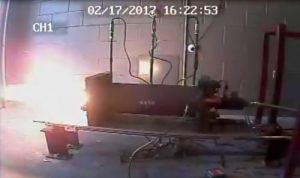
starboard-view A still photo from the burn test.

According to Mr. Matthes, ” The test was extremely successful with outstanding data acquisition that showed the motor preformed nominally, according to expected design parameters.  This was very exciting to have such a good, clean burn, good data, and fitting expected performance.”

Heartland Enterprises and SRM Manufacturing created a newly designed injector plate.  This allowed the class to keep their Friday deadline.  In spite of the piece needing to be manufactured quickly for the project,  these companies came through and the product was, “beautifully machined and performed with 10% of expectation regarding oxidizer mass flow rate,” stated Mr. Matthes.

On January 27, the Fredericsburg Middle School 7th grade GT(Gifted and Talented) group presented their payload for the Redbird #18 Rocket to the senior STEM class. It consisted of a group of sensors to measure UV Light, methane, acceleratometer, and barometric pressure.
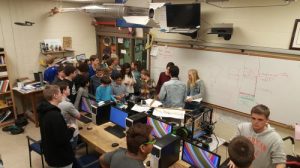
20170127_142251 20170127_135355       The 7th grade GT class presentation.

New this school year, Mr. Matthes started requiring after school and extra curricular hour work on senior projects. When asked how this senior group was doing with this on their project, here is what he had to say about the group.

“There have been  a solid group of students who have been putting time in during study halls and some others who have been able to commit extended numbers of hours outside of school time to keep things moving forward.  These senior students have worked phenomenally.  They bit off a lot to accomplish this year and are on target to meet all of their expectations.  It is quite remarkable having the opportunity and privilege to work with them.  A substitute recently commented that during my absence, walking into the classroom after the passing period between classes was like walking into a full-fledged workforce environment where students were all fully engaged, scheduling, designing, problem solving, and just plain working without any instruction to do so.  I believe the skills these students have honed over the last 4 years through this program and all their other coursework has created a ‘product’ that any college, industry, and organization would wish to recruit.”

Keep up the great work, seniors, what an amazing and glowing endorsement.

If you follow this program and like to view the launches, Rockets 2017  will be held at the Stewart Ranch in Willow City, Texas on the weekend of May 18-21, 2017.  This testing site is open to the public. Please watch the SystemsGo website and this blog for upcoming information on the event. The FHS junior group will be testing their rockets on Thursday, May 18, 2017. The senior group is tentatively scheduled to launch their Goddard level rocket at White Sands Missile Range (WSMR) in New Mexico the week of June 26-30.  There are also launches in Houston for schools in that area the weekend of May 12-14, 2017. New for this year the Hobbs, New Mexico group of schools will launch 1/1 rockets in Jal, New Mexico on April 27, 2017, this site will also be open to public viewing.

The STEM Academy group was encouraged to attend the movie, “Hidden Figures” on Friday, February 10th at Fritztown Cinema. About 35 students from the program attended.

************************

March 31, Covering February 22 – March 31:

The seniors have approximately 60 days as Red Bird #18 is scheduled for completion two weeks before school ends to allow for preliminary systems tests.

March began with more fuel grain tests at Test Stand. Two tests were completed in the first week alone, consisting of many hours of work to accomplish each. A temperature sensor indicated a high enough value in order to cause a programmed shut down on the first test that week.  After investigation, it was found that a ‘electrical noise’ caused an anomaly which gave the sensor its reading, and that it was in fact not outside normal operating parameters. The actual test did not experience any temperature concerns.

The same fuel grain was able to be used again in a 20 second burn, which allowed students to achieve a cumulative 40 second burn on one fuel grain.  The shut down was disabled for the second burn,  allowing the data to still record the temperatures caused by the ‘electrical noise’, but not to stop the burn test and it was a  full success without any further exceptions.

Mr. Matthes was very pleased with these burns and stated , “All data was processed and showed again the test stand was producing verifiable data similar to theoretical expectations.”

Students began another round of testing this week. Six new fuel grains will be tested accounting for three tests each of two different fuel types students have been working on. The  hope is that they will cycle through smoothly due to the fuel grains being prepped prior to testing.
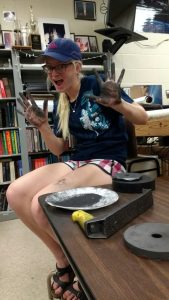
  Here Hannah Boubel is working with graphite in order to make ablative, which is a sacrificial material in the pre and post combustion chamber so the burn does not penetrate the liner and steel test cell.
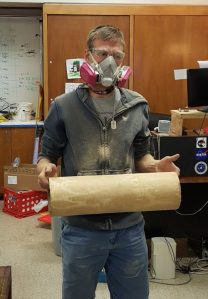
 In this photo,  Sterling Weatherford is preparing a fuel grain for installation in to the test cell.

Along with test stand work, the students have been hard at work on Rebird 18, their Goddard level rocket slated to launch at White Sands Missile Range on June 27th. Students have already contracted with Heartland  Enterprises and SRM Manufacturing for fabrications and parts have been supplied to them.

At this point in the process students are learning true cause and effect, and just how it can affect their outcomes.  The entire success of the vehicle from this point forward is contingent on the group not only working as a team as a whole, but also for each individual team to stay on top of their work and outcome. Many of the components are dependent on the progress of the others. Delays on one team’s  element directly affects the next  team creating delays down the line and strained time schedules.  Individual testing is conducted on each piece as it is finished.  Full up integration and testing of any systems that allow for ground based testing is scheduled for two weeks from the end of school when the rocket is due to be complete.

“They are well on their way to a successful vehicle.  The seniors will not have the luxury of adopting senioritis as there is still significant and mutually dependent work to be accomplished,” Mr. Matthes reported. “These next 60 days will be a true test of their team work, peer loyalty and persistence. ”

As the end of the school year approaches, these students are becoming more and more adept in their learning and knowledge as young and capable engineers. Their end of year rockets will be a testament to that learning, time and ability.

According to Mr. Matthes, “Students are becoming ‘plagued’ with knowledge and experience:  the more they know and become aware of, the more they have to take into consideration and the more challenging the process becomes.  However, it also makes for conditions more aligned with success.  Additionally, if we consider these students products of FHS and the FHS Engineering, then they should be welcomed by a market hungry for what they have to offer.”

The senior group is tentatively scheduled to launch their Goddard level rocket at White Sands Missile Range (WSMR) in New Mexico the week of June 26-30. The current schedule (as of March 31) for that event is as follows:

Sunday, Jun 25th             Travel Day

Monday, Jun 26th            T-1 and Site Set up/Rocket Prep at WC-50

Tuesday, Jun 27th            Launch Day One (Three Rockets – Fredericksburg, Union Grove, Alamo Heights)

Wednesday, Jun 28th     Launch Day Two (Three Rockets – Anahuac, Booker T. #1, Booker T. #2)

Thursday, Jun 29th          Contingency Day

Friday, Jun 30th                Travel Day

***********************

May 2, Covering April 1 – April 30:

While the seniors are down to less than 3 weeks as Red Bird #18 is scheduled for completion two weeks before school ends to allow for preliminary systems tests. Due to delays in manufacturing, testing will have to occur in the process of construction as components come in. Final testing will be the week of June 19th prior to their test at WSMR the following week. It is slated to launch at White Sands Missile Range on June 27th.

During April the seniors tested Low Density polyethylene (LDPE) three times on Test Stand. Data on all tests was consistent and exemplary. Currently the injector plate is being drilled again to increase the oxidizer flow rate to the correct  value to provide for complete combustion.  Due to this testing is on hold. Lately they have been experimenting with different ablative arrangements. The ablative has  burned through slightly but not enough to damage the test cell.

Below is an actual video of an engine burn test.  This one of the first video’s with HD video quality and audio.  The regularly captured video does not have audio embedded.  This is good for them too as they do these tests for NASA and this gives them something  more to show of their work.

https://goo.gl/photos/78HwtXxx8rytjxSV7

Mr. Matthes had this to say about this particular burn,  “It looks pretty good but we’re only getting about 1/3 of the oxidizer we should be getting so it is fuel rich.  It will not be as orange when we get the oxidizer flow rate correct.  The hope is that it is a really clean plume with mach diamonds in the plume.”

The senior’s “junior Test Stand” nick named “Baby Bird” is almost complete. They hope to conduct their first ever test on this new Test Stand possibly late this week. This Test Stand was created by the seniors starting last year during junior studies to test a fuel grain system designed and developed by them to interface with the hyportek injector and tank. They hope to have 3 successful tests on this Test Stand. If they achieve this, then they get to fly this new system at Willow City in last year’s rocket.  At this point,  they are getting fuel grains prepped.  Pictured below, are nozzles created for Baby Bird.

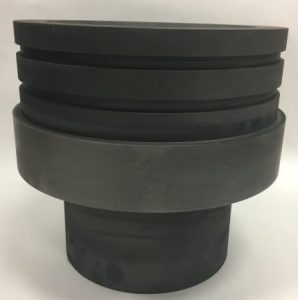
Red Bird #18 still currently does not resemble a rocket, but they are making steady progress. The nozzle has been manufactured, seen here 

and  the nose cone mold is also back, seen here. 
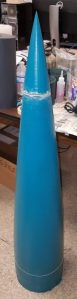
Machining could only be created to within 8 inches of the tip, therefore they created the tip with 3D printing and epoxied it to the nose cone and are preparing it for fiberglass.

Other needed materials are in and have been sent out to Heartland Enterprises for machining.  Currently, Mr. Matthes says that the biggest test coming up will be next week when they pressure test the oxidizer tank.

*************

May 15th, Covering Baby Bird:

Hopes were that three successful tests on the new “junior test stand” nick named “Baby Bird” over the past weekend would result in the opportunity for the seniors in the Fredericksburg STEM Academy to fly a new Hybrid student developed rocket at Willow City.  The purpose of this Test Stand, as highlighted in the last update, was to test a fuel grain system designed and developed by the seniors to interface with the hyportek injector and tank.

Saturday evening, May 6, they conducted their first ever test of the Baby Bird. Unfortunately according to Mr. Matthes, “the containment system experienced thermal damage which tables Baby Bird for this year”
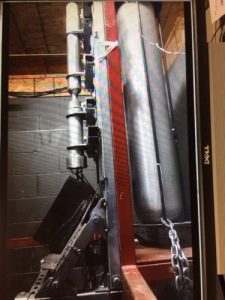
Baby Bird may not send a rocket out this year, but she is not at her end. According to Mr. Matthes, “we will continue with the testing of it…The Baby Bird still is important research that can be utilized by SystemsGo to increase the rigor of the Oberth level of the program to include motor design.”

Mr. Matthes congratulates the class on their hard work and efforts,  “Burn looks great though… well designed propulsion. Very curious to see the data which looked promising at a glance. Great job FHS Engineering Class of 2017!”

****************

May 16, Willow City Launch Week, Two Weeks Before Graduation:

Even though the seniors’ “Baby Bird” Test Stand rocket will not fly at Willow City this year, they are still hard at work and progressing well on Red Bird #18 for WSMR in June. The tank has been tested successfully and the vehicles stability has been verified by NASA. This allowed for the fins to be cut so that they can be beveled for aerodynamic purposes, and then welded to the vehicle.  The door panels on the forward skirt  and aft skirt have been cut, and will be welded to the tank this week.

Four students accumulated 12 hours of  work over the weekend fiberglassing the nose cone. According to Mr. Matthes, “Things are coming together very well, but there is still a lot to do.”

*************************

May 31, Graduation Week:

Seniors are in decent shape on Red Bird #18.  The vehicle is undergoing final welding at SRM Manufacturing.  Nosecone is wrapping up well.  The current set back is the fuel grain.  After conducting extensive testing to get the correct percentage of the two constituents and creating multiple samples at those percentages, when the students mixed their full volume of HTPB (rubber) fuel, it set too quickly and they were unable to pour it.  Students created more samples yesterday of the same percentages but at different temperatures trying to manipulate the cure time.  They are receiving a borrowed supply of one chemical from Alamo Heights High School to complete the fuel grain on a second attempt.

The seniors will also be presenting tomorrow, Thursday, June 1 at FISD’s Central Office board room beginning at 12:15.  They will giving a status update on the development of the Red Bird #18 rocket that is scheduled to launch at White Sands Missile Range in late June, as well as covering the progress and testing on the hybrid rocket motor Test Stand.

All are welcome to observe both presentations.

Subsequent updates will continue to follow the Senior/Graduates and the progress of the Red Bird #18 rocket through June and until after launch at WSMR in late June.

******************

June 21, 1 Week Until Launch at WSMR:

Red Bird #18 is scheduled for testing at White Sands Missile Range(WSMR) next Wednesday, June 28. This marks the last big event for Rockets 2017 and the Fredericksburg STEM Academy for this season.

These are the Goddard level rockets, which are the culmination of all the skills the students have learned throughout their years in the STEM program. This marks the final senior project for those schools that participate in this level of the SystemsGo program.

According to team member, Sterling Weatherford, “We are finishing up our rocket production, with integration and final testing before we head off to White Sands.”

Mr. Matthes reports that welding on the vehicle is complete and it is together. Below is a pictures of the class with the vehicle at SRM Manufacturing, one of the outsource businesses they contracted for help with welding. In order  left to right the students are Jesse Cedillo, Colby Marthaler, Ricky Robles, Langston James, Nathan Bain, Chase Ottmers, Hannah Boubel, Joseph Sanchez, and Sterling Weatherford.

Other members of the group not pictured here are David Becker, Drew McDonald, Matthew Dulaney, Corbin Styles,  Josh Treibs,  Payton Carroll, Cody Pruett, Levi Crawford, and Ian Kendrick.

The students report that they are putting finishing touches on the nosecone, including sanding and a gel coat to create a smooth finished surface. They will be installing the complete motor system in to the rocket today, Wednesday, June 21.

They had been working on integrating the recovery, propulsion and fuel grain systems into the vehicle.  All parts have been fit tested for the integration. Recovery, avionics, and the payload have since been successfully installed.

They are finishing the assembly of the fuel grain including an ablative that the students have chosen to add to the post combustion portion,  after which they can install the fuel grain and the rest of the propulsion system into the rocket.

 Here one of the students shows the injection valve and injector bell arrangement.

Here is a picture of Drew McDonald, Ricky Robles, and Jesse Cedillo earlier when they were mixing fuel for the second attempt at the fuel grain.
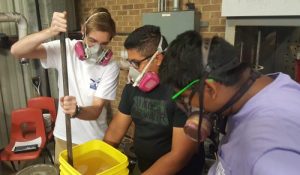
Their final actions will be to test the black powder charges for the recovery system and then they will be ready to move the rocket to WSMR for their full vehicle launch testing.

“We are extremely excited to test our rocket at the upcoming White Sands Missile Range launches,” Sterling reported.

Monday evening they met to discuss  travel plans and trip expectations.

Launches are scheduled for June 28 through June 30. The group will travel out to WSMR on Monday, June 26, and back home again on Saturday, July 1.

There are 5 schools scheduled to launch 6  rockets. These schools include:

  • Alamo Heights (1)
  • Anahuac (1)
  • Booker T. Washington ( 2)
  • Fredericksburg (1)
  • Union Grove (1)

This year is unique in that the Army has some classified tests scheduled that will slightly overlap SystemsGo’s air space on both June 28th and June 30th. This could delay start on Wednesday, and it has already been set to 0700.  The  hope is that all launches will be complete by Thursday afternoon so that Friday will not be needed since another high priority group will be needing that day as a back up day as well. SystemsGo will travel home Friday if this can be accomplished instead of one day later on Saturday.

The current launch schedule (as of June 21)  is as follows:

  • Monday, Jun 25th             Travel Day
  • Tuesday, Jun 26th             T-1 and Site Set up/Rocket Prep at WC-50
  • Wednesday, Jun 27th       Launch Day One (Three Rockets – Fredericksburg, Union Grove, Alamo Heights)
  • Thursday, Jun 28th           Launch Day Two (Three Rockets – Anahuac, Booker T. #1, Booker T. #2)
  • Friday, Jun 29th                Contingency Day/Travel Day
  • Saturday, Jun 30th            Travel Day

The senior group presented their project and made reports on June 1st as their final exam for the year.

Today is 5 days out until the Red Bird #18 group leaves for WSMR. Watch this blog next week for information and reports on this and all the schools’ launches at  White Sands Missile Range.
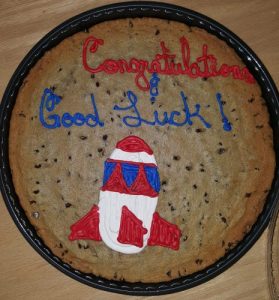
 This was presented to the Red Bird #18 group after their June 1 end of year presentation. The sentiment still holds as we congratulate this group of graduates on their accomplishments and the achievement of finishing their rocket. Good luck at WSMR!

*************************

June 25, Sunday, Getting Ready for WSMR:

The Red Bird #18 Rocket team met at SRM Manufacturing to pick up and load their vehicle into an enclosed trailer provided by Mr. Banfield, Nathan Baine’s step dad. He transported the rocket to WSMR for the team.

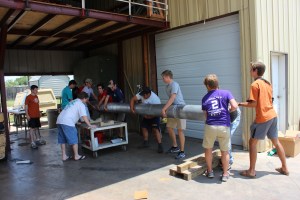
Finishing touches by Luke Morin of SRM Manufacturing.

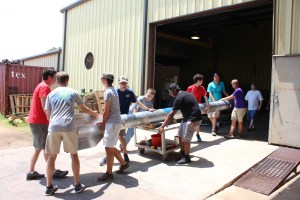
Team photo with the vehicle before loading.   It takes the whole team to move the rocket and load it into the waiting trailer.
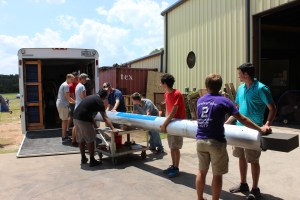
Final photos with the Red Bird #18 Team, instructor, Mr. Matthes, and Luke Morin of  SRM.
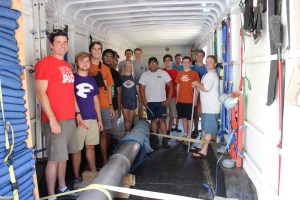
Red Bird #18 Rocket, ready for the trip to White Sands Missile Range in New Mexico.The bundle in the back corner is the nosecone.

After loading, the team and parents reconvened at FHS STEM Academy to load all needed parts and equipment for travel and  final prep of the rocket in New Mexico.

***************************

June 26, Monday, Leaving for WSMR:

The Red Bird #18 team left Fredericksburg at 8:00 a.m. this morning headed to White Sands Missile Range (WSMR) in New Mexico, followed by the SystemsGo team which left Fredericksburg at 9:00 a.m. .

Tomorrow is an informational and set up day. SystemsGo personnel and all students, teachers, and parents from the schools head out at 6:30 a.m. for T-1 briefing and a short presentation by each school on their vehicle and it’s expectations. Afterwards SystemsGo, students and necessary personnel go to West Center 50 launch site to set up and prep vehicles. Parents will be dismissed at that time to find their own entertainment for the day.

Wednesday is the first launch day and at this point, it is slated to be an early morning. Fredericksburg STEM Academy is first up to launch for the day and the current schedule has them testing at 6:00 a.m. The hope is to test 3 vehicles by 10:00 a.m, including Union Grove and Alamo Heights.

*****************************

June 27, Tuesday, T-1 Briefing and Launch Site Setup

SystemsGo and the participating schools had a productive first day at White Sands Missile Range (WSMR) today. They started the day with the T-1 Briefing, which included several presentations by WSMR staff on all they do to make these launches possible. It was an educational and informative session.

WSMR personnel made introductions so all involved would know who they are and who to contact for help from the base. At the end, Scott Netherland introduced the SystemsGo team and specified their roles with the organization. We finished around 11:00 and headed out to West Center 50 launch site(WC50).

All equipment and rockets had to be set up and completed to meet the Wednesday testing schedule. Everything was eventually finished by 8:00 p.m. It was a very productive day albeit a little long and quite hot.

Tomorrow will be a super early morning for all of us. Teams launching and SystemsGo personnel will be headed out to WC50 at 2:30 a.m. And those going to watch the launches from Mission Control will be heading out at 3:30 a.m. to meet our rep at the main gate by 4:30 a.m.

6:00 a.m. Fredericksburg High School
7:30 a.m. Union Grove High School
9:00 a.m. Alamo Heights High School

If it is a perfect day and all goes well with no exceptions with each launch, then the tests should be complete by 12:00 p.m. Realistically, this is a very tight launch sequence with little to no room for errors. If we do not get all three launches tomorrow, then there will be four launches on Thursday. Friday has now been canceled as WSMR has other high priority missions that need the range, so there is no longer a back up day,  and that will also allow everyone to head home on Friday instead of Saturday.

****************************

June 28, Wednesday, Launch Day at WSMR:

Today was an extremely early morning for the SystemsGo team and program participants, Fredericksburg High School, Union Grove High School and Alamo Heights High School. They were all up at 2:00 this morning headed to the range, here at WSMR to test. They had success in that they met all three T times for the day with only 20 minute variances.

Fredericksburg STEM Academy was first to test, leaving the rail at 6:20 a.m. It started off well with what looked to be a beautiful flight, but it was short-lived. It quickly lost thrust climbing to only just over 300′ before nosing over, re-firing, and plowing into and along the range. Luckily, the nose cone chute deployed shortly before impact, taking it away from the harsh landing. WSMR optics reported the vehicle only reached a speed of just under 100 ft/second, but still managed to travel 920′ down range.

This was not quite the flight students had hoped for, but for today they hold the flight record for these three launches. Even though, the schools are not competing against each other but awarded only on their own accomplishments, students all want to have the most successful flight of the season.

Post Mission Analysis by Mr. Matthes of what he observed of the Red Bird #18 Flight and it’s Post Mission testing capabilities: 

“It was evident to me prior to leaving the rail that it was not achieving the desired thrust as its acceleration was poor and not for matching the flight model.  The plume was initially clean but it was also visible that there was incomplete combustion with a very faint trail.  It was consistently lacking thrust. Once it went past horizontal the liquid oxidizer rolled towards the nosecone leaving gas entering the injection system and the plume went black…the re-firing is suspected that as both the vehicle and liquid were falling at the same rate than liquid again was in contact with the aft injection system and propulsion resumed.  Some believe that the injection valve which was powered based on an onboard battery pack had an issue.  The pack was initiated by 12V pad power which operated a latching switch. I don’t see this the most likely cause of it going black and then thrusting again unless there was a fluke connection between the batteries), and plowing into and along the range. Luckily, the nose cone shoot deployed shortly before impact, taking it away from the harsh landing(The FHS Payload was aborted due to a programming error that prevented the recording of data…the payload was therefore saved for future efforts.  FMS payload was therefore saved from a catastrophic landing.

FHS was the only vehicle that did not suffer any mechanical failure.  The aft section is in good condition and I have offered students to test the injection system with their remaining time this summer as we had a delivery of oxidizer just over a week ago.  Because it is fully intact from valve to nozzle they could technically perform a short duration hot fire but I believe the bolts holding the bearings the sled are not rated for the theoretical 2000lb thrust.  I would therefore recommend them conduct a cold flow test.  This could be done with the current 1” Moog valve in the test stand testing the injector plate design and also with the rocket integrated valve.  Students are circumspect that it was the valve that caused the poor ṁ issue.  However in our testing at the test stand the ṁ calculations that lead to the injector plate design lead to an ṁ that was under 40% of expected.  So both are suspect at this time.  Technically the nosecone deployment did “test” the parachute that Chris had specified but unfortunately I can say with reasonable certainty that we did not achieve the 15-20psf with only a 30lb nosecone attached. However, we still have it to test again.”

******************

With Red Bird #18 Behind Them, Here is What They Have Planned Next:

The Red Bird #18 team spent Thursday June 29th, exploring and sight seeing in Alamogordo. New Mexico Museum of Air and Space, and the White Sands National Monument as well as a movie were on the schedule of down time events. Here the group is seen hanging out on the dunes after some sledding at the monument.

Pictured here are Ian Kendrick, Nathan Bain, Langston James, Chase Ottmers, Payton Carroll, David Becker, Jesse Cedillo, Sterling Weatherford, Matthew Dulaney, Hannah Boubel, Joseph Sanchez, Joshua Treibs, Colby Marthaler, and lounging on the  sand in front, Ricardo Robles. Not pictured are Levi Crawford, Christian McDonald, and Corbin Styles.

This year’s group is a tight-knit team of friends, according to Payton Carroll, they were getting together again after WSMR for one last outing as a group.  Each of these students has been impacted by the program and the commradery of being part of this team. Their future plans take them to different places, but all have a clear direction with a very promising outcome.

Here is a list of each and their upcoming plans:

  • Nathan Bain–Embry Riddle–Aerospace Engineering–R & D for Aircraft
  • David Becker–University of Utah–Computer Science–Software Development
  • Hannah Boubel–USMA–BioMedical Engineering–Prosthetic Development
  • Payton Carroll–Texas A&M San Antonio–Medical Engineering–
  • Jesse Dedillo–Angelo State–Computer Science–Software Development
  • Levi Crawford–US Marines–Sniper Training–
  • Matthew Dulaney–UT Austin–Chemical Engineering–Pharmaceutical Research
  • Langston James–Texas A&M–Mechanical Engineering–Outdoor Industry
  • Ian Kendrick–Austin College–Political Science Psychology–Law
  • Colby Marthaler–Texas State–Archeology/Anthropology–Archeologist
  • Christian McDonald–Texas A&M–Architecture Urban Planning
  • Chase Ottmers–Texas A&M–Chemical Engineering–Environment
  • Cody Pruett–Unable to obtain information for this individual
  • Ricardo Robles–Baylor–Political Science Law–Law
  • Joseph Sanchez–Harvard–Mechanical Engineering–Aerospace
  • Corbin Styles–UTSA–Engineering Computer Science–undecided
  • Joshua Treibs–Recently joined the Fredericksburg Vol. Fire Dept., working on getting his EMT certification, plans to go to Paramedic school through UT Health, Emergency Health Sciences
  • Sterling Weatherford–Arizona State University–Aerospace Engineering–US Army Aviator

****************

Author’s End of Year Synopsis: 

Success this year was a very relative thing. By the old original standard, the “Goddard Diamond Award”, a vehicle was only required to get off the rail under propulsion/ignition.  This year, a new standard of awards was outlined at WSMR including the following:

New Awards standards are:

  • Newton Award –off rail 25,000’
  • Einstein Award –off rail 25,000-50,000’
  • Van Braun Award – off rail 30,000-75,000’
  • Kepler Award-off rail 75,000-100,000’

Out of the 6 that were tested, only four, Fredericksburg, Anahuac, Alamo Heights, and the second of the Booker T rockets, Golden Eagle 6, left the rail in tact and under their own propulsion. This qualifies them for the old Goddard Diamond Award and the new Newton Award as outlined above.

Booker T’s Golden Eagle 5 left the rail without its engine, purely flying on expelled Nitrous. The engine and aft skirt stayed hanging askew on the rail. Therefore this could not really be considered as under propulsion/ignition and does not qualify under that standard. Union Grove, sheared off its engine at lift off sending it flying across the pad, which caused the vehicle to slide back down the rail and come to rest on the pad where it burned out, also a disqualification for the award.

That being said, there is still a degree of success achieved in actually building a launch ready rocket, that is accepted to test at WSMR, and bringing it there to test.

Therefore, no team this run was terribly successful in terms of reaching high altitudes. Although for this year, Anahuac achieved the highest altitude and for them this is only the second time off the rail and a much higher altitude than last year’s flight.

For Booker T, this may have been only the second time they have had a vehicle leave the rail and be fully intact. I know they left the rail in 2015 for a very short flight. I do not have information on years prior to that for them.

SystemsGo is extremely proud of all the schools that successfully built a rocket to be tested out at WSMR this year. As they recognize and appreciate the diligence and dedication shown by students and teachers throughout this process, they are striving to hold the schools to a better standard of workmanship and success from here on out for the Goddard level launches. It was for this purpose SystemsGo reiterated these new standards for awards this year at the T-1 briefing, that will have to be adhered to for all future WSMR launches. All rockets must also have a payload and recovery system to qualify to fly and receive an award.

Under these standards,  Anahuac would be the most successful launch this season, and would achieve an award, as shown above. Fredericksburg, Alamo Heights, and Booker T’s Golden Eagle 6 also qualified for this same category.

Now that all that has been said, might I quote Mr. Matthes again, “FHS was the ONLY vehicle that did not suffer any mechanical failure.”  So perhaps, as I said before, there are different degrees of success this year and they may vary widely on your perspective. Congratulations to the 2017 Fredericksburg STEM Academy on a job well done.  You may well have learned more from your short flight, than if you had achieved your desired 100,000′, because where there is no perceived failure, there is also no desire to problem solve and look for the greater success.

************************

This article is the final in a new series of monthly updates that followed the Fredericksburg Engineering/Rocket program this 2016/2017 school year. This school is a participant of the SystemsGo STEM program. This series of articles is intended to support and encourage students in the program as they share their working status and accomplishments throughout the year in the program. These publications are available for tags and re-posting.

www.systemsgo.org as always is the place for more information on this program. Take the time to get your school involved, the future of your students will be greatly benefited. SystemsGo is a Texas-based STEM curriculum program.

#Rockets2017 #SystemsGo #FredricksburgSTEMAcademy #Launcher01 #ItISRocketScience #SystemsGoNews #Highschoolrockets
Rockets 2017-Friday Day 2 Report and Saturday Schedule

Friday had another slow start for rockets. The ceiling was a low again. SystemsGo was able to load 24 out of 25 rockets listed on the schedule onto the rails and launched all 24.The 25th was an abort by one of the schools.

Here are a few of those smiling faces taking their rockets down to the pad.

The north end of the range seemed to be the prime spot for landings today, which kept recovery in that area fairly busy. Unfortunately that left those of us on the south end a little bored so we went to help our northern friends quite often. So then how many recovery teams does it take to find one rocket?

As is normal, Transonics amassed most of those still missing in the field. They also made up the bulk of the final ones shot due to waiting on that cloud ceiling to clear. Coordinates for those have been generated, and the search is ongoing.

David Willden and the group from New Mexico helped out until around noon when they had to launch themselves back towards home. There help was greatly appreciated, and for them it was also further training for next year’s second launch series in Jal.

Phil Houseal was busy interviewing spectators, students and volunteers today. He even managed to catch me and coerce me into another interview this year. We seem to have a continued game between us. We both prefer to be behind the camera instead of in the pictures, so I make sure to catch him and get him in the pictures I post, and he catches me and makes me talk on camera.

Tomorrow is another big day on the range, with a full docket of rockets and extra curricular activities after launches are done as well. It will be a busy and long day. It should be fun though. Hopefully the cloud ceiling will open up earlier so we can start those rockets in a more continuous pattern. And the rain can hold off until after dark and all will be good.

Below is the launch schedule for tomorrow, Saturday. There are 7 schools launching a total of 22 rockets tomorrow.

Saturday, May 20, 2017
School
Name
# 1st Level
Tsiolkovsky
# 2nd Level
Oberth
Akins High School
Joyce Sayce
5
Fabens High School
Manny Moreno
3 2
Henrietta High School
Doug Underwood
2 1
Maypearl High School
James Herrod
1
McGregor High School
Chris Kuhl
1 1
North Lamar High School
Kathy Stewart
1
Northwest High School
Elizabeth Mitias
4 1
7
Schools Launching
Totals 17 5
May 14th Total Rockets 22


The following is a link to the album of pictures from today’s launch. Have a look you and your school rocket just might be in there.

https://www.facebook.com/ginger.burow/media_set?set=a.1477962108891582.1073741889.100000334203350&type=3&uploaded=221

Good luck to all the schools launching on Saturday. I will update the blog after we complete our day again tomorrow. Here is the link to the live stream again.

http://livestream.com/systemsgo

Please remember that although there is no charge for the event, and these launches are open to public viewing, parking and seating is limited due to safety requirements. For this reason, SystemsGo has a provided a link for you to pre-order tickets for those in your party. This also provides SystemsGo with a way to monitor the number of people in attendance each year. This is in no way meant to discourage your attendance, but is instead to help them provide a great experience for students and spectators, while doing all possible to monitor safety issues and attendance numbers at any one time during the launches.

http://www.systemsgo.org/events/

Event details will be available here each day of the event. Daily reports featuring schedules, school names, results, pictures and some editorial content will also be posted.

www.systemsgo.org as always is the place for more information on this program. You may also email them at info@systemsgo.org .Take the time to get your school involved, the future of your students will be greatly benefited.

#SystemsGo #Rockets2017 #FredericksburgSTEMAcademy #Launcher01 #SystemsGoNewMexico

Friday, Day 1 For Houston Rockets 2017-Recap and Saturday’s Schedule

Today, Friday was the first day of Houston rocket launches.  This is new for this year. Usually Friday is just a set up day, but do to more rocket volume to achieve launching, Friday afternoon was added.  Eight schools tested a total of 12 rockets this afternoon.

According to reports from team members at the site, all 12 rockets left the rail. That does not mean each was a perfect launch,  but then that is why they are considered test vehicles. All in all it was a good day with fabulous weather, and a great new location with good results. And they get to do it all over again Saturday.

These are screen shots of the action in Houston. Quality isn’t always perfect but at least you can see some of what went on today. I will add more to Facebook and post them at some point on Saturday. The link to my page is down below these photos.


I do have more photos I grabbed from the live feed as well as some from team members that I will be posting Saturday morning. https://www.facebook.com/ginger.burow

Here is the schedule for Saturday as listed on the SystemsGo website.

Saturday, May 13, 2017
School
Name
# 1st Level
Tsiolkovsky
# 2nd Level
Oberth
Brazosport High School
Bradley Nelson
1
Brazoswood High School
Dale Hobbs
3 1
Channelview High School
Alan Stone
3
Davis High School
Hasan Johnson
2
Kingwood Park High School
Jim Brown
2
Liberty High School
Matthew Williams
2 1
SF Austin High School
Richard Hubbard
5
7
Schools Launching
Totals 18 2
May 21st Total Rockets 20

Please remember that since there is pubic access to this event this year,  there are tickets for order and those may be found on the SystemsGo website as well at this link: https://www.greateventseats.com/events.php?lID=92

Livestream is available again this year so friends and family can watch the action online. The link for that is on SystemsGo‘s website or posted here:  http://livestream.com/systemsgo

Here is Phil Houseal keeping the Livestream action going: 

Event details will be available here each day of the event. Daily reports featuring schedules, school names, results, pictures if available, and some editorial content will also be posted.

www.systemsgo.org as always is the place for more information on this program. You may also email them at info@systemsgo.org .Take the time to get your school involved, the future of your students will be greatly benefited.

SystemsGo Team Travels to Smith Point for an Early Start to Houston Rockets 2017-Friday’s Launch Schedule Included

The StsytemsGo team left today, Thursday, headed to Smith Point, near Anahuac, Texas down near Houston. This is a new location for this year. They arrived there early today,  setting up the launch site, and readying everything for an early start, as launches begin Friday afternoon. This is new for this year.

Launches will continue all day Saturday, and  half a day on Sunday with 17 schools launching a total of 39 vehicles.

The current launch schedule for Friday is shown below and may also be downloaded from SystemsGo website at the following address:  http://www.systemsgo.org/wp-content/uploads/2017/04/Flight-Schedule-Rockets-2017-Houston-4-4-17-.2.pdf


Friday, May 12, 2017
School
Name
# 1st Level
Tsiolkovsky
# 2nd Level
Oberth
Anahuac High School
Kirk Moore
1 1
Dickinson High School
Sara Malloy
1
Eisenhower High School
Jacob Arriaga
1
Pasadena Memorial High School
Katherin Melton
1
Pasadena Memorial High School
Kyle Jurek
1
South Houston High School
Kevin Herron
4
Victoria East High School
Adam Wertman
2
Victoria West High School
Cheryl Clark
1
Schools Launching    8
Totals 12 1
May 21st Total Rockets 13

This new launch site, will allow public access this year. A map to the location as well as directions are available at the SystemsGo Events page found here:

 http://www.systemsgo.org/events/

Phil Houseal  and Zach Pooser will be on site providing the Livestream up-link again this year so friends and family can watch the action online. Here is the link to the live stream for the Houston launches.

http://livestream.com/systemsgo

Zach and Phil provide a great experience for both viewers at home and the students and team on site while helping to bolster the STEM program. Allowing the public to share in the action and see what these students are accomplishing as they apply all they have learned in class, and continue to learn from their launch results, helps SystemsGo to grow interest in the future of the STEM program and the hands on approach to learning.

Please remember that since there is pubic access to this event this year,  there are tickets for order and those may be found on the SystemsGo website as well at this link: https://www.greateventseats.com/events.php

Just a note, the tickets are free of charge but are required for entrance. They are available on site at the gate as well but the preferred method is online at the link above.

Event details will be available here each day of the event. Daily reports featuring schedules, school names, results, pictures if available, and some editorial content will also be posted.

www.systemsgo.org as always is the place for more information on this program. You may also email them at info@systemsgo.org .Take the time to get your school involved, the future of your students will be greatly benefited.

Fredericksburg’s STEM Academy/Rocket Program-Spring Term Update #2 (February 21-March 31)

April 1st is tomorrow, so time is becoming a factor for the Fredericksburg STEM Academy as launch dates approach for the junior and senior groups. There are no fools here though, just  several groups of future engineers working hard to meet their timelines. With March behind them there is only a little over 6 weeks left  for the  junior group until Rockets 2017 and their May 18th test date. The seniors have approximately 60 days as Redbird 18 is scheduled for completion two weeks before school ends to allow for preliminary systems tests.

More on these groups and their current status reports will be later in the article.

Sophomores are currently taking mid-term exams. This is due to the new schedule for classes this year which puts a full year’s curriculum into one standard semester. They have been busy using AutoCAD to create multi view drawings of objects. Dimensioning and tolerancing of these drawings will be learned next, followed by isometric drawings and 3D modeling. The students have been printing models of their multiview drawings using the newly installed 3D printer. All 3  3D printers available now are working well.

The student aide, Colby Marthaler  has also been using the 3D   printers to print all the parts necessary to create a model of the Falcon 9 Rocket SpaceX uses to transport satellites and the Dragon spacecraft into orbit.

Juniors had CDR’s (Critical Design Reviews) due for their rockets by March 30. Unfortunately they are just getting to them. Students will have to be studious in order to meet their May 18th launch date due to being behind schedule at this time. The payload for this rocket is a rapid growth slime mold. They have designed the payload in order to create a controlled experiment in which they should be able to determine how flight impacts the mold’s growth, negatively or positively.

The design criteria for their rocket is a one pound payload and breaking the speed of sound therefore achieving a transonic state. Currently neither criteria has been met so the group has more work to do to accomplish their goals by their launch date.

Their mid-term which is a LabVIEW development project has come along well. They are creating a workable program which requires specific methods and functions in order to attain a goal of designing and fabricating a micro test stand for Estes motors. They will be connecting  a (DAQ) Data Acquisition unit to a computer and registering it to that computer in order to read sensors, and programming a control and DAQ Virtual Instrument in LabView in order to run the test stand.

March began with more fuel grain tests at test stand. Two tests were completed in the first week alone, consisting of many hours of work to accomplish each. A temperature sensor indicated a high enough value in order to cause a programmed shut down on the first test that week.  After investigation, it was found that a ‘electrical noise’ caused an anomaly which gave the sensor its reading, and that it was in fact not outside normal operating parameters. The actual test did not experience any temperature concerns.

The same fuel grain was able to be used again in a 20 second burn, which allowed students to achieve a cumulative 40 second burn on one fuel grain.  The shut down was disabled for the second burn,  allowing the data to still record the temperatures caused by the ‘electrical noise’, but not to stop the burn test and it was a  full success without any further exceptions.

Mr. Matthes was very pleased with these burns and stated , “All data was processed and showed again the test stand was producing verifiable data similar to theoretical expectations.”

Students began another round of testing this week. Six new fuel grains will be tested accounting for three tests each of two different fuel types students have been working on. The  hope is that they will cycle through smoothly due to the fuel grains being prepped prior to testing.

  Here Hannah Boubel is working with graphite in order to make ablative, which is a sacrificial material in the pre and post combustion chamber so the burn does not penetrate the liner and steel test cell.

 In this photo,  Sterling Weatherford is preparing a fuel grain for installation in to the test cell.

Along with test stand work, the students have been hard at work on Rebird 18, their Goddard level rocket slated to launch at White Sands Missile Range on June 27th. Students have already contracted with Heartland  Enterprises and SRM Manufacturing for fabrications and parts have been supplied to them.

At this point in the process students are learning true cause and effect, and just how it can affect their outcomes.  The entire success of the vehicle from this point forward is contingent on the group not only working as a team as a whole, but also for each individual team to stay on top of their work and outcome. Many of the components are dependent on the progress of the others. Delays on one team’s  element directly affects the next  team creating delays down the line and strained time schedules.  Individual testing is conducted on each piece as it is finished.  Full up integration and testing of any systems that allow for ground based testing is scheduled for two weeks from the end of school when the rocket is due to be complete.

“They are well on their way to a successful vehicle.  The seniors will not have the luxury of adopting senioritis as there is still significant and mutually dependent work to be accomplished,” Mr. Matthes reported. “These next 60 days will be a true test of their team work, peer loyalty and persistence. ”

As the end of the school year approaches, these students are becoming more and more adept in their learning and knowledge as young and capable engineers. Their end of year rockets will be a testament to that learning, time and ability.

According to Mr. Matthes, “Students are becoming ‘plagued’ with knowledge and experience:  the more they know and become aware of, the more they have to take into consideration and the more challenging the process becomes.  However, it also makes for conditions more aligned with success.  Additionally, if we consider these students products of FHS and the FHS Engineering, then they should be welcomed by a market hungry for what they have to offer.”

If you follow this program and like to view the launches, Rockets 2017  will be held at the Stewart Ranch in Willow City, Texas on the weekend of May 18-21, 2017.  This testing site is open to the public. Please watch the SystemsGo website and this blog for upcoming information on the event. The FHS junior group will be testing their rockets on Thursday, May 18, 2017.

The senior group is tentatively scheduled to launch their Goddard level rocket at White Sands Missile Range (WSMR) in New Mexico the week of June 26-30. The current schedule for that event is as follows:

Sunday, Jun 25th             Travel Day

Monday, Jun 26th            T-1 and Site Set up/Rocket Prep at WC-50

Tuesday, Jun 27th            Launch Day One (Three Rockets – Fredericksburg, Union Grove, Alamo Heights)

Wednesday, Jun 28th     Launch Day Two (Three Rockets – Anahuac, Booker T. #1, Booker T. #2)

Thursday, Jun 29th          Contingency Day

Friday, Jun 30th                Travel Day

There are also launches in Houston for schools in that area the weekend of May 12-14, 2017. New for this year the Hobbs, New Mexico group of schools will launch 1/1 rockets in Jal, New Mexico on April 27, 2017, this site will also be open to public viewing.

This article is the sixth in a series, new for this school year ’16/’17 of monthly updates that will follow the Fredericksburg STEM Academy/Rocket program. This school is a participant of the SystemsGo STEM program. This series of articles is intended to support, encourage, and challenge students in the program as they share their working status and accomplishments throughout the year in the program. These publications will be available for tags and re-posting.

www.systemsgo.org as always is the place for more information on this program. You may also email them at info@systemsgo.org . Take the time to get your school involved, the future of your students will be greatly benefited.

What’s All This About Rockets?????

You may have noticed that this blog has a yearly burst of articles that follow a non-profit business, known as SystemsGo, and the related high school rocket program, where students build and launch rockets at various locations around Texas, and well as White Sands Missile Range in New Mexico. While this looks really fun and interesting, what is it all about and how has it benefited education and our students’ futures?

This is the beginning of a series of articles about just how it has shaped the lives of individuals that have participated in the program. First off it is part of an educational push to get more students into what is known as the STEM program of learning, and then out into the work force in related fields. You may have seen or heard TV and radio commercials backing the STEM initiative. One such example is the US NAVY. They carry radio and TV commercials stating the benefits of the Science, Technology, Engineering and Mathematics curriculums and the necessities of these skills to jobs in the military and the civilian work force.

The SystemsGo program teaches all of these core classes as well as teaching business applications with it. It helps students learn their strengths and weaknesses in these areas and how to work individually and as a team in order to accomplish a large project. They learn how to manage time and project teams, do project and work analysis, order supplies and inventory items for the project, write documentation and proposals for the project, as well as doing the actual STEM based project elements.

This program began in Fredericksburg High School in 1996, making this its 20th year since its implementation. The following spring the first Red Bird Rocket was sent skyward. In 1999, the first Goddard level Red Bird Rocket was launched at White Sands Missile Range in New Mexico. Since its humble beginnings it has grown from one small town school to currently 48 Texas schools, large and small. Starting next year, 7 New Mexico schools will also begin in the program with their own launch site in New Mexico, participating at the smaller launch levels beginning with Tsiolkovsky(1 pound/1 mile high) next year and  then adding Oberth(achieving transonic velocity under 1300′) hopefully the following year. Of all these schools,  9 are trained and 5 are actively participating at the Goddard(35 pound payload attempting to reach 80,000 to 100,000′-WSMR) level.

This equivolates to more than 10,000 students that have gone through the program, and by my personal estimates, that may be closer to 15,000. Because records from before 2007 are not available, and records after that time are not complete that estimate is known to be on the low-end.  At a rate of  17 students per class per grade level in a 4 year program across 48 schools that equals 3264 students a year learning this valuable academic skill set to better their futures. That is a lot of our college age and current work force that have been impacted by the SystemsGo Rocket program.

If even half of these students followed a STEM career path, that is a bigger success story than any other school sponsored program, and this program is academic based. This is not to throw punches at other extra curricular programs, they all have benefits to the individuals involved in them, but on average, the number of success stories from this program versus the number from two of the bigger programs, ei. athletics and band are quite impressive.

The following are purely observational statistics not exact documented statistics but they do give you an idea.  Out of my three children, 2 have been in the rocket program, 2 have been in athletics, and all three were in band in high school and this is what I observed from their years as well as this year.

For example, the high school band here has approximately 135 students in it. That averages out to about 33 per grade group. Of those 33 students 1-5 may pursue music into college and a career. Out of the whole four-year group, 20 might be music majors. While that is still good it still not a quarter of the group.

Athletics has an even larger student base. I don’t know exact numbers but a close estimate across the board girls and boys, there are close to 300 students involved plus or minus a few that may be in more than one sport. That translates to about 75 students per grade class. Out of that 75 students spread across 19 sports if at least one from each sport goes on to a career in the athletic field.  That is still less than 1/3 of the student base involved.

An average class in the STEM program is usually around 17.  This year’s class had 14. That is about 68 students in any given school year that are in the program. These are much smaller numbers than athletics or band, but by comparison, this academic based program has a much higher rate of students, that not only pursue higher learning in one of these fields, but also achieve a career in their chosen field. Out of the 14 from this year’s class, I was able to get information on 8 of them, and 6 of those are pursuing a STEM related field. On average, 1/2 to 3/4 of the students from any one graduating rocket class go on to  pursue a STEM related career. Those that do not, still state that what they learned from this program helped them to choose their career path and taught them many skills that will carry on into their future work place needs.

There is record of  SystemsGo alumni working at NASA  Stennis and Johnson Space Centers, SpaceX, Ball Engineering, Elon Musk’s Solar City, FMC Technologies, United Space Alliance, Real Time Systems, Ameristar, Lockheed Martin Missile and Fire Systems, Orbital Sciences Corporation, Bradley Arant Boult Cummings LLP, Halliburton, Rutgers Demmings, Petro Engineering, Department of Defense, US Airforce, and the US Navy.  These are just the handful that they have been able to follow, and a few of these employers have several SystemsGo alumni working for them. Not only that several alumni come back each year to help SystemsGo with their launches and some are regular team members.

These students are successful members of the workforce and it all started with this rocket program.  Each student starts out the program curious and hoping to do something really challenging and fun, and they definitely get all that and more. By the time they reach their junior and senior years in the program and begin building rockets, they are also building their futures, discovering who they are, what their strengths are,  and what they are truly interested in doing in those futures. This program is a proven method of helping them achieve the knowledge base, skills, and the interest in careers that will help them accomplish success.  Students from this program go into college ahead of the curve with experience that is learned and achieved, not just taught. Science, Technology, Mathematics and Engineering are the big jobs of not only today, but the future. These students are ready to go out and meet the challenges of these careers.

So the next time you see these rockets in the news and someone asks, “What’s all this about rockets?” Tell them that it is about the future of our world. Tell them that with each rocket built, these students make their small mark in history and it drives them to move forward to make their bigger mark in the future. These are the technological innovators to watch, because they go on to good jobs and strive to accomplish great things. These are student success stories. And if they are asked,

“How did the SystemsGo/Rocket program influence your career path?”

See for yourself, here are just three past students’ answers:

“I did not go directly from high school into an engineering program in college, but being exposed to the ideas and concepts of engineering in the Principles of Technology (precursor to the SystemsGo program) led me there eventually. I learned about my current employer through volunteering with SystemsGo and after I graduated applied for a job with Real Time Systems; I was hired.”–Robert Deaver, FHS graduate 1998.

“Through the two years I was in the Rocket Program, I was able to work with several groups of people on projects. And not only one piece of the rocket, but coordinating, scheduling, and planning with other members to make sure everything was working together. During my second year, I realized that I did not love to do all of the calculations and theory to construct the rocket, but instead more enjoyed dealing with the people and management side of the project. This led me to choose business management and business finance as my dual major so I could help support these people who did work on projects but not actually do the engineering to create the product.”–Derrick Loth, FHS graduate 2012

“Before taking the rocket program classes in high school, I had no idea I was interested in engineering. I learned about the many different engineering paths, and I fell in love with problem solving. I am now working toward my degree in Mechanical Engineering thanks to SystemsGo.”–Anissa Kneese, FHS graduate 2014.

SystemsGo is currently working toward having a better data base of its Alumni which will help keep more accurate numbers  of students and alumni and follow them into their careers so that even more parents, students, and teachers can see the benefits of this program and the results it can achieve. STEM is our future so get involved and encourage your school and students to get involved in this hands on, “education in motion” system of learning.

In future articles, I will be sharing interviews with past SystemsGo students on how the program affected them and influenced their career choices. If you are or if you know a student that would like to participate in sharing their information and stories here please message me either on this blog or in a PM on Facebook with contact information and I will get back to you.

www.systemsgo.org as always is the place for more information on this program. You may also email them at info@systemsgo.org .Take the time to get your school involved, the future of your students will be greatly benefited.