
Technically, the fall term didn’t end until January 19, so we have a minor bit of finishing up to do on that semester, but at this point, January is past and February is better than half through as well. The spring program is already building, therefore, we will finish off and shoot straight into the new semester and the new year, as there are big goals and events for each class group.
This second semester puts the Engineering Program students’ learning to the test as they build rockets and prepare to launch them for Rockets 2018 and their end of class projects. There are still four class groups this semester as freshman through seniors continue course study and strive to complete their section of the program.
Both Freshman and Sophomore groups are new for this semester. Last semester’s groups will not return to the program until next fall. This will mean that the progress reports will seem a bit familiar as these new groups will be doing the same projects and learning tasks that last semester’s group did since they too are at the beginning point of the Freshman and Sophomore programs.
Freshmen comprise a group of 13, pictured below. In the front row: Davis Englert, Roan Hagel, Hayle Mayer, Michael Flores, Gerry Balderas, and Daisuke Kyan.
In the back row: Tyler Smedley, Karson Hager, Cade Terry, Sam O’Leary, Kris Ersch, Travis Klokker, and Carlotta Wilkinson.

 This was for fun, and is freshman doing something wacky!
The new Freshmen group is once again testing structures which they are building from cardboard and tape. They watched an engineering video on I-Beams after their first testing session. This enlightened their understanding of bending moments which they applied to their structures. One of the groups changed their structure by rotating it 90 degrees in order to make it taller than it was wide, which resulted in the structure being the opposite of its original design as well as creating an almost 100% strength increase through the new orientation and heighth. Mr. Matthes states that this was a “Lesson learned and applied.”
Below, the Freshmen show off their structures.
 Cade Terry, Travis Klokker, Sam O’Leary
  Hayle Mayer, Tyler Smedley, Daisuke Kyan
  Karson Hagel, Gerry Balderas, Roan Hager
  Michael Flores, Carlotta Wilkinson, Kris Ersch, Davis Englert
Currently they are working on their post mission analysis on civil engineering, which is allowing them to practice technical writing.

The freshmen have a field trip coming up on March 1. They will be visiting UTSA, Center for the Intrepid and Southwest Research Institute, all in San Antonio. A report and pictures will be presented in a future update.
The new sophomore group for this semester has 13 students, 11 pictured below.
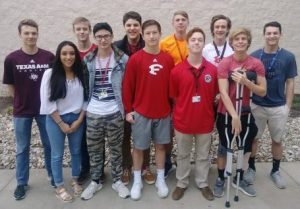
Front row: Gabi Moreno, Manuel Enciso, Jarrett Beard, Tyler Malinak, and Jacob Hinterlach. Back row: Tony Martinez, Noah Stotz, Jowad Aysheh, Jack Fox, Troy Kneese, and Jabin Gipson. Not pictured are Jessen Stableford, and Landon Sparrow.
The sophomores are moving through their course studies on a little more fast-track than last semesters class. This has been initiated in order to further their studies in 3D modeling and printing this round so that they achieve a more significant introduction in that area. They are doing well according to Mr. Matthes and are already beginning AutoCAD. In the past weeks they have successfully completed geometry, multi-view drawings, and engineering lettering.
As of January 23, the first semester studies ended for the Juniors, and opened them up to work on their second semester project in which they are now immersed. This project is to design and develop a one pound payload in a Transonic vehicle to be launched on April 26, at Rockets 2018. This means that their rocket must must be capable of breaking the speed of sound while carrying a one pound payload and remaining under 13,000 feet. The junior group is a large group of 22 students this year so they are unique in that they have been split into two groups, each responsible for their own rocket.
Mr. Matthes had this comment about the two groups, “I am excited to see them working diligently and proudly taking the endeavor as genuine separate groups. The ownership of their rocket and being different from each other’s groups is already evident. They have established their problem statements and are feverishly researching with many, many, many unknowns. As the process goes on their significant dispersion of knowledge and integration with each other slowly but surely migrates to a fully integrated and cohesive design.”
Along with their rockets, the group has another project for the semester. This entails designing and developing a teststand for Estes Motors. These are the small motors used mostly to fly their Generation 1 through 3 rockets. The objective is to create a teststand that will operate using LabVIEW programming to control and monitor ignition, measure thrust, and display and record real-time data to a file.
Seniors are a busy group with four projects still in the works, including Redbird 19, Wind Tunnel, Teststand and Baby Bird Teststand.
On February 1, Redbird 19(RB19) underwent Critical Design Reviews (CDR) with SystemsGo personnel present, and NASA flight engineers participating by Skype. RB19 did well overall. The Redbird 17 tank is being recycled as part of the RB19 design and was successfully tested earlier, as shown below, but will be retested on Friday, Feb.16 after which they will be required to provide documentation to SystemsGo. The team is fully immersed in the development of RB19. They have contracted machine shops and begun providing them work. These include Kager Industries, Heartland Enterprises, and SRM. Other necessary parts are in the order process.
 Corbin Smajstrla, Sergio Walle, Bryce Erwin, Pierce Vasquez, Evan Knapp, and Harrison Spisak prepare to test the RB17/19 tank.
Wind Tunnel also underwent CDRs with NASA and SystemsGo on February 1. Unfortunately it was found to have some issues to resolve. According to Mr. Matthes, the group is, “adapting well to the unexpected queries which arose and are close to having them resolved at this point. ”
Teststand has several upcoming events in March. In mid March, they will be conducting cold flow tests in order to verify the students injection system. This tests the flow rate of oxidizer through the system. Projected live ignition tests have been set for the end of March, and students have been given some solid dates in order to keep them on task to accomplish these.
Baby Bird Teststand is currently on hold. Students have a heavy work load to complete with the other projects. PVC and polypropylene tests will need to be completed on the large Teststand before work can resume on the Baby Bird Teststand.
www.systemsgo.org as always is the place for more information on this program. You may also email them at info@systemsgo.org . Take the time to get your school involved, the future of your students will be greatly benefited.


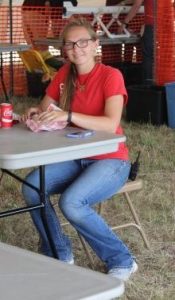 Anissa Kneese,
 has had years of practice to get things right. This year they were even training some new recruits in the program, freshman, Troy Kneese,
  and senior, Jesse Cedillo.
 . Jesse will be attending Angelo State University in the fall for computer science.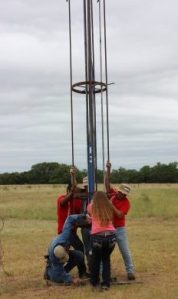


 On the Wings of Angels