Rockets 2017-Saturday Report-Williams Retirement- Sunday Schedule

Saturday was another great day of launches. Let’s see who is paying attention, we had 21 rockets on the schedule and we launched 23. The answer is later in the story. After storms came through the area over night and early this morning, causing a two-hour rain delay, rockets finally started flying around lunch time. The sky finally opened a window of opportunity.

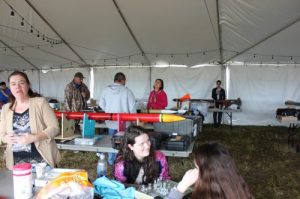
Even though launches started late, Stages 1 and 2 continued on schedule. This meant that when weather finally permitted launching, the spectator tent where rockets wait to go down to Stage 3, was full with more waiting than I have ever seen there.

. 
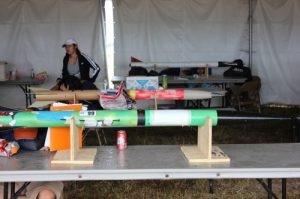
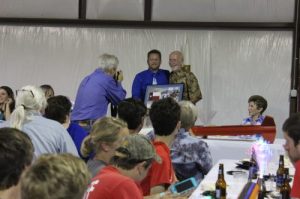
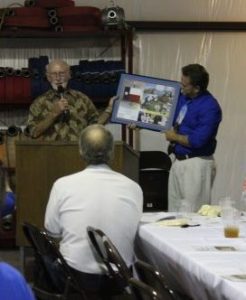
This evening after launches were completed for the schools, two more rockets were sent up as a tribute to retired FHS STEM teacher and SystemsGo founder Brett Williams.  They were both recovered in short order and taken to the Willow City Fire House where a dinner was hosted in his honor. He developed the program that all these schools use to teach the STEM curriculum across Texas and now New Mexico as well.

Several people gave a tribute address honoring and telling stories about Mr. Williams, including Scott Netherland, Andrew Matthes, Rebekah Hyatt, Dave Cambell, and Tom Moser.

Tom is a retired NASA rocket program member who became involved with the program. He served NASA as Deputy Associate Administrator for space station and space flight. These were just one of his many duties at NASA. Tom is one on a list of many influential people who Brett recruited to support the program over the years. After his address, he presented Brett with a NASA Citation for his work and contribution to the STEM program and student education.
 

Below is the launch schedule for today, Sunday. There are 5 schools launching a total of 16 rockets.

Sunday, May 21, 2017
School
Name
# 1st Level
Tsiolkovsky
# 2nd Level
Oberth
Alamo Heights High School
Colin Lang
3
Hardin-Jefferson High School
Mike Fogo
3 1
Manor High School
Will Davis
3
New Tech Odessa                 Richard Linder 1 1
Roosevelt High School            Jared Warsing 3 1
5
Schools Launching
Totals 11 7
May 15th Total Rockets 18

The following is a link to the album of pictures from today’s launch. Have a look, you and your school rocket just might be in there.

https://www.facebook.com/ginger.burow/media_set?set=a.1479031692117957.1073741890.100000334203350&type=3&pnref=story

Here is the second album link to the pictures from Brett William’s party.

https://www.facebook.com/ginger.burow/media_set?set=a.1479469515407508.1073741891.100000334203350&type=3&uploaded=36

Good luck to all the schools launching on Sunday. I will update the blog after we complete our day again tomorrow. Here is the link to the live stream again.

http://livestream.com/systemsgo

Please remember that although there is no charge for the event, and these launches are open to public viewing, parking and seating is limited due to safety requirements. For this reason, SystemsGo has a provided a link for you to pre-order tickets for those in your party. That link can be found at SystemsGo Events page. This also provides SystemsGo with a way to monitor the number of people in attendance each year. This is in no way meant to discourage your attendance, but is instead to help them provide a great experience for students and spectators, while doing all possible to monitor safety issues and attendance numbers at any one time during the launches.

Event details will be available here each day of the event. Daily reports featuring schedules, school names, results, pictures and some editorial content will also be posted.

www.systemsgo.org as always is the place for more information on this program. You may also email them at info@systemsgo.org .Take the time to get your school involved, the future of your students will be greatly benefited.

#SystemsGo #Rockets2017 #FredericksburgSTEMAcademy #Launcher01 #SystemsGoNewMexico

Fredericksburg’s STEM Academy/Rocket Program-Rockets 2017 Willow City Launch Week Update 1

Today is Tuesday, May 16, and the juniors are just days away from testing their vehicle at Stewart Ranch in Willow City at Rockets 2017. They will be launching on Thursday, but the time will be determined on site.

Deadline for construction completion was last Thursday, and unfortunately that one they missed.  Recovering from that has taken diligence because they have their Flight Readiness Review (FRR) due today. This is a must or they will suffer another set back which they cannot afford this close to T time. Mr. Matthes is confident that they will be ready to launch Thursday.

Their payload is fast growth slime mold. It has been growing and spreading and is ready to be packaged into the rocket and sent into space. It is growing well here on earth, the question to be answered is how will space travel affect its growth, negatively or positively?

Here the juniors, Sergio Walla, Bryce Erwin, and Alex West, left to right,  working on the rocket.

In this one Chris Calzada  is cleaning excess epoxy off of a fin mount. 

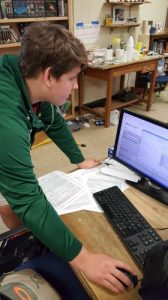
Harrison Spisak, is working on the Flight Readiness Review (FRR)in this last photo.

Even though the seniors’ “Baby Bird” test stand rocket will not fly at Willow City this year, they are still hard at work and progressing well on Red Bird #18 for WSMR in June. The tank has been tested successfully and the vehicles stability has been verified by NASA. This allowed for the fins to be cut so that they can be beveled for aerodynamic purposes, and then welded to the vehicle.  The door panels on the forward skirt  and aft skirt have been cut, and will be welded to the tank this week.

Four students accumulated 12 hours of  work over the weekend fiberglassing the nose cone. According to Mr. Matthes, “Things are coming together very well, but there is still a lot to do.”

This article is the ninth in a series, new for this school year ’16/’17 of updates that will follow the Fredericksburg STEM Academy/Rocket program. This school is a participant of the SystemsGo STEM program. This series of articles is intended to support, encourage, and challenge students in the program as they share their working status and accomplishments throughout the year in the program. These publications will be available for tags and re-posting.

www.systemsgo.org as always is the place for more information on this program. You may also email them at info@systemsgo.org . Take the time to get your school involved, the future of your students will be greatly benefited.

#Rockets2017 #SystemsGo #FredricksburgSTEMAcademy #Launcher01


What’s All This About Rockets: Success Stories–Robert Deaver

In 1996 in the small town of Fredericksburg, Texas a high school Aerospace program was begun and built literally from the classroom skyward as then, teacher, Brett Williams, developed a plan to build and launch rockets in a classroom setting in order to teach and implement a STEM curriculum. This class originally known as Principles of Technology (the POT Class, as it was fondly referred too), later became the SystemsGo program of Education In Motion, teaching students all over the state and now New Mexico too how to use the principles of STEM to build a career.

In this series of Interview style articles, we will meet individuals that studied under this program and have gone on to build their futures on the skills it teaches. The first gentleman we will meet, is Robert Deaver.

When speaking with indiviuals that have been through this STEM program, especially in the beginning, one thing stands out. Most of them started out in the program because the course name/description sounded interesting, and it provided a science credit.  As years went by and the program became known for building and  launching rockets, that in itself became a big draw for the program, although most participants still did not expect it to have the impact on their career choices that it did.

Robert, when asked why he got involved in the STEM program, was no different. “The class name sounded interesting and it counted as a science credit.”

That simple approach drew in the first classes that set forth to build a rocket, launching  the much more valuable vehicle of their futures  as time and learning evolved.

Robert was in the class during its ground breaking days, working on the construction and flight of the Red Bird #1, #2 and #3 rockets. These were the very formative first two years of the program as students and teacher learned together exactly what it took to create these projects. At first this was just a really fun and new concept of hands on learning and teaching that the students enjoyed.

The original class was only a one year class, but students really took to it and then this “science credit” soon became a class that students took because they wanted to experience it again.

“The course was so much fun I asked if i could take it again and was allowed. I initially took the course because it sounded interesting. I took it a second time because it was fun and challenging,” Robert stated when asked what his reasons were for taking the course.

Robert credits the program with setting him on his career path. He earned a BS in Electrical Engineering a the University of Texas at San Antonio and a MS in Computer Engineering at the University of Tennessee. Robert worked for IBM, Dell, and  after graduation, Real Time Systems, where he spent the last four years designing embedded systems that are used world-wide. After his recent marriage he moved to Boerne, where he started a new career as a hardware engineer at Futurex in Bulverde.

“I did not go directly from high school into an engineering program in college, but being exposed to the ideas and concepts of engineering in the Principles of Technology (precursor to the StystemsGo program) led me there eventually. I learned about Real Time Systems through volunteering with SystemsGo and after I graduated applied for a job with RTS and was hired.” Robert stated.

In his time in the program he worked on 3 of the Red Bird Rocket projects, #1, #2, and #3.  On all three, Avionics and Electronics were his main team focus therefore he was instrumental in Altimeter configuration on all three. On RB#1 he also worked on the Audio/Video Recording and Transmission, and the Fill and Fire system design and construction. On RB#2 he took on the Recovery System design, and on RB#3 the Airframe and Fin design.

Live video transmission from rocket to ground is what he remembers as the worst problem that he tried to solve while working on the RB#1 rocket.

“The electronics were ‘fiddly’ and although it worked well on the  ground, we were not able to get it functional during launch.”

In spite of this, RB#1 is still what he remembers as his best success from the program.

“I watched as a rocket  that my team and I researched, designed, and built from scratch soared off the launch pad. That feeling of accomplishment is truly indescribable!”

During these years he learned that he really liked working with electronics.  He also learned how to work on large projects as a team.

“The Red Bird 1, Redbird 2, and Red Bird 3 were by far the largest projects I had participated in at that time. Each project required interaction with others on my team and with other teams to complete.”

Even with all he learned he still did not realize the impact this program would make on his career choices until he was in college.

“During engineering school, I realized how much more prepared I was due to the project and team interaction skills I learned in what later became the SystemsGo Program.”

When I asked Robert  what advice he would give to current and future students in the program, here is what he had to say, “If you even think you are interested in engineering take these classes and pay attention. The problem solving and team work skills you learn in the SystemsGo program will be invaluable once you get to college.”

Another success of this program is that students from past years come back year after year to volunteer with the program. Many take time out of school and careers to do this. Robert is no exception. He volunteers annually  for the Central Texas, South Texas, and Goddard launches. He has also been named a board member, where he is happy to be able to, “help shape the program.”

I would like to thank Robert Deaver for participating in this article series. He is only the first in what I hope to bring to you as an ongoing series of success stories. These are written in hopes that all may understand the impact that STEM can have on your students and future employees. Having a program available at the high school level to teach, encourage and support this type of learning is instrumental to getting these students into great career futures.  Encourage your students to get involved in STEM and the SystemsGo program if it is available at your child’s school. If it is not available, look into how you can bring it to your area. This program will greatly benefit your school and children.

If you know or have a student that went through the program that would like to share their story here, please contact me in the comment section on this blog or if you follow it on Facebook, Twitter, or LinkedIn contact me there, and I will send you information to participate.

www.systemsgo.org as always is the place for more information on this program. You may also email them at info@systemsgo.org .Take the time to get your school involved, the future of your students will be greatly benefited.