Goddard Teacher Training Friday Final

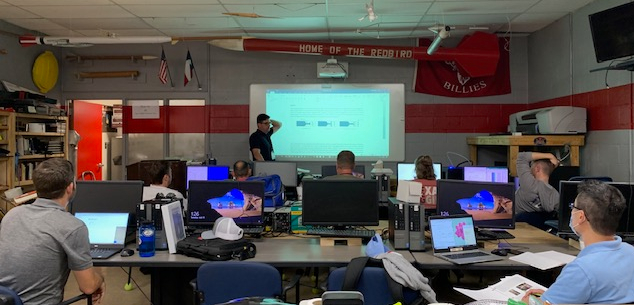
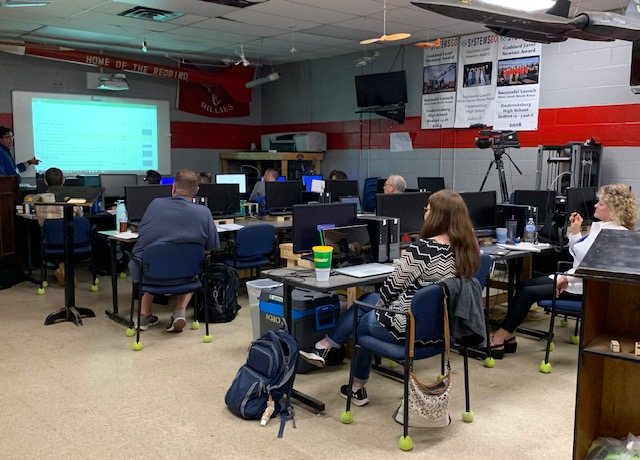
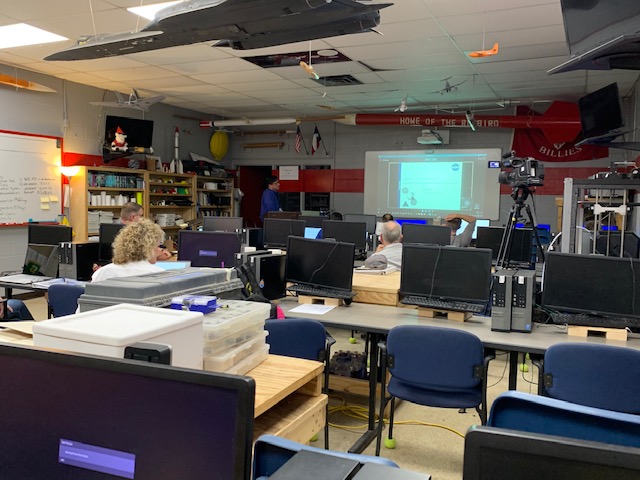
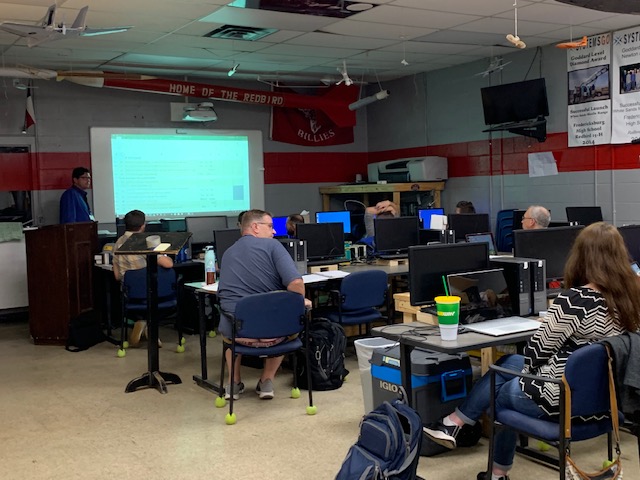
Today marked the final day of the Goddard Teacher Training class. Unfortunately for me, but better for all of them, class was done by the time my lunch came around and I entered the class. Phil Houseal, was packing up his video equipment, Rebekah was packing up snacks, and coffee, and the teachers were headed out to find home again.

Mr. Matthes and I spoke briefly about the day. They spent the morning discussing Stability, and Propulsion. At the end of their time, Rebak Hyatt, spoke about the Philosophies behind rocketry. 

It was my impression from the teachers that they all had a very informative and fun week, delving into the Goddard program. 

July 19-23, four schools will train on the Tsiolkovsky level at Artesia Administration Building in Artesia, New Mexico. Canon City High School from Colorado, and Logan, Elida, and Animas High Schools all from New Mexico will all train with Program Director, Rebekah Hyatt.  These classes are designed for Sophomore, Junior and Senior grade students whose projects are generally one pound/one mile rockets for launch at one of the spring launches.

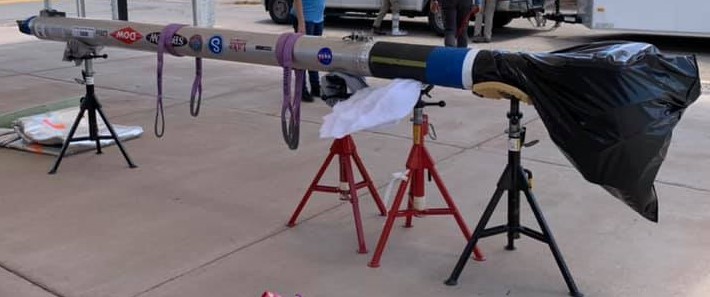
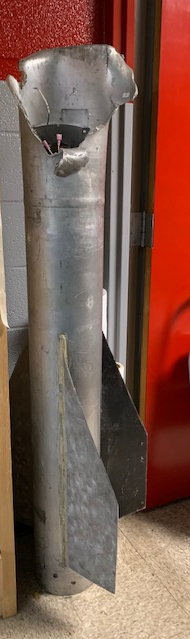
The feature picture for today’s short article is Brazoswood’s Goddard rocket from this year. I thought it a fitting way to end the week. 

www.systemsgo.org as always is the place for more information on this program. You may also email them at info@systemsgo.org .Take the time to get your school involved, the future of your students will be greatly benefited.

#RideTheSky! #Rockets2022 RocketSeason!

Goddard Teacher Training Day 4

Anatomy of a Rocket was the continued subject today in Goddard class. Yesterday encompassed the aft end of the vehicle, where as today it was the forward section. Concentrations on Nosecones, Recovery, Payload and Fins were primary discussions, as per Mr. Matthes. Interestingly, one of those components does not belong on the forward section of a rocket. I do believe that would be a slight design flaw. This leads me to believe that it was obviously the end of the aft section before beginning the forward section. No pun intended.

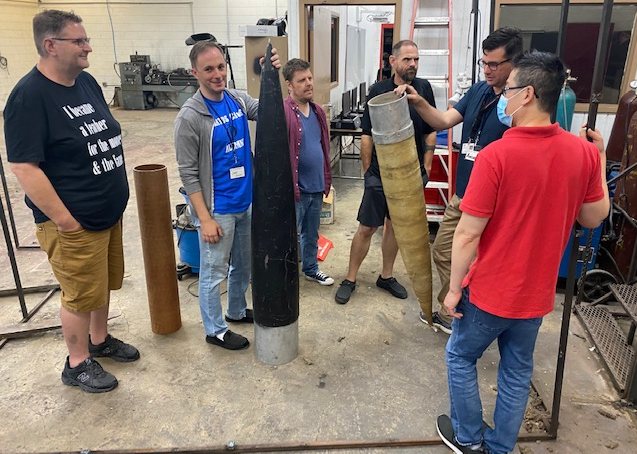
Earlier in the day during the discussion on nosecones, the group took a short field trip to the FHS Engineering storage room. Here they looked at various examples of nosecones that FHS has used on past rockets.

Chris McLeod, told me about this part of the day. He stated that I had missed the best part, and that he knew it was hard to get good pictures of them working on the screen. He then supplied the picture from this field trip, and I used it as the feature for this article. Thank you, Chris!

When I entered the discussion today, they were at the end of examples of chute configurations and deployment options. Below is what greeted me on the screen. They had already come to the consensus that option C was what they were going to include in their diagram.

Recovery had been a big part of the discussion earlier and Chris Madsen, NASA JSC, had conferenced in to aid in this conversation.

There was still some discussions about tethering, reefing, and chording. Mr. Matthes, brought up a chute drawing from earlier in the day to discuss more options and ideas on how to best accomplish these necessities.

Placement of the main and drogue chutes in reference to the avionics and electronics bay, and an antenna system for tracking, recovery and telemetry of the rocket were discussed. The antenna is being implemented since radar tracking is not always a reliable medium. Having this antenna onboard will aid in these areas supplying a secondary system instead of just the radar. Attaching this antenna so that it stays intact during flight and chute deployment seemed to be the more difficult part of adding it to the design.

At this point, the class transitioned to the screen calling on a new volunteer to draw the forward section of their vehicle. Michael Dodson, the teacher from Lovington High School in New Mexico, took on this task.

First they listed the main components that needed to be included:

  • Tank
  • Pressure gauge, pressure release valve, pressure release vent
  • Payload
  • Recovery-shock chords, Main, piston system, drogue
  • Avionics
  • Bulkheads

Just like Wednesday, the drawing kept evolving as they discussed what parts were needed and where their placement would be. Payload was added next. As per what the actual payload would be, I did not hear that answer. Although, 5 pounds of Playdough was mentioned as an option. At the Tsiolkovsky and Oberth levels it has been used, although not 5 pounds.

Playdough is not appropriate as a payload at the Goddard level. It was mentioned by the group as a kind of inside joke and therefore mentioned here to get the attention of certain individuals. You know who you are. We have to lighten the technical mood and have a little fun.

Here the payload compartment has been added to the diagram.

As the thought process stalled, Mr. Matthes, chided the teachers about having a deadline of 5 pm. tomorrow to complete their rocket. He razzed them about not putting in after hours time like the high school students do, to get the work done. During this time Mr. Dodsen added a frontal view of the recovery compartment to the drawing.

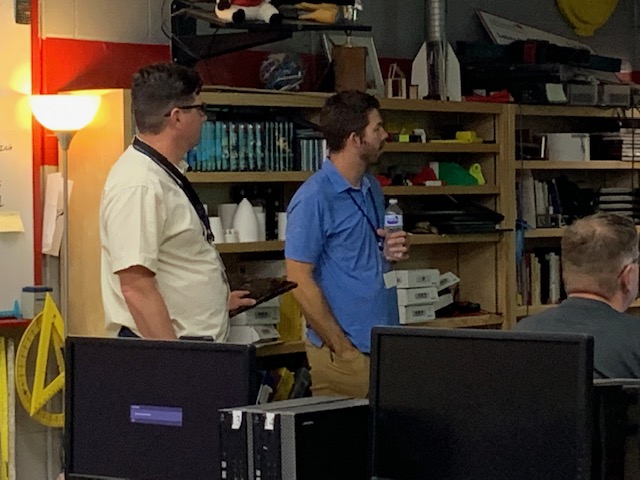
Doug Kimbrell and Doug Underwood sat at the back offering suggestions to the class and combing through material on the computer for ideas.

The class continued their brainstorming as I slipped out again for the day, my 40 minutes of class at it’s end.

Until tomorrow, if you are not dreaming of designing, building, launching and chasing rockets, you obviously have not hung out with this crew enough!

www.systemsgo.org as always is the place for more information on this program. You may also email them at info@systemsgo.org .Take the time to get your school involved, the future of your students will be greatly benefited.

#RideTheSky! #Rockets2022 RocketSeason!

Goddard Teacher Training Day 3

Today’s lesson was concerning the Anatomy of a Rocket. Quite honestly this was not a good class to come into the middle of and expect to keep up.

The best example I can give of how this went is as follows. My family often plays a game at holidays, we call “Pass Around Pictionary.” To sum it up, each person has a piece of paper on which they draw a picture, then fold the paper to hide the picture, and then they pass it to the next person to describe the picture in words. This process continues going back and forth from picture to words each time the paper is passed, and each person can only see what the person before them drew or wrote and must describe using the opposite action.

Now fast forward to today. I walk into a high level rocket training class just as the main lecture on how to design these vehicles has ended, and a student/teacher is selected to go to the board and draw/design a rocket with the help of his classmates. Not only are they drawing this vehicle as they go along, they are problem solving, designing, discussing parameters and components, and redrawing as the thought process changes and develops.

Here Conner Gorman from BCTAL steps up to the screen, at Mr. Matthes’ prodding for a volunteer, and Rhonda Baker, suggests that it is someone else’s time as she has already done board time earlier in the day.

The drawing began simple enough so I tried to draw my own copy picture as they went along. Their board allowed for erasing and changing as they went along. I brought a notebook and an INK pen to class today. It worked well the last two days, but failed me miserably today. I finally gave up on trying to complete the drawing, and went to listing components that I knew were part of a rocket. Needless to say I went from drawing to writing, watching as their diagram continued to evolve.

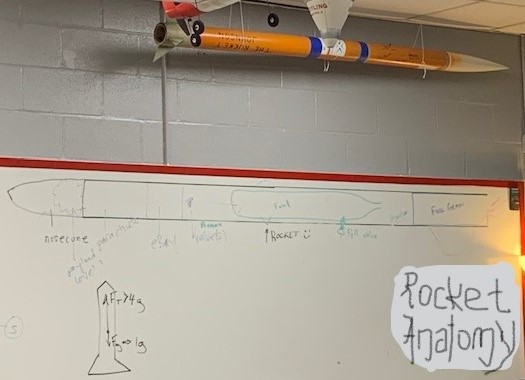
Incidentally, here is what my drawing and notes looked like.

You engineers, teachers and people who really know all this stuff, you can stop laughing now.

This too had it’s downfalls, because even though I know a lot of the pieces that go into a rocket, it is mostly the big stuff, like nose cone, tank, fins and fuel grain, and some of the tiny things like O-rings, valves, nuts, bolts, etc.

We were now discussing all the large, small, tiny, unknown and very necessary items. Several factors that effect each of them, their sizes, configurations, placement possibilities, etc. Not to mention the abbreviations, acronyms, and formulas that were being used as descriptors. I definitely need to take this class from beginning to end!!!

Here, Mr. Gorman almost appears to look like I felt. Although for him, it was probably just a thinking process moment.

One thing is for sure, these teachers were being held to the same standard or higher that the high school students in the program are and they were having to perform, just as they will be directing their future students to do. They were designing and developing a diagram of a rocket that they could look back on later as a working example. Each one was analyzing the possibilities and determining the best, what kind, why that one, and how of it all.

They were thinking through things like injector ports, vents, nozzles, electronics bays and their placements on the vehicles and determining if the design was good. Contemplating if they might need to reach that component later and how they would?

The drawing developed, morphed, changed and was redrawn as questions were put forth and answered. It was amazing to be a part of, but nearly impossible to take notes on and keep track.

Even these pictures really do not do the material or the participation of the working minds, justice. I cannot wait to see where they are tomorrow! Here are two more that were part of their discussion. I will let you fill in the captions for these.

We did have a few new faces today. SystemsGo Executive Director, Scott Netherland; Board President, Doug Kimbrell; and past graduate of the program, Robert Sanchez were all in attendance. At the time that I was there, Scott and Doug were observing. Robert said he was fixing one of the school’s 3D printers so that he could use it to fix the other 3D printer.

Until tomorrow, if you are not dreaming of designing, building, launching and chasing rockets, you obviously have not hung out with this crew enough!

www.systemsgo.org as always is the place for more information on this program. You may also email them at info@systemsgo.org .Take the time to get your school involved, the future of your students will be greatly benefited.

#RideTheSky! #Rockets2022 RocketSeason!

Goddard Teacher Training Day 2

Teachers and others in the program probably already know this, but it was news to me. That was either because I have just missed it in conversation before today, or the fact just never came up. Maybe I should have known, but then I am not a teacher, just a crazy, addicted volunteer that loves and supports the program. The technical term is Rocket Junky! What didn’t I know, well the fact that they only do the Goddard level training every four years!!!!!

Doug Underwood, actually gave me that piece of information today. He is seen here with his materials laid out as the lecture resumes after their lunch break.

Not all schools participate in this level of the program. One reason is because these vehicles are expensive to build. It also requires extra travel for the students and schools, and the only window for launch is a month after the students have graduated and school has dismissed. Most schools stay at the Tsiolkovsky and Oberth levels. Therefore training every year is not always necessary or cost effective. That is my take on the why. Of course, SystemsGo may have more specific reasons for their why.

Either way, at first I was stunned and wondered, how can that be? But, knowing just what I do know, taking the things I have mentioned into account and the fact that not every school that does the Goddard program comes to WSMR to launch every year, it could be made sense of rather quickly.

Today the Goddard class was training on Propulsion. Engineering teacher, Andrew Matthes was manning the presentations, leading the discussions and taking questions again.

Here are a few things I heard in my 30 minutes in class today. Do not expect these session to be perfect and totally technically on because, I am not an engineer, though if I could go back and do this stuff I would. I am just a writer and volunteer for the program that loves to soak up all that I can like a sponge and throw it out there for the many more rocket junkies like me, including other students, teachers, rocket followers, etc. so that we may all have a piece of the action and involvement. First and foremost I love to bring more light to the program in any way I can. And have some fun with all I see, hear and learn.

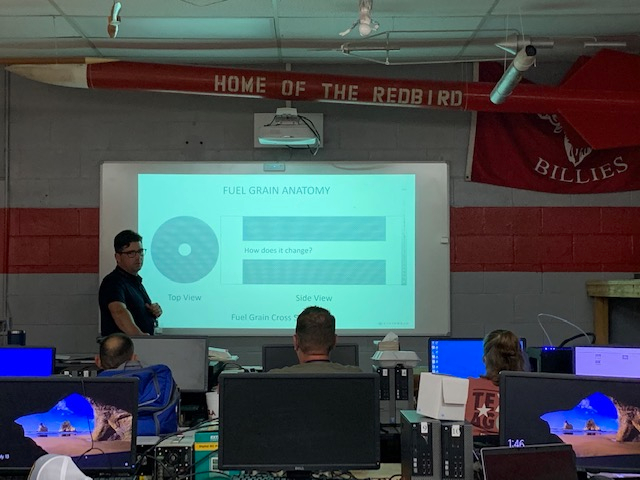
That being said, here is my bit of today’s lessons. There was much discussion about the fuel grain and how it reacts with Nitrous and Oxygen. Specifically how the vapor off the surface of the fuel grain burns with the oxidizer to create combustion. Hot expanding gasses were a topic at this point, which brought forth a quote about hot gasses from the movie, October Sky!

I tried to locate the exact quote, and it did speak about the necessity of the nozzle in the design and how it directs the flow of hot gasses. Of course the comments in the movie went south after hot gasses.

The class went on to discuss fuel grain flow designs. The first of which is pictured here:

This lead to discussions about expansion within the fuel grain, as well as pressure changes, flow rate changes and various other effects as it burns. One such example that is likely with a single port is that the port gets larger as it burns. This changes the Mass Flow Rate also causing the DOF to get larger.

Another comment mentioned was that with only one port, the expansion creates two separate sides to the fuel grain, kind of like two separate pieces of wood burning, which also changes the potential of the propulsion.

According to some in the class, “Two sticks burn better than one!” Chris McLeod, said that I definitely needed to include that comment in today’s blog, so there you have it.

The anatomy of fuel grains and what works well and does not,

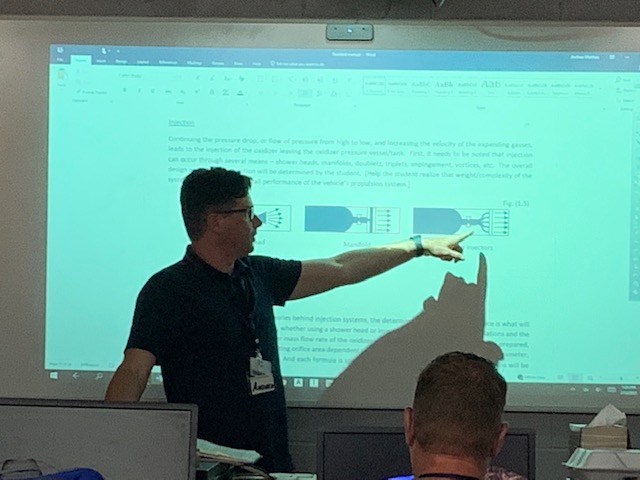
as well as nozzle designs were also touched on while I was present, as seen in the pictures shown above and below.

At the beginning of class the internet was down. Apparently it is an intermittent problem. Mr. Matthes made a call and it restored quickly. Jerry, the FISD, IT guy stopped by to check. He said the server had actual gone off momentarily. Some of you might remember him from Willow City a few years back. He brought his drones out to help aide recovery.

Yesterday, someone commented that they wanted to see who else was in attendance besides, Chris McLeod, so here maybe you can make out a few more people. Rhonda Baker is one you might know.

SystemsGo Program Director, Rebekah Hyatt was there when I first arrived, but left quickly to address some issues back at the office.

The same seven teachers were present for training again today. As previously noted they are from Birdville Career and Tech Center, RL Turner, Union Grove, Brazoswood, Booker T Washington, and Jal High Schools.

Today, most of the photos are already included, but I thought this one could be of some interest since the discussion is Goddard rockets. It is the aft end of an old Goddard vehicle. Not a clue if it belongs to a FHS Red Bird or some other school, but it is a prime example of how success often comes to you in pieces.

IMG_6753

Until tomorrow, if you are not dreaming of rockets, you obviously have not hung out with this crew enough!

www.systemsgo.org as always is the place for more information on this program. You may also email them at info@systemsgo.org .Take the time to get your school involved, the future of your students will be greatly benefited.

#RideTheSky! #Rockets2022 RocketSeason!

Goddard Teacher Training Day 1

Goddard training began today with FHS Engineer teacher, Andrew Matthes directing the class.

SystemsGo Program Director, Rebekah Hyatt, sitting in the back where she was able to add in information or examples as needed. SystemsGo Regional Director, Doug Underwood was also in attendance.

Seven teachers were present for training. Most were from schools around Texas including Birdville Career and Tech Center, RL Turner, Union Grove, Brazoswood, and Booker T Washington High Schools, and one from Jal High School in New Mexico.

I watched and listen for about 40 minutes today, during which, Chris Madsen, NASA JSC, Orion Entry GN&C Systems Manager skyped in to present The SystemsGo Goddard 6-DOF Inputs session of the training.

As I listened to discussions including center of mass, Roll, Yall and Pitch, metric and standard measurement uses, weight balance across the vehicle, just to mention a small fraction of the information being presented, I was really wishing I had brought a folder for notes and not just a camera. I definitely wish I could have stayed for the full presentation as this program and all they do, never ceases to amaze and fascinate me.

Here are a few more pics. Not too much different, but I will check in on them again tomorrow to see if there is more of interest to report.

IMG_6740 IMG_6733

www.systemsgo.org as always is the place for more information on this program. You may also email them at info@systemsgo.org .Take the time to get your school involved, the future of your students will be greatly benefited.

#RideTheSky! #Rockets2022 RocketSeason!

Rockets 2022-Begins With Teacher Training

Rockets 2021 has barely ended as the Team and students returned home from launches at White Sands Missile Range in New Mexico, on June 27th, and July already starts a new year.

Rockets 2022 begins with SystemsGo Teacher Training for the 2021/2022 school year.  22 Schools from Texas, New Mexico, and Colorado will be participating in training on all levels of the program at locations in both Texas and New Mexico.

July 12-16 kicks off these educational events at the Goddard level. FHS Program teacher, Andrew Matthes, will conduct this event in the Fredericksburg High School Engineering Department classroom.


Five teachers from Texas high schools, including Birdville Career and Tech Center, RL Turner, Union Grove, Brazoswood, and Booker T Washington High Schools, and one from Jal High School in New Mexico will attend and secure certification to teach the curriculum at their respective schools this fall. This first week of training encompasses the senior level rockets which launch at White Sands Missile Range. It is the final and highest level of the program. These vehicles are designed to reach 50,000 feet.

July 19-23, four schools will train on the Tsiolkovsky level at Artesia Administration Building in Artesia, New Mexico. Canon City High School from Colorado, and Logan, Elida, and Animas High Schools all from New Mexico will all train with Program Director, Rebekah Hyatt.  These classes are designed for Sophomore, Junior and Senior grade students whose projects are generally one pound/one mile rockets for launch at one of the spring launches.

The following weekend, July 24-25, two teachers will train on the Oberth level also at the Artesia Administration Building in Artesia, New Mexico. One is from the West Texas school of Fabens and the other from Canon City in Colorado.  Regional Coordinator, Doug Underwood, will conduct these trainings. July 31- August 1 he will be in Fredericksburg training Texas teachers on this same level.  Hollenstein, Georgetown and McGregor High Schools will be in attendance in Fredericksburg.  This level teaches students in the Junior and Senior years on the Transonic rockets, which are designed to break the speed of sound.

The next week will be back at Fredericksburg High School, where Program Director, Rebekah Hyatt continues training teachers on the Tsiolkovsky level of rockets. The Texas schools of Summer Creek, Hollenstein, Friendswood, Atascocita, Galena Park, Georgetown, and McGregor will attend this session in Fredericksburg.

The first week in August, PD Hyatt will also be conducting webinars for teachers needing the Intro to Engineering training. These teachers generally work with eighth and ninth graders just starting in the program, which teaches the Research Design and Development Loop as well as the history and basics of rocketry. These are two hour working web trainings that are scheduled as needed. Currently there is only one on Wednesday, August 4th, but a second may be added later.

Covid caused many schools and teachers to drop the program last year. Fortunately, many are returning this year and at least five new schools have been added. SystemsGo is glad to see this uptick in the program.

The more schools and teachers mean many more students involved, and with that many more potential career paths in the STEM fields.

www.systemsgo.org as always is the place for more information on this program. You may also email them at info@systemsgo.org .Take the time to get your school involved, the future of your students will be greatly benefited.

#RideTheSky! #Rockets2022 RocketSeason!

Rockets 2021 Continues Today in Jal, New Mexico!!!

The Rockets 2021 season transitioned to New Mexico this week after three weekends on the Texas Rocket Trail.  New Mexico launches are the fourth for the Tsiolkovsky and Oberth levels.

The current rosters list 8 schools participating in the Jal, New Mexico launch,  where they will be testing 16 rockets. This is the fourth active year for this venue.

Their numbers in both schools and rockets are down in New Mexico since the 2019 season, just as they were in Texas, due to schools navigating COVID parameters.

SystemsGo New Mexico does have a twitter feed  in order to follow the launches. The link is still live, but right now there are no current tweets.  That link is https://twitter.com/SystemsGoNM

All sites are closed to public viewing of launches this year.  However, the launches will se broadcast on Livestream here: https://www.youtube.com/watch?v=SG5OUV944GQ

The  launch dates, locations, and schools are also listed here for your convenience or can be found at http://www.systemsgo.org/events/ .

Jal, New Mexico:

  • Tuesday, May  11 – Thursday, May 13
  • Returning to the launch site on Phillips Hill Road near Jal.
  • Schools participating: Fort Sumner HS, Grady HS, Hagerman HS, Jal HS, Lovington HS, Alamogordo HS, Dora HS, Portales HS
  • 16 expected rockets for testing
  • Tuesday, May 11, 2021
  • 7:00 a.m. to 10:00 a.m. at Jal High School
  • 10:00 a.m. to 1:00 p.m. at Alamogordo High School
  • 1:00 p.m. to 4:00 p.m. at Dora High School
  • Wednesday, May 12th, 2021
  • 7:00 a.m. to 10:00 a.m. at Lovington High School
  • 10:00 a.m. to 1:00 p.m. at Ft. Sumner High School
  • 1:00 p.m. to 4:00 p.m. at Portales High School
  • Thursday, May 13th, 2021
  • 8:00 a.m. to 11:00 a.m. at Hagerman High School
  • 11:00 a.m. to 2:00 p.m. at Grady High School

The sites will be open for admittance at 6:00 a.m. and launches will commence there after.

I am not sure exactly how the time frame on these launches will actually work. The block form of the schedule is a little different than the Texas schedules were. I know in Texas it depended on which schools’ rockets made it through Stages 1, 2, and 3 as to when and what order they launched.  In Jal they have a block 3 hour time frame for each school. I don’t really know how all the Stages factor in so it should be interesting to watch how the launches progress through the day.

Of course rockets are subject to winds, weather and workmanship, all of which can stall a launch. Come join in the action and cheer on these students on the Livsestream. Even though spectators and family cannot be there in person, just knowing you are watching them and cheering them on will boost their morale and bolster their success for their vehicles launch. Besides then you still get to see the look on your students’ faces when their vehicle goes up and then is recovered. That alone, is from priceless.

A live feed for the Jal, New Mexico, launches will be provided at www.systemsgo.org .

The senior groups are tentatively scheduled to launch their Goddard level rockets at White Sands Missile Range (WSMR) in New Mexico in late June. Right now these are still very tentative.  News on this may be available in the next few weeks.  These are not available for public viewing or Livestream due to being tested on a military facility, but blog and SystemsGo updates will be posted online as available during that week.

Please watch the SystemsGo website, SystemsGo Facebook page,  SystemsGo Twitter feed: https://twitter.com/SystemsGoNews  for upcoming information on theses events.

www.systemsgo.org as always is the place for more information on this program. You may also email them at info@systemsgo.org . Take the time to get your school involved, the future of your students will be greatly benefited.

Hope to see you at the launches! #RideTheSkies #texasrockettrail #Rockets2021 #EyesontheSkies

Rockets 2021 Central Texas/Stonewall Ended Today, Sunday, With a Weather Makeup Day

The Central Texas/Stonewall launch hit its final day in this series for the Rockets 2021 season, today. This day was not originally on the schedule but added due to inclement weather on Thursday and Friday to allow schools another launch option if they could not complete theirs due to the bad weather. Only one school, Georgetown High School chose this option. They had four rockets to test today. Three 1 pound/1 mile and 1 Transonic.

All four vehicles were tested and launched, 3 beautifully, and the fourth only made about fifty feet, before tumbling back down near the pad. Even so, all were tested and all recovered.

There was some added interest in this school for the Segner and Spies families, as they had a couple of relatives that recently began working for this school that joined the rocket group at the ranch to watch the launches.

Thanks so much to Sammy Segner, Troy, Jennifer, and Reed Spies, and Richard Koone for the use of their properties and for joining in the hunt for rockets as recovery teams. They made the weekend very enjoyable for everyone involved. It was a great first year at the new location and everyone is looking forward to being there again next season.

There were a total of 71 rockets tested by 20 schools at the Stonewall location for Rockets 2021. The recovery teams did a wonderful job of hunting them and returning them to the students. There were only 2 that were not recovered.

Thanks is also in order for the Stonewall Chamber of Commerce for hosting Stage 1 and 2 at their building.

Pictures from the progress at the site to this weekend are on SystemsGo Facebook page, as well as my Facebook page. They can be found here:

https://www.facebook.com/SystemsGoEducation/

https://www.facebook.com/ginger.burow

If you follow this program and like to view the launches, Rockets 2021 will continue with one more launch next week, May 6-8, with a possible weather make up day again on Sunday. There are some weather predictions for next week that might necessitate using Sunday just as we did this week. The final launch of the junior level rockets will be held in Smith Point just south of Anahuac, Texas (the Southeast Texas/Smith Point launch) for schools in the Houston  and Southeast Texas area.

The Smith Point sites will be open to admittance for students and teachers only at 6:00 a.m. Projected start time for launches is 8:30 a.m. All is contingent on test vehicle readiness and ability to pass Stages 1 and 2. Mission Control will be ready for Stage 3 checks by 8:00 a.m.

Of course rockets are subject to winds, weather and workmanship, all of which can stall a launch.

Restrooms and wash stations will be provided at the launch site. Due to COVID restrictions, no concessions or spectator tent will be available, because no spectators are allowed this year. Teachers are asked to bring pop up tents for themselves and their students. Please remember sunscreen, chairs, umbrellas, extra snacks, drinks, and food.  Downtime entertainment for the students to engage in between launches may also be helpful. Rockets are subject to winds, weather and workmanship, all of which can stall a launch, and delay schedules.

You can still be prepared to join in the action and cheer on these students on the Livestream. The look on your students’ faces when their vehicle goes up and then is recovered, and knowing you are watching and supporting them, is far from priceless.  Shoot them a text, letting them know you are watching online.

A Livestream for each launch will be provided and will be available at www.systemsgo.org as each launch date arrives.

More event details will be available here in upcoming days as events get closer. Daily reports featuring schedule links, school names, results, pictures and some editorial content will be posted during the events if information is available.

The senior groups are tentatively scheduled to launch their Goddard level rockets at White Sands Missile Range (WSMR) in New Mexico in late June.  These are not available for public viewing or Livestream due to being tested on a military facility, but blog and SystemsGo updates will be posted online as available during that week. This will be the fifth launch sequence and will finalize the Rockets 2019 season.

Please watch the SystemsGo website, SystemsGo Facebook page,  SystemsGo Twitter feed: https://twitter.com/SystemsGoNews and this blog for upcoming information on theses events.

www.systemsgo.org as always is the place for more information on this program. You may also email them at info@systemsgo.org . Take the time to get your school involved, the future of your students will be greatly benefited.

Hope to see you at the launches! #RideTheSkies #texasrockettrail #Rockets2019

Rockets 2021 Central Texas/Stonewall Soggy Saturday Evening Launch Report

Today was the third day of launches at Stonewall for Central Texas Rockets 2021. Weather was again the issue of the day. Rain delayed the start again for the second day. Stages 1 and 2 which were able to continue getting all the rockets through checks.

Unfortunately the same could not be said for Stage 3 checks as they were stalled several times for weather. Because of this some teams did not leave their rockets when asked to go for shelter and so those will  still have to pass Stage 3 tomorrow. All those that did leave their rockets have been checked.

The storms kept everything stalled until 4:30 this afternoon when a short window between storms allowed one volley resulting in three off the rail and two misfires. An attempt was made for a second volley but to no avail. Instead it was a race to secure the rockets and equipment to safety and retreat from the site before next line of storms.

That leaves a massive docket of vehicles for testing on Sunday. 51 if all of today’s are actually present.  It will be a busy Sunday if all goes well! Should be interesting to see how many the crew can put up in one day!

Some of the volunteers passed the time playing dominoes during rain storms while no rocket teams were there for checks. The rest of us passed the time visiting and watching the radar. Luckily tomorrow’s forecast looks much better than  the past couple of days.

Livestream should be back up to cover the festivities which will start extra early tomorrow. First rockets up by daybreak as long as we can reach the site after flooding rains this evening.

It’s 11:30 p.m. now and I’m still waiting to cross the Palo Alto  Creek slab and go home along with five other cars of neighbors and B/B guests.

Today was originally scheduled to be the last day of Central Texas Rockets here in Stonewall, but due to weather on Thursday and Friday we are still launching tomorrow. 

Restrooms and wash stations will be provided at the launch site. Due to COVID restrictions, no concessions or spectator tent will be available, because no spectators are allowed this year. Teachers are asked to bring pop up tents for themselves and their students. Please remember sunscreen, chairs, umbrellas, extra snacks, drinks, and food.  Downtime entertainment for the students to engage in between launches may also be helpful. Rockets are subject to winds, weather and workmanship, all of which can stall a launch, and delay schedules.

The Central Texas/Stonewall launch dates, Livestreams and schools are listed here for your convenience or can be found at http://www.systemsgo.org/events/ .

Central Texas/Stonewall:

  • Sunday,  May 2-Weather Contingency Day
  • Launch Site: 2187 Double Horn Road, Stonewall, Texas 78671
    Stage 1 & 2 at Stonewall Chamber of Commerce: 250 Peach Street, Stonewall, TX 78671
  • Schedule for Sunday: All or as close to that as possible!
  • Schools participating: Georgetown HS, Kermit HS, London HS, Carroll HS, New Diana, Kingwood, Hamilton, Roosevelt, Fabens, Harleton, Marble Falls, Union Grove, Victoria East, Victoria West, McGregor, Fredericksburg, Alamo Heights, Ingram, and Canon City.
  • 71 expected rockets for testing
  • A Livestream for each launch will be provided and will be available at www.systemsgo.org as each launch date arrives. Friday’s is as follows: May 2- Day 4

Pictures from the progress at the site to this point are on SystemsGo Facebook page, as well as my Facebook page. They can be found here:

https://www.facebook.com/SystemsGoEducation/

https://www.facebook.com/ginger.burow

A live feed for each launch will be provided and will be available at www.systemsgo.org as each launch date arrives.

Daily reports featuring schedule links, school names, results, pictures and some editorial content will be posted during the events if information is available.

Please watch the SystemsGo website, SystemsGo Facebook page,  SystemsGo Twitter feed: https://twitter.com/SystemsGoNews and this blog for upcoming information on theses events.

www.systemsgo.org as always is the place for more information on this program. You may also email them at info@systemsgo.org . Take the time to get your school involved, the future of your students will be greatly benefited.

Hope to see you at the launches! #RideTheSkies #texasrockettrail #Rockets2021 #EyesontheSkies

Rockets 2021 Central Texas/Stonewall Belay Those Friday Launches

Belay, belay, belay! The story of the day!

The act of belaying, is described as something a leader may require in order to tackle more difficult situations. It means to stop, it’s enough. That is exactly SystemsGo Program Director, Rebekah Hyatt had to do today with rockets. She finally had to make the call based on intel from Patrick Miller our meteorologist to belay any further attempt at launching today, due to weather.

This was not the outcome for the day that anyone had hoped to have. Due to the low cloud ceiling with continuous rain and drizzle it was the only correct answer for the day. Launches were called of for the day, with the hope of resuming tomorrow. Unfortunately, the weather prognosis for tomorrow is also grave. There are only two small windows tomorrow, one around 10:00 a.m. to 12:00 p.m. and another mid-afternoon around 4:00 a.m. If these do not materialize, then Sunday is the only shot for all the rockets left from Thursday, Friday, and Saturday.

Right now that would be eight from Thursday, 19 from today, and a possible 27 from Saturday if all rockets on the current Saturday schedule arrive and pass Stages 1, 2 and 3 checks. If anyone is counting, that is 54 rockets. That will be quite a feat and a super busy day for Sunday. There is a slight possibility of a small contingent being transported to the next launch in Anahuac, but that has plenty of challenges in itself and is not an ideal situation.

The best hope is to get whatever windows however small they may be for tomorrow and put up as many as the team can in that time in order to lighten the load for Sunday. On the bright side, right now Sunday’s weather looks warm, partly cloudy and sunny right now, with the best prognosis for flying rockets we have had all week.

From Thursday’s docket, Fabens and Harleton each have one one pound/one mile yet to test. New Diana, Kingwood, Hamilton, Roosevelt, Harleton, and Marble Falls all show one Transonic each ready to test.

Today’s schedule has Union Grove with one 1/1 and two Transonic, Victoria East with four 1/1, Victoria West with one 1/1, McGregor with two 1/1, Fredericksburg with two Transonic, Alamo Heights with three Transonic, Ingram Tom Moore High School with three 1/1 and Canon City with one 1/1.

Saturday’s schedule is posted below and shows as stated previously, 27 rockets.

I want to take a quick shout out to Canon City. They are a first year launch group and have traveled the farthest to launch this weekend. Unfortunately due to the weather, they may not even be able to be here to see their vehicle fly. That is the case now for several schools, but this is their first rocket, and they are from Canon City, Colorado! They are the first CO school to participate in the launches.

I spoke with them and their teacher, David Laughlin, today, and they were super excited to be here and and be part of the program. Their group was a mix of sophomores to seniors. They were impressed with all the program had taught them, and how much fun it has been to be a part of this learning experience.

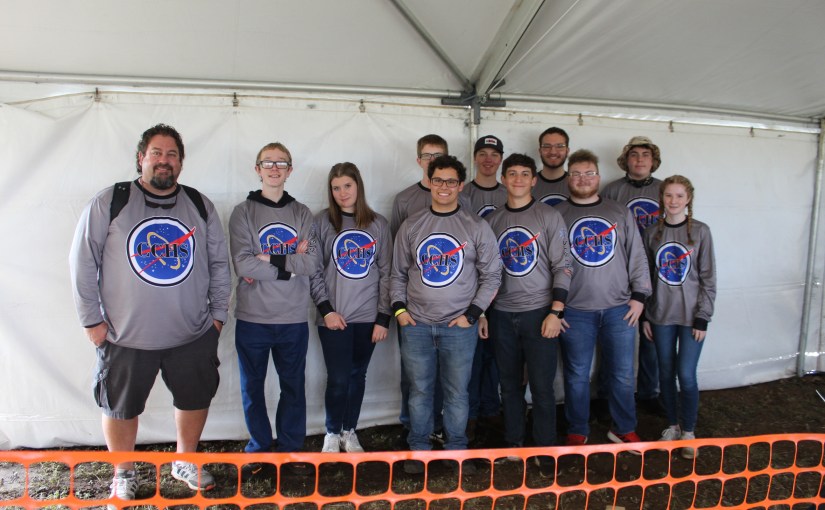
I have to say that the young ladies and gentlemen and their teacher were very polite and friendly and a joy to talk with about their experience in the program. I am greatly remiss that though I was sure I would remember, I did not write them down and have forgotten the students’ names that I spoke with this afternoon. I did get their picture though. They are the cover photo for this blog piece. Congratulations on getting here for your first launch, safe travels, and good luck on your vehicle’s flight.

I also want to report that as of Friday morning, recovery was at 100% as all rockets have been located and returned to Misssion Control.

Tomorrow’s weather window for launching may be unstable right now, and start time unsure, but even so all Stage 1, 2 and 3 checks will remain on schedule with usual start times around 6:00 a.m. The idea is to get all rockets through the stages so they are rail ready when the opportunity arises, be it tomorrow or Sunday.

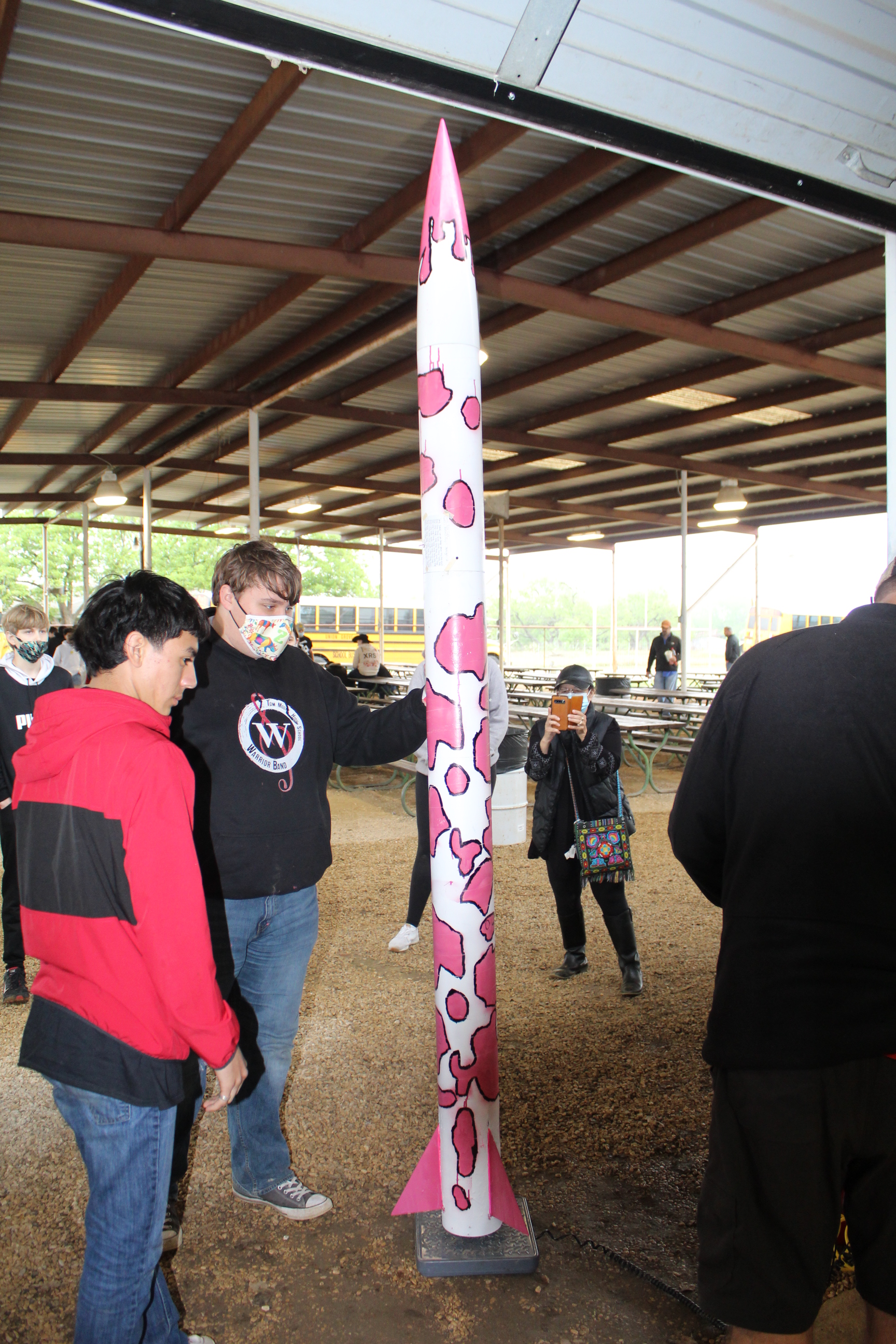
Today’s weather delays afforded me the opportunity to go see the students at Stage 1 and 2. I do not usually have that chance. I did get several pictures of the students and their rockets as they worked through the check points with the staff and their teachers. Here are just a couple of those. The rest can be found on my daily album on Facebook. The link is posted below.
IMG_0803

Pictures from the progress at the site to this point are on SystemsGo Facebook page, as well as my Facebook page. They can be found here:

https://www.facebook.com/SystemsGoEducation/

https://www.facebook.com/ginger.burow

Stages 1 and 2 will continue to be at the Stonewall Chamber of Commerce building.

Restrooms and wash stations will be provided at the launch site. Due to COVID restrictions, no concessions or spectator tent will be available, because no spectators are allowed this year. Teachers are asked to bring pop up tents for themselves and their students. Please remember sunscreen, chairs, umbrellas, extra snacks, drinks, and food.  Downtime entertainment for the students to engage in between launches may also be helpful. Rockets are subject to winds, weather and workmanship, all of which can stall a launch, and delay schedules.

The Central Texas/Stonewall launch dates, Livestream Links and schools are also listed here for your convenience or can be found at http://www.systemsgo.org/events/ .

Central Texas/Stonewall:

  • Saturday, May 1
  • Launch Site: 2187 Double Horn Road, Stonewall, Texas 78671
    Stage 1 & 2 at Stonewall Chamber of Commerce: 250 Peach Street, Stonewall, TX 78671
  • Central Texas-Stonewall 2021 Flight Schedule
  • This is the original projected Saturday schedule. As mentioned above, Thursday and Friday’s remaining rockets will also be attempted given the needed weather window.
  • Schools participating: Georgetown HS, Kermit HS, London HS, Carroll HS, New Diana, Kingwood, Hamilton, Roosevelt, Fabens, Harleton, Marble Falls, Union Grove, Victoria East, Victoria West, McGregor, Fredericksburg, Alamo Heights, Ingram, and Canon City.
  • 71 expected rockets for testing-27 on Saturday, 8 from Thursday, 19  from Friday
  • A Livestream for each launch will be provided and will be available at www.systemsgo.org as each launch date arrives. Friday’s is as follows: May 1- Day 3

The sites will be open to admittance for students and teachers only at 6:00 a.m. Projected start time for launches is normally 8:30 a.m. but currently due to weather, actual launch start time is unknown. Mission Control will update this as weather data allows. All is contingent on test vehicle readiness and ability to pass Stages 1 and 2. Mission Control will be ready for Stage 3 checks by 8:00 a.m. Weather will determine the rest.

More event details will be available here in upcoming days as events progress. Daily reports featuring schedule links, school names, results, pictures and some editorial content will be posted each day of the event if information is available.

Please watch the SystemsGo website, SystemsGo Facebook page,  SystemsGo Twitter feed: https://twitter.com/SystemsGoNews and this blog for upcoming information on theses events.

www.systemsgo.org as always is the place for more information on this program. You may also email them at info@systemsgo.org . Take the time to get your school involved, the future of your students will be greatly benefited.

Hope to see you at the launches! #RideTheSkies #texasrockettrail #Rockets2021 #EyesontheSkies