Rockets 2018-Recap of Sunday, Day 3 and The Last Day of Houston Rockets

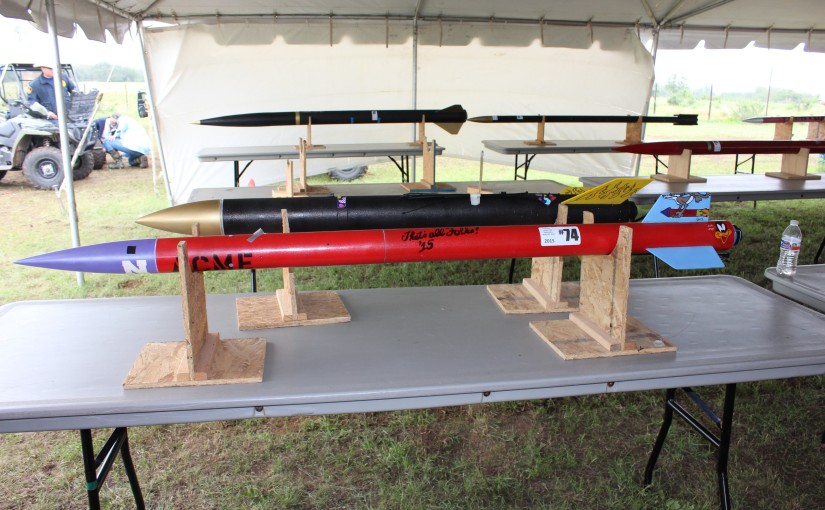
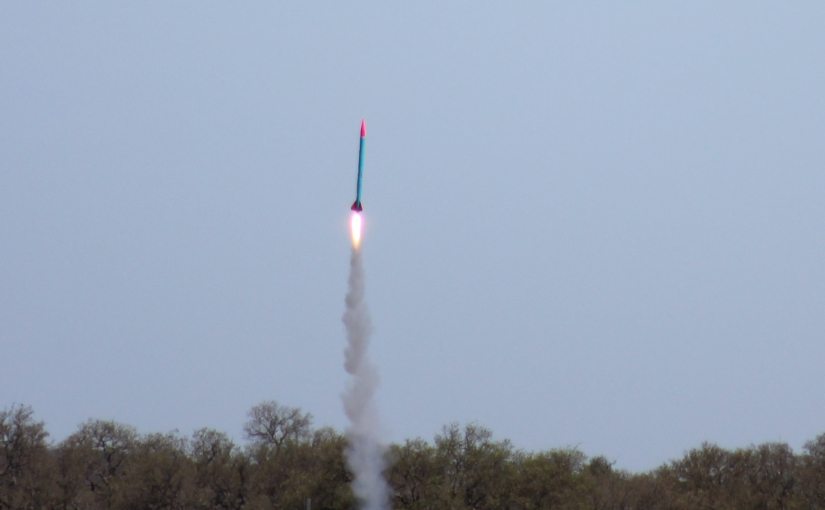
Today, Sunday, was the last day of launches at the Smith Point site for  the SystemsGo team. They had four more schools and eleven more rockets on the schedule. It was a successful day as all eleven left the rail.

Unfortunately, rocket # 138 for Anahuac was the last launch, and just as they were fixing to load, and interviewing the students on that team, the Livestream went down and did not return. It was a little glitchy all day, so not surprising that this happened just unfortunate for the students and their viewers at home. I know SystemsGo regrets when these things happen, but technology doesn’t always cooperate the way we would prefer. Just keeping a WiFi connection down where they were was very difficult. They didn’t even have service for their cell phones.Therefore, this was an unavoidable mishap of technical difficulties.

With that being said, at least the rest of the day and the launches all went well. All vehicles had completed launches by 1800 as best as I could tell without the final feeds.

The site was shut down, cleaned up and the Fredericksburg SystemsGo team members were headed back home by 20000(8:00pm).

Pictures  will be available in Facebook albums for you to view, but I will post a s few of my favorite screen grabs below. Phil will have several from throughout the day and weekend on the SystemsGo Facebook page as well. Links to both our Facebook pages are below.

https://www.facebook.com/ginger.burow

https://www.facebook.com/SystemsGoEducation/

Here is the link to the live stream again. It will still be available as videos of the past event days to watch for about a month.  https://livestream.com/systemsgo 

We have come to the end of another great year of rockets. Here are today’s faves before I go and the rest will be on Facebook. Thanks to all that make these events possible.

I do have one question though, Phil what was up with ketchup pakcet?

If you follow this program Rockets 2018  will continue with the senior/graduate groups which are tentatively scheduled to launch their Goddard level rockets at White Sands Missile Range (WSMR) in New Mexico in late June.  These are not available for public viewing or Livestream due to being tested on a military facility, but blog and SystemsGo updates will be posted online as available during that week.

More event details will be available here as the event gets closer. Daily reports featuring schedules, school names, results, pictures and some editorial content will be posted during the event.

www.systemsgo.org as always is the place for more information on this program. You may also email them at info@systemsgo.org . Take the time to get your school involved, the future of your students will be greatly benefited.

#RideTheSky! #Launcher01 #ItISrocketScience #Rockets2018

What’s All This About Rockets: Success Stories–Robert Deaver

In 1996 in the small town of Fredericksburg, Texas a high school Aerospace program was begun and built literally from the classroom skyward as then, teacher, Brett Williams, developed a plan to build and launch rockets in a classroom setting in order to teach and implement a STEM curriculum. This class originally known as Principles of Technology (the POT Class, as it was fondly referred too), later became the SystemsGo program of Education In Motion, teaching students all over the state and now New Mexico too how to use the principles of STEM to build a career.

In this series of Interview style articles, we will meet individuals that studied under this program and have gone on to build their futures on the skills it teaches. The first gentleman we will meet, is Robert Deaver.

When speaking with indiviuals that have been through this STEM program, especially in the beginning, one thing stands out. Most of them started out in the program because the course name/description sounded interesting, and it provided a science credit.  As years went by and the program became known for building and  launching rockets, that in itself became a big draw for the program, although most participants still did not expect it to have the impact on their career choices that it did.

Robert, when asked why he got involved in the STEM program, was no different. “The class name sounded interesting and it counted as a science credit.”

That simple approach drew in the first classes that set forth to build a rocket, launching  the much more valuable vehicle of their futures  as time and learning evolved.

Robert was in the class during its ground breaking days, working on the construction and flight of the Red Bird #1, #2 and #3 rockets. These were the very formative first two years of the program as students and teacher learned together exactly what it took to create these projects. At first this was just a really fun and new concept of hands on learning and teaching that the students enjoyed.

The original class was only a one year class, but students really took to it and then this “science credit” soon became a class that students took because they wanted to experience it again.

“The course was so much fun I asked if i could take it again and was allowed. I initially took the course because it sounded interesting. I took it a second time because it was fun and challenging,” Robert stated when asked what his reasons were for taking the course.

Robert credits the program with setting him on his career path. He earned a BS in Electrical Engineering a the University of Texas at San Antonio and a MS in Computer Engineering at the University of Tennessee. Robert worked for IBM, Dell, and  after graduation, Real Time Systems, where he spent the last four years designing embedded systems that are used world-wide. After his recent marriage he moved to Boerne, where he started a new career as a hardware engineer at Futurex in Bulverde.

“I did not go directly from high school into an engineering program in college, but being exposed to the ideas and concepts of engineering in the Principles of Technology (precursor to the StystemsGo program) led me there eventually. I learned about Real Time Systems through volunteering with SystemsGo and after I graduated applied for a job with RTS and was hired.” Robert stated.

In his time in the program he worked on 3 of the Red Bird Rocket projects, #1, #2, and #3.  On all three, Avionics and Electronics were his main team focus therefore he was instrumental in Altimeter configuration on all three. On RB#1 he also worked on the Audio/Video Recording and Transmission, and the Fill and Fire system design and construction. On RB#2 he took on the Recovery System design, and on RB#3 the Airframe and Fin design.

Live video transmission from rocket to ground is what he remembers as the worst problem that he tried to solve while working on the RB#1 rocket.

“The electronics were ‘fiddly’ and although it worked well on the  ground, we were not able to get it functional during launch.”

In spite of this, RB#1 is still what he remembers as his best success from the program.

“I watched as a rocket  that my team and I researched, designed, and built from scratch soared off the launch pad. That feeling of accomplishment is truly indescribable!”

During these years he learned that he really liked working with electronics.  He also learned how to work on large projects as a team.

“The Red Bird 1, Redbird 2, and Red Bird 3 were by far the largest projects I had participated in at that time. Each project required interaction with others on my team and with other teams to complete.”

Even with all he learned he still did not realize the impact this program would make on his career choices until he was in college.

“During engineering school, I realized how much more prepared I was due to the project and team interaction skills I learned in what later became the SystemsGo Program.”

When I asked Robert  what advice he would give to current and future students in the program, here is what he had to say, “If you even think you are interested in engineering take these classes and pay attention. The problem solving and team work skills you learn in the SystemsGo program will be invaluable once you get to college.”

Another success of this program is that students from past years come back year after year to volunteer with the program. Many take time out of school and careers to do this. Robert is no exception. He volunteers annually  for the Central Texas, South Texas, and Goddard launches. He has also been named a board member, where he is happy to be able to, “help shape the program.”

I would like to thank Robert Deaver for participating in this article series. He is only the first in what I hope to bring to you as an ongoing series of success stories. These are written in hopes that all may understand the impact that STEM can have on your students and future employees. Having a program available at the high school level to teach, encourage and support this type of learning is instrumental to getting these students into great career futures.  Encourage your students to get involved in STEM and the SystemsGo program if it is available at your child’s school. If it is not available, look into how you can bring it to your area. This program will greatly benefit your school and children.

If you know or have a student that went through the program that would like to share their story here, please contact me in the comment section on this blog or if you follow it on Facebook, Twitter, or LinkedIn contact me there, and I will send you information to participate.

www.systemsgo.org as always is the place for more information on this program. You may also email them at info@systemsgo.org .Take the time to get your school involved, the future of your students will be greatly benefited.


What’s All This About Rockets?????

You may have noticed that this blog has a yearly burst of articles that follow a non-profit business, known as SystemsGo, and the related high school rocket program, where students build and launch rockets at various locations around Texas, and well as White Sands Missile Range in New Mexico. While this looks really fun and interesting, what is it all about and how has it benefited education and our students’ futures?

This is the beginning of a series of articles about just how it has shaped the lives of individuals that have participated in the program. First off it is part of an educational push to get more students into what is known as the STEM program of learning, and then out into the work force in related fields. You may have seen or heard TV and radio commercials backing the STEM initiative. One such example is the US NAVY. They carry radio and TV commercials stating the benefits of the Science, Technology, Engineering and Mathematics curriculums and the necessities of these skills to jobs in the military and the civilian work force.

The SystemsGo program teaches all of these core classes as well as teaching business applications with it. It helps students learn their strengths and weaknesses in these areas and how to work individually and as a team in order to accomplish a large project. They learn how to manage time and project teams, do project and work analysis, order supplies and inventory items for the project, write documentation and proposals for the project, as well as doing the actual STEM based project elements.

This program began in Fredericksburg High School in 1996, making this its 20th year since its implementation. The following spring the first Red Bird Rocket was sent skyward. In 1999, the first Goddard level Red Bird Rocket was launched at White Sands Missile Range in New Mexico. Since its humble beginnings it has grown from one small town school to currently 48 Texas schools, large and small. Starting next year, 7 New Mexico schools will also begin in the program with their own launch site in New Mexico, participating at the smaller launch levels beginning with Tsiolkovsky(1 pound/1 mile high) next year and  then adding Oberth(achieving transonic velocity under 1300′) hopefully the following year. Of all these schools,  9 are trained and 5 are actively participating at the Goddard(35 pound payload attempting to reach 80,000 to 100,000′-WSMR) level.

This equivolates to more than 10,000 students that have gone through the program, and by my personal estimates, that may be closer to 15,000. Because records from before 2007 are not available, and records after that time are not complete that estimate is known to be on the low-end.  At a rate of  17 students per class per grade level in a 4 year program across 48 schools that equals 3264 students a year learning this valuable academic skill set to better their futures. That is a lot of our college age and current work force that have been impacted by the SystemsGo Rocket program.

If even half of these students followed a STEM career path, that is a bigger success story than any other school sponsored program, and this program is academic based. This is not to throw punches at other extra curricular programs, they all have benefits to the individuals involved in them, but on average, the number of success stories from this program versus the number from two of the bigger programs, ei. athletics and band are quite impressive.

The following are purely observational statistics not exact documented statistics but they do give you an idea.  Out of my three children, 2 have been in the rocket program, 2 have been in athletics, and all three were in band in high school and this is what I observed from their years as well as this year.

For example, the high school band here has approximately 135 students in it. That averages out to about 33 per grade group. Of those 33 students 1-5 may pursue music into college and a career. Out of the whole four-year group, 20 might be music majors. While that is still good it still not a quarter of the group.

Athletics has an even larger student base. I don’t know exact numbers but a close estimate across the board girls and boys, there are close to 300 students involved plus or minus a few that may be in more than one sport. That translates to about 75 students per grade class. Out of that 75 students spread across 19 sports if at least one from each sport goes on to a career in the athletic field.  That is still less than 1/3 of the student base involved.

An average class in the STEM program is usually around 17.  This year’s class had 14. That is about 68 students in any given school year that are in the program. These are much smaller numbers than athletics or band, but by comparison, this academic based program has a much higher rate of students, that not only pursue higher learning in one of these fields, but also achieve a career in their chosen field. Out of the 14 from this year’s class, I was able to get information on 8 of them, and 6 of those are pursuing a STEM related field. On average, 1/2 to 3/4 of the students from any one graduating rocket class go on to  pursue a STEM related career. Those that do not, still state that what they learned from this program helped them to choose their career path and taught them many skills that will carry on into their future work place needs.

There is record of  SystemsGo alumni working at NASA  Stennis and Johnson Space Centers, SpaceX, Ball Engineering, Elon Musk’s Solar City, FMC Technologies, United Space Alliance, Real Time Systems, Ameristar, Lockheed Martin Missile and Fire Systems, Orbital Sciences Corporation, Bradley Arant Boult Cummings LLP, Halliburton, Rutgers Demmings, Petro Engineering, Department of Defense, US Airforce, and the US Navy.  These are just the handful that they have been able to follow, and a few of these employers have several SystemsGo alumni working for them. Not only that several alumni come back each year to help SystemsGo with their launches and some are regular team members.

These students are successful members of the workforce and it all started with this rocket program.  Each student starts out the program curious and hoping to do something really challenging and fun, and they definitely get all that and more. By the time they reach their junior and senior years in the program and begin building rockets, they are also building their futures, discovering who they are, what their strengths are,  and what they are truly interested in doing in those futures. This program is a proven method of helping them achieve the knowledge base, skills, and the interest in careers that will help them accomplish success.  Students from this program go into college ahead of the curve with experience that is learned and achieved, not just taught. Science, Technology, Mathematics and Engineering are the big jobs of not only today, but the future. These students are ready to go out and meet the challenges of these careers.

So the next time you see these rockets in the news and someone asks, “What’s all this about rockets?” Tell them that it is about the future of our world. Tell them that with each rocket built, these students make their small mark in history and it drives them to move forward to make their bigger mark in the future. These are the technological innovators to watch, because they go on to good jobs and strive to accomplish great things. These are student success stories. And if they are asked,

“How did the SystemsGo/Rocket program influence your career path?”

See for yourself, here are just three past students’ answers:

“I did not go directly from high school into an engineering program in college, but being exposed to the ideas and concepts of engineering in the Principles of Technology (precursor to the SystemsGo program) led me there eventually. I learned about my current employer through volunteering with SystemsGo and after I graduated applied for a job with Real Time Systems; I was hired.”–Robert Deaver, FHS graduate 1998.

“Through the two years I was in the Rocket Program, I was able to work with several groups of people on projects. And not only one piece of the rocket, but coordinating, scheduling, and planning with other members to make sure everything was working together. During my second year, I realized that I did not love to do all of the calculations and theory to construct the rocket, but instead more enjoyed dealing with the people and management side of the project. This led me to choose business management and business finance as my dual major so I could help support these people who did work on projects but not actually do the engineering to create the product.”–Derrick Loth, FHS graduate 2012

“Before taking the rocket program classes in high school, I had no idea I was interested in engineering. I learned about the many different engineering paths, and I fell in love with problem solving. I am now working toward my degree in Mechanical Engineering thanks to SystemsGo.”–Anissa Kneese, FHS graduate 2014.

SystemsGo is currently working toward having a better data base of its Alumni which will help keep more accurate numbers  of students and alumni and follow them into their careers so that even more parents, students, and teachers can see the benefits of this program and the results it can achieve. STEM is our future so get involved and encourage your school and students to get involved in this hands on, “education in motion” system of learning.

In future articles, I will be sharing interviews with past SystemsGo students on how the program affected them and influenced their career choices. If you are or if you know a student that would like to participate in sharing their information and stories here please message me either on this blog or in a PM on Facebook with contact information and I will get back to you.

www.systemsgo.org as always is the place for more information on this program. You may also email them at info@systemsgo.org .Take the time to get your school involved, the future of your students will be greatly benefited.

Day 4- Houston Rockets Day 2, and Mother’s Day

First let me begin by wishing all you Moms out there a Happy Mother’s Day! I sincerely hope it was a great one for you. I know this wasn’t the ideal mother’s day for my mom, being in rehab for her knee, but at least it will all be done soon and she will be up and going again. My son and I did spend a couple of hours there with her after church today. We had a nice visit. Later I made him go with me to see the movie, Age of Adeline, and then to Wal-Mart shopping. His sister, Kasey, called me right after the movie and found much humor in that I had drug him to a chick flick. I treated him to Whataburger after though.

Houston launches ended around 8:00 pm this evening. It was a successful weekend with only a few transonic not making it to the pad. I watched the launches on Livestream for several hours this afternoon. I saw about 7 go up, before the live feed ended for the day. It was fun to watch, albeit not nearly as fun as it is to be there in person. The live feed only showed the rockets leaving the pad, but didn’t follow them in flight so a little is lost there in the fun and excitement of the activity.

It was amusing to watch the live feed go from the pad to the schools watching the flights. Each time, the students were all there with the camera phones videoing, and they all moved in unison upward following their vehicle into the sky. Next after it landed, they would share high fives with each other, and often with Mr. Brett Williams, the SystemsGo Coordinator. Whether in person or on the stream, they thrill on the students’ faces is still the same.

Congratulations to all the schools and their students that participated this weekend. You have all done a marvelous job, and even if you don’t realize it you are in a category ahead of your  peers in your learning skills. Take it all with you and you will go far.

Congratulations to the whole SystemsGo team, you have one launch set completed for this season. You all be careful on your return trip tonight, I know you are all tired and it’s a long road home. The team finally got on the road after packing up the site, at about 10:20 this evening, which will put them back here somewhere around 2:30 to 3:30 in the morning. God bless you all, safe travels, and I will be praying for you all.

www.systemsgo.org as always is the place for more information on this program. Take the time to get your school involved, the future of your students will be greatly benefited.