Goddard Level Rockets Return to The Skies Once Again in 15 Days, Rockets 2021

The Goddard level rockets, which are the capstones of the SystemsGo program and the culmination of all the skills the students learned throughout their years in the program are set to launch June 25-27. This marks the final senior project for the schools that participate in this level of the program, and the last big event of the Rockets 2021 season.

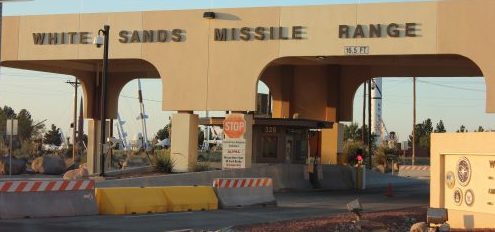
Four schools are scheduled for testing at White Sands Missile Range (WSMR) .  The numbers of schools able to participate in this part of the program this year are significantly down. This is again due to COVID creating learning and participation barriers for students in both the 2020 and 2021 school years. Lack of in class time made it hard for students to finish large projects like these. 

Due to shutdowns for COVID last year, White Sands Missile Range is also backlogged with military contracts that take priority. They are still accommodating our group but our regular range, WC-50 is under heavy contract and will not be available. We will instead be located on a smaller range, ABC-1. This poses several new restrictions for the group.

The first of these is an even more limited number of personnel allowed on the range during set up and launches. ABC-1 is a smaller range than what the group usually uses. It is not equipped with a large bunker like WC-50.  Therefore, only two SystemsGo personnel will stay on the range during each launch. ALL others will be evacuated to Tula G. There will be video and radio communications with the pad available at Tula G. 

A small group of SystemsGo essential people will evacuate to a limit of 5 miles out to expedite turn around between launches.

Because of this change, no non-essential personnel should expect to attend the event. Chaperones should be limited and double as drivers if possible. Along with a smaller launch site, there will not be any public viewing for parents and students at Range Control. WSMR COVID restrictions still do not allow for visitors at Range Control.

The second big change will affect the teams and their rockets. ABC-1 is a much smaller range than is generally used for this event. Because of this, it does not meet the criteria in recovery radius needed for vehicles reaching an altitude of 100,000 feet. Schools are now required to alter their rocket altitude requirements to a lesser height of 50,000 feet. The suggested correction for this is to adapt fuel loads for each vehicle to quell the altitude it can reach.

That sounds simple but adjusting fuel load and altitude also effects things like apogee and recovery deployment just to mention. Students are reminded that adjustments to their altimeters and recovery systems to adapt to the 50,000 ‘ Apogee limit is a necessity.

Part of this program is the challenges and meeting those challenges. It is late in the process, but it will be interesting to see how each team steps up to these new  challenges and overcomes them in the time they still have before arriving for launch at WSMR.

The third change is another location change, this time for the Flight Readiness Reviews (FRR). These are normally conducted on WC-50. ABC-1 cannot accommodate this, so they will be hosted by the Alamogordo High School. Currently this is projected to be in their commons room. These will begin promptly at 7:00 AM, Friday morning, June 25th.  Additional information about this may be available in an update email from Program Director, Rebekah Hyatt, closer to the event.

WSMR has military testing on Friday morning. At its completion, SystemsGo personnel will go down range to ABC-1 to begin set-up for launches.  If Brazoswood and Union Grove are complete at this time they will bring their vehicles and assist in set-up, rail assembly, and will load their rockets onto the rails in preparations of first launch. If not, all remaining schools will wait and come as a group later in the day.

Launches are scheduled for June 26th and June 27th. The team will travel out to WSMR on Wednesday, June 24th, and back home again on either the 27th or the 28th. Hopeful expectations are that all rockets are launch complete on Saturday. Sunday is still open for contingency. There is a probability that WSMR may shift launch days and want testing for SystemsGo to be on Friday and Saturday. If this happens the first two rockets will launch Friday afternoon. This would also move FRR checks up to Thursday afternoon at either the school or the hotel parking lot as is available.

SystemsGo asks that everyone be prepared for any scenario and arrive as early as possible on Thursday so that any changes to the schedule can be accommodated. All paperwork must be turned in on Thursday as well. This includes:

  • UXO briefing registry
  • WSMR waiver
  • SystemsGo waiver

There are four schools scheduled to launch four rockets. These schools in their current projected launch order include:

  • Brazoswood
  • Union Grove
  • Booker T Washington
  • Alamo Heights

This order is based on the random draw and totally contingent on rocket completion and readiness. Otherwise, they will test in order of readiness, first done, first to launch.

Good luck to these students and schools! We will be seeing you very soon in New Mexico!

www.systemsgo.org as always is the place for more information on this program. You may also email them at info@systemsgo.org .Take the time to get your school involved, the future of your students will be greatly benefited.

#Rockets2021 #SystemsGo #RideTheSky #Texasrockettrail #Rockets2021

Goddard Level Rockets Ride The Skies in 17 Days Redbird #20 Among Them

The Goddard level rockets, which are the capstones of the SystemsGo program and the culmination of all the skills the students have learned throughout their years in the STEM program are set to launch June 21-23. This marks the final senior project for the schools that participate in this level of the SystemsGo program.

Redbird #20 is scheduled for testing at White Sands Missile Range (WSMR) Sunday, June 23. This marks the last big event for Rockets 2019 and the Fredericksburg Engineering/Rocket Program.

As of today, May 31, when I was able to get a report on the rocket’s status, from team member, Dawsen Harkins, was in good standing. He reported that as of May 30, the nosecone had been assembled and covered with its first layer of fiberglass.

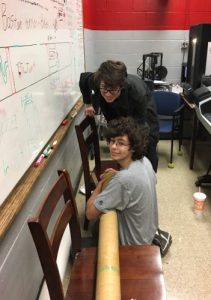
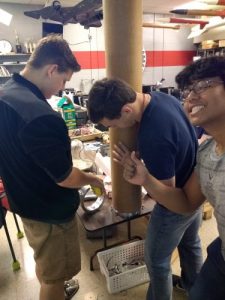
In this photo the nose cone ring is being secured in place, and centered by skewers for fiberglassing.

Although, the tank required 2 trips to SRM to have leaks rewelded, it has now completed its pressure testing successfully. It will be returning to SRM again to have the hatches and holes cut in.

New for this year is a piston valve system. This has also performed well when tested.

This year’s rocket is supporting three payloads. The first came from Harvard University, courtesy of former FHS student, Joseph Sanchez, who attends school there. It is a CubeSat with a pneumatically deployed solar panel.

They second one was created by Keith Jenkins, the FHS IT guy. It is a small electronics bay.

The third the team provided. It is a GoPro camera. It will be positioned behind an acrylic window in the hatch, so that it can look out and video the vehicle’s flight.

According to Harkins, “All components bays have been made and 3D printed and fit perfectly in the rocket.”

The fuel grain is also on the task list. They have assembled the mold for pouring it. One part of the mixture for the fuel grain is still not in but they will be mixing and pouring it as soon as this arrives.

As of this report, supplied last Friday, the following list of things is left and then they are FRR complete.

  1. Complete the fiberglassing of the nose cone.
  2. Make the fuel grain and assemble the motor system.
  3. Assemble the recovery system.
  4. Weld fins to body.
  5. Cut hatches and have holes drilled in the body tube.
  6. Fix minor little things for flight.

The current list of students from this team attending the WSMR launch is as follows:

Rodolfo Avila, Cody Blohm, Gloria Burns, Alexander Casteneda, Lucio Castro Vazquez, Clayton Ellebracht, Jose Escalante, Jabin Gipson, Dawsen Harkins, Cooper McDonald, Eduardo Memije, Bradley Plaza, Joshua Reese-Hadley,  Nicholas Rodriguez, Robert Sanchez, Deja Turkett, Gabriel Voorhees, Carl Wilger, and Robert Zowie.

Currently there is not a team picture available, but here is Nick Rodriguez, Deja Turkett and Dawsen Harkins taking a work break on the stairs at FHS.

Launches are scheduled for June 21st and June 23rd. The team will travel out to WSMR on Wednesday, June 20th, and back home again on the 24th.

There are 7 schools scheduled to launch 8 rockets. These schools include:

  • Alamo Heights
  • Anahuac
  • Booker T. Washington
  • Brazoswood
  • Fredericksburg
  • Marble Falls
  • Union Grove

The current launch schedule is as follows:

  • Thursday, June 2oth
    1. Travel Day
  • Friday, June 21st
    1. Mrorning-T-1/Site Set up WC-50; Afternoon-Launch Union Grove & Alamo Heights ( or whichever rockets are ready)
  • Saturday, June 22rd
    1. Launch Day Two (Four Rockets-Booker T., Anahuac, Marble Falls, & Brazoswood)
  • Sunday, June 23rd
    1. Launch Day Two (Two Rockets-Fredericksburg & Booker T Washington)
  • Monday, June 24th
    1. Travel Day (Could travel home on the 23rd if operations are complete in time.)

This article is for the 2018/2019 school year to update the Fredericksburg Engineering/Rocket program. This school is a participant of the SystemsGo STEM program. This series of articles is intended to support and encourage students in the program as they share their working status and accomplishments throughout the year in the program. These publications will be available for tags and re-posting.

www.systemsgo.org as always is the place for more information on this program. You may also email them at info@systemsgo.org .Take the time to get your school involved, the future of your students will be greatly benefited.

#Rockets2018 #SystemsGo #FredricksburgSTEMAcademy #Launcher01 #RideTheSky #Texasrockettrail


Fredericksburg’s Engineering/Rocket Program-Rockets 2018 Willow City Launch Week Pre-Launch Update

Today is Wednesday, April 25, and the juniors are a day away from testing their vehicle at Stewart’s Hillview Ranch in Willow City at Rockets 2018. They will be launching on Thursday, but the time will be determined on site. Also, this year the larger class volume meant two teams and two rockets.

According to Mr. Matthes, Engineering Instructor, both teams finished both rockets on time this year. They were due by the end of class, last Thursday. Both teams made use of the after school hours requirement in order to finish, with a couple of students stretching that to midnight in order to complete the work.

As of Monday, both vehicles were described as being in good shape by Mr. Matthes, with the only issue still in play, attempting to lighten the weight in order to increase speed.

Aside from that, Mr. Matthes had this to say about the upcoming launch, ” I do not rubber stamp any rocket.  Failure is an option in the program as it is in life.  If the students have a rocket that passes inspection, goes to the pad and gets tested they are successful…but the rocket can still fail.  The existence of uncertainty is partly why the students are so invested in their rocket.  It is because it is their solution without guarantee of meeting the project’s objective.  They’ve poured their hearts into this project for five months and will get to see their ‘babies’ launch, just as parents hope to see the fruits of their parenting, without guarantees of outcome, launch their children into life.  This is an inherent part of research.  Paramount though is the fact that true failure only occurs if the process stops and lessons are not learned in the process.”

He also commented that he had seen GREAT looking rockets fail so he’s reticent about getting the students’ hopes up too much.  And on the flip side, I  have seen some rockets that I thought for sure would fall apart on the way down to the pad, and they amazed us all.

Flight Readiness Reviews(FRRs) were due by the end of class on yesterday, Tuesday. One team completed by the bell, but the other will be capping off at the beginning of class on Wednesday.

 Robert Sanchez and Esten Cooke with their vehicle.

 Pictured here are Ander Castaneda, Dawson Harkins, Cody Blohm, Deja Turkett, Cooper McDonald, Josh Handley, Gloria Burns, and Ethan Scott.

 Team members Robert Sanchez and Gloria Burns.
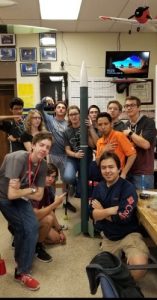
Pictures provided by Katie Burns.

Some juniors and seniors will have an opportunity to work at the launch pads during the event.  This affords them the chance to get experience prepping the rockets for flight and getting closer to the action. This is a privilege typically reserved only for seniors.

Unfortunately I was unable to obtain a picture and Team name from Team 1.

Pictured below is Team 2 with their rocket.

Meusebach (Team 2): Clockwise from #1 at the bottom. Cooper McDonald, Cody Blohm, Ander Castaneda, Deja Turkett, Josh Handley, Gloria Burns, Robert Zowie, Eduardo Memije, Ethan Scott, Dawson Harkins, and Rudy Avila show off their rocket just after completion last Wednesday evening, April 18th.

If you plan to attend any of this year’s launches please register for your attendance ticket at https://www.greateventseats.com/SystemsGo or they may be gotten at the gate. These are free but required for admittance to each site.  Reserving them ahead at the website is preferred to obtaining them at the gate because the latter slows entrance to the site and may result in you missing the viewing of your intended launch.

You may also view any of these launches on Livestream. That link is available on the SystemsGo or at the following link from them: Here is the link to the live stream again. https://livestream.com/systemsgo

The launch schedules for each venue are available at http://www.systemsgo.org/events/ . I will post it here for each launch day as well. I want it to be as accurate as possible so I will refrain from posting schedules until the evening before each launch day in case there are any late changes.

Here is a PDF  map link and Google graphic map link to the site. These links are available on the SystemsGo web site as well.

Please watch the SystemsGo website, SystemsGo Facebook page: https://www.facebook.com/pg/SystemsGoEducation/posts/?ref=notif ,  SystemsGo Twitter feed: https://twitter.com/SystemsGoNews and this blog for upcoming information on these events.

This article is the fifth in a series, new for this school year ’17/’18 of updates that will follow the Fredericksburg STEM Academy/Rocket program. This school is a participant of the SystemsGo STEM program. This series of articles is intended to support, encourage, and challenge students in the program as they share their working status and accomplishments throughout the year in the program. These publications will be available for tags and re-posting.

www.systemsgo.org as always is the place for more information on this program. You may also email them at info@systemsgo.org . Take the time to get your school involved, the future of your students will be greatly benefited.

#RideTheSky #Rockets2018 #SystemsGo #FredricksburgEngineeringRocketProgram #Launcher01

Fredericksburg’s Engineering Rocket Program-Second Term Update #2 (February 16-April 13)

It is April and we have some catching up to do on the  FHS Engineering program. It has been two months since our last update and quite a bit has been happening on all levels.  Along with class work, launches start this month in Jal, New Mexico  on April 21 and Fredericksburg (Willow City) April 26-28 so time is becoming a factor for the Junior and senior groups.  Each group is working hard to meet their timelines. Rockets 2018 is the pinnacle event for the upper level groups, as their rocket projects are basically the final grade for the year.

The seniors have approximately 73 days until Redbird 19 is TENTATIVELY scheduled for testing at White Sands Missile Range, which is usually in the last week of June.  This date is still not a permanent date until the Army finalizes, closer to that time. Mr. Matthes will announce that date when it becomes readily available. Their completion date for  preliminary systems tests is usually two weeks before school ends. This would be May 18 which cuts them down to 59 days.

More on these groups and their current status reports will be later in the article.

Freshman participated in a field trip on March 1st, in which they visited Southwest Research Institute(SwRI), the Center for the Intrepid,  and the UTSA VIZlab.  At the Center for the Intrepid, the students were able to see biomedical equipment at work helping wounded Veterans in their recovery. Along with the engineering aspect of this, Mr. Matthes hoped that they took away a new respect for our military servicemen and women and the full extent of the sacrifices they make each day for our country’s safety.

Former FHS Engineering Alumni, Drake Horstman, was the students’ guide when they visited the UTSA VIZlab, toured the campus, engineering lab and community areas. During the visit, Drake, provided  entertainment and wisdom coupled with numerous stories about his experiences in the FHS Engineering Program. Inside the lab, the students were able to see several visual interaction devices.

At Southwest Research Institute, students learned technical information about engines, modifications and fuel efficiency. The content here was a little over their knowledge base,  and may have overwhelmed the students a little, according to Mr. Matthes. In spite of that, it was still a good visit for the students, and the coordinator at SwRI commented  about their behavior stating, “they are better than a lot of the college students who come through.”

These visits are designed to expose the students to different aspects in the engineering fields. The impressions they take from here will help them make decisions down the road on whether engineering is for them, and if so, help them determine a particular area of interest.

The Freshmen also participated in their first Critical Design Review (CDR). They were tasked with presenting solutions to fix the damaged launch tower for the Red Bird rockets. This gives them practice on presentation skills and feedback on designs for their project.

Mr. Matthes stated that, “the students may have felt “roasted” with constructive criticism and feedback. But, that they should know, that it is part of improvement and growth of design and not personal.” He mentioned that this was also discussed briefly at the end of the trip to SwRI, by the hosting engineer.

The sophomores have advanced well in the curriculum and are presently several weeks ahead of their  current deadlines. Their current focus is on dimensioning objects, denoting measurements and creating fabrication notes. Due to this, their proficiency has advanced well.

Mr. Matthes is quite impressed with the Juniors selection of a class name. Here is how he describes it,”The juniors named their class “Conatus” which translates from Latin, to impulse and means striving.  From a historical philosophy origin it relates to the nature of something to continue its existence.”

The pressure is on with an April 19th rocket completion date looming ever closer. The rocket must be completed one week prior to their April 26th launch, because after it is completed they must also complete a Flight Readiness Review which often uncovers errors and problems that must be resolved.  This week provides adequate time for those things to happen.

According to Mr. Matthes neither team has anything that quite resembles a rocket as of yet, but each is working through a pile of parts that arrived. Most were not ordered until the end of March which was quite late, but each group began working with tangible parts  the end of last week.

Team #2 decided to make use of Monday’s teacher in-service day, by putting in about four hours of work. Shown below from team #2 are clockwise starting from the bottom, Cooper McDonald, Gloria Burns, Ethan Scott, and Dawson Harkins as they take measurements off the back-end of the rocket and motor system.

Both teams do have a work in progress at this point.  According to Mr. Matthes, “Pressure makes diamonds and rockets.”

Incidentally, another incentive for each comes from SystemsGo. A flawless flight and perfect recovery may afford that team the chance to re-fly their vehicle with a different fuel grain in order to collect data for SystemsGo.

The miniature Teststand is an ongoing project for the juniors as well. They are using LabVIEW programming as a means to start ignition and measure thrust, as well as using 3D modeling in order to develop a unique physical Teststand model. The class is split into working groups of 3. According to Mr. Matthes, “They are on track to have this done by the end of school and I am excited to see what they come up with.”

Seniors are progressing well with Redbird 19, wind tunnel and the large Teststand development.

Construction is beginning on Redbird 19 now that parts are returning from Heartland Enterprises. According to Mr. Matthes the parts, “look beautiful, and most parts are in.” Now that parts are available there is a bullet list of accomplishments to be achieved including, overlaying the nose cone in fiberglass, creating a mold and then pouring the fuel grain, making a custom hose for the injection valve, testing  recovery chute deployment, integrating avionics into the vehicle, and Mr. Jenkins is in the process of manufacturing the payload.

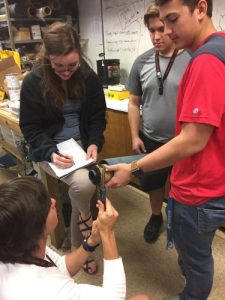
Here Harrison Spisak, Bryce Erwin, and Sergio Walle are checking the fit of the injector, nozzle and retaining ring in their fuel grain liner.

Currently wind tunnel is well underway, as students are receiving and ordering parts. The program is nearing completion and the electronics used for the drag testing measurement has arrived. Hunter Smith, a SpaceX programmer at the McGregor facility has been assisting Rebecca Sechrist through a Skype session. He has been providing analysis and comprehension in areas he has already assisted, as well as a starting point from which to move ahead. According to Mr. Matthes, “The students are making headway but must begin to make a push in order to finish this outstanding design by summer.”

Deadlines are quickly evolving for Teststand, as the group’s progress here is steady but slow. They have installed a flow meter to directly measure Nitrous oxide. Load cells which measure thrust have been changed out and fuel grains have also been readied for testing.

The stand itself is nearing a test ready state. New to this year’s stand are changes in the injection system. The new system will allow more controls of the flow. A parent plate has been designed by students and fabricated by another local machine shop, Kager Industries,  which will hold a smaller injection disc allowing students the ability to change out the disc which controls the rate of flow. The plate can be installed as soon as the 0.05″ holes have been drilled through. Next, the LabVIEW program will be fully tested on the stand.  Afterwards, a cold flow test will be conducted in order to measure the oxidizer flow rate and determine if the size and pattern of holes in the new disc are correct. If the cold flow tests are successful, then hot fire tests can begin.

The Baby Bird Teststand is still on hold until further notice.

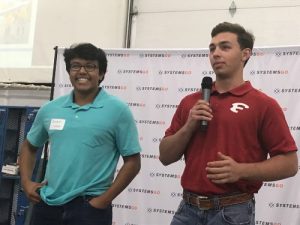
SystemsGo hosted a BBQ dinner event for the neighbors in Willow City. Seniors, Bryce Erwin and Sergio Walle, pictured below,  spoke at the event. Their purpose was to educate attendees about the educational process of the program and how it relates to the upcoming launches, as well as to share their own experiences in the program.

Additionally, Harrison Spisak and Corbin Smajstrala spoke to the Morning Rotary last month on similar subjects.

Mr. Matthes would personally like to thank all four of these young men for committing to these events and participating in them. In both cases, participants and SystmesGo staff commended them on their exceptional performances.

This article is the fourth for the 2017/2018 school year in a series of periodic updates that will follow the Fredericksburg Engineering/Rocket program. This school is a participant of the SystemsGo STEM program. This series of articles is intended to support and encourage students in the program as they share their working status and accomplishments throughout the year in the program. These publications will be available for tags and re-posting.

www.systemsgo.org as always is the place for more information on this program. You may also email them at info@systemsgo.org . Take the time to get your school involved, the future of your students will be greatly benefited.

2017/2018 Fredericksburg’s Engineering/Rocket Program-October/Early November Hi Lights

September  and October have come and gone and  we are now half way through November and the Fredericksburg High School Engineering Program is deep into their studies busy learning and working at all levels. Eight weeks have passed since our first Engineering Program update and the first semester is halfway through.
Since our last update, the Freshmen have created an electrical design for the NASA built and designed Orion space capsule. Keith Kunz from Teledyne was their audience for this presentation.  Teledyne works with offshore oil exploration developing and designing hard and software for their use.  As an audience for these presentations, individuals like Mr. Kunz, provide constructive criticism such as design strengths and weaknesses, areas that did not match the design logic, things that were overlooked, and skills of presentation.
Currently the Freshman are working on a bio-engineering project, which will be designed to help student, Cody Bearden, who has Spinal Muscular Atrophy, which keeps him confined to a wheelchair. It will be a hoverchair.   Yesterday they presented their project to a new audience, consisting of Tim Nolan, an  AirEvac pilot and previous Marin Corps helicopter pilot, Todd Keener a mechanical engineer, and Scott Netherland, Executive Director of SystemsGo .  Details on this presentation will be forthcoming in our next update.
Sophomore students are still working at their own pace in this year’s class. Due to this,  the further along the year rolls, the larger the gap is between the slowest and fastest student. Because of this some are already starting to learn Isometrics, which are 2D representations of 3D objects. The class as a whole is also studying Dimensioning.
“They are all making good progress, but having them self pace has led to some really taking off with AutoCAD,” states Mr. Matthes.
The Engineering program flew in Brian Evans from Space Propulsion Group out of Butte, Montana to conduct a two-day seminar for the Juniors and Seniors.
Pictured here are Juniors, Gloria Burns, Cooper McDonald and Eston Cooke with Mr. Evans: 
According to Mr. Matthes, “Students really enjoyed having insight from Mr. Evans.”
For the past two months, the Juniors have been learning new skills on Excel which allowed them to better understand the math of starting a new model. They have been creating spreadsheets for a hypothetical bakery where they used calculation, look ups and other functions in order to track materials, hours, and productivity.  Class time has been split between this project and the physics of flight.
Three weeks earlier, the class flew their Generation 1 rockets.  The parameters for this first flight, were just have a rocket on the pad to fly and served as a platform for them to learn and start asking questions on how to correct their flights.
These flights were of varying degrees of stability with some being completely unstable, some having a corkscrew affect and others displaying very straight flights. The instruction on stability follows this flight test and leads into the Generation 2 tests.
Last week Generation 2 rockets were finally launched.  They had been patiently waiting due to several scheduling conflicts with school college fair days and bad weather, windy days.
For this test they actually had to prove the stability of their rockets. This is accomplished by literally cutting the rockets in half.  Students are forced to be intentional about stabilizing their vehicles. The pictures below are from the Generation 2 flights.
Here, Eduardo Memije and Gloria Burns load their G1 Rocket for launching.
In this photo, Deja Turkett and Bradley Plaza take their turn for launch.
Here the whole Junior class group displays their rockets on launch day.
Currently they are splitting their class time between LabVIEW Programming which they have just begun and the continued study of the physics of flight. Next they will be studying fluids, aerodynamics and drag, and impulse, as well as factors affecting drag, this is all part of prepping for Generation 3 rockets.
According to Mr. Matthes, “Their next objective is to reach 1800 feet using RockSim to design the rockets.  They are assessed on the closeness of construction to design:  it is a tough mark to make without extreme precision.”
On Tuesday, Nov. 7, the Seniors traveled to Houston. After arrival, the group spent four hours at Space Center Houston. According to Mr. Matthes, the students, “had a blast!”

In this mock up, Evan Knapp mounts the Space Shuttle on top of the 747 that transports the shuttle back to Kennedy Space Center.
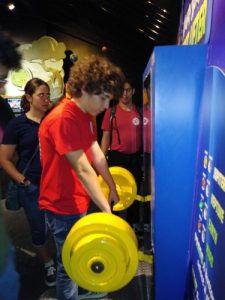
Corbin Smajstrla is seen here pumping iron on different planets where the gravity is not the same.
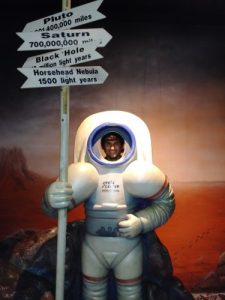
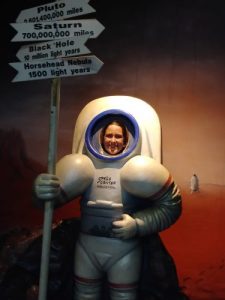
Chris Calzada (left) and Rebecca Sechrist (below) pose for pictures in space.
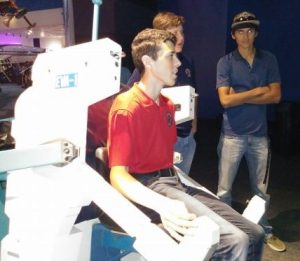
Evan Knapp maneuvers his EVA device back to the ISS as Chris Calzada and Harrison Spisak look on.

 Next the group visited Rocket Park so that the students could get a visual grasp on the enormity of the Saturn V Rocket that took men to the moon and back.
 Relaxing at the end of the day beneath the Apollo capsule on the Saturn V.
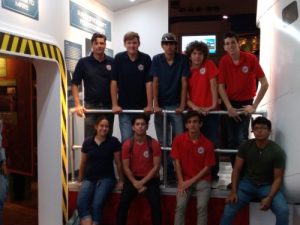
The entire travelling crew. Top row: Instructor Andrew Matthes, Harrison Spisak, Chris Calzada, Corbin Smajstrla, and Evan Knapp. Bottom row: Rebecca Sechrist, Pierce Vasquez, Joey Leal, and Sergio Walle.

Later, Joyce Abbey, the voice of the SystemsGo launches, and Dave Ladrack, a longtime program friend and supporter, joined the students for dinner.
On Wednesday, Nov. 8, they arrived at Johnson Space Center along with nine other schools and met, Chris Madsen, pictured below, a Guidance, Navigation and Control (GNC) engineer in the flight dynamics department.
Mr. Madsen coordinated and oversaw the program for the students, and gave an overview of College Co-op opportunities. He encouraged the students to be involved and to acquire work experience while still in college.  All nine schools gave presentations of their flight models explaining the projected flights of their rockets to engineers and representatives from other schools who have also taken on a similar tasks.
After lunch the documentation students need in order to be cleared for flight at White Sand next summer, was discussed. Mr. Madsen used examples and an overview of his job in comparison so that students could see that what he does is similarly an extremely more complex version of what the students are building.
 Later that afternoon, FHS had a meeting to present preliminary design reviews of both the wind tunnel project and Redbird #19 to five engineers. This was  three hours of presentation and a question and answer session.
“It was a tremendous opportunity for the students and the feedback was excellent,” reported Mr. Matthes. “The trip was a success.”
Design progress has been made on Redbird #19 but many details still have to be worked out before it can be considered an integrated system.
Mr. Matthes feels that, “The input from this trip will be significantly helpful for drawing both flaws and considerations to light as they proceed forward. “
 The group has been working hard to pull together everything for the Redbird #19 presentation, this has made it necessary to put Teststand on hold for the past week.
Something new the Engineering Program is working on, is the N.E.W. Y.O.U. Event, short for National Engineers Week Youth Outreach United. This will be the first time the FHS Engineering Program will be hosting this event. The purpose of this event, is to expose students from 4th through 8th graders to engineering. They will participate in activities and interact with high school engineering students while learning in a fun and relaxed environment.
FHS Engineering Program has already been readying for the event with two separate planning meetings involving about 20 students in order to organize and divide tasks. Everything is moving along well and they anticipate a great event.
National Engineers Week will begin February 18th. The N.E.W.Y.O.U Event will be held the day before on Saturday, February 17th.  Forth through sixth graders will attend the morning session, and seventh and eighth graders will attend the afternoon/evening session.
This article is the second for the 2017/2018 school year in a series of monthly updates that will follow the Fredericksburg Engineering/Rocket program. This school is a participant of the SystemsGo STEM program. This series of articles is intended to support and encourage students in the program as they share their working status and accomplishments throughout the year in the program. These publications will be available for tags and re-posting.

www.systemsgo.org as always is the place for more information on this program. You may also email them at info@systemsgo.org . Take the time to get your school involved, the future of your students will be greatly benefited.