Goddard Teacher Training Day 3

Today’s lesson was concerning the Anatomy of a Rocket. Quite honestly this was not a good class to come into the middle of and expect to keep up.

The best example I can give of how this went is as follows. My family often plays a game at holidays, we call “Pass Around Pictionary.” To sum it up, each person has a piece of paper on which they draw a picture, then fold the paper to hide the picture, and then they pass it to the next person to describe the picture in words. This process continues going back and forth from picture to words each time the paper is passed, and each person can only see what the person before them drew or wrote and must describe using the opposite action.

Now fast forward to today. I walk into a high level rocket training class just as the main lecture on how to design these vehicles has ended, and a student/teacher is selected to go to the board and draw/design a rocket with the help of his classmates. Not only are they drawing this vehicle as they go along, they are problem solving, designing, discussing parameters and components, and redrawing as the thought process changes and develops.

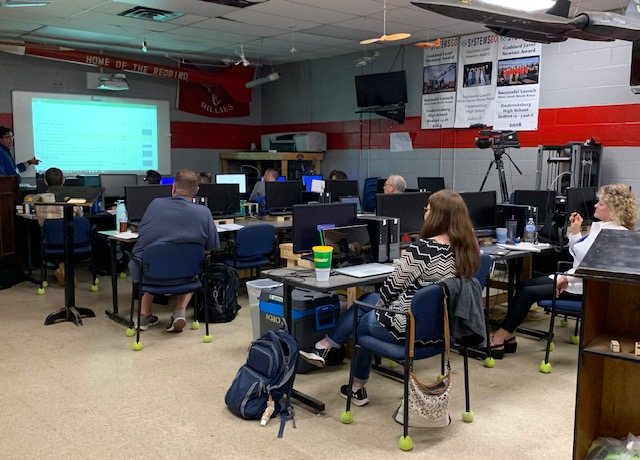
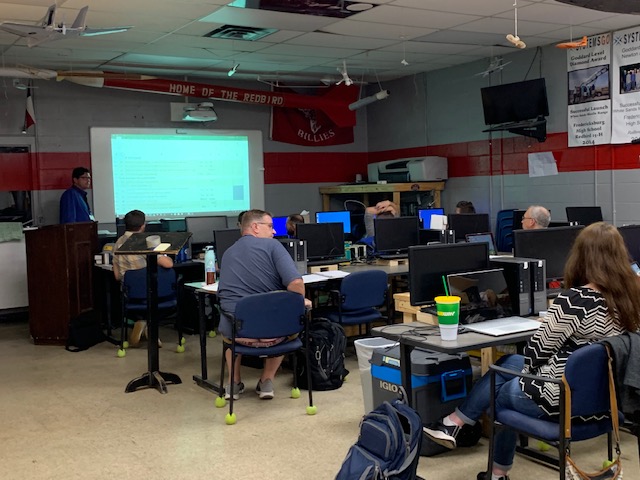
Here Conner Gorman from BCTAL steps up to the screen, at Mr. Matthes’ prodding for a volunteer, and Rhonda Baker, suggests that it is someone else’s time as she has already done board time earlier in the day.

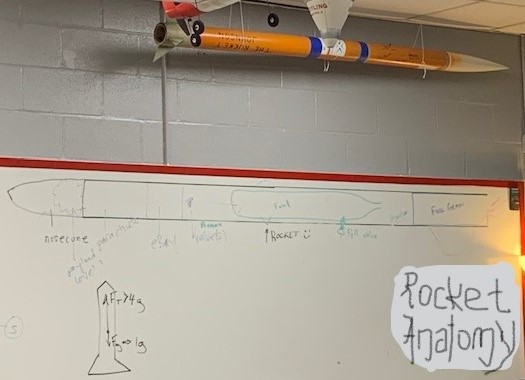
The drawing began simple enough so I tried to draw my own copy picture as they went along. Their board allowed for erasing and changing as they went along. I brought a notebook and an INK pen to class today. It worked well the last two days, but failed me miserably today. I finally gave up on trying to complete the drawing, and went to listing components that I knew were part of a rocket. Needless to say I went from drawing to writing, watching as their diagram continued to evolve.

Incidentally, here is what my drawing and notes looked like.

You engineers, teachers and people who really know all this stuff, you can stop laughing now.

This too had it’s downfalls, because even though I know a lot of the pieces that go into a rocket, it is mostly the big stuff, like nose cone, tank, fins and fuel grain, and some of the tiny things like O-rings, valves, nuts, bolts, etc.

We were now discussing all the large, small, tiny, unknown and very necessary items. Several factors that effect each of them, their sizes, configurations, placement possibilities, etc. Not to mention the abbreviations, acronyms, and formulas that were being used as descriptors. I definitely need to take this class from beginning to end!!!

Here, Mr. Gorman almost appears to look like I felt. Although for him, it was probably just a thinking process moment.

One thing is for sure, these teachers were being held to the same standard or higher that the high school students in the program are and they were having to perform, just as they will be directing their future students to do. They were designing and developing a diagram of a rocket that they could look back on later as a working example. Each one was analyzing the possibilities and determining the best, what kind, why that one, and how of it all.

They were thinking through things like injector ports, vents, nozzles, electronics bays and their placements on the vehicles and determining if the design was good. Contemplating if they might need to reach that component later and how they would?

The drawing developed, morphed, changed and was redrawn as questions were put forth and answered. It was amazing to be a part of, but nearly impossible to take notes on and keep track.

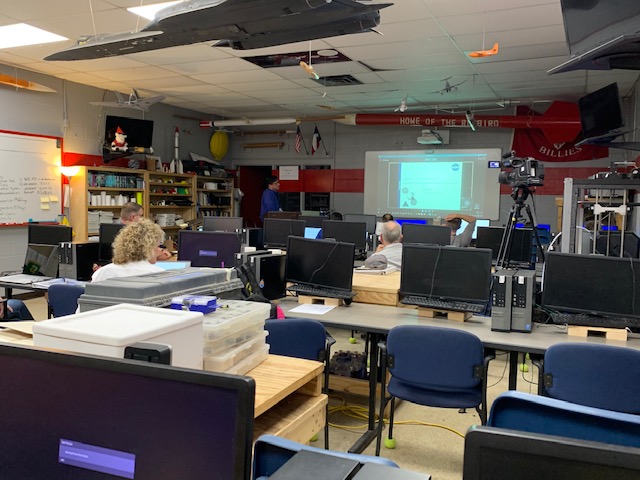
Even these pictures really do not do the material or the participation of the working minds, justice. I cannot wait to see where they are tomorrow! Here are two more that were part of their discussion. I will let you fill in the captions for these.
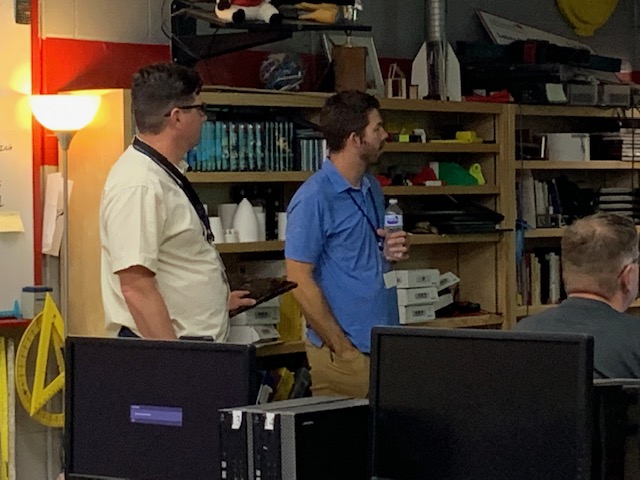
We did have a few new faces today. SystemsGo Executive Director, Scott Netherland; Board President, Doug Kimbrell; and past graduate of the program, Robert Sanchez were all in attendance. At the time that I was there, Scott and Doug were observing. Robert said he was fixing one of the school’s 3D printers so that he could use it to fix the other 3D printer.

Until tomorrow, if you are not dreaming of designing, building, launching and chasing rockets, you obviously have not hung out with this crew enough!

www.systemsgo.org as always is the place for more information on this program. You may also email them at info@systemsgo.org .Take the time to get your school involved, the future of your students will be greatly benefited.

#RideTheSky! #Rockets2022 RocketSeason!

Goddard Teacher Training Day 2

Teachers and others in the program probably already know this, but it was news to me. That was either because I have just missed it in conversation before today, or the fact just never came up. Maybe I should have known, but then I am not a teacher, just a crazy, addicted volunteer that loves and supports the program. The technical term is Rocket Junky! What didn’t I know, well the fact that they only do the Goddard level training every four years!!!!!

Doug Underwood, actually gave me that piece of information today. He is seen here with his materials laid out as the lecture resumes after their lunch break.

Not all schools participate in this level of the program. One reason is because these vehicles are expensive to build. It also requires extra travel for the students and schools, and the only window for launch is a month after the students have graduated and school has dismissed. Most schools stay at the Tsiolkovsky and Oberth levels. Therefore training every year is not always necessary or cost effective. That is my take on the why. Of course, SystemsGo may have more specific reasons for their why.

Either way, at first I was stunned and wondered, how can that be? But, knowing just what I do know, taking the things I have mentioned into account and the fact that not every school that does the Goddard program comes to WSMR to launch every year, it could be made sense of rather quickly.

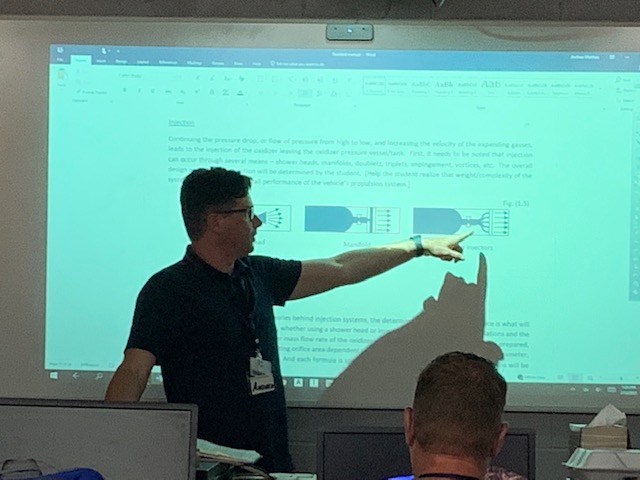
Today the Goddard class was training on Propulsion. Engineering teacher, Andrew Matthes was manning the presentations, leading the discussions and taking questions again.

Here are a few things I heard in my 30 minutes in class today. Do not expect these session to be perfect and totally technically on because, I am not an engineer, though if I could go back and do this stuff I would. I am just a writer and volunteer for the program that loves to soak up all that I can like a sponge and throw it out there for the many more rocket junkies like me, including other students, teachers, rocket followers, etc. so that we may all have a piece of the action and involvement. First and foremost I love to bring more light to the program in any way I can. And have some fun with all I see, hear and learn.

That being said, here is my bit of today’s lessons. There was much discussion about the fuel grain and how it reacts with Nitrous and Oxygen. Specifically how the vapor off the surface of the fuel grain burns with the oxidizer to create combustion. Hot expanding gasses were a topic at this point, which brought forth a quote about hot gasses from the movie, October Sky!

I tried to locate the exact quote, and it did speak about the necessity of the nozzle in the design and how it directs the flow of hot gasses. Of course the comments in the movie went south after hot gasses.

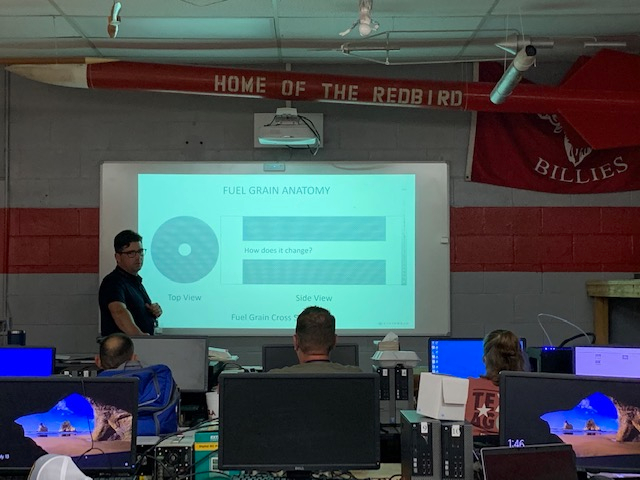
The class went on to discuss fuel grain flow designs. The first of which is pictured here:

This lead to discussions about expansion within the fuel grain, as well as pressure changes, flow rate changes and various other effects as it burns. One such example that is likely with a single port is that the port gets larger as it burns. This changes the Mass Flow Rate also causing the DOF to get larger.

Another comment mentioned was that with only one port, the expansion creates two separate sides to the fuel grain, kind of like two separate pieces of wood burning, which also changes the potential of the propulsion.

According to some in the class, “Two sticks burn better than one!” Chris McLeod, said that I definitely needed to include that comment in today’s blog, so there you have it.

The anatomy of fuel grains and what works well and does not,

as well as nozzle designs were also touched on while I was present, as seen in the pictures shown above and below.

At the beginning of class the internet was down. Apparently it is an intermittent problem. Mr. Matthes made a call and it restored quickly. Jerry, the FISD, IT guy stopped by to check. He said the server had actual gone off momentarily. Some of you might remember him from Willow City a few years back. He brought his drones out to help aide recovery.

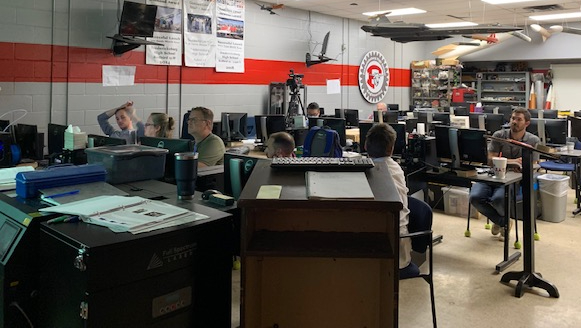
Yesterday, someone commented that they wanted to see who else was in attendance besides, Chris McLeod, so here maybe you can make out a few more people. Rhonda Baker is one you might know.

SystemsGo Program Director, Rebekah Hyatt was there when I first arrived, but left quickly to address some issues back at the office.

The same seven teachers were present for training again today. As previously noted they are from Birdville Career and Tech Center, RL Turner, Union Grove, Brazoswood, Booker T Washington, and Jal High Schools.

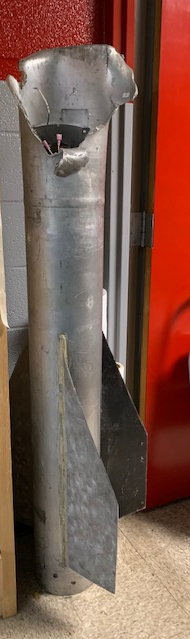
Today, most of the photos are already included, but I thought this one could be of some interest since the discussion is Goddard rockets. It is the aft end of an old Goddard vehicle. Not a clue if it belongs to a FHS Red Bird or some other school, but it is a prime example of how success often comes to you in pieces.

IMG_6753

Until tomorrow, if you are not dreaming of rockets, you obviously have not hung out with this crew enough!

www.systemsgo.org as always is the place for more information on this program. You may also email them at info@systemsgo.org .Take the time to get your school involved, the future of your students will be greatly benefited.

#RideTheSky! #Rockets2022 RocketSeason!

Goddard Teacher Training Day 1

Goddard training began today with FHS Engineer teacher, Andrew Matthes directing the class.

SystemsGo Program Director, Rebekah Hyatt, sitting in the back where she was able to add in information or examples as needed. SystemsGo Regional Director, Doug Underwood was also in attendance.

Seven teachers were present for training. Most were from schools around Texas including Birdville Career and Tech Center, RL Turner, Union Grove, Brazoswood, and Booker T Washington High Schools, and one from Jal High School in New Mexico.

I watched and listen for about 40 minutes today, during which, Chris Madsen, NASA JSC, Orion Entry GN&C Systems Manager skyped in to present The SystemsGo Goddard 6-DOF Inputs session of the training.

As I listened to discussions including center of mass, Roll, Yall and Pitch, metric and standard measurement uses, weight balance across the vehicle, just to mention a small fraction of the information being presented, I was really wishing I had brought a folder for notes and not just a camera. I definitely wish I could have stayed for the full presentation as this program and all they do, never ceases to amaze and fascinate me.

Here are a few more pics. Not too much different, but I will check in on them again tomorrow to see if there is more of interest to report.

IMG_6740 IMG_6733

www.systemsgo.org as always is the place for more information on this program. You may also email them at info@systemsgo.org .Take the time to get your school involved, the future of your students will be greatly benefited.

#RideTheSky! #Rockets2022 RocketSeason!

Rockets 2022-Begins With Teacher Training

Rockets 2021 has barely ended as the Team and students returned home from launches at White Sands Missile Range in New Mexico, on June 27th, and July already starts a new year.

Rockets 2022 begins with SystemsGo Teacher Training for the 2021/2022 school year.  22 Schools from Texas, New Mexico, and Colorado will be participating in training on all levels of the program at locations in both Texas and New Mexico.

July 12-16 kicks off these educational events at the Goddard level. FHS Program teacher, Andrew Matthes, will conduct this event in the Fredericksburg High School Engineering Department classroom.


Five teachers from Texas high schools, including Birdville Career and Tech Center, RL Turner, Union Grove, Brazoswood, and Booker T Washington High Schools, and one from Jal High School in New Mexico will attend and secure certification to teach the curriculum at their respective schools this fall. This first week of training encompasses the senior level rockets which launch at White Sands Missile Range. It is the final and highest level of the program. These vehicles are designed to reach 50,000 feet.

July 19-23, four schools will train on the Tsiolkovsky level at Artesia Administration Building in Artesia, New Mexico. Canon City High School from Colorado, and Logan, Elida, and Animas High Schools all from New Mexico will all train with Program Director, Rebekah Hyatt.  These classes are designed for Sophomore, Junior and Senior grade students whose projects are generally one pound/one mile rockets for launch at one of the spring launches.

The following weekend, July 24-25, two teachers will train on the Oberth level also at the Artesia Administration Building in Artesia, New Mexico. One is from the West Texas school of Fabens and the other from Canon City in Colorado.  Regional Coordinator, Doug Underwood, will conduct these trainings. July 31- August 1 he will be in Fredericksburg training Texas teachers on this same level.  Hollenstein, Georgetown and McGregor High Schools will be in attendance in Fredericksburg.  This level teaches students in the Junior and Senior years on the Transonic rockets, which are designed to break the speed of sound.

The next week will be back at Fredericksburg High School, where Program Director, Rebekah Hyatt continues training teachers on the Tsiolkovsky level of rockets. The Texas schools of Summer Creek, Hollenstein, Friendswood, Atascocita, Galena Park, Georgetown, and McGregor will attend this session in Fredericksburg.

The first week in August, PD Hyatt will also be conducting webinars for teachers needing the Intro to Engineering training. These teachers generally work with eighth and ninth graders just starting in the program, which teaches the Research Design and Development Loop as well as the history and basics of rocketry. These are two hour working web trainings that are scheduled as needed. Currently there is only one on Wednesday, August 4th, but a second may be added later.

Covid caused many schools and teachers to drop the program last year. Fortunately, many are returning this year and at least five new schools have been added. SystemsGo is glad to see this uptick in the program.

The more schools and teachers mean many more students involved, and with that many more potential career paths in the STEM fields.

www.systemsgo.org as always is the place for more information on this program. You may also email them at info@systemsgo.org .Take the time to get your school involved, the future of your students will be greatly benefited.

#RideTheSky! #Rockets2022 RocketSeason!

Rockets 2021 Continues Today in Jal, New Mexico!!!

The Rockets 2021 season transitioned to New Mexico this week after three weekends on the Texas Rocket Trail.  New Mexico launches are the fourth for the Tsiolkovsky and Oberth levels.

The current rosters list 8 schools participating in the Jal, New Mexico launch,  where they will be testing 16 rockets. This is the fourth active year for this venue.

Their numbers in both schools and rockets are down in New Mexico since the 2019 season, just as they were in Texas, due to schools navigating COVID parameters.

SystemsGo New Mexico does have a twitter feed  in order to follow the launches. The link is still live, but right now there are no current tweets.  That link is https://twitter.com/SystemsGoNM

All sites are closed to public viewing of launches this year.  However, the launches will se broadcast on Livestream here: https://www.youtube.com/watch?v=SG5OUV944GQ

The  launch dates, locations, and schools are also listed here for your convenience or can be found at http://www.systemsgo.org/events/ .

Jal, New Mexico:

  • Tuesday, May  11 – Thursday, May 13
  • Returning to the launch site on Phillips Hill Road near Jal.
  • Schools participating: Fort Sumner HS, Grady HS, Hagerman HS, Jal HS, Lovington HS, Alamogordo HS, Dora HS, Portales HS
  • 16 expected rockets for testing
  • Tuesday, May 11, 2021
  • 7:00 a.m. to 10:00 a.m. at Jal High School
  • 10:00 a.m. to 1:00 p.m. at Alamogordo High School
  • 1:00 p.m. to 4:00 p.m. at Dora High School
  • Wednesday, May 12th, 2021
  • 7:00 a.m. to 10:00 a.m. at Lovington High School
  • 10:00 a.m. to 1:00 p.m. at Ft. Sumner High School
  • 1:00 p.m. to 4:00 p.m. at Portales High School
  • Thursday, May 13th, 2021
  • 8:00 a.m. to 11:00 a.m. at Hagerman High School
  • 11:00 a.m. to 2:00 p.m. at Grady High School

The sites will be open for admittance at 6:00 a.m. and launches will commence there after.

I am not sure exactly how the time frame on these launches will actually work. The block form of the schedule is a little different than the Texas schedules were. I know in Texas it depended on which schools’ rockets made it through Stages 1, 2, and 3 as to when and what order they launched.  In Jal they have a block 3 hour time frame for each school. I don’t really know how all the Stages factor in so it should be interesting to watch how the launches progress through the day.

Of course rockets are subject to winds, weather and workmanship, all of which can stall a launch. Come join in the action and cheer on these students on the Livsestream. Even though spectators and family cannot be there in person, just knowing you are watching them and cheering them on will boost their morale and bolster their success for their vehicles launch. Besides then you still get to see the look on your students’ faces when their vehicle goes up and then is recovered. That alone, is from priceless.

A live feed for the Jal, New Mexico, launches will be provided at www.systemsgo.org .

The senior groups are tentatively scheduled to launch their Goddard level rockets at White Sands Missile Range (WSMR) in New Mexico in late June. Right now these are still very tentative.  News on this may be available in the next few weeks.  These are not available for public viewing or Livestream due to being tested on a military facility, but blog and SystemsGo updates will be posted online as available during that week.

Please watch the SystemsGo website, SystemsGo Facebook page,  SystemsGo Twitter feed: https://twitter.com/SystemsGoNews  for upcoming information on theses events.

www.systemsgo.org as always is the place for more information on this program. You may also email them at info@systemsgo.org . Take the time to get your school involved, the future of your students will be greatly benefited.

Hope to see you at the launches! #RideTheSkies #texasrockettrail #Rockets2021 #EyesontheSkies

Rockets 2019 Season Boasts a Successful Start at Jal, New Mexico Last Week!!!

The Rockets 2019 Season kicked off last week with a thrilling launch series in Jal, New Mexico. According to reports from SystemsGo Program Director, Rebekah Hyatt and SystemsGo New Mexico head, Dave willden, 32 rockets sailed the skies over New Mexico, successfully.

“It was an exciting start to the SystemsGo Rockets 2019 season!” -Rebekah Hyatt.

Many volunteers joined Willden and his staff, Kelley Alsup, Naira Mendoza and Christine Hendershot –  of the PVREC #8  to coordinate and carry out this outstanding event.

Superintendent, Brian Snider, and Pricipal, Elaine O’Neal graciously loaned the use of their schools for Stage 1 and 2, to which SystemsGo would like to extend a special thanks.

SystemsGo New Mexico is continuing to grow, so keep your “Eyes to the Skies” for next year’s rocket event.

Later in the summer, eight Texas schools are currently on the roster to attempt a possible 10 rockets at White Sands Missile Range ,   also in New Mexico, completing the Rockets 2019 season.

If you follow this program Rockets 2019  will continue with three  more launches in April and May. Next the brand new site in Jack County in North Texas will be the place to be. Followed by the Central Texas/Fredericksburg launch which will be at the Sammy Segner Ranch in Stonewall, Texas.  And last of the junior level launches will be held in Smith Point just south of Anahuac, Texas.

A live feed for each of these three launches will be available at www.systemsgo.org as each launch date arrives.

More event details will be available here in upcoming days as events get closer. Daily reports featuring schedule links, school names, results, pictures and some editorial content will be posted during the events if information is available.

Please watch the SystemsGo website, SystemsGo Facebook page,  SystemsGo Twitter feed: https://twitter.com/SystemsGoNews and this blog for upcoming information on theses events.

www.systemsgo.org as always is the place for more information on this program. You may also email them at info@systemsgo.org . Take the time to get your school involved, the future of your students will be greatly benefited.

Hope to see you at the launches! #RideThe Skies!


Rockets 2019 Blasts Off 5 Times this Season, Begining at Jal, New Mexico Next Week!!!

The  2019 Rocket season is boasting five launches this year! The SystemsGo program added a brand new venue in North Texas as well as a new location for the original Central Texas launch, making three Texas launches and one New Mexico launch for the Tsiolkovsky and Oberth levels. The fifth and final launch for the season is the Goddard level at White Sands Missile Range, in New Mexico.

The current rosters list 13 schools participating in the Jal, New Mexico launch,  where they will be testing 33 rockets. This is the third year for this venue and already they are outfitted with their own staff and volunteers. Fredericksburg Program Staff will still be there to help and oversee operations. Their numbers in both schools and rockets has greatly increased since their first season. They began with 6 schools and 10 rockets, only testing Tsiolkovsky vehicles. Now they test both Tsiolkovsky and Oberth level vehicles, and  have doubled the amount of participating schools and more than tripled the rocket numbers.

With 13 schools launching in Jal, and a total of 51 schools in the three Texas launches, that brings the grand total of schools to 64. Add testing 145 rockets at the Texas launches to Jal’s 33 and 178 rockets will #RideTheSkies for this 2019 Rocket season.

Later in the summer, eight Texas schools are currently on the roster to attempt a possible 10 rockets at White Sands Missile Range in New Mexico, completing the fifth launch and finalizing the season.

SystemsGo New Mexico does have a twitter feed  in order to follow the launches. The link is still live, but right now there are no current tweets.  That link is https://twitter.com/SystemsGoNM

All sites will be open to public viewing of launches except White Sands Missile Range. However, if you plan to attend any of these launches please register for your attendance ticket ahead of time or obtain them at the gate. These are free but required for admittance to each site as they also include a waiver for access to the site.  Reserving them ahead at the website is preferred to obtaining them at the gate because the latter slows entrance to the site and may result in you missing the viewing of your intended launch.

The  launch dates, locations, map links, ticket links, and schools are also listed here for your convenience or can be found at http://www.systemsgo.org/events/ .

Jal, New Mexico:

North Texas/Jack County:

  • Friday, April 26-Saturday, April 27
  • New Launch Site: FM 2210 W and Gowan Ranch Lane, Jacksboro, TX 76458
    Stage 1 & 2 at Perrin VFD: 2210 W Hackley Street, Perrin, TX 76486
  • https://www.greateventseats.com/NthTexas
  • North Texas-Jack County 2019 Flight Schedule
  • Map to Sites (PDF)
  • Schools participating: Buinger CTE Academy, Carroll HS, Henrietta HS, Hollenstein CTC, Scurry-Rosser HS, University HS, Birdville CTAL, Grapevine HS, Maypearl HS, Northwest HS, Petrolia HS, RL Turner HS
  • 39 expected rockets for testing

Central Texas/Stonewall:

Southeast Texas/Smith Point

The sites will be open for admittance at 8:00 a.m. and launches will commence at 8:30 a.m.  Of course rockets are subject to winds, weather and workmanship, all of which can stall a launch. Come join in the action and cheer on these students. Admission is free, but the look on your students’ faces when their vehicle goes up and then is recovered, is far from priceless.

If you follow this program and like to view the launches, Rockets 2019  will continue with three  more launches in April and May. Next the brand new site in Jack County in North Texas will be the place to be. The launch site is in Jacksboro while Stages 1 and 2 are at the Fire Department in nearby Perrin. Patience may be in order if you are watching here, since occasionally  there can be small kinks to work out at a new location. Of course as those of you know that have watched before, patience is a normal requirement with test vehicles.  39 rockets will be tested by 12 schools at this new site this year.

The Central Texas/Fredericksburg launch site  will be third in the line up this year. It has moved from Willow City to the Sammy Segner Ranch in Stonewall, Texas.  Stages 1 and 2 will be at the Stonewall Chamber of Commerce building.  This is a new location for this launch as well, but hopefully it will continue to run smoothly (as smooth as this kind of thing does anyway) since it is the same basic crew and volunteers, with a few new volunteers too, but just in a new place.  This testing site covers mostly the Fredericksburg and Hill Country area schools. Currently there are 49 rockets scheduled for launch by 22 schools at this location.

The last of the junior level launches will be held in Smith Point just south of Anahuac, Texas for schools in the Houston  and Southeast Texas area.   Currently  57 vehicles are scheduled for testing by 17 schools at this site.  This location is in its third year for that area. Information and a map links are available.

A live feed for each launch, except Jal, New Mexico, will be provided and will be available at www.systemsgo.org as each launch date arrives.

The senior groups are tentatively scheduled to launch their Goddard level rockets at White Sands Missile Range (WSMR) in New Mexico in late June.  These are not available for public viewing or Livestream due to being tested on a military facility, but blog and SystemsGo updates will be posted online as available during that week.

More event details will be available here in upcoming days as events get closer. Daily reports featuring schedule links, school names, results, pictures and some editorial content will be posted during the events if information is available.

Please watch the SystemsGo website, SystemsGo Facebook page,  SystemsGo Twitter feed: https://twitter.com/SystemsGoNews and this blog for upcoming information on theses events.

www.systemsgo.org as always is the place for more information on this program. You may also email them at info@systemsgo.org . Take the time to get your school involved, the future of your students will be greatly benefited.

Hope to see you at the launches!