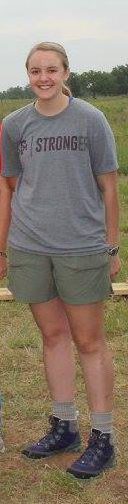
Welcome back to Rocket Success stories. This is the second installment of this series of Interview style articles, in which we meet individuals that studied under the SystemsGo STEM program and have gone on to build their futures on the skills it teaches. Last month we met, Robert Deaver, a 1996 graduate of the program. This month we are looking at a young lady that is a more recent graduate also from Fredericksburg High School in 2014, miss Anissa Kneese.
Anissa is currently a college student at Texas A&M, which allows us to talk with her now and to check back with her and see exactly where her education and career choices have taken her in the future. This is in a way, the middle of her path, but the drive she has to complete her engineering goals are a direct correlation of her experience in the program.
“Before taking the rocket program classes in high school, I had no idea I was interested in engineering, I learned about the many different engineering paths. and I fell in love with problem solving. I am now working toward my degree in Mechanical Engineering thanks to SystemsGo.”
Anissa joined the STEM program out of curiosity her freshman year, because of all she had heard about it from friends and family. She quickly realized that this class would shape her future.
“After completing the first class freshman year, I was considering majoring in engineering in college. Sophomore year pushed me even more in that direction, and after junior year there was no doubt what so ever this was my future career path. Senior year was the icing on the cake!”
As she studied in the program, her reasons changed from curiosity to excitement and the class became a priority for her.
“By junior year I was so eager to go to class every day. I knew I would learn something new or something really eventful and exciting would happen. Like running a successful student designed test that caused a nearby resident to call the fire department!” Engine and fuel burn tests can be loud and though most folks have become accustomed to these tests, this one was particularly loud, and caused a stir, something she recalls with guarded humor.
Anissa participated on two teams. The first was the Mechanical team for static hybrid propulsion testing, and then the injector team for the Redbird #15 Rocket, as long as helping with electronics, payload and engine installation. Her specific jobs on these projects included, “For propulsion and testing I prepped fuel grains by ensuring their size was exact, installing them in the test cell, and preparing the test cell by sealing the cell to prevent oxidizer leakage. After each test I would clean the test cell and prep the next fuel grain. I also set up oxidizer tanks and plumbing from the tanks to the test cell. During tests, I would make sure all solid and liquid weights were recorded to be used in calculations in the days to follow.”
The Redbird #15 is the rocket that her group designed to launch at White Sands Missile Range. This is where she really had to put her education to work and it presented her with her hardest problem to solve.
“The toughest problem I came across was “trouble shooting” an injector design that had mysteriously failed in a Redbird rocket from the year before. My teammates and I designed several tests to attempt to understand the previous failure, and this proved to be quite difficult. After a redesign with new materials, the injector worked flawlessly in our Redbird rocket.”
Even with this struggle accomplished with perfect results, she considers another success the greatest her and her team accomplished during their time in the program.
“I would consider my (and my team’s) best success being the first high school team to complete a full round of three 40 second hybrid test burns. This had been attempted by several classes before us (and even ourselves the year before), so coming back the next year and being successful was a great feeling.”
The SystemsGo program teaches individual accountability as well as team coherence. Anissa found this to be one of the most important things she learned in the program.
“This program taught me countless lessons and technical approaches to problems, but the most important thing I learned was the importance of communication. It is impossible to accomplish any great task without full communication and understanding from every team member involved.”
Many of the students who have participated in this program, not only go on to higher education and careers in STEM fields, they enjoy giving back to the program where ever possible. Anissa is no exception to this, she returns each year to help as launch pad lead at the Willow City launches. If possible she plans to continue helping and being involved with the program however possible.
“I would enjoy mentoring and helping students in the future with the design process or understanding the set up and procedures of building the static propulsion testing. I would also enjoy having a job with SystemsGo in the future. I think having experience in industry would be valuable to gain first, but I would enjoy coming back and teaching at some point.
Her current advice for students considering or currently in the program is, “work as hard as you can every day. Don’t be afraid to get sweaty and leave class with your hands dirty. It doesn’t matter how smart you are, you will learn so much if you are eager to get involved!”
Along with the fantastic education the SystemsGo STEM program provides in the Science, Technology, Engineering, and Mathematics fields, it also helps build confidence and character. It teaches each student to reach into themselves and take pride in what they are accomplishing and can accomplish. For many students, it is a learning boost they may never have known they needed until they discovered it in themselves during the program. Anissa sums up that experience.
“I learned that I am capable of accomplishing anything I have my heart in and I’m willing to work hard to achieve.”
I would like to thank Anissa Kneese for participating in this article series. These are written in hopes that all may understand the impact that STEM can have on your students and future employees. Having a program available at the high school level to teach, encourage and support this type of learning is instrumental to getting these students into great career futures. Encourage your students to get involved in STEM and the SystemsGo program if it is available at your child’s school. If it is not available, look into how you can bring it to your area. This program will greatly benefit your school and children.
If you know or have a student that went through the program that would like to share their story here, please contact me in the comment section on this blog or if you follow it on Facebook, Twitter, or LinkedIn contact me there, and I will send you information to participate.
http://www.systemsgo.org as always is the place for more information on this program. You may also email them at info@systemsgo.org .Take the time to get your school involved, the future of your students will be greatly benefited.


 On the Wings of Angels