September and October have come and gone and we are now half way through November and the Fredericksburg High School Engineering Program is deep into their studies busy learning and working at all levels. Eight weeks have passed since our first Engineering Program update and the first semester is halfway through.
Since our last update, the Freshmen have created an electrical design for the NASA built and designed Orion space capsule. Keith Kunz from Teledyne was their audience for this presentation. Teledyne works with offshore oil exploration developing and designing hard and software for their use. As an audience for these presentations, individuals like Mr. Kunz, provide constructive criticism such as design strengths and weaknesses, areas that did not match the design logic, things that were overlooked, and skills of presentation.
Currently the Freshman are working on a bio-engineering project, which will be designed to help student, Cody Bearden, who has Spinal Muscular Atrophy, which keeps him confined to a wheelchair. It will be a hoverchair. Yesterday they presented their project to a new audience, consisting of Tim Nolan, an AirEvac pilot and previous Marin Corps helicopter pilot, Todd Keener a mechanical engineer, and Scott Netherland, Executive Director of SystemsGo . Details on this presentation will be forthcoming in our next update.
Sophomore students are still working at their own pace in this year’s class. Due to this, the further along the year rolls, the larger the gap is between the slowest and fastest student. Because of this some are already starting to learn Isometrics, which are 2D representations of 3D objects. The class as a whole is also studying Dimensioning.
“They are all making good progress, but having them self pace has led to some really taking off with AutoCAD,” states Mr. Matthes.
The Engineering program flew in Brian Evans from
Space Propulsion Group out of Butte, Montana to conduct a two-day seminar for the Juniors and Seniors.
Pictured here are Juniors, Gloria Burns, Cooper McDonald and Eston Cooke with Mr. Evans:

According to Mr. Matthes, “Students really enjoyed having insight from Mr. Evans.”
For the past two months, the Juniors have been learning new skills on Excel which allowed them to better understand the math of starting a new model. They have been creating spreadsheets for a hypothetical bakery where they used calculation, look ups and other functions in order to track materials, hours, and productivity. Class time has been split between this project and the physics of flight.
Three weeks earlier, the class flew their Generation 1 rockets. The parameters for this first flight, were just have a rocket on the pad to fly and served as a platform for them to learn and start asking questions on how to correct their flights.
These flights were of varying degrees of stability with some being completely unstable, some having a corkscrew affect and others displaying very straight flights. The instruction on stability follows this flight test and leads into the Generation 2 tests.
Last week Generation 2 rockets were finally launched. They had been patiently waiting due to several scheduling conflicts with school college fair days and bad weather, windy days.
For this test they actually had to prove the stability of their rockets. This is accomplished by literally cutting the rockets in half. Students are forced to be intentional about stabilizing their vehicles. The pictures below are from the Generation 2 flights.
Here, Eduardo Memije and Gloria Burns load their G1 Rocket for launching.
In this photo, Deja Turkett and Bradley Plaza take their turn for launch.
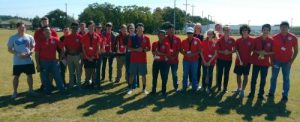
Here the whole Junior class group displays their rockets on launch day.
Currently they are splitting their class time between LabVIEW Programming which they have just begun and the continued study of the physics of flight. Next they will be studying fluids, aerodynamics and drag, and impulse, as well as factors affecting drag, this is all part of prepping for Generation 3 rockets.
According to Mr. Matthes, “Their next objective is to reach 1800 feet using RockSim to design the rockets. They are assessed on the closeness of construction to design: it is a tough mark to make without extreme precision.”
On Tuesday, Nov. 7, the Seniors traveled to Houston. After arrival, the group spent four hours at
Space Center Houston. According to Mr. Matthes, the students, “had a blast!”
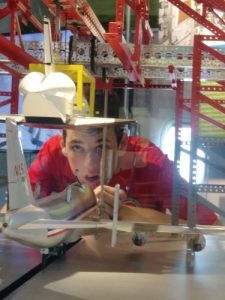 In this mock up, Evan Knapp mounts the Space Shuttle on top of the 747 that transports the shuttle back to Kennedy Space Center.

Corbin Smajstrla is seen here pumping iron on different planets where the gravity is not the same.

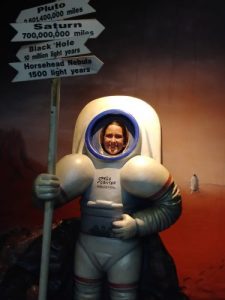
Chris Calzada (left) and Rebecca Sechrist (below) pose for pictures in space.
 Evan Knapp maneuvers his EVA device back to the ISS as Chris Calzada and Harrison Spisak look on.
Next the group visited
Rocket Park so that the students could get a visual grasp on the enormity of the Saturn V Rocket that took men to the moon and back.

Relaxing at the end of the day beneath the Apollo capsule on the Saturn V.
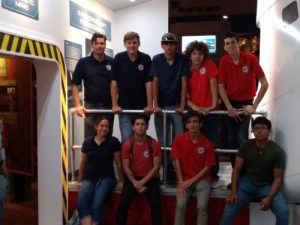 The entire travelling crew. Top row: Instructor Andrew Matthes, Harrison Spisak, Chris Calzada, Corbin Smajstrla, and Evan Knapp. Bottom row: Rebecca Sechrist, Pierce Vasquez, Joey Leal, and Sergio Walle.
Later, Joyce Abbey, the voice of the
SystemsGo launches, and Dave Ladrack, a longtime program friend and supporter, joined the students for dinner.
On Wednesday, Nov. 8, they arrived at
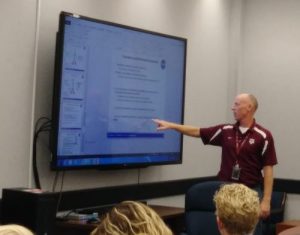
Johnson Space Center along with nine other schools and met, Chris Madsen, pictured below, a Guidance, Navigation and Control (GNC) engineer in the flight dynamics department.
Mr. Madsen coordinated and oversaw the program for the students, and gave an overview of College Co-op opportunities. He encouraged the students to be involved and to acquire work experience while still in college. All nine schools gave presentations of their flight models explaining the projected flights of their rockets to engineers and representatives from other schools who have also taken on a similar tasks.
After lunch the documentation students need in order to be cleared for flight at White Sand next summer, was discussed. Mr. Madsen used examples and an overview of his job in comparison so that students could see that what he does is similarly an extremely more complex version of what the students are building.
Later that afternoon, FHS had a meeting to present preliminary design reviews of both the wind tunnel project and Redbird #19 to five engineers. This was three hours of presentation and a question and answer session.
“It was a tremendous opportunity for the students and the feedback was excellent,” reported Mr. Matthes. “The trip was a success.”
Design progress has been made on Redbird #19 but many details still have to be worked out before it can be considered an integrated system.
Mr. Matthes feels that, “The input from this trip will be significantly helpful for drawing both flaws and considerations to light as they proceed forward. “
The group has been working hard to pull together everything for the Redbird #19 presentation, this has made it necessary to put Teststand on hold for the past week.
Something new the Engineering Program is working on, is the N.E.W. Y.O.U. Event, short for National Engineers Week Youth Outreach United. This will be the first time the FHS Engineering Program will be hosting this event. The purpose of this event, is to expose students from 4th through 8th graders to engineering. They will participate in activities and interact with high school engineering students while learning in a fun and relaxed environment.
FHS Engineering Program has already been readying for the event with two separate planning meetings involving about 20 students in order to organize and divide tasks. Everything is moving along well and they anticipate a great event.
National Engineers Week will begin February 18th. The N.E.W.Y.O.U Event will be held the day before on Saturday, February 17th. Forth through sixth graders will attend the morning session, and seventh and eighth graders will attend the afternoon/evening session.
This article is the second for the 2017/2018 school year in a series of monthly updates that will follow the Fredericksburg Engineering/Rocket program. This school is a participant of the
SystemsGo STEM program. This series of articles is intended to support and encourage students in the program as they share their working status and accomplishments throughout the year in the program. These publications will be available for tags and re-posting.
www.systemsgo.org as always is the place for more information on this program. You may also email them at info@systemsgo.org . Take the time to get your school involved, the future of your students will be greatly benefited.
 In this photo the nose cone ring is being secured in place, and centered by skewers for fiberglassing.
 It will be returning to SRM again to have the hatches and holes cut in.

 Robert Sanchez and Esten Cooke with their vehicle.
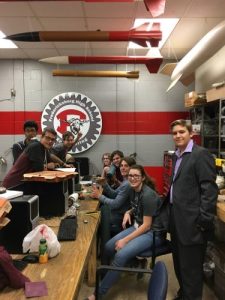 Pictured here are Ander Castaneda, Dawson Harkins, Cody Blohm, Deja Turkett, Cooper McDonald, Josh Handley, Gloria Burns, and Ethan Scott.
 Team members Robert Sanchez and Gloria Burns.



 On the Wings of Angels