Day 59-Rockets at WSMR -Launch Day 1-Update

Monday was another long day for the SystemsGo team, students from Marble Falls and Anahuac High Schools, and WSMR officials as they commenced the first day of tests.  Start time on the range at 0400 was with no electricity due to lightning strikes the evening before, but this was quickly corrected.

The Fill and Fire System completed set up with the addition of the Comm Readout Displays which allow the bunk house and the pad to see a digital readout of the temperature,  pressure, and weight for the vehicle on the pad during the launch preparation sequences. The full system was tested and minor glitches addressed which brought it to 100% working and readiness. Throughout the day the system was reported to work great and continued at 100%.

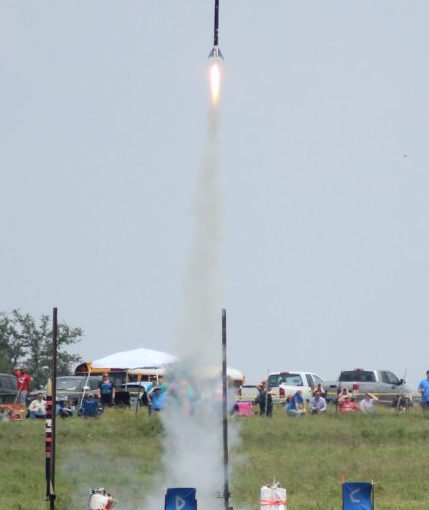
Marble Falls was originally scheduled to test a 0830, instead it made it to the pad at around 1200. The vehicle passed its final fill and fire tests and went vertical around 1230. The survey team set the angel at 85 degrees with an azimuth of 355. Six Nitrous bottles were loaded into the tank. At this point it almost over pressured and began to release venting liquid instead of gas. At 175 lbs and 900 PSI  the vehicle was determined ready for launch. Switches were good, and flame was good, but the injector failed to open and the rocket went into a still fire burn on the pad, continuing to burn for four minutes, until the bottom began leaking the nitrous.

Army rules forbid any contact during this time and for 30 minutes after the fire burned out. At that time the Oxidizer crew was allowed to approach and evaluate the vehicle. The rocket was too hot too touch delaying removal of it from the pad for another hour.

Minor damages were reported to the launch rail and trailer, but nothing that would affect or delay any future launches at this time. Instead it was just enough to give Captain Garrett something to do over the summer again.

At approximately 1400 Anahuac’s vehicle was brought to the pad and cleared for launch. At fill, one and a half bottles were loaded into the tank at which time it began leaking out from a vehicle malfunction, and Anahuac had to be scratched.

This concluded the tests for the day, setting today’s successful launch rate at zero. Any school that actually makes it this far is still a success for the simple fact that they attempted a launch of a vehicle of this size. They still have post analysis to do and challenges to over come to prevent these outcomes in the future.

Mother nature was reported to have attended the tests today as well and thrown her own challenges into the range for the crew to overcome, as well as find some humor in once they had passed. First a large dirt devil spawned right on top of the range and attempted to steal one of the large staging tents, causing a commotion as individuals scrambled after and reset it. Later, two birds were fighting on a transformer out by the pad, when a loud pop resounded, right after which one bird fell to the ground while the other made its escape and the power at the pad went down. Luckily they were using generators so this did not affect the pad and they continued as it was being fixed.

The crew spent fourteen hours at the range today, with an 8 hour launch window. Tomorrow they begin their day at 0900 with a shortened 6 hour launch window due to some other military tests scheduled for that morning early. Union Grove High School will be first followed by Booker T Washington High School. Both rockets are reported to be at 100% and waiting.

That concludes Monday’s WSMR Rocket update.

www.systemsgo.org as always is the place for more information on this program. Take the time to get your school involved, the future of your students will be greatly benefited. SystemsGo is a Texas-based STEM curriculum program.

Tune in again tomorrow for an update from Tuesday and a schedule of Wednesday’s launches at White Sands Missile Range this week.


Day 58-Rockets at WSMR Setup Day

SystemsGo had a productive first day today in spite of a long night on the road getting in around 0200 and a short night of sleep. They were at the range bright and early Sunday morning to set up for the launches and finish and evaluate rockets.

The SystemsGo team split into groups.  Captain Garrett and Steve Burow headed up the group at the pad setting up the launch rail. Robert Dever and Randy Kuhlmann set up the Fill and Fire system and proceeded with on-site testing. Brett Williams and Chelsea Burow rolled out all the cabling and connected the electrical systems and after which they helped Andrew Matthes who was overseeing the student groups with final checks and problem solving on rockets.

The first four schools for this Goddard level program were there with their rockets ready for leak and readiness tests. These tests are standard operating procedure used to create safeguards and ensure a successful launch as long as there are no internal parameters that cause the rocket to fail. No rocket will launch without passing these tests. An initial fail does not mean that the rocket is scratched for launch, only that the school has a short window of time in which to correct the issue so that it may be retested, pass and proceed to launch. Time constraints do not allow for continuous testing so the vehicle must pass quickly or be pulled from the launch sequence.

Marble Falls first test showed a minor problem, they were able to fix the issue and passed their second test. They are ready to launch and are scheduled as the first school for tomorrow morning at 0830.

Anahuac is scheduled to launch second tomorrow, but they are currently still working to resolve an issue shown in their test.

Union Grove is scheduled as first launch on Tuesday morning. They passed all their leak and readiness tests and are on standby for launch from 1200 to 1600 Monday in the event that Anahuac is not ready, or extra time allows.

Booker T Washington passed their leak test. They are scheduled as the second launch on Tuesday and are currently still finishing some last minute adjustments.

Set up and systems tests also went well. The new Fill and Fire system tested at 100% minus the Comm Readout Displays because a thunderstorm and lightning in the area prevented them from setting up that part of the system. This display allows mission control and the pad to communicate by sight through a constantly evolving digital readout in order to better coordinate launch sequences without the delay of radio communications, allowing for more safety and efficiency during the Fill and Fire, and count down stages. This last component will be set up early Monday morning and will complete its readiness check before the first launch, putting the full system at 100%.

A few members of the SystemsGo team got drenched in the fast approaching storm while they were down at the pad trying to put Marble Falls’ rocket on the rail so that it would be ready for launch Monday morning. Instead it was covered and left to be raised on the rail early Monday morning.

The Army has allotted an eight-hour window for testing tomorrow. The day begins at 0400 at the range for the SystemsGo team to accomplish these last necessities left from set up today. Then at 0600 the survey team shows up provide angel and azimuth settings for the launches to ensure they perform in a set area of the range for safety and recovery. Then if everything is in perfect order, Marble Falls will test their rocket launching at 0830. Anahuac or Union Grove will follow as quickly in succession as readiness allows.

www.systemsgo.org as always is the place for more information on this program. Take the time to get your school involved, the future of your students will be greatly benefited. SystemsGo is a Texas based STEM curriculum program.

Tune in again tomorrow for an update from Monday and a schedule of Tuesday’s launches at White Sands Missile Range this week.


Day 57-Rockets on the Road to WSMR

The SystemsGo team had a rough start to their day. They were scheduled to leave Fredericksburg at 10:00 this morning, but due to the final touches and tests on the new Fill and Fire system taking much longer than originally thought, the team didn’t leave until 4:20 this afternoon.  This system has been ready for some time, but engineers are always thinking of ways to further improve their product to ensure that it is always better than first envisioned. That coupled with all the new safeguards and the new Comm Readout Display on a brand new system meant that final touches recently decided upon caused thoroughness and perfection to be a bit time extensive, but most definitely worth the time and delay. It should prove to be an awesome system.

It is going to be a really long night tonight as well as a long day setting up out at the range tomorrow. This group will be running on very little sleep before they have to hit the road to the range in the morning. Hopefully set up will go really well tomorrow so they can call it an early evening and catch up on the sleep they are losing tonight.

By the time they finally got on the road, the two engineers, Robert and Randy that were working on the Fill and Fire had already spent about 32 hours straight working. Add that to the rest of the group driving all night and it just might be an exhausted and definitely all business and no nonsense group to deal with for more reasons than just to get the job done. I really feel for the group and wish them safe travels and a productive trip and day tomorrow.

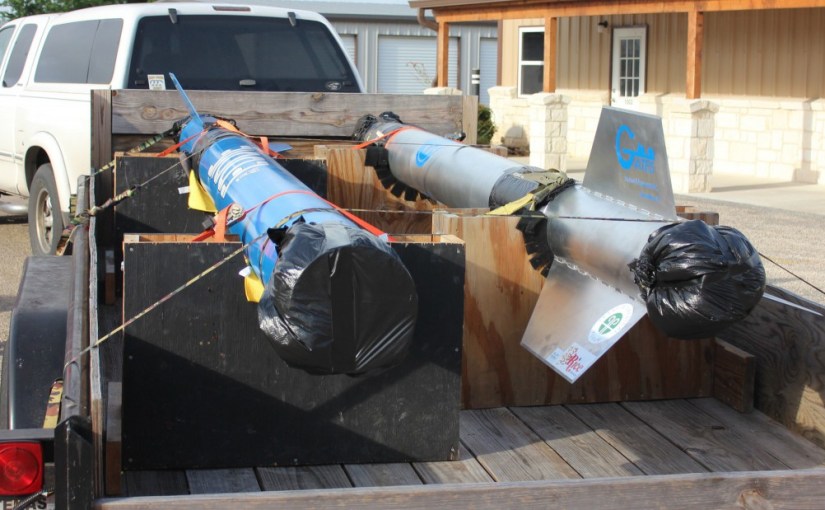
They were leaving Fort Stockton shortly before 9:00 pm after a short break for food. They seem to be making good time for three pick-up trucks pulling a box trailer of equipment, a trailer with the large wire wheels and three rockets, and another trailer with the launch rail, and launch equipment.

Tomorrow’s schedule is mostly setup and prep for the first launches to begin on Monday. Five schools are scheduled to launch at White Sands this week. They include, Marble Falls High School, Anahuac High School, Union Grove High School, Booker T Washington High School, and Alamo Heights High School.

I will post updates to things in WSMR as they are available this week, hopefully daily.

www.systemsgo.org as always is the place for more information on this program. Take the time to get your school involved, the future of your students will be greatly benefited.

Tune again tomorrow for a schedule of Monday’s launches at White Sands Missile Range this week.

12:51: The group just left El Paso after another short stop. They are still making good time.
2:00 AM The group arrived safely in Alamogordo and is catching what sleep they can before an early morning start.

Day 56 – Rockets at White Sands Missile Range

While the more public focus of SystemsGo Rockets 2015, the launches of the Tsiolkovsky (1 pound/1 mile), and Oberth (Transonic) rockets may have come to a close for this year, the program has not finished for the year. The SystemsGo Rocket program now transitions to Goddard level rockets. These rockets and their subsequent launches at WSMR (White Sands Missile Range) are the culmination of all the skills the students have learned  throughout their years in the STEM program. This is their final senior project for those schools that participate in this level of the SystemsGo program.

By now these students have spent a minimum of 2 years, some three, and as the program expands with new STEM requirements in education, as many as four years will have been spent following and learning in this system of education. They have spent countless hours both in and out of class.

The year is divided by semester into two project bases. The first semester deals with early design phases including payload, performance, and vehicle configuration. Once the payload and an initial vehicle design concept have been developed the student project team begins developing a flight profile. This is used to predict what will happen during testing, including vehicle stresses and flight dynamics. By semester’s end, a test vehicle configuration should be fairly realized.

Semester two is the culmination of everything the students have learned in the first semester, and the continuation of using life and work skills to manufacture their test vehicle, perform a test and analyze their test vehicle findings. Success for this project is determined by two things.

1. Was the rocket finished by the scheduled date and delivered to the pad for testing?

2. How was the rocket’s flight performance in relation to its design parameters?

This translates to the students manufacturing a rocket from scratch; usually weighing in at between 250 to 450 lbs; to reach high altitudes and Mach 3 to Mach 4 velocities. This project is what all the previous years’ effort have been building up.

At this point, in order to achieve their goal, one large working team, divides into several smaller teams with designated goals for each part of design and development for the vehicles’ creation, propulsion, and testing. These component teams include:

Nose cone

Avionics/payload

Oxidizer tank

Injection

Fuel Grain

Nozzle

Engine case/forward skirt/fins

Each team first creates a workable timeline and then begins researching all necessities and questions concerning their team’s component. Questions they encounter may include function, simplicity, mass, etc. Students present their findings in the form of mathematical calculations for their design and these are reviewed and critiqued by aerospace professionals. Students must find their own solutions to any problems presented to them by these professionals.  Once a mathematical argument and a design drawing have been created, the team starts another research phase into the materials to build their component. In this phase students must be able to show critical thinking skills while studying different materials and their costs, safety, ease with which to work and whether they can be ordered in within time constraints. After the design is developed and reviewed and the correct materials determined, a Critical Design Review (CDR) is presented to the other teams for acceptance. If approved the team then begins development of the component, acquiring materials and enlisting any help they may need from local industry. If it is declined then the team redesigns it until the component is accepted by the entire group. If the original time line is kept each team’s component will be finished by the deadline. To ensure this each team must undergo a Flight Readiness Review (FRR) showing that their project is 100% ready. Once all components have demonstrated a 100% readiness, then the complete vehicle can be constructed  into a full standing rocket. SystemsGo calls this their “‘all-up’ configuration.” At this point, Standard Operating Procedures (SOP) must be developed and adhered to in order to test their rocket. To do this, students must be in communication with the launch facility, create support teams, and prepare necessary paperwork. Final preparations for the launch also include students working together to make sure the components are all prepped and ready, or working in mission control, meteorology, safety and other areas needed at the launch.

Next the rocket is tested and hopefully undergoes a successful launch. After this a Post Mission Analysis is done to evaluate the complete performance of the vehicle. This marks the end of the of the  program.

The knowledge base the students acquire through this program include: as quoted from the SystemsGo website: design and development, critical thinking, fabrication/machining, problem solving, teamwork, communication, analysis/application, documentation,  presentation, research, time/project management, budgets/purchasing, public relations, and computer skills in RockSim, Excel, Microsoft Word and PowerPoint.

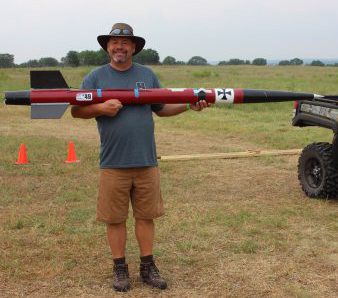
These rockets which usually stand between 20 to 25 feet and range from 8 to 10 inches in diameter are an amazing sight to behold if for no other reason than that they are built by high school students, not professional aerospace engineers. They are built by the future of these industries. Many of these students go on to become engineers, machinists, scientists, physicists, mathematicians, and countless other business professionals. This STEM based program teaches them skills they can apply to life and use to continue into their future learning and job markets.  If you have a student in the STEM program at your school who is excited about what they are doing, take interest, get involved and don’t miss the chance to see what they is happening first hand whenever possible. You are watching the future in something we can all be proud. These students are doing truly amazing things.

This article was intended to be a synopsis of the program in hopes that others may take interest and pay attention to what these students are achieving, so that more schools might implement the program for their students. It is well worth the time an effort involved. What better way to learn than to have the students apply what they are learning first hand and achieve a workable goal. The teacher is the instructor, guide, mentor, and timeline manager, but  the  project’s success or failure is in the students’ hands. They are the project managers that do all that is needed to see that this vehicle makes it to the pad and then into the sky. If your student makes it to this level, don’t miss out, you want to see this monster fly. It is a proud moment you won’t forget, and even more importantly, neither will your student. Their future begins here, don’t miss out on the chance to support their dreams.

I hope I have done the program justice, as I tried to describe it in a way that might be understood by all and draw some interest. My husband Steve, said I should just say, “Kids make really bad a$$ rockets and launch them at White Sands Missile Range.”

Well he has a point and that is the just of it, but it is really a whole lot more than that!

www.systemsgo.org as always is the place for more information on this program. Take the time to get your school involved, the future of your students will be greatly benefited.

Tune again tomorrow for a schedule of the upcoming launches at White Sands Missile Range this week, and hopefully some daily high lights from the group.