SystemsGo’s Rockets 2018 Officially Ended Sunday as the Team Traveled Home and Transitioned into 2019 Preps

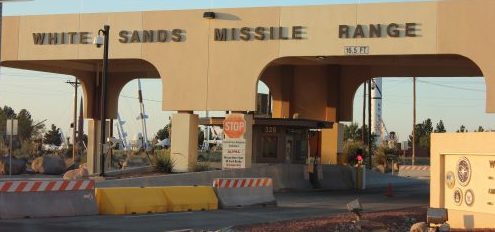
At 8:00 a.m.  Sunday morning, the SystemsGo team traveled home from White Sands Missile Range, arriving safely in Fredericksburg around 7:00 p.m. The FHS students and teachers followed arriving shortly after.

WSMR concludes another successful year of launches that begain with Jal, NM, Houston, and Willow City. The group helped test 140 Tchaikovsky and Oberth rockets and 6 Goddard level rockets for the Rockets 2018 season.

Now the volunteer staff returns to their daily lives and the SystemsGo team transitions into a season of program updates before new training begins with more schools, teachers, students and rockets. It won’t be long and the “launch season” will be back again with Rockets 2019. Next year’s season will begin again in the spring with launches in Jal, New Mexico, Houston (Anahua), Fredericksburg, and White Sands Missile Range. It should prove to be another exciting year.

There will be some changes next year as they are looking at relocating their Fredericksburg Rocket launches to a new location in Gillespie county, which will be announced at a later date.

That concludes the 2018 WSMR Rocket updates.

www.systemsgo.org as always is the place for more information on this program. Take the time to get your school involved, the future of your students will be greatly benefited.

Saturday,Rockets 2018-Final Day at WSMR

SystemsGo scheduled three tests today at White Sands Missile Range, Booker T. Washington, Alamo Heights, and Anahuac. After these three launches, Union Grove would have the opportunity to have a second attempt at launch after fixing the malfunction from Friday’s launch.

Booker T. Washington’s rocket was the first test. Students had loaded the rocket onto the rail before leaving West Center 50 Range at mission completion last evening. The schedule had the school’s T time set for 8:00 a.m. It’s actual T time ended up being at 9:12 after two holds caused by issues with wiring on the rocket which caused the vehicle to have to be vented,  brought down, fixed and reloaded. Unfortunately, the rocket never left the rail. At ignition, the rocket only smoked,  ending in a misfire. Due to the misfire, a 30 minute wait time had to be observed for safety until it could be removed. Following the 30 minute wait, the vehicle was the vented and removed from the rail. It is believed that the injection system did not open.

Alamo Heights  was next on the rail. The schedule was now two hours behind. They loaded without incident and observed a T time of 11:57. It achieved ignition and lifted off the rail. It was a great launch, but turned on its side, continuing on up with an angle headed down range. The rocket reached a peak altitude of 23,083 feet, but due to the launch rail being at a MSL (mean sea level) of 4,521 feet, the final height reached was 18,562 feet. This number is calculated by subtracting the MSL from the peak altitude.

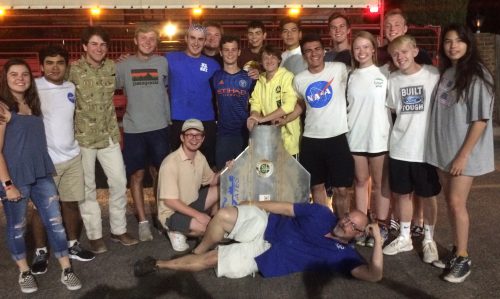
Vehicle velocity was 1503 feet per second. It traveled 26326.323 feet down range which equals 4.986 miles. WSMR reported that the chute did deploy before landing. Alamo Heights’ rocket had the second highest altitude, and also achieved the greatest distance traveled traveled for the weekend. After WSMR recovered the rocket it was determined that only the Drogue chute opened and then melted as the vehicle was still burning. Because of this the rocket had a ballistic re-entry, burying itself in the range. Only the engine casing with fins intact was returned to the team as seen in the picture above. In the picture below, the team is shown with the rocket before launch.

FD40E23B-2318-4A1E-87E2-7A43651DDEDF

Anahuac was next on the rail at 2:09 p.m. They had no lift at ignition, only a partial burn. It also vented the Nitrous through a hole in the injector bay. According to analysis from Anahuac, a hose between the injector and diffuser plate blew a fitting where it attached to the diffuser plate. They are not sure what caused this at this time, but they were able to confirm that the tank and injector were intact. The partial burn created another hang/misfire situation creating another safety delay of 30 minutes before the vehicle could be off loaded from the rail.

By the time this delay was up it was 2:45 and range end time for air space was 3:30. This effectively ended our mission time on the range, called officially by WSMR officials. Due to this, Union Grove was unable to go for a second attempt.

The mission was then called complete. Cleaning and packing up of WC50 began,  as this was the official last day of testing for SystemsGo, students, and WSMR personnel.

Safe travels to all schools heading home, tomorrow. It is back to Texas for the SystemsGo team tomorrow as well. Tonight, the team enjoyed dinner, drinks, conversation and an early bed time.

www.systemsgo.org as always is the place for more information on this program. You may also email them at info@systemsgo.org .Take the time to get your school involved, the future of your students will be greatly benefited. minute

Friday, Rockets 2018-WSMR Launch Day 1 Report and New Saturday Schedules

Today was an extremely early morning for the SystemsGo team and program participants, Fredericksburg High School, Brazoswood High School, Booker T. Washington, and Anahuac High School. They were all headed  out to the WC50 range, at 5:00 a.m. to test. They had success and were able to left off the rail.

Fredericksburg High School was first to test, leaving the rail at 9:24 a.m. after some minor delays. The vehicle blew the injection port door and a hose blew out of the open hole, but in spite of this, it still achieved a beautiful lift off.  Unfortunately though it acquired height, it was not in the air long enough for either radar or EOD to get a definitive lock on it. They estimated it at somewhere between 2000 and 10000 feet, but were unable to calculate a Real time stat on it. The vehicle suffered an explosion upon return to the range and landed in pieces 200 yards down range to the right of the pad. It was recovered shortly after launch. Congratulations, Fredericksburg on a very nice flight.

Fredericksburg’s rocket team.


SystemsGo was able to have Brazoswood loaded on the rail, set for a 12:15 T time. The rocket commenced fill developed a small leak. While the students and teams were evaluating this development, WSMR experienced an emergency down range that affected the airspace SystemsGo uses for launch. The launch was set to hold leaving the filled rocket on the rail to wait. The launch was called to surrender the airspace and launch.  Luckily changes were made to the airspace and the student team decided they were able to fly with the leak. The delay had caused to vehicle to leak out Nitrous bringing it’s fuel level down to less than 50%. The decision was made to test as it was. Their rocket had a unique injection system involving a multiple hose configuration which worked well.

The vehicle achieved lift off at 12:18 in spite of all the delays. The rocket left the rail trailing a large classic flame and literally zoomed into the sky. The flight only had 46 seconds of air time, but it achieved a max altitude of  28,572 with a starting of 4521 feet above sea level, calculating out to an altitude of 24,051 feet at a velocity of 2508 feet per second. It traveled 5562.167 feet equaling 1.053 miles down range. They were able to recover the vehicle, but the narrow section at the top was broken about 6 inches above the tank. At this time they are unable to confirm whether or not any chutes were deployed.

An accompanying Brazoswood parent, Lisa Baker, stated that the “Nose cone went to a location that only God is allowed to go!”

This was their first year to bring a rocket to WSMR, and they achieved quite a launch. I can only imagine what they would have done with a full tank and no leak. They are currently the weekend leaders. Congratulations Brazoswood!

Brazoswood at the T-1 Briefing.

Union Grove was loaded onto the rail next, but unfortunately it suffered a slight malfunction in the injection system that caused the Nitrous to blow out the bottom of the rocket. Fill was stopped and the vehicle was removed for repairs. They will attempt to launch again tomorrow afternoon.

Mission was called complete for the day by WSMR at 2:30 p.m.

Booker T. Washington’s rocket was loaded onto the rail in preparation of the first launch tomorrow.

Tomorrow’s schedule is also an early one as it mirror’s today’s starting schedule.  They are all going out to the range at 5:00 a.m. to prepare for a beginning T of 8:00 a.m. If the schedule holds, and all for tests lift off with out delays, they should be packing up the range by 3:00 p.m. If not a decision will be made at that time as whether the contingency slots on Monday will be used, or the group will call the mission and head home.

The following is the schedule at this time:

Saturday launch order:

8:00 a.m. Booker T. Washington High School
10:00 a.m. Alamo Heights High School
12:00 p.m. Anahuac High School
14:00 p.m. Union Grove High School

Event details will continue to be available here. Information  will be available late tomorrow evening after all tests are complete and the range has been packed up. Pictures are not allowed on the range, but some pictures of teams getting ready to leave for the range with their vehicles might be available. If anything is available I will post it for your viewing pleasure.

www.systemsgo.org as always is the place for more information on this program. You may also email them at info@systemsgo.org .Take the time to get your school involved, the future of your students will be greatly benefited.

Thursday, Welcome to White Sands Missile Range-T-1 Briefing and WC-50 Set up Day and Friday Schedules

Today was a productive first day at White Sands Missile Range (WSMR) for the SystemsGo and the participating schools.

This year the group was invited to begin their engagement at WSMR with the viewing of a live Missile Test. The group watched the test which consisted of three missiles from the Missile Park on White Sands Missile Range at 8:00 a.m.

This viewing meant an early morning for the group rising at 4:00 a.m. in order to have the convoy at the Las Cruces Gate by 6:45 a.m. so that all vehicles could be checked through the gate in time to watch the test. Early mornings are a pretty normal occurance for the time here at WSMR.   Tomorrow will be no exception.

After the Missile Test viewing, the group was lead to the Post Theater. They were officially welcomed to WSMR and participated in the T-1 Briefing, Safety and Security procedures briefing, Public Affairs briefing, as well as other important informational briefings. During this time each school also gave their Student Rocket Presentations encompassing the details about and expectations of their vehicles.It was an educational and informative session.

WSMR personnel made introductions so all involved would know who they are and who to contact for help from the base. Scott Netherland introduced the SystemsGo team and specified their roles with the organization. We finished around 10:30 and headed out to West Center 50 launch site(WC50).

After arrival at WC-50 at around 11:30 a.m., the group worked hard to complete full project equipment set up, after which, they performed a communications check,  field readiness and systems checks, all rockets went through final pressure checks, and simulated launch countdown was enacted.

Fredericksburg’s Rocket was loaded onto the rail and left for first launch tomorrow morning.

The group left the range for the day at 7:00 p.m.

Tomorrow will be another  early morning for all of us. Teams launching and SystemsGo personnel will be headed out to WC50 at 5:00 a.m. to meet WSMR personnel at the Tula gate by 6:00 a.m.

Those going to watch the launches from Mission Control will be heading out at 6:00 a.m. to meet our rep in the gravel lot outside the main gate near Las Cruces, by 7:00 a.m.

Tomorrow’s launch schedule is as follows:

8:00 a.m. Fredericksburg High School
10:00 a.m. Brazoswood High School
12:00 a.m. Booker T. Washington High School                                                                    14:00 a.m. Anahuac High School

If it is a perfect day and all goes well with no exceptions with each launch, then the tests should be complete by 15:00 p.m.

Realistically, this is a very tight launch sequence with little to no room for errors. If we do not get all four launches tomorrow, then they will carry over into Saturday time slots creating up to four  launches on Saturday. Last year SystemsGo was able to hold this schedule. Hopefully tomorrow will go as well.

Sunday is a contingency day if needed in which four more vehicles could launch, otherwise we will travel home that day.

Best of luck to all schools so that they may have a successful launch tomorrow and that all schedules hold true.

Here is the current preview of the launches scheduled for Saturday. Tomorrow’s blog will have a final schedule for the day based on Friday’s test success.

Saturday’s launch order: Union Grove, Alamo Heights, any retests.

Event details will continue to be available here. I will provide more information each morning as to how the schedule and other event details will progress for that day and how launches went for the schools testing that day. Pictures are not allowed on the range, but some pictures of teams getting ready to leave for the range with their vehicles might be available. If anything is available I will post it for your viewing pleasure.

www.systemsgo.org as always is the place for more information on this program. You may also email them at info@systemsgo.org. Take the time to get your school involved, the future of your students will be greatly benefited.

Wednesday Rockets Headed to White Sands-Day 1-Report and Tuesday Early Information

The SystemsGo team left Fredericksburg at 10:43 a.m. this morning headed to White Sands Missile Range (WSMR) in New Mexico. They traveled with the Fredericksburg High School rocket group. After supper in El Paso, they arrived in Alamogordo, NM, for lodging at 7:33 p.m. this evening. All participating schools also arrived safely.

Tomorrow is an informational and set up day. SystemsGo personnel and all students, teachers, and parents from the schools will have an early morning. We will be leaving the hotel at 5:45 a.m. to meet up at the gravel lot out side the Main Gate (Las Cruces) at 6:45 a.m.

The convoy will be led to Missile Park to view a live Missile Test at 8:00 a.m. Next, they will proceed to the Post Theater for the T-1 briefing and a short presentation by each school on their vehicle and it’s expectations. Afterwards SystemsGo, students and necessary personnel go to West Center 50 launch site to set up and prep vehicles.

Parents will be dismissed at that time to find their own entertainment for the day. Only SystemsGo personnel, teachers, student teams and essential personnel will go to WC50.

Friday is the first launch day and at this point, it is slated to be an early morning. Fredericksburg High School is first up to launch for the day and the current schedule has them testing at 8:00 a.m. The hope is to test 4 vehicles by 2:00 p.m, including Brazoswood, Booker T. Washington, and Anahuac.

Event details will continue to be available here. I will provide more information each day as to how the schedule and other event details will progress for that day and how launches went for the schools testing the previous day. Pictures are not allowed on the range, but some pictures of teams getting ready to leave for the range with their vehicles might be available. If anything is available, I will post it for your viewing pleasure.

www.systemsgo.org as always is the place for more information on this program. You may also email them at info@systemsgo.org . Take the time to get your school involved. The future of your students will be greatly benefited.


Fredericksburg’s Engineering Rocket Program-Pre-Launch Week Red Bird #19 Update

Red Bird #19 is scheduled for testing at White Sands Missile Range(WSMR) next Friday, June 22. This marks the last big event for Rockets 2018 and the Fredericksburg STEM Academy for this season.

These are the Goddard level rockets, which are the culmination of all the skills the students have learned throughout their years in the STEM program. This marks the final senior project for those schools that participate in this level of the SystemsGo program.

As of today, June 15, the Fredericksburg Engineering Red Bird #19 rocket team is due to pick up the vehicle from SRM tomorrow,  now that the welding is completed. The team still has to complete the assembly of the motor and then integrate it, as well as the,  injector valve, payload, and parachutes.  They will be attempting to finish the FRR tonight. In spite of the remaining tasks they are on schedule to make their launch at WSMR.

Red Bird #19 has an 8 inch diameter and is 25 feet long. The team outsourced the payload to the district IT employee and former FMS science teacher, Keith Jenkins. He created a sensor for the vehicle that will measure methane levels at the time of nose cone deployment.

When asked about the rocket’s expectations, Harrison Spisak stated, “My expectations are about 65,00 feet, but after NASA evaluated it they estimated 102,000.” Therefore that is the hopeful estimate if all goes perfectly.

Today, team members, Joey Leal and Harrison Spisak were working on the FRR, and T-1 briefing as seen in the photos below.

4C58DEE3-F0F1-4B7D-86E8-FC30158BAF10

Here the nose cone and injection system also await integration.

Here Joey Leal checks on the rockets progress at SRM machine shop.

b41a30c2-c575-4337-86d4-10f5bd769b98.jpeg

91C623D5-6FE9-4D38-B65C-E8DB349090AD

Harrison Spisak’s father will be hauling the rocket on his trailer to White Sands for the team.

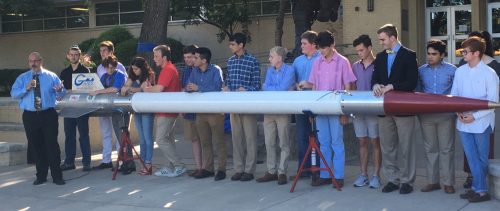
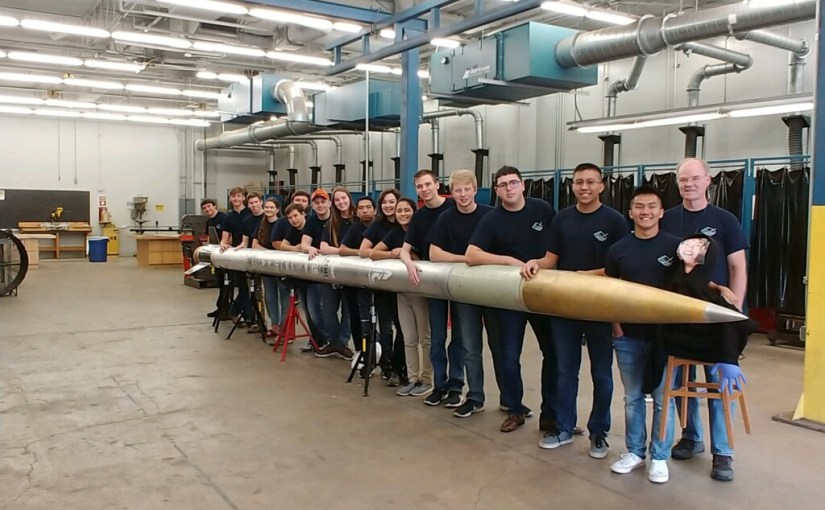
Pictured here is this year’s Red Bird #19 Team:  Back Row:  Harrison Spisak, Jacob Wienecke, Evan Knapp, Bryce Erwin, Sergio Walle. Front Row:  Corbin Smajstrla, Rebecca Sechrist, Pierce Vasquez, Joey Leal.  Not pictured in the seniors picture was Chris Calzada.

Launches are scheduled for June 22nd and June 23rd, with a contingency day on the 24th if needed. The team will travel out to WSMR on Wednesday, June 20th, and back home again on the 23rd.

There are 5 schools scheduled to launch 6  rockets. These schools include:

  • Alamo Heights
  • Anahuac
  • Booker T. Washington
  • Brazoswood
  • Fredericksburg
  • Union Grove

The current launch schedule is as follows:

  • Wednesday, June 2oth          Travel Day
  • Thursday, June 21st              T-1 and Site Set up/Rocket Prep at WC- 50
  • Friday, June 22rd                   Launch Day One (Four Rockets-Fredericksburg,  Brazoswood, Booker T., Anahuac)
  • Saturday, June 23rd              Launch Day Two (Two Rockets–Union Grove, Alamo Heights)
  • Sunday, June 24th                 Contingency Day/ Travel Day
  • Monday, June 25th                Travel Day if needed

This article is the eighth for the 2017/2018 school year in a series of periodic updates that has followed the Fredericksburg Engineering/Rocket program. This school is a participant of the SystemsGo STEM program. This series of articles is intended to support and encourage students in the program as they share their working status and accomplishments throughout the year in the program. These publications will be available for tags and re-posting.

www.systemsgo.org as always is the place for more information on this program. You may also email them at info@systemsgo.org .Take the time to get your school involved, the future of your students will be greatly benefited.

#Rockets2018 #SystemsGo #FredricksburgSTEMAcademy #Launcher01 #RideTheSky

Rockets 2018-Houston-Pictures by Sean Hannon From the Weekend

Houston Rockets 2018 had many talented photographers on site this year. This makes for a gallery of great pictures, and this new album definitely falls into that category.

Sean Hannon’s photographs surely do not disappoint their audience. He regularly contributes his photographs from the launches to SystemsGo. He did a great job of capturing not only the people and rockets, but also the action. Here are just a few from his album.


The full album can be found at  the two following locations:

https://flic.kr/s/aHsmc4SsMb

and the SystemsGo website at:

http://www.systemsgo.org/media-gallery/

The SystemsGo website also has a host of other media from this year’s events as well as past years.

If you would like to watch this year’s launches again or maybe you missed them, the Livestream link to the videos will be available for about a month. You can find them here:

https://livestream.com/systemsgo

Thank you Sean Hannon for your photography works and the opportunity to share them with my readers and rocket followers.

If you follow this program Rockets 2018  will continue with the senior/graduate groups which are scheduled to launch their Goddard level rockets at White Sands Missile Range (WSMR) in New Mexico June 22-24.  These are not available for public viewing or Livestream due to being tested on a military facility, but blog and SystemsGo updates will be posted online as available during that week.

More event details will be available here as the event gets closer. Daily reports featuring schedules, school names, results, pictures and some editorial content will be posted during the event.

www.systemsgo.org as always is the place for more information on this program. You may also email them at info@systemsgo.org . Take the time to get your school involved, the future of your students will be greatly benefited.

#RideTheSky! #Launcher01 #ItISrocketScience #Rockets2018

Fredericksburg’s Engineering Rocket Program-(April 13-June 1) Final Classroom Update for Freshmen, Sophomores, Juniors and Seniors

Today is May 31, 2018 and we are catching up on the FHS Engineering program and what they have done since April 13th. This article will also bring the a fabulous year to an end for the Freshmen, Sophomores, and Juniors, since the school year is ending this Friday, June 1st, with graduation. They will all resume studies in the program next school year. After graduation, we will resume Redbird #19 updates with the graduates through June until they have launched at White Sands Missile Range (WSMR).

It has been seven weeks since our last update on the Freshmen, Sophomores, and Seniors and quite a bit has been happening on all levels.

On Tuesday, May 15, the Freshmen embarked on a field trip to three locations. They began here in Fredericksburg, at Fischer and Wieser. Next they went on to the University of Texas at Austin to the JJ Pickle Research Center-Ferguson Structural Engineering Lab, and then a main campus tour including the Engineering Education and Research Building.

Ashley Seelig, Dietz Fischer and Nicole Whorton began the day at Fischer and Wieser giving the students a historical background on the company. Afterwards they took them on a walk through of the plant during which they described all aspects of their process, beginning with material acquisition through the shipment of products. Students found this familiar as it closely related to their orange juice production project completed earlier this year.

It was noted that the staff at Fischer and Wieser all work well with each other. They provide a comfortable working environment with a sense of family and pride in what they do.  They were all happy to host the students and show them around.

At the JJ Pickle Research Center-Ferguson Structural Engineering Lab at UT,  Dr. Tricia Clayton hosted the students. She began by discussing structural engineering and the scope of the work they do at the lab. The facility is nearly 50,000 square feet, and one of the largest labs in the country for testing and research of structures. This includes material types, fabrication process integrity, testing on pieces taken out of operation (like cracked bridge structures), train track safety and much more.

Next Dr. Clayton enlightened students on how she progressed from a high school student, to a PhD recipient, as well as a researcher and college professor.  Mr. Matthes commented that, “Her enthusiasm was contagious as her passion for her field of study and teaching bubbled to the surface.”

FHS Alumnus Matthew Dulaney,  and Sterling Weatherford took the group to lunch at the Market Place located below Dobie Dormitory. Matthew is studying Chemical Engineering at UT and Sterling who was visiting, is studying Aerospace Engineering at Arizona State University. The two shared their own individual perspectives of their college experiences as they gave the students a walking tour of the main campus.

The students’ last stop was at the Engineering Education and Research Center Building. Here they found the building’s structural supports interesting, as well as a 3 story, 10 foot radius spiral staircase with only a center support structure. The main attraction was on the bottom floor. There they admired the very extensive 3D printing lab. The air conditioning was also a major hit with the students after their campus tour in the heat.

As far as class work, they have done quite a lot since the mid-April program report. They have completed their Orange Juice Production Plant project as well as a project to calculate aerodynamic drag on a rocket. They are currently trying to research and calculate the characteristics of a hybrid rocket motor. This is the aerospace component of the project.  This has helped the students reach new heights and has left them a bit overwhelmed according to Mr. Matthes.  They presented their findings in the classroom on Tuesday.

The sophomores were allowed to work through the curriculum at their own pace this year, due to that the group is spread out in their studies. While there are those that have completed the curriculum others are still working hard to get all the materials done.  Those that have completed ahead, have moved forward into 3D modelling and printing of their material findings.

Next year, a new class called Intermediate Computer Aided Drafting and Design (ICADD) will be added, allowing new students the opportunity to delve deeper into 3D modeling with AutoDesk’s program, Inventor.  This is a good thing, according to Mr. Matthes because, “The class should provide students all the fundamentals of 3D modelling and having those skills down will have them ready to take on other equivalent programs such as SolidWorks (A Common 3D Modelling Software For Mechanical Type of  Drawings).  This will have them ready for any higher education drafting classes as colleges and technical schools tend to stick with those two software suites for modelling mechanical drafting.”

There have been two updates on the Juniors as they launched their rockets at the Fredericksburg Rockets 2018 in Willow City on late April 26th. If you missed those launches, you can still view them on the Livestream videos from the weekend. They can be found at the following link:

https://livestream.com/systemsgo

Here are some pictures from Mr. Matthes of the Junior teams on their launch day. I have also included a synopsis of their rocket’s accomplishments that day.

Team 1’s rocket, labeled as rocket #34 had a beautiful lift off from the rail, but before reaching its full height went into a cork screw spin, nosed over and began a ballistic decent. It landed hard on its side in a field to the left of the Pad and charges didn’t deploy until hitting the ground. It was fully recovered which enabled them to get  data from the rocket. Their vehicle reached 588 mph, 0.78 Mach.


Team 2 had an awesome flight with full deployment  and recovery. The rocket flew to a height of 11,232 feet at a speed of 763.6 miles per hour. The vehicle broke the first sound barrier at 1.027 Mach. Unfortunately their camera did not turn on  properly so no flight video, and their payload which was a bag of Cheezits which was supposed to burst open due to pressure drop,  was still intact, the bag did not open. Congratulations on breaking the sound barrier.


And here are some additional students that helped at the pad during the Fredericksburg launches.


Currently the Juniors have been completing things in order to present their Post Mission Analysis this week.  Team 1, was on Tuesday at 1:40 p.m. and Team 2 on Thursday at 12:30 p.m. at FISD’s Central Office board room. All are welcome to attend. Come learn about the program. Asking questions of the presenting students is encouraged.

This will conclude this year’s reports on the Juniors. We will pick up with them next year as seniors when they begin their Goddard level project and attempt to launch at White Sands Missile Range.

The Seniors have approximately 23 days until Redbird 19 is scheduled for testing at White Sands Missile Range, on June 22.  This date is fairly permanent  but still at the mercy of the Army until closer to that time. Mr. Matthes will announce if there are any changes to that date.

Progress on the Redbird #19 rocket is ongoing. Students are in a waiting and coordinating process with SRM, a local machine shop with which  that they have the larger metal work contracted out. A helping advantage they have this year, is that FHS Alumni, Joseph Sanchez, hired on for the summer with Luke Morin at SRM. Joseph has been instrumental as a liaison between the team and the machine shop. Mr. Matthes states, that “this will surely help organizationally with the completion of the project.” He also says, “Kudos” to Joseph for his ability to acquire a summer job at SRM.

The Redbird #19 team is currently slated to depart for White Sands on June 20th with the test-minus-one(T-1) briefing  on the morning of the 21st, and final rocket preparations occurring that afternoon. Students are expected to give an overview of their rocket, payload and flight expectations for WSMR officials at the T-1 briefing.

Fredericksburg will be first to fly on the 22nd, therefore their rocket will be loaded onto the rail and left over night the 21st. This allows things to move faster the next morning as loading the payload, attaching the nose cone, loading oxidizer, and testing the rocket are all that will need to be done.

According to Mr. Matthes,  “As always, there is a chance the rocket won’t fly due to some technical failure occurring in the process of filling or ignition.  This sort of failure occurs regularly at White Sands as a testing grounds.  The difference between what the students do and industry does is cycling the process:  conducting a post mission analysis, correcting sources of problems and then having another go.  The lack of the opportunity to try again makes the individual testing of as many components as possible all the more important.  As of yet, the only testing performed has been on the altimeter which has proved positive for expected operation.  Time will tell what else the students have time to test.”

The team is running late on their completion  schedule due to their own delays and some things beyond their control and this will likely mean no preliminary testing of components, but they are expected to complete the rocket in time for launch.

Mr. Matthes had this to say about the senior class, “The class of 10 students together has accumulated over a 1000 hours of overtime (out of class engineering time) and has a few hundred to go before the project is done.  They have worked hard and will see the fruits of their labor continue over the summer. The students graduate Friday night and after 3 years, and 4 years for many of them, it is always bittersweet to send my students off.  The projects always delay the farewells until post launch but it is a significant leap for these young men and Miss Secrhist.  I am proud of all of them and look forward to all the great things ahead in their lives.  It is a diverse group of students with extensive interests and pathways.  I’m sure their paths will twist and turn as they move on but their trajectory looks promising and exciting.”

Congratulations to Harrison Spisak on s job well done! He was awarded the Engineering Academic Excellence Award, on May 7, at the FHS Academic Excellence Awards Banquet.

This article is the seventh for the 2017/2018 school year in a series of periodic updates that has followed the Fredericksburg Engineering/Rocket program. This school is a participant of the SystemsGo STEM program. This series of articles is intended to support and encourage students in the program as they share their working status and accomplishments throughout the year in the program. These publications will be available for tags and re-posting.

www.systemsgo.org as always is the place for more information on this program. You may also email them at info@systemsgo.org . Take the time to get your school involved, the future of your students will be greatly benefited.


Rockets 2018-Houston-New Pictures From the Weekend

Houston Rockets 2018 is done, but new pictures from the event have been made possible by David Brady from NASA. David and his daughter Erika, shown below,  are regular participants at the event for about three years now.

Correct me if I am wrong and it is longer, David.

Even though we have a Livestream link at the location, internet and cell service in the area is very minimal. David has generously provided pictures to me and SystemsGo each year, but like everyone else there, it can’t be done during the event, due to service and time. Therefore, I am going to share a few in this quick blog post, and then the link to Dropbox, for those who would like to see the rest.

Thank you so much David for your time, dedication and generosity in supporting rockets and sharing your photos with all of us.

These are just a small selection of what David has sent in. The rest can be found at this address:

https://www.dropbox.com/sh/n31fev7bl2nwnd1/AACHcVjtiAVizPNvBb2N3P35a?dl=0

If you would like to watch this year’s launches again or maybe you missed them, the Livestream link to the videos will be available for about a month. You can find them here:

https://livestream.com/systemsgo

And to the rest of you readers, you knew I couldn’t let it end that easy. I will take any excuse to write something about our rocket program, even if it is just a small post.

If you follow this program Rockets 2018  will continue with the senior/graduate groups which are tentatively scheduled to launch their Goddard level rockets at White Sands Missile Range (WSMR) in New Mexico in late June.  These are not available for public viewing or Livestream due to being tested on a military facility, but blog and SystemsGo updates will be posted online as available during that week.

More event details will be available here as the event gets closer. Daily reports featuring schedules, school names, results, pictures and some editorial content will be posted during the event.

www.systemsgo.org as always is the place for more information on this program. You may also email them at info@systemsgo.org . Take the time to get your school involved, the future of your students will be greatly benefited.

#RideTheSky! #Launcher01 #ItISrocketScience #Rockets2018

Fredericksburg’s Engineering Rocket Program-Second Term Update #2 (February 16-April 13)

It is April and we have some catching up to do on the  FHS Engineering program. It has been two months since our last update and quite a bit has been happening on all levels.  Along with class work, launches start this month in Jal, New Mexico  on April 21 and Fredericksburg (Willow City) April 26-28 so time is becoming a factor for the Junior and senior groups.  Each group is working hard to meet their timelines. Rockets 2018 is the pinnacle event for the upper level groups, as their rocket projects are basically the final grade for the year.

The seniors have approximately 73 days until Redbird 19 is TENTATIVELY scheduled for testing at White Sands Missile Range, which is usually in the last week of June.  This date is still not a permanent date until the Army finalizes, closer to that time. Mr. Matthes will announce that date when it becomes readily available. Their completion date for  preliminary systems tests is usually two weeks before school ends. This would be May 18 which cuts them down to 59 days.

More on these groups and their current status reports will be later in the article.

Freshman participated in a field trip on March 1st, in which they visited Southwest Research Institute(SwRI), the Center for the Intrepid,  and the UTSA VIZlab.  At the Center for the Intrepid, the students were able to see biomedical equipment at work helping wounded Veterans in their recovery. Along with the engineering aspect of this, Mr. Matthes hoped that they took away a new respect for our military servicemen and women and the full extent of the sacrifices they make each day for our country’s safety.

Former FHS Engineering Alumni, Drake Horstman, was the students’ guide when they visited the UTSA VIZlab, toured the campus, engineering lab and community areas. During the visit, Drake, provided  entertainment and wisdom coupled with numerous stories about his experiences in the FHS Engineering Program. Inside the lab, the students were able to see several visual interaction devices.

At Southwest Research Institute, students learned technical information about engines, modifications and fuel efficiency. The content here was a little over their knowledge base,  and may have overwhelmed the students a little, according to Mr. Matthes. In spite of that, it was still a good visit for the students, and the coordinator at SwRI commented  about their behavior stating, “they are better than a lot of the college students who come through.”

These visits are designed to expose the students to different aspects in the engineering fields. The impressions they take from here will help them make decisions down the road on whether engineering is for them, and if so, help them determine a particular area of interest.

The Freshmen also participated in their first Critical Design Review (CDR). They were tasked with presenting solutions to fix the damaged launch tower for the Red Bird rockets. This gives them practice on presentation skills and feedback on designs for their project.

Mr. Matthes stated that, “the students may have felt “roasted” with constructive criticism and feedback. But, that they should know, that it is part of improvement and growth of design and not personal.” He mentioned that this was also discussed briefly at the end of the trip to SwRI, by the hosting engineer.

The sophomores have advanced well in the curriculum and are presently several weeks ahead of their  current deadlines. Their current focus is on dimensioning objects, denoting measurements and creating fabrication notes. Due to this, their proficiency has advanced well.

Mr. Matthes is quite impressed with the Juniors selection of a class name. Here is how he describes it,”The juniors named their class “Conatus” which translates from Latin, to impulse and means striving.  From a historical philosophy origin it relates to the nature of something to continue its existence.”

The pressure is on with an April 19th rocket completion date looming ever closer. The rocket must be completed one week prior to their April 26th launch, because after it is completed they must also complete a Flight Readiness Review which often uncovers errors and problems that must be resolved.  This week provides adequate time for those things to happen.

According to Mr. Matthes neither team has anything that quite resembles a rocket as of yet, but each is working through a pile of parts that arrived. Most were not ordered until the end of March which was quite late, but each group began working with tangible parts  the end of last week.

Team #2 decided to make use of Monday’s teacher in-service day, by putting in about four hours of work. Shown below from team #2 are clockwise starting from the bottom, Cooper McDonald, Gloria Burns, Ethan Scott, and Dawson Harkins as they take measurements off the back-end of the rocket and motor system.

Both teams do have a work in progress at this point.  According to Mr. Matthes, “Pressure makes diamonds and rockets.”

Incidentally, another incentive for each comes from SystemsGo. A flawless flight and perfect recovery may afford that team the chance to re-fly their vehicle with a different fuel grain in order to collect data for SystemsGo.

The miniature Teststand is an ongoing project for the juniors as well. They are using LabVIEW programming as a means to start ignition and measure thrust, as well as using 3D modeling in order to develop a unique physical Teststand model. The class is split into working groups of 3. According to Mr. Matthes, “They are on track to have this done by the end of school and I am excited to see what they come up with.”

Seniors are progressing well with Redbird 19, wind tunnel and the large Teststand development.

Construction is beginning on Redbird 19 now that parts are returning from Heartland Enterprises. According to Mr. Matthes the parts, “look beautiful, and most parts are in.” Now that parts are available there is a bullet list of accomplishments to be achieved including, overlaying the nose cone in fiberglass, creating a mold and then pouring the fuel grain, making a custom hose for the injection valve, testing  recovery chute deployment, integrating avionics into the vehicle, and Mr. Jenkins is in the process of manufacturing the payload.

Here Harrison Spisak, Bryce Erwin, and Sergio Walle are checking the fit of the injector, nozzle and retaining ring in their fuel grain liner.

Currently wind tunnel is well underway, as students are receiving and ordering parts. The program is nearing completion and the electronics used for the drag testing measurement has arrived. Hunter Smith, a SpaceX programmer at the McGregor facility has been assisting Rebecca Sechrist through a Skype session. He has been providing analysis and comprehension in areas he has already assisted, as well as a starting point from which to move ahead. According to Mr. Matthes, “The students are making headway but must begin to make a push in order to finish this outstanding design by summer.”

Deadlines are quickly evolving for Teststand, as the group’s progress here is steady but slow. They have installed a flow meter to directly measure Nitrous oxide. Load cells which measure thrust have been changed out and fuel grains have also been readied for testing.

The stand itself is nearing a test ready state. New to this year’s stand are changes in the injection system. The new system will allow more controls of the flow. A parent plate has been designed by students and fabricated by another local machine shop, Kager Industries,  which will hold a smaller injection disc allowing students the ability to change out the disc which controls the rate of flow. The plate can be installed as soon as the 0.05″ holes have been drilled through. Next, the LabVIEW program will be fully tested on the stand.  Afterwards, a cold flow test will be conducted in order to measure the oxidizer flow rate and determine if the size and pattern of holes in the new disc are correct. If the cold flow tests are successful, then hot fire tests can begin.

The Baby Bird Teststand is still on hold until further notice.

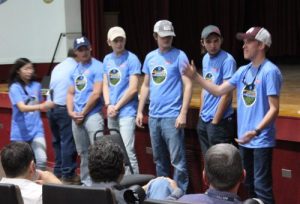
SystemsGo hosted a BBQ dinner event for the neighbors in Willow City. Seniors, Bryce Erwin and Sergio Walle, pictured below,  spoke at the event. Their purpose was to educate attendees about the educational process of the program and how it relates to the upcoming launches, as well as to share their own experiences in the program.

Additionally, Harrison Spisak and Corbin Smajstrala spoke to the Morning Rotary last month on similar subjects.

Mr. Matthes would personally like to thank all four of these young men for committing to these events and participating in them. In both cases, participants and SystmesGo staff commended them on their exceptional performances.

This article is the fourth for the 2017/2018 school year in a series of periodic updates that will follow the Fredericksburg Engineering/Rocket program. This school is a participant of the SystemsGo STEM program. This series of articles is intended to support and encourage students in the program as they share their working status and accomplishments throughout the year in the program. These publications will be available for tags and re-posting.

www.systemsgo.org as always is the place for more information on this program. You may also email them at info@systemsgo.org . Take the time to get your school involved, the future of your students will be greatly benefited.