SystemsGo New Mexico Rockets 2018 Launches Were a Great Success Saturday in Jal

Congratulations to SystemsGoNM on a great launch in Jal, NM and completion of their second year. Saturday, Seven schools attempted launching a total of 18 rockets, four of which were Transonics.  These are new to this launch site this year as they only attempted 1 lb/1 mile vehicles at their inaugural launch last year. All four Transonics launched successfully and 10 of the 1 lb/1 mile vehicles launched, leaving only four vehicles unable to launch. That is quite an impressive start for the New Mexico program branch. Staff from SystemsGo in both Texas and New Mexico were very pleased with this year’s launch outcome.

Since the New Mexico program is still in the learning stages for both the schools and the launch personnel, having only four vehicles unable to clear for testing is really a great start for this second year, especially with the addition of Transonic rockets. But more learning to enhance and improve the program for schools and team is still in the works for next year and beyond.

Dignitaries from Chevron, Virgin Galactic and a New Mexico State Senator, along with press were on hand to observe, commend and report on the success of the day. Many were quite impressed with several problem solving fixes that Chelsea Burow, pad operator was able to institute in order to ensure the successful launch of some of the rockets. These were great teaching moments for both students and other personnel at the pad.

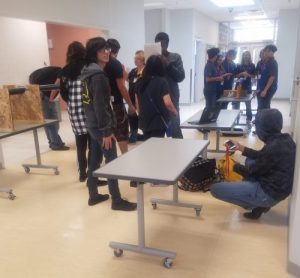
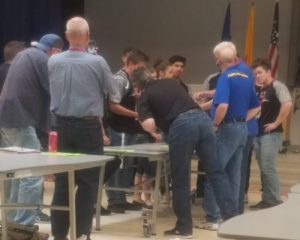
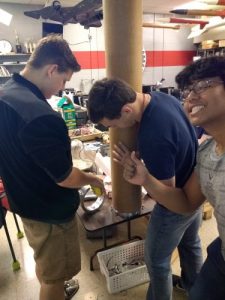
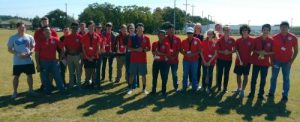
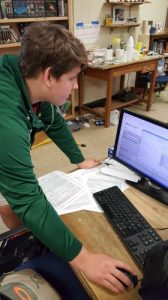
Stage 1 and 2 opened Friday afternoon for early rocket checks and clearing. Here are a few pictures from that event at the Jal Elementary School. Photos provided by Naira Mendoza, SystemsGo New Mexico.
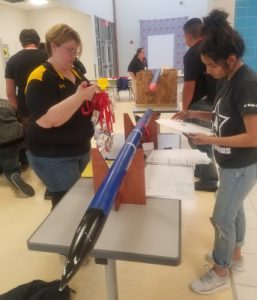
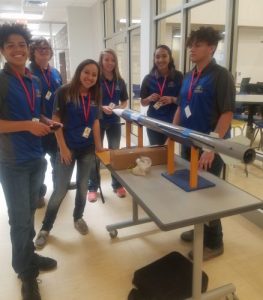
Stage 1

 Stage 2

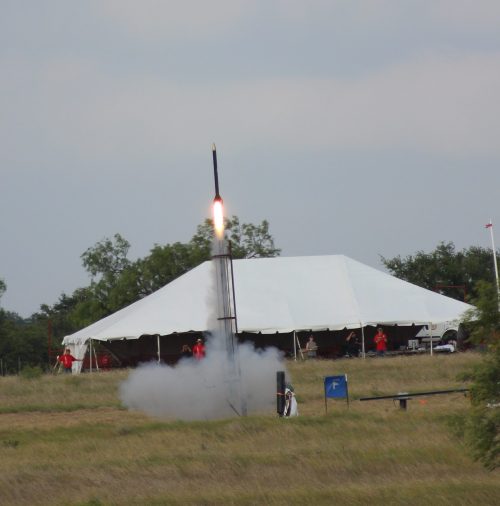
The Jal High School rocket featured below on pad A was the first to be launched for the day, and the first Transonic up for the program. It was reported to have been a beautiful launch. They have a lot to be proud of with this vehicle.

These photos from the pad were sent in by Chelsea Burow, SystemsGo team member and pad operator.

Chelsea also reported that three students from Jal High School helped her at the pad, Saturday. She regrets that she cannot remember all their names, so as to not forget any one of them all names will be left out. According to Chelsea, these three students were a great asset to her at the pad. She said that they were not only helpful, but very polite and she was very happy to have them at the pad with her. They have told her that they plan to return to help again next year, which she thinks is an awesome idea.

Unfortunately things were quite busy for all personnel so I did not receive many photos for this article, but two links are posted below these pictures, where more can be found.

0F599589-AC07-403D-92D1-253126114952If you saw the picture of this new sign in Friday’s post, you probably figured it was big. This may help put it in perspective, as SystemsGo pad operator, Chelsea Burow, stands next to it.

The following two links are a good place to find photos from Saturday’s launch.

https://www.facebook.com/pg/SystemsGoEducation/posts/?ref=notif

https://www.facebook.com/pg/SystemsGoNM/posts/?ref=page_internal

This closes out the SystemsGoNM launch activities.

Tomorrow the team members from SystemsGo in Texas will be continuing operations in Willow City for the Fredericksburg  launches. Dave Willden, SystemsGo New Mexico head, will be coming to help at these launches.

Rockets 2018  will continue with two  more launches. The first will be held at the Stewart’s Hillview Ranch in Willow City, Texas, as mentioned above. It is host to the largest of the now three launch events. This year’s launch is a little earlier than usual with the event taking place on the weekend of April 26-28, 2018.  This testing site covers the Fredericksburg and Hill Country area schools and all Texas schools not participating in the Houston launches.

Next, in Smith Point just south of Anahuac, Texas,  the Houston area schools will launch, on the weekend of  May 11-13, 2018. If you have been to the Houston area launches in the past you may want to check out the SystemsGo website for information because this is only the second year at this location. Information and a map link are available on the website.

The senior groups are tentatively scheduled to launch their Goddard level rockets at White Sands Missile Range (WSMR) in New Mexico in late June.  These are not available for public viewing or Livestream due to being tested on a military facility, but blog and SystemsGo updates will be posted online as available during that week.

If you plan to attend any of this year’s launches please register for your attendance ticket at https://www.greateventseats.com/SystemsGo or they may be gotten at the gate. These are free but required for admittance to each site.  Reserving them ahead at the website is preferred to obtaining them at the gate because the latter slows entrance to the site and may result in you missing the viewing of your intended launch.

You may also view any of the launches except WSMR on Livestream. That link will be available on the SystemsGo website closer to the launch.

The launch schedules for each venue are available at http://www.systemsgo.org/events/ . I will post it here for each launch day as well. I want it to be as accurate as possible so I will refrain from posting schedules until the evening before each launch day in case there are any late changes.

Please watch the SystemsGo website, SystemsGo Facebook page,  SystemsGo Twitter feed: https://twitter.com/SystemsGoNews and this blog for upcoming information on these events.

More event details will be available here in upcoming days/weeks as events get closer. Daily reports featuring schedules, school names, results, pictures and some editorial content will be posted during the events.

www.systemsgo.org as always is the place for more information on this program. You may also email them at info@systemsgo.org. Take the time to get your school involved, the future of your students will be greatly benefited.

Hope to see you at the launches! #ItISRocketScience #RideTheSky #Launcher01

SystemsGo New Mexico Blasts Off Its 2nd Year of Rocket Launches Tomorrow

Hello Rocket Fans, are you ready to #RideTheSky, cheering on your innovative, creative, intelligent students?! Well, tomorrow is the day! Rockets will be headed into the heavens in Jal, New Mexico. This is the second year for the SystemsGo New Mexico group and they are ready and up to the challenge, as they add Transonic vehicles to their launches for the first time at this venue. Last year they only attempted 1 pound/1 mile rockets so it will be another new learning curve for the students and volunteers at the site. No worries though, they have been training for this and the group has it all in hand.

Stage 1 and Stage 2 rocket check ins start at 1:00 today and run through 5:00 p.m. at Jal Elementary School. If your school’s rocket clears stage 2 today, Friday, it must remain at the elementary school overnight. Pick up time starts at 7:00 a.m. for these rockets.

Check out the new welcome sign at the site. That is pretty amazing!

The launch site at Phillips Hill Road will open for Stage 3 for rockets cleared on Friday evening only, at 7:30 a.m.  All others report to the elementary school for Stage 1 and 2 checks and clearing. Do not bring your rocket to the launch site unless it has been cleared at Stage 2.

Please note, schools that were here last year, both the Stage 1 & 2 facility and the launch site are in different places from last year. Be sure you have correct directions and the new map link: http://www.bringonthescience.com

Recovery teams you will have a briefing at the launch site at 7:30 a.m.

General admission to the launch site begins at 8:00 a.m. Rockets are scheduled to begin launching at 8:30 but no sooner. Of course, as I mentioned yesterday, they are subject to wind, weather and workmanship all of which can delay a launch. Better put in the immortal words of Mr. Brett Williams, “A hundred things have to go right for a successful launch, but it only takes one thing going wrong to prevent it.”  With that being said, take a seat, have patience, and just have fun. Be sure to bring some sideline entertainment. Books, cards, dominoes, and games are always good, or you can join in Rocket Trivia with Joyce  Bk Abbey,the voice of rockets, who will be there to MC the event.

An important reminder to the day’s events is that you DO need admittance tickets. You can pre-register for these at the following link: https://www.greateventseats.com/SystemsGo . When you register for these, you are also signing a waiver for entrance to the launch site. These are required to get in. You can obtain them at the gate, but it is discouraged as it slows down entrance for you and anyone behind you to the site and may result in you and anyone behind you missing your intended launch. Pre-registration is preferred.

Concessions will be available for purchase at the launch site.  Portable bathrooms will also be set up. As spectators though, remember your chairs, card tables, umbrellas, sun screen, jackets, blankets, and entertainment for down time between launches.

The current schedule of launches is  shown below and is available here: http://www.systemsgo.org/events/ .

Saturday, April 21, 2018
School Name / Teacher 1/1 Transonic
Hagerman HS
Andrew Rodriguez
1
Hobbs HS
Shawna Carter
5
Jal HS
Nathan Richard
1 1
Lake Arthur HS
Steve Goluska
1 1
Loving HS
David Janzen
2 1
Lovington HS
Michael Dodson
2 1
New Tech Odessa HS
Richard Lindner
2
7 Schools Launching
Totals 14 4
Total Rockets 18

Don’t forget, all volunteers, teachers, teams and admins are invited to Jal Country Club for a hamburger and hot dog cook out from 5:00 p.m. to 7:00 p.m. Dave Willden is your gracious host for this event.

Current weather conditions for Saturday show a bit of a warm up.  40 is the predicted low and 71 is the high. That is not too bad for the desert in April. Dress is layers, you may need a light jacket in the morning.

Good luck to the seven schools participating in this year’s New Mexico event. No matter the outcome of your launch, you have successfully designed, built and delivered a rocket to the pad for testing. In doing just that, you have learned more and will take with you more than some achieve in a life time.

Parents and spectators be sure you are ready with the cameras to catch the expressions on your students’ faces for two different events. The first is when their vehicle leaves the pad headed into the sky, and the second is when Recovery hands it back to them after launch and recovery. These are the faces of joy, excitement, and fulfillment  you want to see as much as you do that rocket soaring into the blue.

SystemsGo New Mexico has a Facebook page: https://www.facebook.com/SystemsGoNM/  , and also a twitter feed: https://twitter.com/SystemsGoNM . These are a good source of information.  Joyce Bk Abbey will be manning both and posting pictures and updates throughout the day in leu of Livestream which will not be available at this particular launch this year.

SystemsGo New Mexico is headed up by David Willden.

Please watch the SystemsGo website, SystemsGo Facebook page,  SystemsGo Twitter feed: https://twitter.com/SystemsGoNews and this blog for upcoming information on these events.

After completion another report will be posted here, featuring results, pictures and some editorial content cataloging the success of the event.

http://www.systemsgo.org as always is the place for more information on this program. You may also email them at info@systemsgo.org. Take the time to get your school involved, the future of your students will be greatly benefited.

Hope to see you at the launches! #ItISRocketScience #RideTheSky #Launcher01

Fredericksburg’s Engineering Rocket Program-Second Term Update #2 (February 16-April 13)

It is April and we have some catching up to do on the  FHS Engineering program. It has been two months since our last update and quite a bit has been happening on all levels.  Along with class work, launches start this month in Jal, New Mexico  on April 21 and Fredericksburg (Willow City) April 26-28 so time is becoming a factor for the Junior and senior groups.  Each group is working hard to meet their timelines. Rockets 2018 is the pinnacle event for the upper level groups, as their rocket projects are basically the final grade for the year.

The seniors have approximately 73 days until Redbird 19 is TENTATIVELY scheduled for testing at White Sands Missile Range, which is usually in the last week of June.  This date is still not a permanent date until the Army finalizes, closer to that time. Mr. Matthes will announce that date when it becomes readily available. Their completion date for  preliminary systems tests is usually two weeks before school ends. This would be May 18 which cuts them down to 59 days.

More on these groups and their current status reports will be later in the article.

Freshman participated in a field trip on March 1st, in which they visited Southwest Research Institute(SwRI), the Center for the Intrepid,  and the UTSA VIZlab.  At the Center for the Intrepid, the students were able to see biomedical equipment at work helping wounded Veterans in their recovery. Along with the engineering aspect of this, Mr. Matthes hoped that they took away a new respect for our military servicemen and women and the full extent of the sacrifices they make each day for our country’s safety.

Former FHS Engineering Alumni, Drake Horstman, was the students’ guide when they visited the UTSA VIZlab, toured the campus, engineering lab and community areas. During the visit, Drake, provided  entertainment and wisdom coupled with numerous stories about his experiences in the FHS Engineering Program. Inside the lab, the students were able to see several visual interaction devices.

At Southwest Research Institute, students learned technical information about engines, modifications and fuel efficiency. The content here was a little over their knowledge base,  and may have overwhelmed the students a little, according to Mr. Matthes. In spite of that, it was still a good visit for the students, and the coordinator at SwRI commented  about their behavior stating, “they are better than a lot of the college students who come through.”

These visits are designed to expose the students to different aspects in the engineering fields. The impressions they take from here will help them make decisions down the road on whether engineering is for them, and if so, help them determine a particular area of interest.

The Freshmen also participated in their first Critical Design Review (CDR). They were tasked with presenting solutions to fix the damaged launch tower for the Red Bird rockets. This gives them practice on presentation skills and feedback on designs for their project.

Mr. Matthes stated that, “the students may have felt “roasted” with constructive criticism and feedback. But, that they should know, that it is part of improvement and growth of design and not personal.” He mentioned that this was also discussed briefly at the end of the trip to SwRI, by the hosting engineer.

The sophomores have advanced well in the curriculum and are presently several weeks ahead of their  current deadlines. Their current focus is on dimensioning objects, denoting measurements and creating fabrication notes. Due to this, their proficiency has advanced well.

Mr. Matthes is quite impressed with the Juniors selection of a class name. Here is how he describes it,”The juniors named their class “Conatus” which translates from Latin, to impulse and means striving.  From a historical philosophy origin it relates to the nature of something to continue its existence.”

The pressure is on with an April 19th rocket completion date looming ever closer. The rocket must be completed one week prior to their April 26th launch, because after it is completed they must also complete a Flight Readiness Review which often uncovers errors and problems that must be resolved.  This week provides adequate time for those things to happen.

According to Mr. Matthes neither team has anything that quite resembles a rocket as of yet, but each is working through a pile of parts that arrived. Most were not ordered until the end of March which was quite late, but each group began working with tangible parts  the end of last week.

Team #2 decided to make use of Monday’s teacher in-service day, by putting in about four hours of work. Shown below from team #2 are clockwise starting from the bottom, Cooper McDonald, Gloria Burns, Ethan Scott, and Dawson Harkins as they take measurements off the back-end of the rocket and motor system.

Both teams do have a work in progress at this point.  According to Mr. Matthes, “Pressure makes diamonds and rockets.”

Incidentally, another incentive for each comes from SystemsGo. A flawless flight and perfect recovery may afford that team the chance to re-fly their vehicle with a different fuel grain in order to collect data for SystemsGo.

The miniature Teststand is an ongoing project for the juniors as well. They are using LabVIEW programming as a means to start ignition and measure thrust, as well as using 3D modeling in order to develop a unique physical Teststand model. The class is split into working groups of 3. According to Mr. Matthes, “They are on track to have this done by the end of school and I am excited to see what they come up with.”

Seniors are progressing well with Redbird 19, wind tunnel and the large Teststand development.

Construction is beginning on Redbird 19 now that parts are returning from Heartland Enterprises. According to Mr. Matthes the parts, “look beautiful, and most parts are in.” Now that parts are available there is a bullet list of accomplishments to be achieved including, overlaying the nose cone in fiberglass, creating a mold and then pouring the fuel grain, making a custom hose for the injection valve, testing  recovery chute deployment, integrating avionics into the vehicle, and Mr. Jenkins is in the process of manufacturing the payload.

Here Harrison Spisak, Bryce Erwin, and Sergio Walle are checking the fit of the injector, nozzle and retaining ring in their fuel grain liner.

Currently wind tunnel is well underway, as students are receiving and ordering parts. The program is nearing completion and the electronics used for the drag testing measurement has arrived. Hunter Smith, a SpaceX programmer at the McGregor facility has been assisting Rebecca Sechrist through a Skype session. He has been providing analysis and comprehension in areas he has already assisted, as well as a starting point from which to move ahead. According to Mr. Matthes, “The students are making headway but must begin to make a push in order to finish this outstanding design by summer.”

Deadlines are quickly evolving for Teststand, as the group’s progress here is steady but slow. They have installed a flow meter to directly measure Nitrous oxide. Load cells which measure thrust have been changed out and fuel grains have also been readied for testing.

The stand itself is nearing a test ready state. New to this year’s stand are changes in the injection system. The new system will allow more controls of the flow. A parent plate has been designed by students and fabricated by another local machine shop, Kager Industries,  which will hold a smaller injection disc allowing students the ability to change out the disc which controls the rate of flow. The plate can be installed as soon as the 0.05″ holes have been drilled through. Next, the LabVIEW program will be fully tested on the stand.  Afterwards, a cold flow test will be conducted in order to measure the oxidizer flow rate and determine if the size and pattern of holes in the new disc are correct. If the cold flow tests are successful, then hot fire tests can begin.

The Baby Bird Teststand is still on hold until further notice.

SystemsGo hosted a BBQ dinner event for the neighbors in Willow City. Seniors, Bryce Erwin and Sergio Walle, pictured below,  spoke at the event. Their purpose was to educate attendees about the educational process of the program and how it relates to the upcoming launches, as well as to share their own experiences in the program.

Additionally, Harrison Spisak and Corbin Smajstrala spoke to the Morning Rotary last month on similar subjects.

Mr. Matthes would personally like to thank all four of these young men for committing to these events and participating in them. In both cases, participants and SystmesGo staff commended them on their exceptional performances.

This article is the fourth for the 2017/2018 school year in a series of periodic updates that will follow the Fredericksburg Engineering/Rocket program. This school is a participant of the SystemsGo STEM program. This series of articles is intended to support and encourage students in the program as they share their working status and accomplishments throughout the year in the program. These publications will be available for tags and re-posting.

www.systemsgo.org as always is the place for more information on this program. You may also email them at info@systemsgo.org . Take the time to get your school involved, the future of your students will be greatly benefited.

2017/2018 Fredericksburg’s Engineering/Rocket Program-October/Early November Hi Lights

September  and October have come and gone and  we are now half way through November and the Fredericksburg High School Engineering Program is deep into their studies busy learning and working at all levels. Eight weeks have passed since our first Engineering Program update and the first semester is halfway through.
Since our last update, the Freshmen have created an electrical design for the NASA built and designed Orion space capsule. Keith Kunz from Teledyne was their audience for this presentation.  Teledyne works with offshore oil exploration developing and designing hard and software for their use.  As an audience for these presentations, individuals like Mr. Kunz, provide constructive criticism such as design strengths and weaknesses, areas that did not match the design logic, things that were overlooked, and skills of presentation.
Currently the Freshman are working on a bio-engineering project, which will be designed to help student, Cody Bearden, who has Spinal Muscular Atrophy, which keeps him confined to a wheelchair. It will be a hoverchair.   Yesterday they presented their project to a new audience, consisting of Tim Nolan, an  AirEvac pilot and previous Marin Corps helicopter pilot, Todd Keener a mechanical engineer, and Scott Netherland, Executive Director of SystemsGo .  Details on this presentation will be forthcoming in our next update.
Sophomore students are still working at their own pace in this year’s class. Due to this,  the further along the year rolls, the larger the gap is between the slowest and fastest student. Because of this some are already starting to learn Isometrics, which are 2D representations of 3D objects. The class as a whole is also studying Dimensioning.
“They are all making good progress, but having them self pace has led to some really taking off with AutoCAD,” states Mr. Matthes.
The Engineering program flew in Brian Evans from Space Propulsion Group out of Butte, Montana to conduct a two-day seminar for the Juniors and Seniors.
Pictured here are Juniors, Gloria Burns, Cooper McDonald and Eston Cooke with Mr. Evans: 
According to Mr. Matthes, “Students really enjoyed having insight from Mr. Evans.”
For the past two months, the Juniors have been learning new skills on Excel which allowed them to better understand the math of starting a new model. They have been creating spreadsheets for a hypothetical bakery where they used calculation, look ups and other functions in order to track materials, hours, and productivity.  Class time has been split between this project and the physics of flight.
Three weeks earlier, the class flew their Generation 1 rockets.  The parameters for this first flight, were just have a rocket on the pad to fly and served as a platform for them to learn and start asking questions on how to correct their flights.
These flights were of varying degrees of stability with some being completely unstable, some having a corkscrew affect and others displaying very straight flights. The instruction on stability follows this flight test and leads into the Generation 2 tests.
Last week Generation 2 rockets were finally launched.  They had been patiently waiting due to several scheduling conflicts with school college fair days and bad weather, windy days.
For this test they actually had to prove the stability of their rockets. This is accomplished by literally cutting the rockets in half.  Students are forced to be intentional about stabilizing their vehicles. The pictures below are from the Generation 2 flights.
Here, Eduardo Memije and Gloria Burns load their G1 Rocket for launching.
In this photo, Deja Turkett and Bradley Plaza take their turn for launch.
Here the whole Junior class group displays their rockets on launch day.
Currently they are splitting their class time between LabVIEW Programming which they have just begun and the continued study of the physics of flight. Next they will be studying fluids, aerodynamics and drag, and impulse, as well as factors affecting drag, this is all part of prepping for Generation 3 rockets.
According to Mr. Matthes, “Their next objective is to reach 1800 feet using RockSim to design the rockets.  They are assessed on the closeness of construction to design:  it is a tough mark to make without extreme precision.”
On Tuesday, Nov. 7, the Seniors traveled to Houston. After arrival, the group spent four hours at Space Center Houston. According to Mr. Matthes, the students, “had a blast!”

In this mock up, Evan Knapp mounts the Space Shuttle on top of the 747 that transports the shuttle back to Kennedy Space Center.

Corbin Smajstrla is seen here pumping iron on different planets where the gravity is not the same.
Chris Calzada (left) and Rebecca Sechrist (below) pose for pictures in space.
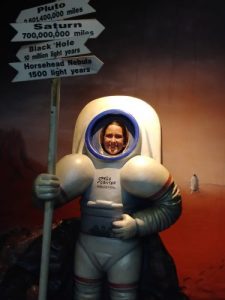
Evan Knapp maneuvers his EVA device back to the ISS as Chris Calzada and Harrison Spisak look on.

 Next the group visited Rocket Park so that the students could get a visual grasp on the enormity of the Saturn V Rocket that took men to the moon and back.
 Relaxing at the end of the day beneath the Apollo capsule on the Saturn V.
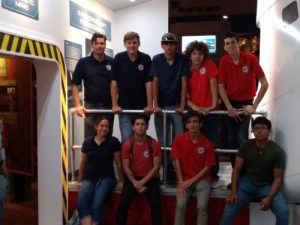
The entire travelling crew. Top row: Instructor Andrew Matthes, Harrison Spisak, Chris Calzada, Corbin Smajstrla, and Evan Knapp. Bottom row: Rebecca Sechrist, Pierce Vasquez, Joey Leal, and Sergio Walle.
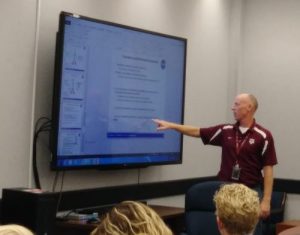
Later, Joyce Abbey, the voice of the SystemsGo launches, and Dave Ladrack, a longtime program friend and supporter, joined the students for dinner.
On Wednesday, Nov. 8, they arrived at Johnson Space Center along with nine other schools and met, Chris Madsen, pictured below, a Guidance, Navigation and Control (GNC) engineer in the flight dynamics department.
Mr. Madsen coordinated and oversaw the program for the students, and gave an overview of College Co-op opportunities. He encouraged the students to be involved and to acquire work experience while still in college.  All nine schools gave presentations of their flight models explaining the projected flights of their rockets to engineers and representatives from other schools who have also taken on a similar tasks.
After lunch the documentation students need in order to be cleared for flight at White Sand next summer, was discussed. Mr. Madsen used examples and an overview of his job in comparison so that students could see that what he does is similarly an extremely more complex version of what the students are building.
 Later that afternoon, FHS had a meeting to present preliminary design reviews of both the wind tunnel project and Redbird #19 to five engineers. This was  three hours of presentation and a question and answer session.
“It was a tremendous opportunity for the students and the feedback was excellent,” reported Mr. Matthes. “The trip was a success.”
Design progress has been made on Redbird #19 but many details still have to be worked out before it can be considered an integrated system.
Mr. Matthes feels that, “The input from this trip will be significantly helpful for drawing both flaws and considerations to light as they proceed forward. “
 The group has been working hard to pull together everything for the Redbird #19 presentation, this has made it necessary to put Teststand on hold for the past week.
Something new the Engineering Program is working on, is the N.E.W. Y.O.U. Event, short for National Engineers Week Youth Outreach United. This will be the first time the FHS Engineering Program will be hosting this event. The purpose of this event, is to expose students from 4th through 8th graders to engineering. They will participate in activities and interact with high school engineering students while learning in a fun and relaxed environment.
FHS Engineering Program has already been readying for the event with two separate planning meetings involving about 20 students in order to organize and divide tasks. Everything is moving along well and they anticipate a great event.
National Engineers Week will begin February 18th. The N.E.W.Y.O.U Event will be held the day before on Saturday, February 17th.  Forth through sixth graders will attend the morning session, and seventh and eighth graders will attend the afternoon/evening session.
This article is the second for the 2017/2018 school year in a series of monthly updates that will follow the Fredericksburg Engineering/Rocket program. This school is a participant of the SystemsGo STEM program. This series of articles is intended to support and encourage students in the program as they share their working status and accomplishments throughout the year in the program. These publications will be available for tags and re-posting.

www.systemsgo.org as always is the place for more information on this program. You may also email them at info@systemsgo.org . Take the time to get your school involved, the future of your students will be greatly benefited.


2017/2018 Fredericksburg’s Engineering/Rocket Program-September Hi Lights

The new school year is three weeks into session and with it, the Fredericksburg High School Engineering Program has begun working toward new goals.

This year (Fall semester) there are actually classes representing each grade level. This is different from last year in that there were two classes of Freshman in the fall and two classes of Sophomores in the spring. There will be a class of 12 Freshman  in the fall and another class of 12 in the spring, and a class of 16 Sophomores in the fall and another class of 12 in the spring.

The Freshman classes began by learning about the design and development loop. This is important because it gives them an understanding on how industry approaches problems in order to develop new innovation. Leadership and teamwork have been a strong topic of class discussion as well as exercises to put these traits into practice. This week in class they are testing cardboard structures they have built as part of the structural project part of their class.

  Pictured: Kyle Kuhlman, Andrew Kendrick, and Gavin West.

   Pictured: Luke Tucker, Benji Robles, and Kolby Fryburger.

  Pictured: Paige Guzy, Emily Ma, Evertt Borton.

 Pictured: Nehemiah Cabral, Sadie Eidson, and Eli Rode.

  Here the whole class shows off their cardboard structures for testing.

Sadie Eidson with an unofficial test of her structure post ‘real’ testing while Gavin West looks on awaiting collapse without satisfaction.

Pictured here is this semester’s Freshman class: Back Row: Kolby Fryburger, Luke Tucker, Everett Borton, Gavin West, Nehemiah Cabral, Benji Robles. Front Row:  Eli Rode, Andrew Kendrick, Kyle Kuhlman, Sadie Eidson, Paige Guzy, Emily Ma.

Mr. Matthes reports, “They are doing very well.”

Sophomores are practicing drawing multi-views by hand. Students are able to work at their own pace this year, as long as they meet scheduled deadlines on assignments. This allows for those that learn at a faster pace to advance in the curriculum a little sooner. It should also allow them to have more time to become proficient on 3D modeling which will be a skill they will need as they move up in future classes. Soon they will begin the basics of drawing  on AutoCAD. Due to the individual pacing, one student was able to  begin AutoCAD yesterday.

Pictured here is this semester’s Sophomore class: Back Row: Noah Downey; Tommy Johnson, Gavin Eckert, Lane Wallendorf, Ryan Scroggie, Landon West, Clay Crouse. Front Row: Dalton Waters, Blake Boubel, Ryan Davis, Luke Duderstadt, Ryan Majors, Chad Braden, Gerry Balderas. Not Pictured here are Josephine Shaw and Alek Vasquez.

Junior  and Senior classes will encompass both semesters as one class group each. There are 22 Juniors in the program and 10 Seniors.

Due to the accelerated class schedule implemented at FHS last year, most one year courses are now accomplished in one semester. Because of this, the Junior year course study is actually two classes in one spread out over both semesters. Class time is currently split between two courses of study. In the first half of class they are beginning the basics of hybrid rocket propulsion and the book learning of the math to model it. In the second half of the class, they have researched advanced technology and dimensional analysis.

According to Mr. Matthes, “Many of them reflected afterward that they have a better understanding of math, how to work with units, what the units mean, and how the math has meaning and can be worked like a puzzle.  They are very excited and extremely sharp.  They work effectively as a group and seem to have great chemistry together.”

Pictured here is this year’s Junior class: Back Row:  Jabin Gipson, Cooper McDonald, Ander Castaneda, Gabe Voorhees, Jose Escalante, Clay Ellebracht, Dawson Harkins. Middle Row: Jana Brockmann, Robert Sanchez, Esten Cooke, Gloria Burns, Carl Wilger, Nicholas Rodriguez, Lucio Castro, Cody Blohm. Front Row:  Eduardo Memije, Robert Zowie, Brad Plaza, Ethan Scott, Deja Turkett, Rudy Avila, Josh Handley.

The Seniors are a busy and ambitious group this year. They have taken on four large endeavors including: The Red Bird #19 Rocket, a wind tunnel, the  NASA large motor test stand, and the Small HyperTek interface test stand, known as Baby Bird.

The Red Bird #19 will actually be a modified version of the Red Bird #17 from two years ago which did not leave the rail due to the injection failing. They will be rebuilding the propulsion and injection systems in order to correct the past problems with the rocket that kept it from launching in 2016.  –Small editorial comment here: As we have seen with other schools in past years at WSMR, this does not mean an easy fix. Quite often trying to correctly discern and correct another team’s issues on an unsuccessful vehicle can be harder than starting from scratch. It will be interesting to follow them and see what they find and how these new modifications affect this year’s flight test at WSMR.  FHS Engineering Project Leadership for Red Bird #19 is Chief Engineer, Harrison Spisak, and Project Manager, Bryce Erwin.

The Wind Tunnel is new for this year. This device is for testing drag on an object. To do this, the system uses a fan to create artificial wind which is forced over the object to create a drag.  FHS Engineering Project Leadership for the wind tunnel is Chief Engineer, Pierce Vasquez, and Project Manager,Rebecca Sechrist.

Testing on Baby Bird, the Hypertek test stand continues this year.  The purpose of this test stand, as highlighted in the last year’s updates, is to test a fuel grain system designed and developed by the students to interface with the hypertek injector and tank. Original plans were that three successful tests on this test stand would result in the opportunity for the seniors in the Fredericksburg Engineering Program to fly a new Hybrid student developed rocket at Willow City. This year’s team is continuing testing and development for this goal.  FHS Engineering Project Leadership for this test stand is Chief Engineer, Evan Knapp, and Project Manager, Sergio Walle.

Testing also continues on the NASA Test stand for large motors. Even though there is no new grant from NASA this year, there are plenty of materials  acquired from last year’s grant to continue testing.  FHS Engineering Project Leadership for this test stand is Chief Engineer, Joey Leal, and Project Manager, Corbin Smajstrla.

Mr. Matthes commented about this year’s seniors, “The group, already has plans set to come in this weekend to begin their endeavors.  They seem both excited about the projects and motivated to accomplish them.”

Last school year the program implemented a Senior out of class work schedule. Students signed a contract requiring them to commit to a set amount of overtime/after class work time in order to meet all deadlines and complete their rocket/projects for the year. The group is currently establishing a working schedule in order to implement these hours.  

Pictured here is this year’s Senior class: Back Row:  Harrison Spisak, Jacob Wienecke, Evan Knapp, Bryce Erwin, Sergio Walle. Front Row:  Corbin Smajstrla, Rebecca Sechrist, Pierce Vasquez, Joey Leal.  Not pictured in the seniors picture was Chris Calzada.

You may have seen the following information on a flyer your Engineering student brought home inviting you to the FHS open house  that was held on Monday, September 11. If you no longer have it or were not able to attend, Mr. Matthes has asked that you take note of the following date and time for:

FHS Engineering Night

SAVE THE DATE:

When: Monday,  SEPTEMBER 25TH, 6:00PM

Why:  Learn about the nationally recognized FHS Engineering/Rocket Program

Who:  Anyone – tell other parents and your friends, even if they aren’t in the program until next semester or aren’t a part of it yet. It is available to interested and current students as well as parents and interested community members.

Where:  Auditorium, plan on sitting up front for an “A”. Address is 1107 S. Highway 16

What:  Information/Order forms on Polos, t-shirts, decals and lanyards.

Including: Program objectives, overview of classes, media, and special guest alumni via Skype.

Follow Us, the FHS Engineering Program

You and your student are also invited to use the forms of media communication listed below to receive information and updates on all things Engineering.

The first is REMIND, (a text format) where you will find event notifications, updates, organizational coordination, and brief positive news provided on the program.

Text to 81010 the message @fhseng2021 for freshman Principles of Applied Engineering class

Text to 81010 the message @fhseng2020 for sophomores Engineering Design and Presentation 1

Text to 81010 the message @fhseng2019 junior Engineering Design and Presentation 2

Text to 81010 the message @fhseng2018 seniors Engineering Design & Problem Solving, Scientific Research and Design

Mr. Matthes sincerely hopes that students and parents will more actively follow and invest in the Engineering Program here at FHS.  One method to help with this is providing updates related to engineering and our Engineering Program through social media.  These will contain postings related to student activities as well as industry activity.  Familiarity with current events and current research in industry is a major source of inspiration and exposure to potential future endeavors.


fhseng

https://www.instagram.com/fhseng/?hl=en


The entire Engineering Program was invited to a movie night at the  engineering classroom, Wednesday evening, September 13 at 7:00 p.m. They viewed the movie the Matrix. Mr. Matthes  believed that a correlation between the students and the movie characters could be drawn and that could be beneficial to them. “It is my hope they recognize the metaphor for their own lives and begin to believe in themselves as I believe them, as Morpheus believes in Neo.” About 20 were able to attend.
 This article is the first  for the 2017/2018 school year in a series of monthly updates that will follow the Fredericksburg Engineering/Rocket program. This school is a participant of the SystemsGo STEM program. This series of articles is intended to support and encourage students in the program as they share their working status and accomplishments throughout the year in the program. These publications will be available for tags and re-posting.

www.systemsgo.org as always is the place for more information on this program. You may also email them at info@systemsgo.org . Take the time to get your school involved, the future of your students will be greatly benefited.


Tuesday, T-1 Briefing and Set up Day at WSMR and Wednesday Schedules

SystemsGo and the participating schools had a productive first day at White Sands Missile Range (WSMR) today. They started the day with the T-1 Briefing, which included several presentations by WSMR staff on all they do to make these launches possible. It was an educational and informative session.

WSMR personnel made introductions so all involved would know who they are and who to contact for help from the base. At the end, Scott Netherland introduced the SystemsGo team and specified their roles with the organization. We finished around 11:00 and headed out to West Center 50 launch site(WC50).

All equipment and rockets had to be set up and completed to meet the Wednesday testing schedule. Everything was eventually finished by 8:00 p.m. It was a very productive day albeit a little long and quite hot. It was a bit of a “Murphy’s Law kind of day”.

The first incident was our truck running out of diesel about 6 miles from the launch site. Gary, one of our range specialists, came and saved the day for us. Then the fill and fire system wouldn’t work correctly, only to discover that it was a bit of human error not system error. We were able to find humor and relief in the fact that it was actually all ok. One of the generators ran out of fuel as well. The last thing for the day was a screw on the rail that prevented the loading of the Fredericksburg rocket and much maneuvering had to be done to fix both the rail and the rocket lugs to get it loaded so we could all finally go home for the evening. There were other minor things, but it was all things that could be fixed.

Tomorrow will be a super early morning for all of us. Teams launching and SystemsGo personnel will be headed out to WC50 at 2:30 a.m. And those going to watch the launches from Mission Control will be heading out at 3:30 a.m. to meet our rep at the main gate by 4:30 a.m.

6:00 a.m. Fredericksburg High School
7:30 a.m. Union Grove High School
9:00 a.m. Alamo Heights High School

If it is a perfect day and all goes well with no exceptions with each launch, then the tests should be complete by 12:00 p.m. Realistically, this is a very tight launch sequence with little to no room for errors. If we do not get all three launches tomorrow, then there will be four launches on Thursday. Friday has now been canceled as WSMR has other high priority missions that need the range, so there is no longer a back up day.

Therefore, let us all hope and pray for the best for each school so that they may have a successful launch tomorrow and that all schedules hold true.

Here is the current preview of the launches scheduled for Thursday. Tomorrow’s blog will have a final schedule for the day based on Wednesday’s test success.

Thursday launch order: Anahuac, Booker T. Washington (1), Booker T. Washington (2)
Event details will continue to be available here. I will provide more information each morning as to how the schedule and other event details will progress for that day and how launches went for the schools testing that day. Pictures are not allowed on the range, but some pictures of teams getting ready to leave for the range with their vehicles might be available. If anything is available I will post it for your viewing pleasure.

www.systemsgo.org as always is the place for more information on this program. You may also email them at info@systemsgo.org .Take the time to get your school involved, the future of your students will be greatly benefited.

Fredericksburg STEM Academy/Rocket Program-Launch Report for Rockets 2017 WSMR Launch Week Red Bird #18 Update

Red Bird #18 is scheduled for testing at White Sands Missile Range(WSMR) next Wednesday, June 28. This marks the last big event for Rockets 2017 and the Fredericksburg STEM Academy for this season.

These are the Goddard level rockets, which are the culmination of all the skills the students have learned throughout their years in the STEM program. This marks the final senior project for those schools that participate in this level of the SystemsGo program.

According to team member, Sterling Weatherford, “We are finishing up our rocket production, with integration and final testing before we head off to White Sands.”

Mr. Matthes reports that welding on the vehicle is complete and it is together. Below is a pictures of the class with the vehicle at SRM Manufacturing, one of the outsource businesses they contracted for help with welding. In order  left to right the students are Jesse Cedillo, Colby Marthaller, Ricky Robles, Langston James, Nathan Bain, Chase Ottmers, Hannah Boubel, Joseph Sanchez, and Sterling Weatherford.

Other members of the group not pictured here are David Becker, Drew McDonald, Matthew Dulaney, Corbin Styles,  Josh Treibs,  Payton Carroll, Cody Pruett, Levi Crawford, and Ian Kendrick.

The students report that they are putting finishing touches on the nosecone, including sanding and a gel coat to create a smooth finished surface. They will be installing the complete motor system in to the rocket today, Wednesday, June 21.

They had been working on integrating the recovery, propulsion and fuel grain systems into the vehicle.  All parts have been fit tested for the integration. Recovery, avionics, and the payload have since been successfully installed.

They are finishing the assembly of the fuel grain including an ablative that the students have chosen to add to the post combustion portion,  afterwhich they can install the fuel grain and the rest of the propulsion system into the rocket.

 Here one of the students shows the injection valve and injector bell arrangement.
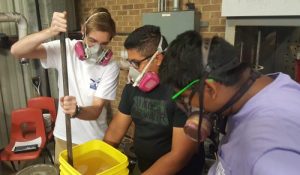
Here is a picture of Drew McDonald, Ricky Robles, and Jesse Cedillo earlier when they were mixing fuel for the second attempt at the fuel grain.

Their final actions will be to test the black powder charges for the recovery system and then they will be ready to move the rocket to WSMR for their full vehicle launch testing.

“We are extremely excited to test our rocket at the upcoming White Sands Missile Range launches,” Sterling reported.

Monday evening they met to discuss  travel plans and trip expectations.

Launches are scheduled for June 28 through June 30. The group will travel out to WSMR on Monday, June 26, and back home again on Saturday, July 1.

There are 5 schools scheduled to launch 6  rockets. These schools include:

  • Alamo Heights (1)
  • Anahuac (1)
  • Booker T. Washington ( 2)
  • Fredericksburg (1)
  • Union Grove (1)

This year is unique in that the Army has some classified tests scheduled that will slightly overlap SystemsGo’s air space on both June 28th and June 30th. This could delay start on Wednesday, and it has already been set to 0700.  The  hope is that all launches will be complete by Thursday afternoon so that Friday will not be needed since another high priority group will be needing that day as a back up day as well. SystemsGo will travel home Friday if this can be accomplished instead of one day later on Saturday.

The current launch schedule is as follows:

  • Monday, Jun 25th             Travel Day
  • Tuesday, Jun 26th             T-1 and Site Set up/Rocket Prep at WC-50
  • Wednesday, Jun 27th       Launch Day One (Three Rockets – Fredericksburg, Union Grove, Alamo Heights)
  • Thursday, Jun 28th           Launch Day Two (Three Rockets – Anahuac, Booker T. #1, Booker T. #2)
  • Friday, Jun 29th                Contingency Day/Travel Day
  • Saturday, Jun 30th            Travel Day

Both the Junior and senior groups presented there projects and made reports on June 1st as their final exam for the year. Below is the junior group after their presentation.

This article is the eleventh in a series, new for this school year ’16/’17 of updates that have followed the Fredericksburg STEM Academy/Rocket program. This school is a participant of the SystemsGo STEM program. This series of articles is intended to support, encourage, and challenge students in the program as they share their working status and accomplishments throughout the year in the program. These publications will be available for tags and re-posting.

Subsequent updates will continue to follow the Senior/Graduates and the progress of the Red Bird #18 rocket after launch at WSMR next week.

Today is 5 days out until the Red Bird #18 group leaves for WSMR. Watch this blog next week for information and reports on this and all the schools’ launches at  White Sands Missile Range.

 This was presented to the Red Bird #18 group after their June 1 end of year presentation. The sentiment still holds as we congratulate this group of graduates on their accomplishments and the achievement of finishing their rocket. Good luck at WSMR!

www.systemsgo.org as always is the place for more information on this program. You may also email them at info@systemsgo.org .Take the time to get your school involved, the future of your students will be greatly benefited.

#Rockets2017 #SystemsGo #FredricksburgSTEMAcademy #Launcher01


Rockets 2017-Sunday’s Report-End of Fredericksburg Launches

Sunday is usually a light day at rockets, but not this year. Although we only had 5 schools, there were 16 rockets to launch. Out of those 15 made it to the air. The last one was still in stage 3  with some issues to be fixed, when nature decided we were done for the weekend and a storm rolled in with lightning and rain. Luckily many areas had been packing  things they no longer needed so at least it wasn’t all left to do in the down pour. We all pretty much got soaked anyway, but hey that is Rockets, the weather is always a factor.

We had a total of 81 rockets launched for the weekend and found all but 14 according to recovery captain, Braxton Roemer, seen here quizzing kids and adults on late 80’s rock and pop music during a break in the action.

This gives the recovery group about a 92% recovery rate for the weekend. It could be 93 because Steve found one late yesterday afternoon but was unable to recover it due to severe lightning, but he knows where it is, so either someone will eventually go back for it, the land owner will find it and bring it in, or it will be Team Burow’s first find next year.

Yesterday, I let Steve go solo on recovery, and I joined my daughter, Chelsea, at the pad. I was able to watch first hand all that goes on to get these vehicles in the air. The pad crew makes it look easy, but it’s a little more complicated than what you might think. The original crew of Chelsea Burow, Anissa Kneese,

Josh Hampton, Bryan Heffner,  and Cade Ottmers has had years of practice to get things right. This year they were even training some new recruits in the program, freshman, Troy Kneese, and senior, Jesse Cedillo.. Jesse will be attending Angelo State University in the fall for computer science.
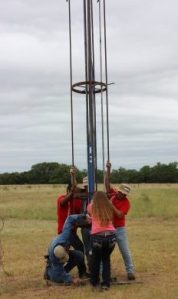
It is a coordinated effort as rockets come to the pad, and they do pictures of the students with the rocket “set” on the rail. Afterwards, the students return to Mission Control so the pad crew can load the rocket properly and safely.

Crew members then attach the match and seat the motor onto the stem assembly, which is a two-part tube fit tightly together, which delivers Nitruos into the tank, and allows Gox to flow over the fuel grain to help with ignition. The stem is fed through the fuel grain and the bell of the motor into the tank of the rocket. This can be difficult as it has to go through very small opens inside the motor and has to be done totally by feel and knowledge of the different motors used in the vehicles,  and the vehicle has to be level while doing this.  It is no small task, but this group makes it look easy, most of  the time. The consensus on the pad is the “L” motors are the worst to seat.  There were quite a few L motors yesterday, but they managed them all. Jesse is seating a rocket in his photo above.

After this is achieved they do systems checks and then raise the rail, ready for launches. This is referred to as “going vertical”.

Pad members work in small groups throughout the pad attempting to load all 6 rails if enough vehicles are available. Occasionally it takes the whole crew at once to raise the rails on some of the larger or more complicated rockets.

When launching begins and a vehicle is “Armed” (this is basically the altimeter is turned on and verified to be working) then all must clear the pad except the two members working to launch a particular rocket. Next they go for fill, after which the launch count down sequence is initiated. At this point the they run for cover in the bunkers.

After the rocket has cleared the pad everyone watches skyward and hopes for a good flight and successful deployment of  the recovery system. Once the vehicle is confirmed down or determined to be too far away and has no chance of coming down near the pad, then the  crew is back out to work the next one.

If a rocket fails to leave the rail, then the pad crew determines if it is something they can fix on the rail or if it has to be unloaded and returned to Stage 3. At which point the students and technicians will re-evaluate and determine if they can fix the vehicle for another attempt at launch, or abort.

The crew members are all past students of the program and know quite well what to look for if a rocket fails to launch. Most of the time it is minor things that can be fixed on the spot, but not always. Another factor that will cause a delay on the pad is empty fuel tanks.  At that point they move to another rail while tanks are replaced.

This is just a small synopsis of what they do and not nearly all of their skills. They are an accomplished group and I really enjoyed my time there on Sunday.  I helped where I could with several rockets, took pictures of students and their rockets, and the launches, and assisted in tearing down the 1 lb/1 ml rails and other aspects of the pad that were no longer needed as we were awaiting the  arrival of the final Transonic launches.

Since most of you know that I am in Recovery out at rockets each year, I will let you know I didn’t shirk my duties completely. I recovered a nose cone, a rocket bottom ring, and two body tube shrapnel pieces from two different launches while working at the pad.

This marks the end of another great year of rockets for the smaller level vehicles. Rockets 2017 has only the Goddard level launches left which are coming up in late June. There is a fairly strong date, but I won’t be posting that until closer to time since they can still be subject to change at the Army’s need. I will keep everyone posted on that as information is available. Good luck to all those schools and safe travels when you go there. For more information as usual check their website at www.systemsgo.org .

I will be posting a final update on how the Fredericksburg STEM Academy’s junior class rocket did this past Thursday at Willow City. They are evaluating their data and then we will have more details.

The following is a link to the album of pictures from Sunday’s launch. Have a look, you and your school rocket just might be in there.

https://www.facebook.com/ginger.burow/media_set?set=a.1479975588690234.1073741892.100000334203350&type=3&pnref=story

Event details will be available here each day of any launch event. Daily reports featuring schedules, school names, results, pictures and some editorial content will also be posted.

www.systemsgo.org as always is the place for more information on this program. You may also email them at info@systemsgo.org .Take the time to get your school involved, the future of your students will be greatly benefited.

#SystemsGo #Rockets2017 #FredericksburgSTEMAcademy #Launcher01 #SystemsGoNewMexico

Fredericksburg Rockets 2017-Thursday Day 1 Report – Friday Schedule

Thursday went well. It started off a little slow due to clouds and a low ceiling. Fortunately, it burned off in the afternoon and launches started lining up with only intermittent delays. it was basically a warm, humid, and windy day, but turned out well in the end for rockets. Recovery went fairly well with only a few Transonics still in the field at the end of the day.  Hopefully they will still be recovered before the end of the weekend.

Original Fredericksburg High School STEM teacher and SystemsGo originator and program developer was on site today. He visited with folks, observed how things were working and even worked the Pad until around lunch. It was a nice treat having him on site a while again. He even said he might drop by again before the weekend is over.

We also had working guests from the new SystemsGo New Mexico. Director David Willden was helping a mission control as well as one recovery team that was from his group too.  #SystemsGoNewMexico

The original schedule listed 22 rockets, but the final total launched was 19.

Below is the launch schedule for tomorrow, Friday. There are 7 schools launching a total of 25 rockets tomorrow.

Friday, May 19, 2017
School
Name
# 1st Level
Tsiolkovsky
# 2nd Level
Oberth
Buinger CTE Academy
Michael Skrzynski
2 3
Hamilton High School
Seaborn Achby
1 1
Marble Falls High School
Leslie Alexander
2 1
RL Turner High School
Bill Richardson
2
Tom Moore (Ingram) High School
David Bunch
4
Union Grove High School
Greg Park
2 1
University High School
Dennis Oubre
4 2
7
Schools Launching
Totals 17 8
May 13th Total Rockets 25

The following is a link to the album of pictures from today’s launch. Have a look you and your school rocket just might be in there.

https://www.facebook.com/ginger.burow/media_set?set=a.1476991132322013.1073741888.100000334203350&type=3&uploaded=143

Good luck to all the schools launching on Friday. If I get a chance to do some updates during the day tomorrow , then I will but don’t count on it. It will probably just be one at the end of day. Here is the link to the live stream again.

http://livestream.com/systemsgo

Please remember that although there is no charge for the event, and these launches are open to public viewing, parking and seating is limited due to safety requirements. For this reason, SystemsGo has a provided a link for you to pre-order registration tickets for those in your party. This also provides SystemsGo with a way to monitor the number of people in attendance each year. This is in no way meant to discourage your attendance, but is instead to help them provide a great experience for students and spectators, while doing all possible to monitor safety issues and attendance numbers at any one time during the launches. These  tickets are FREE. They can be found on the SystemsGo Events page. Look for the little ticket icon that says, “Admit One”.

Event details will be available here each day of the event. Daily reports featuring schedules, school names, results, pictures and some editorial content will also be posted.

www.systemsgo.org as always is the place for more information on this program. You may also email them at info@systemsgo.org .Take the time to get your school involved, the future of your students will be greatly benefited.

#SystemsGo #Rockets2017 #FredericksburgSTEMAcademy #Launcher01 #SystemsGoNewMexico

Fredericksburg’s STEM Academy/Rocket Program-Rockets 2017 Willow City Launch Week Update 1

Today is Tuesday, May 16, and the juniors are just days away from testing their vehicle at Stewart Ranch in Willow City at Rockets 2017. They will be launching on Thursday, but the time will be determined on site.

Deadline for construction completion was last Thursday, and unfortunately that one they missed.  Recovering from that has taken diligence because they have their Flight Readiness Review (FRR) due today. This is a must or they will suffer another set back which they cannot afford this close to T time. Mr. Matthes is confident that they will be ready to launch Thursday.

Their payload is fast growth slime mold. It has been growing and spreading and is ready to be packaged into the rocket and sent into space. It is growing well here on earth, the question to be answered is how will space travel affect its growth, negatively or positively?

Here the juniors, Sergio Walla, Bryce Erwin, and Alex West, left to right,  working on the rocket.

In this one Chris Calzada  is cleaning excess epoxy off of a fin mount. 

Harrison Spisak, is working on the Flight Readiness Review (FRR)in this last photo.

Even though the seniors’ “Baby Bird” test stand rocket will not fly at Willow City this year, they are still hard at work and progressing well on Red Bird #18 for WSMR in June. The tank has been tested successfully and the vehicles stability has been verified by NASA. This allowed for the fins to be cut so that they can be beveled for aerodynamic purposes, and then welded to the vehicle.  The door panels on the forward skirt  and aft skirt have been cut, and will be welded to the tank this week.

Four students accumulated 12 hours of  work over the weekend fiberglassing the nose cone. According to Mr. Matthes, “Things are coming together very well, but there is still a lot to do.”

This article is the ninth in a series, new for this school year ’16/’17 of updates that will follow the Fredericksburg STEM Academy/Rocket program. This school is a participant of the SystemsGo STEM program. This series of articles is intended to support, encourage, and challenge students in the program as they share their working status and accomplishments throughout the year in the program. These publications will be available for tags and re-posting.

www.systemsgo.org as always is the place for more information on this program. You may also email them at info@systemsgo.org . Take the time to get your school involved, the future of your students will be greatly benefited.

#Rockets2017 #SystemsGo #FredricksburgSTEMAcademy #Launcher01