Fredericksburg’s Engineering/Rocket Program-Rockets 2018 Willow City Launch Week Pre-Launch Update

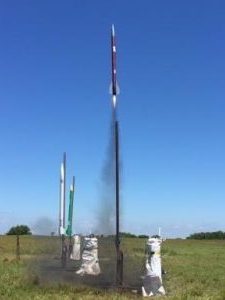
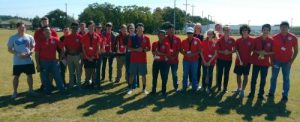
Today is Wednesday, April 25, and the juniors are a day away from testing their vehicle at Stewart’s Hillview Ranch in Willow City at Rockets 2018. They will be launching on Thursday, but the time will be determined on site. Also, this year the larger class volume meant two teams and two rockets.

According to Mr. Matthes, Engineering Instructor, both teams finished both rockets on time this year. They were due by the end of class, last Thursday. Both teams made use of the after school hours requirement in order to finish, with a couple of students stretching that to midnight in order to complete the work.

As of Monday, both vehicles were described as being in good shape by Mr. Matthes, with the only issue still in play, attempting to lighten the weight in order to increase speed.

Aside from that, Mr. Matthes had this to say about the upcoming launch, ” I do not rubber stamp any rocket.  Failure is an option in the program as it is in life.  If the students have a rocket that passes inspection, goes to the pad and gets tested they are successful…but the rocket can still fail.  The existence of uncertainty is partly why the students are so invested in their rocket.  It is because it is their solution without guarantee of meeting the project’s objective.  They’ve poured their hearts into this project for five months and will get to see their ‘babies’ launch, just as parents hope to see the fruits of their parenting, without guarantees of outcome, launch their children into life.  This is an inherent part of research.  Paramount though is the fact that true failure only occurs if the process stops and lessons are not learned in the process.”

He also commented that he had seen GREAT looking rockets fail so he’s reticent about getting the students’ hopes up too much.  And on the flip side, I  have seen some rockets that I thought for sure would fall apart on the way down to the pad, and they amazed us all.

Flight Readiness Reviews(FRRs) were due by the end of class on yesterday, Tuesday. One team completed by the bell, but the other will be capping off at the beginning of class on Wednesday.

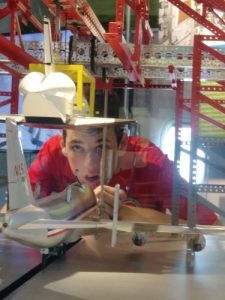
 Robert Sanchez and Esten Cooke with their vehicle.
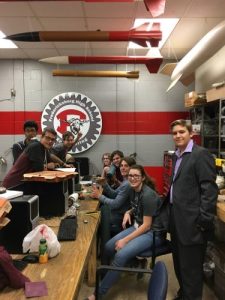
 Pictured here are Ander Castaneda, Dawson Harkins, Cody Blohm, Deja Turkett, Cooper McDonald, Josh Handley, Gloria Burns, and Ethan Scott.

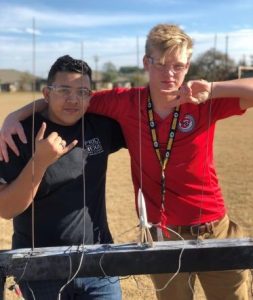
 Team members Robert Sanchez and Gloria Burns.

Pictures provided by Katie Burns.

Some juniors and seniors will have an opportunity to work at the launch pads during the event.  This affords them the chance to get experience prepping the rockets for flight and getting closer to the action. This is a privilege typically reserved only for seniors.

Unfortunately I was unable to obtain a picture and Team name from Team 1.

Pictured below is Team 2 with their rocket.

Meusebach (Team 2): Clockwise from #1 at the bottom. Cooper McDonald, Cody Blohm, Ander Castaneda, Deja Turkett, Josh Handley, Gloria Burns, Robert Zowie, Eduardo Memije, Ethan Scott, Dawson Harkins, and Rudy Avila show off their rocket just after completion last Wednesday evening, April 18th.

If you plan to attend any of this year’s launches please register for your attendance ticket at https://www.greateventseats.com/SystemsGo or they may be gotten at the gate. These are free but required for admittance to each site.  Reserving them ahead at the website is preferred to obtaining them at the gate because the latter slows entrance to the site and may result in you missing the viewing of your intended launch.

You may also view any of these launches on Livestream. That link is available on the SystemsGo or at the following link from them: Here is the link to the live stream again. https://livestream.com/systemsgo

The launch schedules for each venue are available at http://www.systemsgo.org/events/ . I will post it here for each launch day as well. I want it to be as accurate as possible so I will refrain from posting schedules until the evening before each launch day in case there are any late changes.

Here is a PDF  map link and Google graphic map link to the site. These links are available on the SystemsGo web site as well.

Please watch the SystemsGo website, SystemsGo Facebook page: https://www.facebook.com/pg/SystemsGoEducation/posts/?ref=notif ,  SystemsGo Twitter feed: https://twitter.com/SystemsGoNews and this blog for upcoming information on these events.

This article is the fifth in a series, new for this school year ’17/’18 of updates that will follow the Fredericksburg STEM Academy/Rocket program. This school is a participant of the SystemsGo STEM program. This series of articles is intended to support, encourage, and challenge students in the program as they share their working status and accomplishments throughout the year in the program. These publications will be available for tags and re-posting.

www.systemsgo.org as always is the place for more information on this program. You may also email them at info@systemsgo.org . Take the time to get your school involved, the future of your students will be greatly benefited.

#RideTheSky #Rockets2018 #SystemsGo #FredricksburgEngineeringRocketProgram #Launcher01

Rockets 2018- Fredericksburg Launches Start in Willow City, Thursday

The SystemsGo team has returned from the Jal Launches of Rockets 2018, and immediately transitioned to Willow City on Monday as launches begin there Thursday for Fredericksburg Rockets 2018. Launches at the Stewart’s Hillview Ranch in Willow City will only be 3 days this year, Thursday, April 26 through Saturday, April 28. Teams are already well into all the preparation to make this another fantastic event.

This testing site covers the Fredericksburg and Hill Country area schools and all Texas schools not participating in the Houston launches. Currently there are 66 rockets scheduled for launch by 24 schools at that location.

Launches will begin Thursday through Saturday at approximately 8:30 a.m. and will last at least through 5:30 p.m. each day, wind weather and rocket readiness provided.

Phil  Houseal will be providing Livestream from the site again this year so friends and family can watch the action online if they cannot attend the event. Joyce BK Abbey the voice of rockets will be keeping us informed and up to date throughout each day, as well as providing Rocket Trivia,  and her special brand of on site entertainment. Be sure to also watch for interviews with the rocket teams.

Texas Concessions will be providing food, snacks, and refreshments at the launch site once again this year. Restrooms will be available on site as well.

There is an 80% chance of rain Wednesday evening, so be prepared for damp conditions on the range on Thursday if that actually materializes. Of course they still have a 10% chance in for Thursday too, but then all that may change again, because as we all know Texas weather doesn’t live by the weather man’s predictions. Therefore, it is always best to be prepared for all conditions as it may be cold in the morning, hot in the afternoon, windy, rainy, or sunny.  Sunscreen, rain gear and a chair are recommended. Also be advised that weather will play a factor in launch time availability and may cause delays. Please be patient.

Please remember that since there is public access to this event, there are registration tickets for order and those may be found on the SystemsGo website as well at this  link:  https://www.greateventseats.com/SystemsGo . They are FREE, but REQUIRED. There is a waiver for admission you will sign along with your admittance ticket. You can get them at the gate but it is strongly advised to do this online ahead of time so that you do not slow yourself or anyone else down getting onto the range. This could cause you and others to miss your intended launches.

Here is the link to the live stream again. https://livestream.com/systemsgo

Map links to the site in both PDF and Google graphics are on the SystemsGo website at the following link:

http://www.systemsgo.org/events/

But just in case here is a picture of the PDF style map:

And here is the PDF  map link and Google graphic map link to the site as well.

Pictures  will be available here in this blog and in Facebook albums for you to view at the end of each days launches.  Phil and SystemsGo will be posting throughout the event on Facebook as well. Links to both our Facebook pages are below.

https://www.facebook.com/ginger.burow

https://www.facebook.com/SystemsGoEducation/

Here is the schedule of schools launching Thursday. It boasts 10 schools and 19 rockets:

Thursday, April 26, 2018
School Name / Teacher 1/1 Trans
Fredericksburg HS
Andrew Matthes
2
Granger HS
Chaston Kubacak
1
Hamilton HS
Tom Parrish
1
Harleton HS
Hayland Hardy
1 1
Henrietta HS
Sarah Dickey
1 1
Hollenstein CTC
Rick Griffith
3
Maypearl HS
Allex Wilson
1
New Diana HS
Shawn Warden
1
Roosevelt HS
Jared Warsing
2 1
Union Grove HS
Greg Park
2 1
10
Schools Launching
Totals 9 10
Total Rockets                 19

I will post each days schedules in this blog. They can also be found in original format on the SystemsGo website Events page.

More event details will be available here after the completion of Saturday’s event.

If you follow this program and like to view the launches, Rockets 2018  will continue with one more launch series at this level in May. This launch will be held in Smith Point just south of Anahuac, Texas for schools in the Houston area, on the weekend of May 11-13, 2018.  They currently have 56 vehicles scheduled for test by 15 schools at this site.  If you have been to the Houston area launches in the past you may want to check out the SystemsGo website for information because this location is only in its second year for that area. Information and a map link are available. This launch will also be available on Livestream and the link is listed above.

The senior/graduate groups are tentatively scheduled to launch their Goddard level rockets at White Sands Missile Range (WSMR) in New Mexico in late June.  These are not available for public viewing or Livestream due to being tested on a military facility, but blog and SystemsGo updates will be posted online as available during that week.

More event details will be available here in upcoming days as events get closer. Daily reports featuring schedules, school names, results, pictures and some editorial content will be posted during the events.

www.systemsgo.org as always is the place for more information on this program. You may also email them at info@systemsgo.org . Take the time to get your school involved, the future of your students will be greatly benefited.

Hope to see you at the races, nope, but I will race you for a rocket!  #RideTheSky! #Launcher01 #ItISrocketScience #Rockets2018

Your local Recovery Team rocket Junkie wishes all the schools and students a picture perfect flight and recovery.


Rockets 2018 Begins at Jal, New Mexico This Weekend!!!

Rockets 2018 begins this season’s launch series in Jal, New Mexico this Saturday, April 21, 2018 at a launch site on Phillips Hill Road.New Mexico High schools from Jal, Hobbs, Loving, Lovington, Hagerman and Lake Arthur, along with one Texas school, New Tech Odessa will have students participating in the program with 18 rockets scheduled to test. New Tech Odessa is joining the group in Jal this year, as it is much closer for them than any of the Texas sites they have gone to previously.

This is the second year for the SystemsGo New Mexico group, headed up by David Willden. After training in 2016 at the Fredericksburg launches in Willow City, the group began their launches at the new site in April of 2017 with 10 Tsiolkovsky Level (1 lb/ 1 mile) vehicles. This year, they will attempt 14 Tsiolkovsky Level and 4 Oberth Level (Transonic velocity while staying under 13000′) vehicles.

Friday, starting at 8:30 a.m. there is training for Range Safety Officers (RSO’s) for stage 2 and stage 3 volunteers. This is to train and build the volunteer base for the New Mexico events.  Jal Elementary will also be set up for Stage 1 and Stage 2 as Early Check in begins at 1:00 p.m. on Friday and continues until 5:00 p.m.

Friday evening, Dave Willden is hosting a cook-out for volunteers, teachers, teams and admin at the Jal Country Club from 5:00 p.m. to 7:00 p.m. Burgers and hot dogs will be served.

Scott Netherland, Rebekah Hyatt, and Gene Garrett from SystemsGo Texas are leaving at noon Thursday, headed to Jal to participate in the event. Chelsea Burow, also SystemsGo Texas will be meeting them there on Friday evening.

This site will be open to public viewing of launches, as are all sites except White Sands Missile Range. A link to location information and a map link are available at http://www.systemsgo.org/events/ .  The site will be open for admittance at 8:00 a.m. and launches will commence presumably at 8:30 a.m. Of course rockets are subject to winds, weather and workmanship, all of which can stall a launch. Come join in the action and cheer on these students. Admission is free, but the look on your students’ faces when their vehicle goes up and then is recovered, is far from priceless.

If you plan to attend Jal or any of this year’s launches please register for your attendance ticket at https://www.greateventseats.com/SystemsGo or they may be obtained at the gate. These are free but required for admittance to each site as they also include a waiver for access to the site.  Reserving them ahead at the website is preferred to obtaining them at the gate because the latter slows entrance to the site and may result in you missing the viewing of your intended launch.

The schedule of launches for Jal is available at http://www.systemsgo.org/events/ .  I will post it here for launch day. I want it to be as accurate as possible so I will refrain from posting it now in case there are any late changes.

A live feed for Saturday’s launches has not been confirmed yet, but I believe something may be in the works for that option.   Information about the event, map links and schedule links are available at  http://www.bringonthescience.com

Here is a reproduction of the map, but the one you will find online will be much clearer. 

SystemsGo New Mexico does have a twitter feed they started last year in order to follow the launches. This link is still live, but right now there are no current tweets.  That link is https://twitter.com/SystemsGoNM

Please watch the SystemsGo website, SystemsGo Facebook page,  SystemsGo Twitter feed: https://twitter.com/SystemsGoNews and this blog for upcoming information on theses events.

More event details will be available here after the completion of Saturday’s event.

If you follow this program and like to view the launches, Rockets 2018  will continue with two  more launches in April and May. Next the Stewart Ranch in Willow City, Texas will host the largest of the now three launch events on the weekend of April 26-28, 2018.  This testing site covers the Fredericksburg and Hill Country area schools and all Texas schools not participating in the Houston launches. Currently there are 66 rockets scheduled for launch by 24 schools at that location.

The second will be held in Smith Point just south of Anahuac, Texas for schools in the Houston area, on the weekend of May 11-13, 2018.  They currently have 56 vehicles scheduled for test by 15 schools at this site.  If you have been to the Houston area launches in the past you may want to check out the SystemsGo website for information because this location is only in its second year for that area. Information and a map link are available.

The senior groups are tentatively scheduled to launch their Goddard level rockets at White Sands Missile Range (WSMR) in New Mexico in late June.  These are not available for public viewing or Livestream due to being tested on a military facility, but blog and SystemsGo updates will be posted online as available during that week.

More event details will be available here in upcoming days as events get closer. Daily reports featuring schedules, school names, results, pictures and some editorial content will be posted during the events.

www.systemsgo.org as always is the place for more information on this program. You may also email them at info@systemsgo.org . Take the time to get your school involved, the future of your students will be greatly benefited.

Hope to see you at the launches!


Fredericksburg’s Engineering Rocket Program-Second Term Update #2 (February 16-April 13)

It is April and we have some catching up to do on the  FHS Engineering program. It has been two months since our last update and quite a bit has been happening on all levels.  Along with class work, launches start this month in Jal, New Mexico  on April 21 and Fredericksburg (Willow City) April 26-28 so time is becoming a factor for the Junior and senior groups.  Each group is working hard to meet their timelines. Rockets 2018 is the pinnacle event for the upper level groups, as their rocket projects are basically the final grade for the year.

The seniors have approximately 73 days until Redbird 19 is TENTATIVELY scheduled for testing at White Sands Missile Range, which is usually in the last week of June.  This date is still not a permanent date until the Army finalizes, closer to that time. Mr. Matthes will announce that date when it becomes readily available. Their completion date for  preliminary systems tests is usually two weeks before school ends. This would be May 18 which cuts them down to 59 days.

More on these groups and their current status reports will be later in the article.

Freshman participated in a field trip on March 1st, in which they visited Southwest Research Institute(SwRI), the Center for the Intrepid,  and the UTSA VIZlab.  At the Center for the Intrepid, the students were able to see biomedical equipment at work helping wounded Veterans in their recovery. Along with the engineering aspect of this, Mr. Matthes hoped that they took away a new respect for our military servicemen and women and the full extent of the sacrifices they make each day for our country’s safety.

Former FHS Engineering Alumni, Drake Horstman, was the students’ guide when they visited the UTSA VIZlab, toured the campus, engineering lab and community areas. During the visit, Drake, provided  entertainment and wisdom coupled with numerous stories about his experiences in the FHS Engineering Program. Inside the lab, the students were able to see several visual interaction devices.

At Southwest Research Institute, students learned technical information about engines, modifications and fuel efficiency. The content here was a little over their knowledge base,  and may have overwhelmed the students a little, according to Mr. Matthes. In spite of that, it was still a good visit for the students, and the coordinator at SwRI commented  about their behavior stating, “they are better than a lot of the college students who come through.”

These visits are designed to expose the students to different aspects in the engineering fields. The impressions they take from here will help them make decisions down the road on whether engineering is for them, and if so, help them determine a particular area of interest.

The Freshmen also participated in their first Critical Design Review (CDR). They were tasked with presenting solutions to fix the damaged launch tower for the Red Bird rockets. This gives them practice on presentation skills and feedback on designs for their project.

Mr. Matthes stated that, “the students may have felt “roasted” with constructive criticism and feedback. But, that they should know, that it is part of improvement and growth of design and not personal.” He mentioned that this was also discussed briefly at the end of the trip to SwRI, by the hosting engineer.

The sophomores have advanced well in the curriculum and are presently several weeks ahead of their  current deadlines. Their current focus is on dimensioning objects, denoting measurements and creating fabrication notes. Due to this, their proficiency has advanced well.

Mr. Matthes is quite impressed with the Juniors selection of a class name. Here is how he describes it,”The juniors named their class “Conatus” which translates from Latin, to impulse and means striving.  From a historical philosophy origin it relates to the nature of something to continue its existence.”

The pressure is on with an April 19th rocket completion date looming ever closer. The rocket must be completed one week prior to their April 26th launch, because after it is completed they must also complete a Flight Readiness Review which often uncovers errors and problems that must be resolved.  This week provides adequate time for those things to happen.

According to Mr. Matthes neither team has anything that quite resembles a rocket as of yet, but each is working through a pile of parts that arrived. Most were not ordered until the end of March which was quite late, but each group began working with tangible parts  the end of last week.

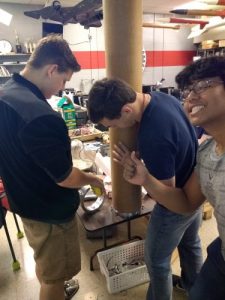
Team #2 decided to make use of Monday’s teacher in-service day, by putting in about four hours of work. Shown below from team #2 are clockwise starting from the bottom, Cooper McDonald, Gloria Burns, Ethan Scott, and Dawson Harkins as they take measurements off the back-end of the rocket and motor system.

Both teams do have a work in progress at this point.  According to Mr. Matthes, “Pressure makes diamonds and rockets.”

Incidentally, another incentive for each comes from SystemsGo. A flawless flight and perfect recovery may afford that team the chance to re-fly their vehicle with a different fuel grain in order to collect data for SystemsGo.

The miniature Teststand is an ongoing project for the juniors as well. They are using LabVIEW programming as a means to start ignition and measure thrust, as well as using 3D modeling in order to develop a unique physical Teststand model. The class is split into working groups of 3. According to Mr. Matthes, “They are on track to have this done by the end of school and I am excited to see what they come up with.”

Seniors are progressing well with Redbird 19, wind tunnel and the large Teststand development.

Construction is beginning on Redbird 19 now that parts are returning from Heartland Enterprises. According to Mr. Matthes the parts, “look beautiful, and most parts are in.” Now that parts are available there is a bullet list of accomplishments to be achieved including, overlaying the nose cone in fiberglass, creating a mold and then pouring the fuel grain, making a custom hose for the injection valve, testing  recovery chute deployment, integrating avionics into the vehicle, and Mr. Jenkins is in the process of manufacturing the payload.

Here Harrison Spisak, Bryce Erwin, and Sergio Walle are checking the fit of the injector, nozzle and retaining ring in their fuel grain liner.

Currently wind tunnel is well underway, as students are receiving and ordering parts. The program is nearing completion and the electronics used for the drag testing measurement has arrived. Hunter Smith, a SpaceX programmer at the McGregor facility has been assisting Rebecca Sechrist through a Skype session. He has been providing analysis and comprehension in areas he has already assisted, as well as a starting point from which to move ahead. According to Mr. Matthes, “The students are making headway but must begin to make a push in order to finish this outstanding design by summer.”

Deadlines are quickly evolving for Teststand, as the group’s progress here is steady but slow. They have installed a flow meter to directly measure Nitrous oxide. Load cells which measure thrust have been changed out and fuel grains have also been readied for testing.

The stand itself is nearing a test ready state. New to this year’s stand are changes in the injection system. The new system will allow more controls of the flow. A parent plate has been designed by students and fabricated by another local machine shop, Kager Industries,  which will hold a smaller injection disc allowing students the ability to change out the disc which controls the rate of flow. The plate can be installed as soon as the 0.05″ holes have been drilled through. Next, the LabVIEW program will be fully tested on the stand.  Afterwards, a cold flow test will be conducted in order to measure the oxidizer flow rate and determine if the size and pattern of holes in the new disc are correct. If the cold flow tests are successful, then hot fire tests can begin.

The Baby Bird Teststand is still on hold until further notice.

SystemsGo hosted a BBQ dinner event for the neighbors in Willow City. Seniors, Bryce Erwin and Sergio Walle, pictured below,  spoke at the event. Their purpose was to educate attendees about the educational process of the program and how it relates to the upcoming launches, as well as to share their own experiences in the program.

Additionally, Harrison Spisak and Corbin Smajstrala spoke to the Morning Rotary last month on similar subjects.

Mr. Matthes would personally like to thank all four of these young men for committing to these events and participating in them. In both cases, participants and SystmesGo staff commended them on their exceptional performances.

This article is the fourth for the 2017/2018 school year in a series of periodic updates that will follow the Fredericksburg Engineering/Rocket program. This school is a participant of the SystemsGo STEM program. This series of articles is intended to support and encourage students in the program as they share their working status and accomplishments throughout the year in the program. These publications will be available for tags and re-posting.

www.systemsgo.org as always is the place for more information on this program. You may also email them at info@systemsgo.org . Take the time to get your school involved, the future of your students will be greatly benefited.

Second Term Update #1 (Dec. 22-Feb. 16)-Fredericksburg’s Engineering/Rocket Program

Technically, the fall term didn’t end until January 19, so we have a minor bit of finishing up to do on that semester, but at this point, January  is past and February is better than half through as well.  The spring program is  already building, therefore, we will finish off and shoot straight into the new semester and the new year, as there are big goals and events  for each class group.

This second semester puts the Engineering Program students’ learning to the test as they build rockets and prepare to launch them for Rockets 2018 and their end of class projects. There are still four class groups this semester as freshman through seniors continue course study and  strive  to complete their section of the program.

Both Freshman and Sophomore groups are new for this semester. Last semester’s groups will not return to the program until next fall. This will mean that the progress reports will seem a bit familiar as these new groups will be doing the same projects and learning tasks that last semester’s group did since they too are at the beginning point of the Freshman and Sophomore programs.

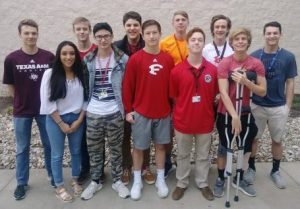
Freshmen comprise a group of 13, pictured below. In the front row: Davis Englert, Roan Hagel, Hayle Mayer, Michael Flores, Gerry Balderas, and Daisuke Kyan.

In the back row: Tyler Smedley, Karson Hager, Cade Terry, Sam O’Leary, Kris Ersch, Travis Klokker, and Carlotta Wilkinson.

 This was for fun, and is freshman doing something wacky!

The new Freshmen group is once again testing structures which they are building from cardboard and tape. They watched an engineering video on I-Beams after their first testing session. This enlightened their understanding of bending moments which they applied to their structures.  One of the groups changed their structure by rotating it 90 degrees in order to make it taller than it was wide, which resulted in the structure being the opposite of its original design as well as creating an almost 100% strength increase through the new orientation and heighth.  Mr. Matthes states that this was a “Lesson learned and applied.”

Below, the Freshmen show off their structures.

 Cade Terry, Travis Klokker,  Sam O’Leary    Hayle Mayer, Tyler Smedley, Daisuke Kyan Karson Hagel, Gerry Balderas, Roan Hager    Michael Flores, Carlotta Wilkinson, Kris Ersch, Davis Englert
Currently they are working on their post mission analysis on civil engineering, which is allowing them to  practice technical writing.

The freshmen have a field trip coming up on March 1. They will be visiting UTSA, Center for the Intrepid and Southwest Research Institute, all in San Antonio. A report and pictures will be presented in a future update.

The new sophomore group for this semester has 13 students,  11 pictured below.

Front row: Gabi Moreno, Manuel Enciso, Jarrett Beard, Tyler Malinak, and Jacob Hinterlach. Back row: Tony Martinez, Noah Stotz, Jowad Aysheh, Jack Fox, Troy Kneese, and Jabin Gipson. Not pictured are Jessen Stableford, and Landon Sparrow.

The sophomores are moving through their course studies on a little more fast-track than last semesters class. This has been initiated in order to further their studies in 3D modeling and printing this round so that they achieve a more significant introduction in that area. They are doing well according to Mr. Matthes and are already beginning AutoCAD. In the past weeks they have successfully completed geometry, multi-view drawings, and engineering lettering.

As of January 23, the first semester studies ended for the Juniors, and opened them up to work on their second semester project in which they are now immersed. This project is to design and develop a one pound payload in a Transonic vehicle to be launched on April 26, at Rockets 2018.  This means that their rocket must must be capable of breaking the speed of sound while carrying a one pound payload and remaining under 13,000 feet. The junior group is a large group of 22 students this year so they are unique in that they have been split into two groups, each responsible for their own rocket.

Mr. Matthes had this comment about the two groups, “I am excited to see them working diligently and proudly taking the endeavor as genuine separate groups.  The ownership of their rocket and being different from each other’s groups is already evident.  They have established their problem statements and are feverishly researching with many, many, many unknowns.  As the process goes on their significant dispersion of knowledge and integration with each other slowly but surely migrates to a fully integrated and cohesive design.”

Along with their rockets, the group has another project for the semester. This entails designing and developing a teststand for Estes Motors. These are the small motors used mostly to fly their Generation 1 through 3 rockets. The objective is to create a teststand that will operate using LabVIEW programming to control and monitor ignition, measure thrust, and display and record real-time data to a file.

Seniors are a busy group with four projects still in the works, including Redbird 19, Wind Tunnel, Teststand and Baby Bird Teststand.

On February 1, Redbird 19(RB19) underwent Critical Design Reviews (CDR) with SystemsGo personnel present, and NASA flight engineers participating by Skype. RB19 did well overall.  The Redbird 17 tank is being recycled as part of  the RB19 design and was successfully tested earlier, as shown below, but will be retested on Friday, Feb.16 after which they will be required to provide documentation to SystemsGo. The team is fully immersed in the development of RB19. They have contracted machine shops and begun providing them work. These include Kager Industries, Heartland Enterprises, and SRM. Other necessary parts are in the order process.

Corbin Smajstrla, Sergio Walle, Bryce Erwin, Pierce Vasquez, Evan Knapp, and Harrison Spisak prepare to test the RB17/19 tank.

Wind Tunnel also underwent CDRs  with NASA and SystemsGo on February 1. Unfortunately it was found to have some issues to resolve. According to Mr. Matthes, the group is, “adapting well to the unexpected queries which arose and are close to having them resolved at this point. ”

Teststand has several upcoming events in March. In mid March, they will be conducting cold flow tests in order to verify the students injection system. This tests the flow rate of oxidizer through the system.  Projected live ignition tests have been set for the end of March, and students have been given some solid dates in order to keep them on task to accomplish these.

Baby Bird Teststand is currently on hold. Students have a heavy work load to complete with the other projects. PVC and polypropylene tests will need to be completed on the large Teststand before work can resume on the Baby Bird Teststand.

This article is the Third for the 2017/2018 school year in a series of monthly updates that will follow the Fredericksburg Engineering/Rocket program. This school is a participant of the SystemsGo STEM program. This series of articles is intended to support and encourage students in the program as they share their working status and accomplishments throughout the year in the program. These publications will be available for tags and re-posting.

www.systemsgo.org as always is the place for more information on this program. You may also email them at info@systemsgo.org . Take the time to get your school involved, the future of your students will be greatly benefited.

Fredericksburg Engineering Program Hosts the N.E.W.Y.O.U. Event for 4th through 8th Grade Students

The Fredericksburg Engineering Program will be hosting the N.E.W.Y.O.U (National Engineers Week Youth Outreach United) Event in participation with FISD Community Education. National Engineers Week will begin February 18th. The N.E.W.Y.O.U Event will be held the Saturday before on February 17th.
The event will be held at the Fredericksburg Middle School. This is the first time the FHS Engineering Program will host this event. The high school group has been working hard organizing this event in order to insure it will be a fun and educational time for all participants.
Join the FHS student mentors as they introduce you and your friends to engineering in fun group setting. You will learn while watching videos, playing games, completing challenges and winning prizes, including a door prize for each session.
Forth and fifth graders will attend the morning session, from 9:00 a.m. to 12:00 p.m. The cost for this session is $29 and includes snacks, drinks and a shirt.
Sixth through eighth graders will attend the afternoon/evening session from 1:30 p.m. to 9:30 p.m. The cost for this session is $49 and includes, snacks, drinks, dinner and a shirt.
***Please note that in order to receive your shirt, you must be registered by Feb. 13.

Look for more information in the newspaper and students of those grades should have brought home flyers in the past week. Look below for a copy of that flyer in case you missed it.

The Fredericksburg Engineering/Rocket Program hopes to see you there.

FLYER:

4th-5th and 6th-8th Graders!!!

Come hang out with high school engineering students while having fun playing games, completing challenges in groups with high school mentors, watching cool videos and learning about engineering.  Prizes abound with an awesome door prize for each session.  See details below!  Downloadable registration form may be found at the bottom or call Community Education at (830)997-7182.

New You Flyer JPEG.JPG

Awards Day for the Red Bird #18 2017Alumni

Today, Friday, December 22, 2017 at 10:30 in Mr. Matthes’ classroom,  FHS Engineering Class of 2017 was presented with their banner for a successful flight of the Red Bird #18 at White Sands Missile Range last summer.

They received the Goddard Level Newton Award from SystemsGo. The award was presented to them by Scott Netherland, Executive Director of SystemsGo.


Photographed (right to left): Colby Marthaller, Sterling Weatherford, Matthew Dulaney, Ian Kendrick, Hannah Boubel, Cody Pruett, Joseph Sanchez, Ricky Robles, Scott Netherland, and Payton Carroll.

The banner will be displayed at the FHS campus at a later date.

Congratulations to these students on their achievement as well as future endeavours.

www.systemsgo.org as always is the place for more information on this program. You may also email them at info@systemsgo.org . Take the time to get your school involved, the future of your students will be greatly benefited.

2017/2018 Fall Session Hi Lights Wrap Up for Fredericksburg’s Engineering/Rocket Program-(Nov. 10-Dec. 22)

Next Friday, December 22, the Fredericksburg High School Engineering/Rocket Program will dismiss for Christmas break. When they do, five weeks will have passed since the last update on their program. This is a busy group, and there is plenty to report on their learning and progress as we wrap up the fall semester.

The Freshman have been learning about  production/manufacturing engineering  and have recently completed their project which was an orange juice manufacturing factory design.  The class split into working groups of four because of the complexity of the problem. Their product goal for the plant was to take raw material and produce packaged juice in palletized product bundles ready for sale. According to Mr. Matthes, “It was a successful endeavor with lots of different results when it came to the challenging research it required.”

On Friday, December 15,  they presented their latest project over engineering fluidity.  Each student was expected to work independently to create new launch lugs for the senior level rocket. Their new lug designs need to be more aerodynamic than the current lugs.  Each student was able to show what they were capable of on their own, instead of having the co-dependency of fellow students. This solo venture challenged them to create a multiview drawing of their own new design, as well as featuring their understanding of units of measurement and how they all work together, something that will be of great significance for their final project in the future, which is to research the math and then design a hybrid rocket motor.   A  highly significant amount of math and even more units will  require their careful attention in that upcoming project . What they are learning as they work through this propulsion/aerospace problem will become relevant to them again when they begin their junior studies in 19 months. Therefore it is an important study in which to end the course.

Just to remind everyone, the Sophomore students are still working in a self paced manner in this year’s class. Therefore a good growth mark for them in their class progress  is  3D printing, which they have recently begun.  They have also shown marked achievement in their Autocad,  Dimensioning and Isometric drawing skills. In part this is due to their receptiveness to all the constructive feedback.

Luke Duderstadt working on Autocad.

“They have advanced tremendously in their attention to detail, ability to see things with greater special awareness, and pride in workmanship.  The transformation has been fun to witness,” states Mr. Matthes.

LabVIEW programming is an important focus for the juniors. At this point, Mr. Matthes says it is too early to tell their final success in this area, but so far, they are progressing well.

Fluids and aerodynamic drag have been the focus of their studies related to rockets these past five weeks. After learning these new skills, they were able to test them on the design and development of their Generation 3 rockets. In order to do this, they had to create a rocket that was stable with exactly a ‘margin’ of 1 while reaching 1800 feet in RockSim simulation and design software. Students were able to launch their actual Gen 3 rockets on Friday, Dec. 15 after they had in class rocket presentations and evaluations that morning. Additionally they were further challenged with a short deadline in which to create these rockets. They met this head on and were ready for presentations.

“It was collectively the best group of Gen 3 flights I have seen in years,” reports  Mr. Matthes.

Bradley Plaza and Carl Wilger prepare to launch their Generation 3 rocket.
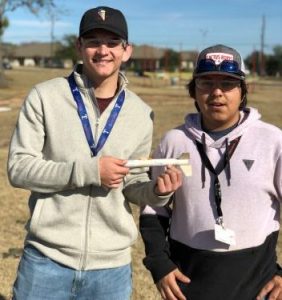
Jabin Gipson and Rudy Avila model their Generation 3 rocket on launch day.

They will detail the many lessons they learned, including  results from mistakes in design, construction, evaluation process, and the significance of attention to detail in their post mission analysis (PMA). As they begin their second semester project, all these lessons will be critical learning tools in the success of this larger rocket.

Mr. Matthes reported, ” I was thoroughly impressed with all of them.  It was the kind of work ethic that will make their senior year a success if they can manage to keep up the motivation and focus.”

Critical design reviews (CDR) are the main focus for seniors on all four of their projects, which include the Red Bird #19 Rocket, a wind tunnel, the  NASA large motor test stand, and the Small HyperTek interface test stand, known as Baby Bird. Currently the group is running short on time their schedules and task lists are not reflecting all that they should. There is a possibility that they are either not aware of all that they have missed, or they are really close to being ready. Mr. Matthes is unsure at this point which one it is.

Pictured here is the seniors’ flow straightener prototype for their wind tunnel. It was 3D printed on a Makerbot.

They are scheduled to hold a preliminary design review with alumni at 10:00 on Wednesday, January 10th, here in the classroom. A full CDR will be due at the end of January.

“One potential reality is that if it becomes evident there is not enough time for everything, some project(s) may require postponing.  We are hoping for the best,”  states Mr. Matthes.

On Friday, December 22, 2017 at 10:30 in Mr. Matthes’ classroom,  last year’s alumni will be presented with their banner for flying the Red Bird #18 at White Sands Missile Range.  Seniors will have a question and answer session with alumni  to share experiences and receive advice.

At 7:00 p.m. also on Friday the 22nd, all alumni of the Fredericksburg Aeroscience/Engineering program are invited to come to Hondo’s and join Mr. Williams and Mr. Matthes for visiting over dinner and drinks.  It will be casual, come and go as you like bringing significant others and friends as desired.

Mr. Matthes reminds all program students, “In January, the spring program begins and deadlines and target dates for their projects become highly important in order to meet projected launch dates.”

NEW YOU (National Engineers Week Youth Outreach United) continues its progress in planning the 4th-8th grade engineering outreach event to be held on February 17th.  Look for more in the newspaper and students of those grades bring home flyers in January.

 This article is the Third for the 2017/2018 school year in a series of monthly updates that will follow the Fredericksburg Engineering/Rocket program. This school is a participant of the SystemsGo STEM program. This series of articles is intended to support and encourage students in the program as they share their working status and accomplishments throughout the year in the program. These publications will be available for tags and re-posting.

www.systemsgo.org as always is the place for more information on this program. You may also email them at info@systemsgo.org . Take the time to get your school involved, the future of your students will be greatly benefited.


2017/2018 Fredericksburg’s Engineering/Rocket Program-October/Early November Hi Lights

September  and October have come and gone and  we are now half way through November and the Fredericksburg High School Engineering Program is deep into their studies busy learning and working at all levels. Eight weeks have passed since our first Engineering Program update and the first semester is halfway through.
Since our last update, the Freshmen have created an electrical design for the NASA built and designed Orion space capsule. Keith Kunz from Teledyne was their audience for this presentation.  Teledyne works with offshore oil exploration developing and designing hard and software for their use.  As an audience for these presentations, individuals like Mr. Kunz, provide constructive criticism such as design strengths and weaknesses, areas that did not match the design logic, things that were overlooked, and skills of presentation.
Currently the Freshman are working on a bio-engineering project, which will be designed to help student, Cody Bearden, who has Spinal Muscular Atrophy, which keeps him confined to a wheelchair. It will be a hoverchair.   Yesterday they presented their project to a new audience, consisting of Tim Nolan, an  AirEvac pilot and previous Marin Corps helicopter pilot, Todd Keener a mechanical engineer, and Scott Netherland, Executive Director of SystemsGo .  Details on this presentation will be forthcoming in our next update.
Sophomore students are still working at their own pace in this year’s class. Due to this,  the further along the year rolls, the larger the gap is between the slowest and fastest student. Because of this some are already starting to learn Isometrics, which are 2D representations of 3D objects. The class as a whole is also studying Dimensioning.
“They are all making good progress, but having them self pace has led to some really taking off with AutoCAD,” states Mr. Matthes.
The Engineering program flew in Brian Evans from Space Propulsion Group out of Butte, Montana to conduct a two-day seminar for the Juniors and Seniors.
Pictured here are Juniors, Gloria Burns, Cooper McDonald and Eston Cooke with Mr. Evans: 
According to Mr. Matthes, “Students really enjoyed having insight from Mr. Evans.”
For the past two months, the Juniors have been learning new skills on Excel which allowed them to better understand the math of starting a new model. They have been creating spreadsheets for a hypothetical bakery where they used calculation, look ups and other functions in order to track materials, hours, and productivity.  Class time has been split between this project and the physics of flight.
Three weeks earlier, the class flew their Generation 1 rockets.  The parameters for this first flight, were just have a rocket on the pad to fly and served as a platform for them to learn and start asking questions on how to correct their flights.
These flights were of varying degrees of stability with some being completely unstable, some having a corkscrew affect and others displaying very straight flights. The instruction on stability follows this flight test and leads into the Generation 2 tests.
Last week Generation 2 rockets were finally launched.  They had been patiently waiting due to several scheduling conflicts with school college fair days and bad weather, windy days.
For this test they actually had to prove the stability of their rockets. This is accomplished by literally cutting the rockets in half.  Students are forced to be intentional about stabilizing their vehicles. The pictures below are from the Generation 2 flights.
Here, Eduardo Memije and Gloria Burns load their G1 Rocket for launching.
In this photo, Deja Turkett and Bradley Plaza take their turn for launch.
Here the whole Junior class group displays their rockets on launch day.
Currently they are splitting their class time between LabVIEW Programming which they have just begun and the continued study of the physics of flight. Next they will be studying fluids, aerodynamics and drag, and impulse, as well as factors affecting drag, this is all part of prepping for Generation 3 rockets.
According to Mr. Matthes, “Their next objective is to reach 1800 feet using RockSim to design the rockets.  They are assessed on the closeness of construction to design:  it is a tough mark to make without extreme precision.”
On Tuesday, Nov. 7, the Seniors traveled to Houston. After arrival, the group spent four hours at Space Center Houston. According to Mr. Matthes, the students, “had a blast!”

In this mock up, Evan Knapp mounts the Space Shuttle on top of the 747 that transports the shuttle back to Kennedy Space Center.

Corbin Smajstrla is seen here pumping iron on different planets where the gravity is not the same.
Chris Calzada (left) and Rebecca Sechrist (below) pose for pictures in space.
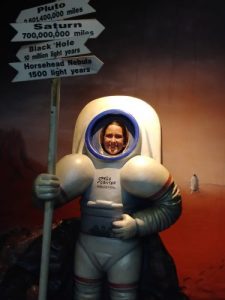
Evan Knapp maneuvers his EVA device back to the ISS as Chris Calzada and Harrison Spisak look on.

 Next the group visited Rocket Park so that the students could get a visual grasp on the enormity of the Saturn V Rocket that took men to the moon and back.
 Relaxing at the end of the day beneath the Apollo capsule on the Saturn V.
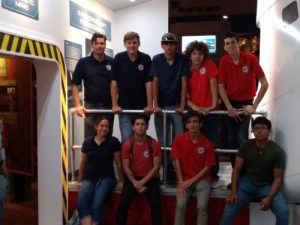
The entire travelling crew. Top row: Instructor Andrew Matthes, Harrison Spisak, Chris Calzada, Corbin Smajstrla, and Evan Knapp. Bottom row: Rebecca Sechrist, Pierce Vasquez, Joey Leal, and Sergio Walle.
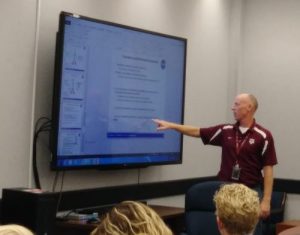
Later, Joyce Abbey, the voice of the SystemsGo launches, and Dave Ladrack, a longtime program friend and supporter, joined the students for dinner.
On Wednesday, Nov. 8, they arrived at Johnson Space Center along with nine other schools and met, Chris Madsen, pictured below, a Guidance, Navigation and Control (GNC) engineer in the flight dynamics department.
Mr. Madsen coordinated and oversaw the program for the students, and gave an overview of College Co-op opportunities. He encouraged the students to be involved and to acquire work experience while still in college.  All nine schools gave presentations of their flight models explaining the projected flights of their rockets to engineers and representatives from other schools who have also taken on a similar tasks.
After lunch the documentation students need in order to be cleared for flight at White Sand next summer, was discussed. Mr. Madsen used examples and an overview of his job in comparison so that students could see that what he does is similarly an extremely more complex version of what the students are building.
 Later that afternoon, FHS had a meeting to present preliminary design reviews of both the wind tunnel project and Redbird #19 to five engineers. This was  three hours of presentation and a question and answer session.
“It was a tremendous opportunity for the students and the feedback was excellent,” reported Mr. Matthes. “The trip was a success.”
Design progress has been made on Redbird #19 but many details still have to be worked out before it can be considered an integrated system.
Mr. Matthes feels that, “The input from this trip will be significantly helpful for drawing both flaws and considerations to light as they proceed forward. “
 The group has been working hard to pull together everything for the Redbird #19 presentation, this has made it necessary to put Teststand on hold for the past week.
Something new the Engineering Program is working on, is the N.E.W. Y.O.U. Event, short for National Engineers Week Youth Outreach United. This will be the first time the FHS Engineering Program will be hosting this event. The purpose of this event, is to expose students from 4th through 8th graders to engineering. They will participate in activities and interact with high school engineering students while learning in a fun and relaxed environment.
FHS Engineering Program has already been readying for the event with two separate planning meetings involving about 20 students in order to organize and divide tasks. Everything is moving along well and they anticipate a great event.
National Engineers Week will begin February 18th. The N.E.W.Y.O.U Event will be held the day before on Saturday, February 17th.  Forth through sixth graders will attend the morning session, and seventh and eighth graders will attend the afternoon/evening session.
This article is the second for the 2017/2018 school year in a series of monthly updates that will follow the Fredericksburg Engineering/Rocket program. This school is a participant of the SystemsGo STEM program. This series of articles is intended to support and encourage students in the program as they share their working status and accomplishments throughout the year in the program. These publications will be available for tags and re-posting.

www.systemsgo.org as always is the place for more information on this program. You may also email them at info@systemsgo.org . Take the time to get your school involved, the future of your students will be greatly benefited.


The Best Haunted Thrill-The 290 Haunted House vs. The Theater of Terror

This year, the Fredericksburg area boasted two haunted houses for our Halloween enjoyment. The first and original for the area was Audelia Delacruz’s Haunted House,also know as The 290 Haunted House, which started at her house in Stonewall some years ago, but has been housed in the large white building on 290 East across from Trade Days for at least the last 3 years. The second, Theater of Terror, was hosted by the Freddyburg Youth Theater and the Fredericksburg Theater Company and took place at the Steve W.  Shepherd Theater or in reality the store-room there on the FTC facility grounds.

First let me say that I do not scare easy at these events.  I am more likely to get spooked walking around in my own house, or outside in the pasture in the dark than I am at a Halloween event. My own imagination and fear of animals that might attack, etc. in the dark are more likely to get me to jump. But that being said, I am always looking forward to the event that might scare me. To this end, I was very excited to attend these two events, just to see if they could scare me.

Both houses are put together by a collaboration of adults and teens/children and participation inside is both as well. One has several years experience of putting on a haunted house production, where the other is in its first year, unless I have somehow missed it in past years. If that is the  case please correct me. The latter has years of experience putting on theater productions. Both have the resources available to put on an exceptional production. Both have smoke, strobe lights, and dimly lit rooms. One also had other lights,  flashing or glowing things to add to the effects as well of lots of sound effects. Each also had a bit of narration.

Here is the major difference, props and costumes. One far out did the other. Any guesses on which one you think it was?

In one house, every participant was well costumed and fully make-upped so that they were the character they were playing and could not be easily recognized as themselves. In the other, this was not the case. I readily recognized several of them, though in costume, not nearly as well as the other house, and make up was little to none other than a bit of blood on the hands and maybe face.

One made full use of props and decorations, and created a unique theme for each room of the house, covering a multitude of creepy specters to incite your fears. There were people, scary statues,  and any number of things that left you waiting and wondering, “is it a real person or not and is it going to move and get me when I go by?” The other house had little difference between sets from room to room, and had almost the same theme in each.

One house also made much more use of the space they had available making the experience last longer, the other was considerably shorter. Sadly, in this second house, I was surprised to already be at the end. A literal, “that’s it???,” moment.

Another big difference was price, $5  for the 290 Haunted House verses $12 for the Theater of Terror.

I do give the participants props for all their hard work during the hours of operation  they made a valiant effort to scare their guests.  Even there when you consider one was a house of family and friend participants that are out to have a good time and provide the community some entertainment, and the other a theater arts group with the same goal, perhaps with a bit of fund-raising thrown in,  there was still a night and day difference between the two.  They do all deserve praise for all the before work organizing and setting these houses up, and now tearing them down.

Now before I tell you which was which  I have a question for you.  Think about the two groups,  which group would expect it to be?

The winner for me, this year was Audelia Delacruz’s  290 Haunted House. To answer the question, did it scare me? No it didn’t scare me, even though I was quite impressed with what all they had done and I did quite enjoy going through. It did make me jump and laugh at myself at least once, and it has done that every year. I will be back again next year.

So now to both groups, I can’t wait to see how you raise the bar next year.