Happy Halloween-The Final Fare Cafe’

My arms were full of food which I balanced against the wall as I opened the cooler door and reached in groping for the light switch on the wall inside. As my hand finally made purchase of the switch, someone else’s hand clamped tightly over my wrist preventing me from turning the light on. Stunned I shrieked briefly, dropping my load, before standing there wide-eyed, and still, unable to move and unsure if I should. As far as I knew, I was alone, all of the other staff in the restaurant had gone home, so I had no idea who to expect. After a few seconds I finally gathered my wits, or perhaps lost them, and hollered, “Who’s in there? Let go of me and show yourself.”

There was no answer, but the hand suddenly released me and I yanked my arm back and slammed the cooler door. I knew there was a safety latch inside, and whoever was in there could still get out. Grabbing a rolling-pin off a rack near the door, I waited. Nothing happened, not even a sound. My hands shook, and my wrist still felt the imprint of icy fingers as I braved the door again. I grabbed the latch and yanked the door wide backing away quickly. No one came out. I eased closer and peered into the darkness, seeing nothing.

“It’s ok, I’m not going to hurt you,” I said still brandishing my rolling-pin, and slowly reaching around to the switch. This time I flipped it on and as light flooded the cooler, I looked around, seeing absolutely no one, only racks full of food.

I braced the door open and began picking up and moving my supplies into the cooler, keeping a watchful eye. As I turned to leave and reached for the switch, it clicked off, on its own. A coincidence I told myself as I hurried out and shut the door.

I knew no one had walked past me while I loaded supplies into the cooler, but I searched the restaurant looking for the intruder.

The place always took on an eerie silence when it was empty after dark, which I had grown used to, and usually welcomed it after a long busy day. I was always here late preparing things for the breakfast crowd.

The restaurant was a renovated underground basement, beneath an old rock building full of little rooms which had been renovated and filled with stores designed to delight any shopper. Noises like pops, creaks, and whines from the old wood, rock, and metal reacting to temperature changes and wind whistling through old cracks and crevices were normal. In the late hours, the building had a life of its own, with a full chorus of sounds.

I had listened to the old building speak to the night in its usual way as I worked. Sometimes this seemed like being an eaves dropper on a private conversation. This particular evening while I worked, this conversation had seemed even more animated as though some sort of real excitement were being discussed. The wind howled outside, branches scraped against windows, the tin awning above the outside entrance popped and complained as the temperature cooled, and the wood stairs creaked as though they still bore the footfalls of the day. My small noises as I put away cooking pans and shoved boxes seemed loud in the absence of other human noises, but the building seemed as though it were trying to be heard over me tonight. I had become lost in my own thoughts.
If I had been truly present in nature’s conversation on this evening, I would have realized sooner, that the building had gone from highly animated to quiet. It had ceased its conversation, as though in hushed stillness we both waited to see what I would find.

It came in the form of blackness, as every light in the restaurant went out. I moved toward the light switch by the back door where shallow light filtered down the outside stairwell from a street light a few yards away. Just as I reached for it, the light nearest me came on, followed by each light across the restaurant, one by one.

I turned to walk back into the kitchen, watching the lights resume burning; there on the floor in my path set one of the very frying pans I had previously put away. I picked it up glancing around as I did, “Ok, who is here?” I laughed nervously, “Come on, show yourself!”

As the last lights came on, I saw him walk toward me dressed in an old style, gray pen stripe suit and a black top hat. Just for a fleeting second he was there, and then he was gone.

There was the sudden loud crashing of several pots onto the tile floor in the kitchen. I turned in time to see the last of them fall from their shelf as though someone had swept them off from one side to the other. I saw no one there to have caused their descent. I rather cautiously began picking them up and replacing them on the shelf. As I placed the last one back in its spot, another one fell, just missing my head. I tried putting it away several times and each time it clattered past me to the floor.

“Alright, so you don’t want that one up there. How about we just leave it on the stove?” I asked setting it on the nearest burner. As I looked up, I was startled to see him standing next to me. He reached and moved the pan from the front burner to the back, and then took two steps away and disappeared.

I stood still, waiting. Then five minutes after his disappearance, the building resumed it former chatter.

I finished my work looking over my shoulder all evening and then went home. The next day the pan I had left on the stove, had been put away again.

“Thank you to whoever put the pan away that pan I left it on the stove last night,” I said.

“There wasn’t a pan on the stove when we came in,” was the unanimous response.

One of the other cooks stopped and gave me an earnest look, “You met him, didn’t you?”

“Met who?” I asked, not sure I wanted to share the previous evening’ events.

“Dr. Fritz, our resident ghost,” he answered.

I said nothing.

During that day, the good doctor, took a special interest in me. He moved my cup and hid my spatula. Sometimes he would even lay the utensil I was searching for by my side for me to find. I even saw him walk by a few times, as did other staff and even some patrons.

That evening I found myself alone again. I was cleaning the stove which still had hot food on it when he appeared in a rage and threw the pot and its contents at me, and I barely had time to dodge the mass of it. I tried to ignore this and just clean it up, when he shoved another thankfully empty pot off the shelf above onto my head.

As I stood up from cleaning his mess, I realized there were several other ghosts walking the premises. Each wore white gowns that tied shut in the back and they appeared to be searching for someone or something. He was watching them too, looking distraught. Occasionally it seemed they spoke to one another in passing; mumbled voices I could hear, but not understand.

As I worked, they all disappeared again, and it was only him and me. He sat with his head in his hands at a corner table, ignoring me, which I welcomed. I finished my work and left that night.

He greeted me and some of my staff early that next morning with a glass bowl crashing at our feet as we entered the door. Several of the other ghosts were with him. He moved from one to the next to the next as though observing them. At least it was a slow day, but I noticed that these other ghosts, appeared to be patients still dressed in hospital gowns, perhaps whom the good Dr. lost some many decades past, and they seemed to account for his mood.

Some of the patrons observed theses ghosts walking right through tables as though nothing was there. Others would lie down on the tables as though sleeping and simply disappear. None of our regular customers seemed anything but intrigued by all this, leading me to believe I was the last to know of our paranormal friends. The dishes crashing in the kitchen, only mildly startled any of our customers.

I was sure they thought we were really having a bad day back there, and I supposed we were. A bad mood day for the ghost doctor resulted in our subsequent hardships. Before the evening was over I had to get stitches from the cut a large chef’s knife had left across my arm when it sailed through the air at me. Luckily the last of our customers had left just before this happened. Perhaps a courtesy he afforded us.

I have found that the customers come here because they are fascinated with eating where the dead still walk the rooms.
Why do we all still work here? Why not find another job you might ask? The question is, why leave? The good doctor is temperamental, but he hasn’t lost a patient in 100 years, which makes us relatively safe, except minor mishaps of his moods. And the ones he lost are still walk the floors of a century old renovated hospital morgue, known as The Final Fare Café.

Happy Halloween all! Hope you have a fun and safe night!


September Highlights- Fredericksburg’s STEM/Rocket Program

The school year is now into it’s seventh week. September has come and gone and the Fredericksburg High School STEM Academy has been working steady at all levels. Each group has new skills they are learning, goals they are working to achieve and events they are working towards.

Mr. Matthes says that, ” The Freshman are great! Already I have seen an improvement in their presentation skills. They have also been successful in finishing the structural engineering fix for the SystemsGo launch tower, and have followed up with a PMA (post mission analysis) and current event report.”

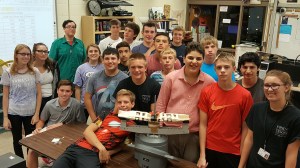
2nd-period-freshman-w-structures

This is the second period Freshman class with their structures. Students including in the picture, in no alphabetical order are as follows: Jowad Aysheh, Gloria Burns, Luke Duderstadt, Manuel Enciso, Jack Fox, Jack Gallagher, Jacob Hinterlach, Thomas Johnson, Troy Kneese, Aquilino Perez, Zoe Rivera, Darien Robles, Jessen Stableford, Noah Stotz, Deja Turkett, Alek Vasquez, Calissa Vollmar, Dalton Waters, Joshua Wienecke,  and Zachary Willis.

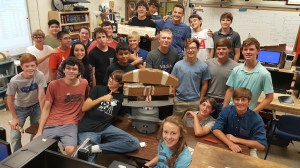
3rd-period-freshman-w-structures

This is the third period Freshman class with  their structures. Students including in the picture, in alphabetical order are as follows: Dylan Ahrens, Jarrett Beard, Jorge Giral, Blake Boubel, Chad Braden, Jacob Brown, Esten Cooke, Samuel Cowsar, Ryan Davis, Gavin Eckert, Tucker Elliot, Frank Fackovec, Cathryn Huff, Brendon Huynh, Abel Jaimes, Ryan Majors, Antonio Martinez, Tristan McDonald, Gabriela Moreno, Robert Sanchez, Landon Sparrow, Carl Wilger, Lane Wallendorf, and Landon West.

The freshman will be traveling to several companies to investigate how engineering plays a part in their industries. This will take place over the next three months in three separate trips. Included in these trips are: Caterpillar Manufacturing, Aqua Power Cutting, Soutwest Research Institute (SwRI), Toyota Manufacturing, and Center for the Intrepid, all out-of-town trips, and Fischer and Wieser, Heartland Enterprises, Ltd. , Swissomation, Kager Industries, and Rode’s Iron and Pipe locally.  During the month of October they will visit Caterpillar Manufacturing and Aqua Power Cutting.

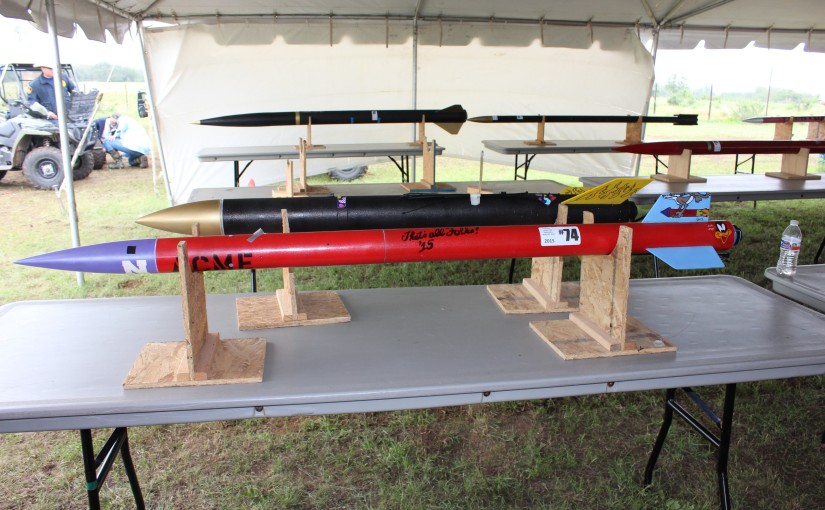
The Juniors are currently working in the R&D (Research and Development) element of the curriculum after having completed building and launching their Generation 1 model rockets. During this phase they are working on modeling the motor burn.

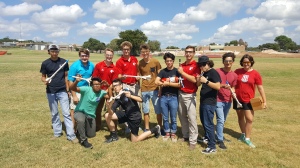
gen-1-rockets

Junior class with the Generation 1 rockets.

Seniors are alternating between rocket history and  work on the test stand and testbed. They are currently in a break from the history but will rejoin it in a couple of weeks. Mean while they have  conducted successful CDR’s (critical design review) for test stand that generated positive and developmental feedback.  They have also had success updating the testbed. Wiring and programming issues have been corrected,  they were able to create a new tank system which will increase safety in the fill and weigh of nitrous operating systems, as well as succeeding in making the testbed more frictionless.  Their senior rocket is still in the works as they continue in the design  development of the vehicle.

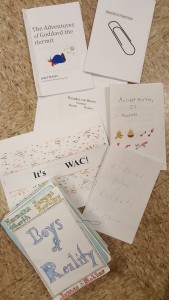
New this year, the seniors created rocket history children’s books.  Students will be doing recordings of themselves reading the books, and both the books and the audios will be sent to the Fredericksburg Elementary School where students there will be able to read the books and hear the high school authors read the books to them.

20161011_074947

According to Mr. Matthes, “Their rocket history children’s books were awesome!”

On November 7 & 8, the senior group has a chance to go to the NASA Johnson Space Center,  for flight profile reviews, grant updates, and a possible preliminary design review. Three students will go for sure, and those will be named at a later date.

Seniors, here is your challenge for the month, according to Mr Matthes, “If you complete the analysis of historic test data from the teststand then you will all be eligible to attend this trip. He would like to see that happen and take you all. Can you meet the challenge? Next month’s edition of this article series will publish the answer to this challenge. Now is your chance to show my readers and Mr. Matthes that you can meet the challenge.

This article is the second in a new series of monthly updates that will follow the Fredericksburg STEM Academy/Rocket program. This school is a participant of the SystemsGo STEM program. This series of articles is intended to support, encourage, and challenge students in the program as they share their working status and accomplishments throughout the year in the program. These publications will be available for tags and re-posting.

www.systemsgo.org as always is the place for more information on this program. You may also email them at info@systemsgo.org . Take the time to get your school involved, the future of your students will be greatly benefited.

What’s All This About Rockets: Success Stories-Anissa Kneese

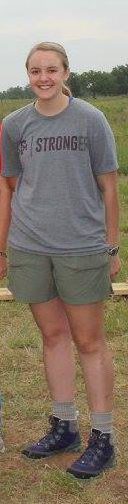
Welcome back to Rocket Success stories. This is the second installment of this series of Interview style articles, in which we meet individuals that studied under the SystemsGo STEM program and have gone on to build their futures on the skills it teaches. Last month we met, Robert Deaver, a 1996 graduate of the program.  This month we are looking at a young lady that is a more recent graduate also from Fredericksburg High School in 2014, miss Anissa Kneese.

Anissa is currently a college student at Texas A&M, which allows us to talk with her now and to check back with her and see exactly where her education and career choices have taken her in the future. This is in a way, the middle of her path, but the drive she has to complete her engineering goals are a direct correlation of her experience in the program.

“Before taking the rocket program classes in high school, I had no idea I was interested in engineering, I learned about the many different engineering paths. and I fell in love with problem solving. I am now working toward my degree in Mechanical Engineering thanks to SystemsGo.”

Anissa joined the STEM program out of curiosity her freshman year, because of all she had heard about it from friends and family. She quickly realized that this class would shape her future.

“After completing the first class freshman year, I was considering majoring in engineering in college. Sophomore year pushed me even more in that direction, and after junior year there was no doubt what so ever this was my future career path. Senior year was the icing on the cake!”

As she studied in the program, her reasons changed from curiosity to excitement and the class became a priority for her.

“By junior year I was so eager to go to class every day. I knew I would learn something new or something really eventful and exciting would happen. Like running a successful student designed test that caused a nearby resident to call the fire department!” Engine and fuel burn  tests can be loud and though most  folks have become accustomed to these tests, this one was particularly loud, and caused a stir, something she recalls with guarded humor.

Anissa participated on two teams. The first was the Mechanical team for static hybrid propulsion testing, and then the injector team for the Redbird #15 Rocket, as long as helping with electronics, payload and engine installation.  Her specific jobs on these projects included, “For propulsion and testing I prepped fuel grains by ensuring their size was exact, installing them in the test cell, and preparing the test cell by sealing the cell to prevent oxidizer leakage. After each test I would clean the test cell and prep the next fuel grain. I also set up oxidizer tanks and plumbing from the tanks to the test cell. During tests, I would make sure all solid and liquid weights were recorded to be used in calculations in the days to follow.”

The Redbird #15 is the rocket that her group designed to launch at White Sands Missile Range. This is where she really had to put her education to work and it presented her with her hardest problem to solve.

“The toughest problem I came across was “trouble shooting” an injector design that had mysteriously failed  in a Redbird rocket from the year before. My teammates and I designed several tests to attempt to understand the previous failure, and this proved to be quite difficult. After a redesign with new materials, the injector worked flawlessly in our Redbird rocket.”

Even with this struggle accomplished with perfect results, she considers another success the greatest her and her team accomplished during their time in the program.

“I would consider my (and my team’s) best success being the first high school team to complete a full round of three 40 second hybrid test burns. This had been attempted by several classes before us (and even ourselves the year before), so coming back the next year and being successful was a great feeling.”

The SystemsGo program teaches individual accountability as well as team coherence. Anissa found this to be one of the most important things she learned in the program.

“This program taught me countless lessons and technical approaches to problems, but the most important thing I learned was the importance of communication. It is impossible to accomplish any great task without full communication and understanding from every team member involved.”

Many of the students who have participated in this program, not only go on to higher education and careers in STEM fields, they enjoy giving back to the program where ever possible. Anissa is no exception to this, she returns each year to help as launch pad lead at the Willow City launches.  If possible she plans to continue helping and being involved with the program however possible.

“I would enjoy mentoring and helping students in the future with the design process or understanding the set up and procedures of building the static propulsion testing. I would also enjoy having a job with SystemsGo in the future. I think having experience in industry would be valuable to gain first, but I would enjoy coming back and teaching at some point.

Her current advice for students considering or currently in the program is, “work as hard as you can every day. Don’t be afraid to get sweaty and leave class with your hands dirty. It doesn’t matter how smart you are, you will learn so much if you are eager to get involved!”

Along with the fantastic education the SystemsGo STEM program provides in the Science, Technology, Engineering, and Mathematics fields, it also helps build confidence and character. It teaches each student to reach into themselves and take pride in what they are accomplishing and can accomplish. For many students, it is a learning boost they may never have known they needed until they discovered it in themselves during the program. Anissa sums up that experience.

“I learned that I am capable of accomplishing anything I have my heart in and I’m willing to work hard to achieve.”

I would like to thank Anissa Kneese for participating in this article series.  These are written in hopes that all may understand the impact that STEM can have on your students and future employees. Having a program available at the high school level to teach, encourage and support this type of learning is instrumental to getting these students into great career futures.  Encourage your students to get involved in STEM and the SystemsGo program if it is available at your child’s school. If it is not available, look into how you can bring it to your area. This program will greatly benefit your school and children.

If you know or have a student that went through the program that would like to share their story here, please contact me in the comment section on this blog or if you follow it on Facebook, Twitter, or LinkedIn contact me there, and I will send you information to participate.

http://www.systemsgo.org as always is the place for more information on this program. You may also email them at info@systemsgo.org .Take the time to get your school involved, the future of your students will be greatly benefited.

August’s New Beginnings- Fredericksburg’s STEM/Rocket Program

The new school year is in its second week and with it, the Fredericksburg High School Engineering program has begun working toward new goals.

The program is off to a “Great start,” according to Engineering instructor, Andrew Matthes.  “We received a NASA grant to continue testing and replace some older components for safety and increased fidelity in test data.”

A date of October 21, 2016 is set for Teststand  operations to start.  A Teststand task list and working groups have been established by the Senior group.

New to the program this year is a Senior out of class work schedule. Students signed a contract requiring them to commit to a set amount of overtime/after class work time in order to meet all deadlines and complete their rocket/project for the year. The group is currently establishing a working schedule in order to implement these hours.  As for the actual rocket, the class is currently studying the rocket history portion of the curriculum.

This year (Fall semester) there are four classes.  Forty-four freshman are enrolled in two separate classes, the junior class has twelve students and the senior class has eighteen. There will be two Sophomore classes starting in the Spring semester.

This article is the first in a new series of monthly updates that will follow the Fredericksburg Engineering/Rocket program. This school is a participant of the SystemsGo STEM program. This series of articles is intended to support and encourage students in the program as they share their working status and accomplishments throughout the year in the program. These publications will be available for tags and re-posting.

www.systemsgo.org as always is the place for more information on this program. You may also email them at info@systemsgo.org . Take the time to get your school involved, the future of your students will be greatly benefited.


What’s All This About Rockets: Success Stories–Robert Deaver

In 1996 in the small town of Fredericksburg, Texas a high school Aerospace program was begun and built literally from the classroom skyward as then, teacher, Brett Williams, developed a plan to build and launch rockets in a classroom setting in order to teach and implement a STEM curriculum. This class originally known as Principles of Technology (the POT Class, as it was fondly referred too), later became the SystemsGo program of Education In Motion, teaching students all over the state and now New Mexico too how to use the principles of STEM to build a career.

In this series of Interview style articles, we will meet individuals that studied under this program and have gone on to build their futures on the skills it teaches. The first gentleman we will meet, is Robert Deaver.

When speaking with indiviuals that have been through this STEM program, especially in the beginning, one thing stands out. Most of them started out in the program because the course name/description sounded interesting, and it provided a science credit.  As years went by and the program became known for building and  launching rockets, that in itself became a big draw for the program, although most participants still did not expect it to have the impact on their career choices that it did.

Robert, when asked why he got involved in the STEM program, was no different. “The class name sounded interesting and it counted as a science credit.”

That simple approach drew in the first classes that set forth to build a rocket, launching  the much more valuable vehicle of their futures  as time and learning evolved.

Robert was in the class during its ground breaking days, working on the construction and flight of the Red Bird #1, #2 and #3 rockets. These were the very formative first two years of the program as students and teacher learned together exactly what it took to create these projects. At first this was just a really fun and new concept of hands on learning and teaching that the students enjoyed.

The original class was only a one year class, but students really took to it and then this “science credit” soon became a class that students took because they wanted to experience it again.

“The course was so much fun I asked if i could take it again and was allowed. I initially took the course because it sounded interesting. I took it a second time because it was fun and challenging,” Robert stated when asked what his reasons were for taking the course.

Robert credits the program with setting him on his career path. He earned a BS in Electrical Engineering a the University of Texas at San Antonio and a MS in Computer Engineering at the University of Tennessee. Robert worked for IBM, Dell, and  after graduation, Real Time Systems, where he spent the last four years designing embedded systems that are used world-wide. After his recent marriage he moved to Boerne, where he started a new career as a hardware engineer at Futurex in Bulverde.

“I did not go directly from high school into an engineering program in college, but being exposed to the ideas and concepts of engineering in the Principles of Technology (precursor to the StystemsGo program) led me there eventually. I learned about Real Time Systems through volunteering with SystemsGo and after I graduated applied for a job with RTS and was hired.” Robert stated.

In his time in the program he worked on 3 of the Red Bird Rocket projects, #1, #2, and #3.  On all three, Avionics and Electronics were his main team focus therefore he was instrumental in Altimeter configuration on all three. On RB#1 he also worked on the Audio/Video Recording and Transmission, and the Fill and Fire system design and construction. On RB#2 he took on the Recovery System design, and on RB#3 the Airframe and Fin design.

Live video transmission from rocket to ground is what he remembers as the worst problem that he tried to solve while working on the RB#1 rocket.

“The electronics were ‘fiddly’ and although it worked well on the  ground, we were not able to get it functional during launch.”

In spite of this, RB#1 is still what he remembers as his best success from the program.

“I watched as a rocket  that my team and I researched, designed, and built from scratch soared off the launch pad. That feeling of accomplishment is truly indescribable!”

During these years he learned that he really liked working with electronics.  He also learned how to work on large projects as a team.

“The Red Bird 1, Redbird 2, and Red Bird 3 were by far the largest projects I had participated in at that time. Each project required interaction with others on my team and with other teams to complete.”

Even with all he learned he still did not realize the impact this program would make on his career choices until he was in college.

“During engineering school, I realized how much more prepared I was due to the project and team interaction skills I learned in what later became the SystemsGo Program.”

When I asked Robert  what advice he would give to current and future students in the program, here is what he had to say, “If you even think you are interested in engineering take these classes and pay attention. The problem solving and team work skills you learn in the SystemsGo program will be invaluable once you get to college.”

Another success of this program is that students from past years come back year after year to volunteer with the program. Many take time out of school and careers to do this. Robert is no exception. He volunteers annually  for the Central Texas, South Texas, and Goddard launches. He has also been named a board member, where he is happy to be able to, “help shape the program.”

I would like to thank Robert Deaver for participating in this article series. He is only the first in what I hope to bring to you as an ongoing series of success stories. These are written in hopes that all may understand the impact that STEM can have on your students and future employees. Having a program available at the high school level to teach, encourage and support this type of learning is instrumental to getting these students into great career futures.  Encourage your students to get involved in STEM and the SystemsGo program if it is available at your child’s school. If it is not available, look into how you can bring it to your area. This program will greatly benefit your school and children.

If you know or have a student that went through the program that would like to share their story here, please contact me in the comment section on this blog or if you follow it on Facebook, Twitter, or LinkedIn contact me there, and I will send you information to participate.

www.systemsgo.org as always is the place for more information on this program. You may also email them at info@systemsgo.org .Take the time to get your school involved, the future of your students will be greatly benefited.


What’s All This About Rockets?????

You may have noticed that this blog has a yearly burst of articles that follow a non-profit business, known as SystemsGo, and the related high school rocket program, where students build and launch rockets at various locations around Texas, and well as White Sands Missile Range in New Mexico. While this looks really fun and interesting, what is it all about and how has it benefited education and our students’ futures?

This is the beginning of a series of articles about just how it has shaped the lives of individuals that have participated in the program. First off it is part of an educational push to get more students into what is known as the STEM program of learning, and then out into the work force in related fields. You may have seen or heard TV and radio commercials backing the STEM initiative. One such example is the US NAVY. They carry radio and TV commercials stating the benefits of the Science, Technology, Engineering and Mathematics curriculums and the necessities of these skills to jobs in the military and the civilian work force.

The SystemsGo program teaches all of these core classes as well as teaching business applications with it. It helps students learn their strengths and weaknesses in these areas and how to work individually and as a team in order to accomplish a large project. They learn how to manage time and project teams, do project and work analysis, order supplies and inventory items for the project, write documentation and proposals for the project, as well as doing the actual STEM based project elements.

This program began in Fredericksburg High School in 1996, making this its 20th year since its implementation. The following spring the first Red Bird Rocket was sent skyward. In 1999, the first Goddard level Red Bird Rocket was launched at White Sands Missile Range in New Mexico. Since its humble beginnings it has grown from one small town school to currently 48 Texas schools, large and small. Starting next year, 7 New Mexico schools will also begin in the program with their own launch site in New Mexico, participating at the smaller launch levels beginning with Tsiolkovsky(1 pound/1 mile high) next year and  then adding Oberth(achieving transonic velocity under 1300′) hopefully the following year. Of all these schools,  9 are trained and 5 are actively participating at the Goddard(35 pound payload attempting to reach 80,000 to 100,000′-WSMR) level.

This equivolates to more than 10,000 students that have gone through the program, and by my personal estimates, that may be closer to 15,000. Because records from before 2007 are not available, and records after that time are not complete that estimate is known to be on the low-end.  At a rate of  17 students per class per grade level in a 4 year program across 48 schools that equals 3264 students a year learning this valuable academic skill set to better their futures. That is a lot of our college age and current work force that have been impacted by the SystemsGo Rocket program.

If even half of these students followed a STEM career path, that is a bigger success story than any other school sponsored program, and this program is academic based. This is not to throw punches at other extra curricular programs, they all have benefits to the individuals involved in them, but on average, the number of success stories from this program versus the number from two of the bigger programs, ei. athletics and band are quite impressive.

The following are purely observational statistics not exact documented statistics but they do give you an idea.  Out of my three children, 2 have been in the rocket program, 2 have been in athletics, and all three were in band in high school and this is what I observed from their years as well as this year.

For example, the high school band here has approximately 135 students in it. That averages out to about 33 per grade group. Of those 33 students 1-5 may pursue music into college and a career. Out of the whole four-year group, 20 might be music majors. While that is still good it still not a quarter of the group.

Athletics has an even larger student base. I don’t know exact numbers but a close estimate across the board girls and boys, there are close to 300 students involved plus or minus a few that may be in more than one sport. That translates to about 75 students per grade class. Out of that 75 students spread across 19 sports if at least one from each sport goes on to a career in the athletic field.  That is still less than 1/3 of the student base involved.

An average class in the STEM program is usually around 17.  This year’s class had 14. That is about 68 students in any given school year that are in the program. These are much smaller numbers than athletics or band, but by comparison, this academic based program has a much higher rate of students, that not only pursue higher learning in one of these fields, but also achieve a career in their chosen field. Out of the 14 from this year’s class, I was able to get information on 8 of them, and 6 of those are pursuing a STEM related field. On average, 1/2 to 3/4 of the students from any one graduating rocket class go on to  pursue a STEM related career. Those that do not, still state that what they learned from this program helped them to choose their career path and taught them many skills that will carry on into their future work place needs.

There is record of  SystemsGo alumni working at NASA  Stennis and Johnson Space Centers, SpaceX, Ball Engineering, Elon Musk’s Solar City, FMC Technologies, United Space Alliance, Real Time Systems, Ameristar, Lockheed Martin Missile and Fire Systems, Orbital Sciences Corporation, Bradley Arant Boult Cummings LLP, Halliburton, Rutgers Demmings, Petro Engineering, Department of Defense, US Airforce, and the US Navy.  These are just the handful that they have been able to follow, and a few of these employers have several SystemsGo alumni working for them. Not only that several alumni come back each year to help SystemsGo with their launches and some are regular team members.

These students are successful members of the workforce and it all started with this rocket program.  Each student starts out the program curious and hoping to do something really challenging and fun, and they definitely get all that and more. By the time they reach their junior and senior years in the program and begin building rockets, they are also building their futures, discovering who they are, what their strengths are,  and what they are truly interested in doing in those futures. This program is a proven method of helping them achieve the knowledge base, skills, and the interest in careers that will help them accomplish success.  Students from this program go into college ahead of the curve with experience that is learned and achieved, not just taught. Science, Technology, Mathematics and Engineering are the big jobs of not only today, but the future. These students are ready to go out and meet the challenges of these careers.

So the next time you see these rockets in the news and someone asks, “What’s all this about rockets?” Tell them that it is about the future of our world. Tell them that with each rocket built, these students make their small mark in history and it drives them to move forward to make their bigger mark in the future. These are the technological innovators to watch, because they go on to good jobs and strive to accomplish great things. These are student success stories. And if they are asked,

“How did the SystemsGo/Rocket program influence your career path?”

See for yourself, here are just three past students’ answers:

“I did not go directly from high school into an engineering program in college, but being exposed to the ideas and concepts of engineering in the Principles of Technology (precursor to the SystemsGo program) led me there eventually. I learned about my current employer through volunteering with SystemsGo and after I graduated applied for a job with Real Time Systems; I was hired.”–Robert Deaver, FHS graduate 1998.

“Through the two years I was in the Rocket Program, I was able to work with several groups of people on projects. And not only one piece of the rocket, but coordinating, scheduling, and planning with other members to make sure everything was working together. During my second year, I realized that I did not love to do all of the calculations and theory to construct the rocket, but instead more enjoyed dealing with the people and management side of the project. This led me to choose business management and business finance as my dual major so I could help support these people who did work on projects but not actually do the engineering to create the product.”–Derrick Loth, FHS graduate 2012

“Before taking the rocket program classes in high school, I had no idea I was interested in engineering. I learned about the many different engineering paths, and I fell in love with problem solving. I am now working toward my degree in Mechanical Engineering thanks to SystemsGo.”–Anissa Kneese, FHS graduate 2014.

SystemsGo is currently working toward having a better data base of its Alumni which will help keep more accurate numbers  of students and alumni and follow them into their careers so that even more parents, students, and teachers can see the benefits of this program and the results it can achieve. STEM is our future so get involved and encourage your school and students to get involved in this hands on, “education in motion” system of learning.

In future articles, I will be sharing interviews with past SystemsGo students on how the program affected them and influenced their career choices. If you are or if you know a student that would like to participate in sharing their information and stories here please message me either on this blog or in a PM on Facebook with contact information and I will get back to you.

www.systemsgo.org as always is the place for more information on this program. You may also email them at info@systemsgo.org .Take the time to get your school involved, the future of your students will be greatly benefited.

Friday, SystemsGo’s Rockets 2016 Officially Ends as Team Travels Home and Transitions into Next Year Preps

At 7:30 a.m.  this morning, the SystemsGo team and Fredericksburg students traveled home from White Sands Missile Range, arriving safely in Fredericksburg around 5:30 p.m.

WSMR marks the end of another successful year with launches in Houston, Willow City included. The group helped test 90 Tchaikovsky and Oberth rockets and 7 Goddard level rockets for the Rockets 2016 season.

Now the volunteer staff returns to their daily lives and the SystemsGo team enjoys a much needed break before continuing with more schools, students and rockets. It won’t be long and the “launch season” will be back again with Rockets 2017. This coming season will start a little earlier with launches in April for the new New Mexico schools that will be coming online. It should prove to be an exciting year.

For now, SystemsGo transitions back to helping schools and teachers implement this STEM based program so that more students can participate in this system of learning.

That concludes Friday’s WSMR Rocket update.

www.systemsgo.org as always is the place for more information on this program. Take the time to get your school involved, the future of your students will be greatly benefited. SystemsGo is a Texas-based STEM curriculum program.

Team photo includes from left to right, (SystemsGo founder), Cade Ottmers, Brian Heffner, Josh Hampton, Chelsea Burow, Gene Garrett, Steve Burow, Randy Kuhlmann, Robert Dever, and Andrew Matthes (FHS STEM program instructor).

Thursday, Final WSMR Launch Day

Today was the final day of testing at WSMR for SystemsGo student programs. Fredericksburg was the only official launch scheduled, with two remaining test times for any retests needed. Unfortunately it was a sad day for Fredericksburg as well. Their rocket had ignition but the injector failed therefore it never left the pad.

At first they were going to allow them a second test time at 12:30 p.m. but after inspection it was determined that they did not have enough spare components to repair the vehicle and so the second test was scrubbed.

At that point the SystemsGo team, Fredericksburg students and WSMR personnel cleaned up West Center 50 and left, officially ending our White Sands Missile Range launch operations.

This evening the team gets some much-needed rest time before returning to Fredericksburg. Except for Chelsea and Steve they are returning to Lubbock this evening and then to Fredericksburg on Friday evening. The team and the Fredericksburg students spent the afternoon seeing the New Mexico Museum of Air and Space and the White Sands National Monument, where they met the challenge of climbing and sliding down the dunes.

Tomorrow is back to Texas and a long Fourth of July Holiday weekend.

There were four out of seven rockets that left the rail this year. Seven out of seven would have been even better but this is still a good end to the season. The thing to bear in mind is that with all these tests whether they leave the rail or not there is always and element of further knowledge to be obtained from what transpired with each vehicle. That deducing, understanding and learning from both what went right and what went wrong whether the vehicle launched of not, and all the education and skills each student learned to get it to this point is the true important lesson.

Thank you so much to White Sands Missile Range for all the support, man power, time, education, entertainment, information and fun you provided in order for SystemsGo and these four schools to come out and test their vehicles. Your continued support in this education of future generations is highly appreciated.

www.systemsgo.org as always is the place for more information on this program. You may also email them at info@systemsgo.org .Take the time to get your school involved, the future of your students will be greatly benefited.

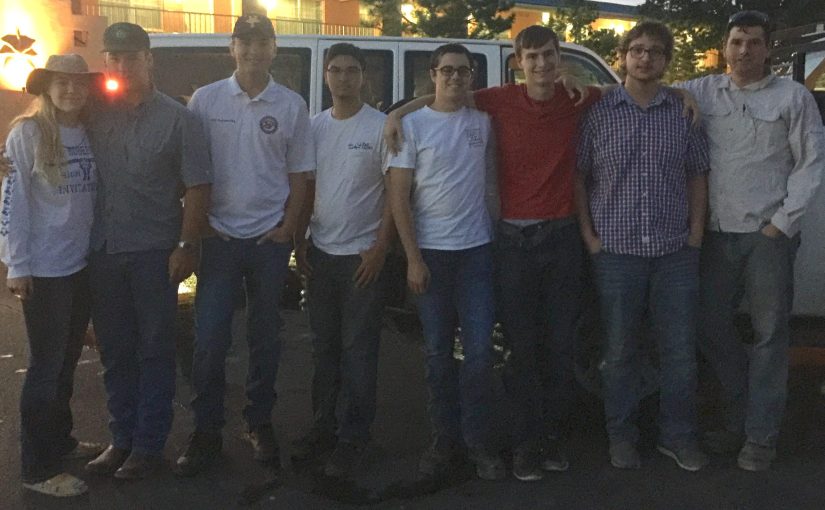
The picture on this blog piece is of the Fredericksburg rocket team this morning prior to their vehicle test. It was provided by team member Zane Brown. Team members are from left to right: Katie Habecker, Link Millard, Dorian Jones, Garrett Ottmers, Nathan Weatherford, Alex Scudder, Zane Brown, and teacher, Andrew Matthes.

Late Update to Wednesday, Launch Day 2 at WSMR

This is just a quick update to my earlier post. Booker T Washington has decided not to go for a retest on either of their failed rockets today. That means Fredericksburg is tomorrow’s only attempted launch test. It’s T time is 8:30 a.m.

Wednesday, Launch Day 2 at WSMR

The Anahuac rocket left the rail this year at 8:36 a.m. It traveled 171 meters (appx. 576.27’).  The Estes motor blew out at ignition as the rocket started its lift off. This caused the rocket to spiral upward and eventually nose over and continue into the range a few hundred yards to the right of the launch rail, digging a crater and leaving dust for some distance. The Anahuac teachers were prepared and blew party horns to celebrate as soon as the vehicle came to rest. Congratulations Anahuac on your first successful launch!!!!!

The next two T times were both held by Booker T Washington High School. Both of these rockets were carrying a payload consisting of a PVC container with space pebbles that they were testing to see how they would react upon reentry to the earth’s surface.

Unfortunately it was not a good day for Booker T. They achieved success in making it to the pad, but flight was not to be. Neither vehicle left the pad.

On the 11:00 a.m. test of Golden 5 the Junior class rocket, the valve froze shut not allowing the Nitrous Oxide to mix with the fuel at ignition resulting in a small puff of smoke and a misfire.

The 2:15 p.m. test of their Senior class rocket, failed due to a fault in the ignition wire  which resulted in no ignition and the system venting out the Nitrous. There is no word at this time as to whether either vehicle will be able to retest in one of tomorrow’s two available retest T’s. Even if one of the vehicles can be repaired in time there may not be more Nitrous available for them to conduct any additional testing.

At this time, the 8:30 a.m. T time is scheduled for Fredericksburg’s Red Bird #17 rocket. If no other retesting occurs, then the mission will be complete, then clean up and pack up will end the day for SystemsGo, students, and WSMR personnel.

Good luck to Fredericksburg and tomorrow and safe travels to all schools heading home.

Tomorrow’s test schedule is as follows:

  • 8:30 a.m. Fredericksburg
  • 11:00 a.m. Retest (1)
  • 2:00 p.m. Retest (2)

Event details will continue to be available here. I will provide more information each morning as to how the schedule and other event details will progress for that day and how launches went for the schools testing that day. Pictures are not allowed on the range, but some pictures of teams getting ready to leave for the range with their vehicles might be available. If anything is available I will post it for your viewing pleasure.

www.systemsgo.org as always is the place for more information on this program. You may also email them at info@systemsgo.org .Take the time to get your school involved, the future of your students will be greatly benefited.

The picture was provided by parent, Teresa Moore, of the Anahuac High School Rocket team after their launch here at WSMR. Students pictured are (not in order) Anne-Marie Henry, Madalyn Orozco, Maria Magana, Kaitelynn Innerarity, Mason Duhon, Shon Patton, Dante Nguyen, Beau Cendejas, Austin Hodges, Meghan Thomas, Zack Rose, and Caleb Moore.