Day 62- SystemsGo Team Ends Another Successful Year

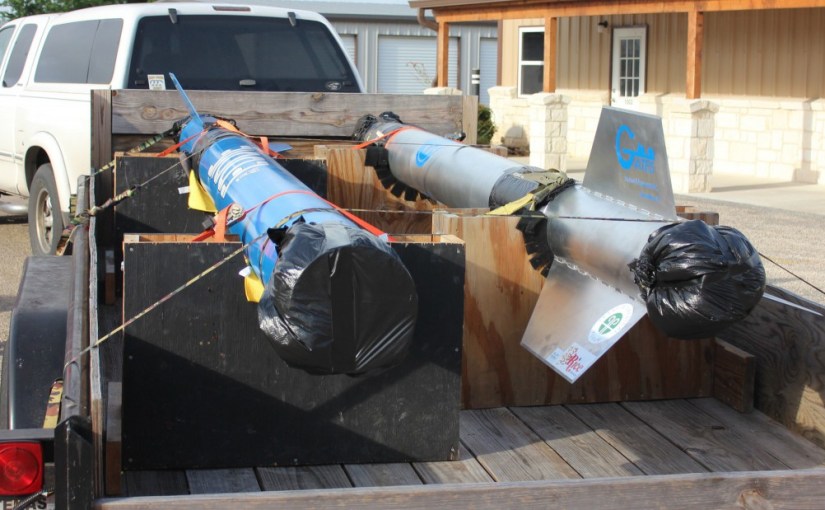
The SystemsGo team traveled home from White Sands Missile Range in New Mexico today. They left Alamogordo around 0800 and arrived safely in Fredericksburg around 1845.

They have now completed another successful year with launches in Houston, Willow City, and WSMR. The group helped students attempt the launches of over 90 Tchaikovsky and Oberth rockets and 6 Goddard level rockets.

Now they take a short needed break before getting fired up for a new year with more schools, students and rockets. It won’t be long and the “launch season” will be back again.

SystemsGo transitions back to helping schools and teachers implement this STEM based program so that more students can participate in this system of learning.

That concludes Thursday’s WSMR Rocket update.

www.systemsgo.org as always is the place for more information on this program. Take the time to get your school involved, the future of your students will be greatly benefited. SystemsGo is a Texas-based STEM curriculum program.

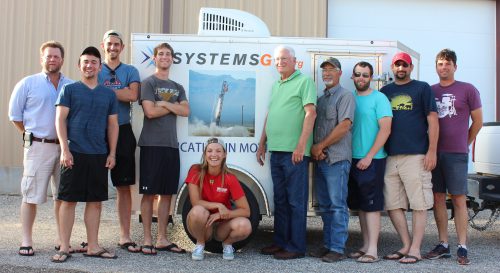
Team photo includes from left to right, Brett Williams (SystemsGo founder), Cade Ottmers, Brian Heffner, Josh Hampton, Chelsea Burow, Gene Garrett, Steve Burow, Randy Kuhlmann, Robert Dever, and Andrew Matthes (FHS STEM program instructor).

Day 61-Rockets at WSMR-Final Launch Day-Update

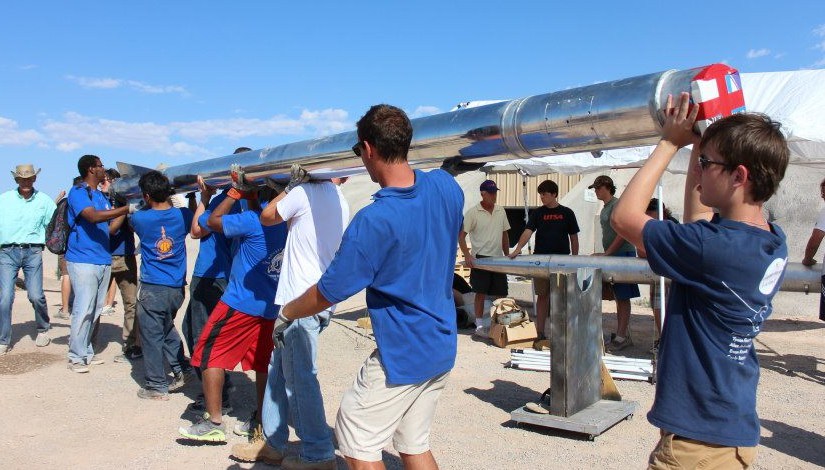
Today was the final launch day at WSMR for this year’s participating schools. Alamo Heights High School was scheduled for launches of two separate rockets today, one that they were unable to launch while at WSMR last year, and a new one from this year’s class. Union Grove was on standby for a second attempt if time permitted.

The SystemsGo team and the high schools had another early start to the day arriving at WSMR at 0400, with an eight hour window for launches. Transition times between launches were running at two hours each, which allowed all three launch attempts to be completed quickly, everything to be packed up, and the group off the range by 1800.

Alamo Heights started off with their new rocket at the pad. They had a successful fill, fire, and launch. The vehicle climaxed at 17,000 feet, and then nosed over and came down ballistic. What was recovered from it was in pieces.

Alamo Height second rocket, the return from last year took the pad next. It too had a successful fill, fire, and launch, leaving the pad behind and reaching an altitude of 34,000 feet. This rocket also came down ballistic, and they were only able to recover the motor section.

Union Grove was able to attempt a second launch. They had a successful fill, which ended in a vehicle malfunction that caused the injector system to open but no ignition. Speculation is that the Estes motor inside with the electric match did not light because of a possible wire short in the rocket.

That concluded the launch series at WSMR for this year. To recap out of six vehicles, there were two successful launches each with failed recovery systems. One more low altitude launch with in flight mechanical failure causing premature landing and continued burn out. One complete hang fire on the rail. And two scratched due to vehicle malfunctions at fill.

Congratulations to all five schools for getting this far. There are schools every year that aspire to be here, and do not make it. You have accomplished a great deal. You have all met the objective of the program which is to create a scratch built rocket, have it completed and ready for flight, and on the rail attempting launch at White Sands Missile Range. The goal of flight, may have been elusive, or perhaps achieved but still problematic, but you made it here, and each of you has something to learn from the event and some will have the chance to study, fix and try again. All of you are in an elite group of past and present students that attempted to launch a rocket at WSMR.

Tomorrow is another long day of travel as the SystemsGo team and participating schools all head back to Texas. Hopefully it will be a safe, smooth trip home without any issues.

That concludes Wednesday’s WSMR Rocket update.

www.systemsgo.org as always is the place for more information on this program. Take the time to get your school involved, the future of your students will be greatly benefited. SystemsGo is a Texas-based STEM curriculum program.

Tune in again tomorrow for an update from Thursday’s trip home from White Sands Missile Range this week.


Day 60- Rockets at WSMR- Launch Day 2-Update

This morning started around 0900 on WC 50 range at WSMR. Earlier start was not available due to actual military testing scheduled for today. Two schools, Union Grove and Booker T Washington were on the schedule with a 6 hour window for completion.

The SystemsGo team spent the first hour plus, conducting readiness checks on the Nitrous tanks making sure they were switched out for full ones, making sure the Pad was completely operational, and safety testing the Fill and Fire system to be sure it continued at 100%. During this time, students evaluated their rocket and checked to be sure their vehicle was completely prepared for launch.

Between 1030 and 1100 all systems were deemed ready as was Union Grove’s rocket so it was moved to the launch rail. It went vertical around 1145 and commenced fill. As the third Nitrous tank was filling into the rocket, a small piece at the top of the Estes motor in the injection system froze, and collapsed causing Nitrous to vent. At this point the launch had to abort. The problem was easily fixed and the rocket was readied for a second attempt after Union Grove if time allowed.

It took approximately two hours to remove Union Grove’s rocket and put Booker T Washington’s rocket  on the rail, switch out Nitrous tanks, and wait on the survey teams to provide a new azimuth and angel for the rail for the new launch. During this time another thunderstorm was fast approaching. At 1420 they began fill, as the third tank was loading the Army reported lightning ten miles out. Fill was completed and the rocket was ready to fire so the teams all went to the bunk house and began countdown. Twelve seconds from launch the Army called abort due too high winds that would have affected the rocket’s projections.  After another 45 minutes to one hour, they were given the go for launch again and restarted the countdown at one minute and 30 seconds (90 seconds). Rain continued throughout this time.

The initial launch went well. The rocket ignited and left the rail. It traveled 30 to 40 feet up where the bolts at the top of the nozzle cracked, the rocket lost control, and nose-dived into the range between 180 to 200 feet from the launch rail. It continued burning on the ground, and continued storming so it was allowed to stay where it was and burn out. The Army took over monitoring it until they deemed it safe to approach.

This rocket was caring a NASA payload in the form of a container that was filled with lava rocks meant to represent moon rocks. The purpose of the payload was to test the container and evaluate how it would hold up to space flight and impact at  landing. The container was crushed and the rocks strewn all over the crash site. It was determined that the container would not hold up as part of the nose cone.

The decision to abort for the day was made because of continued heavy rain, lightning, and wind in the storm. Two hours elapsed before the storm let up and they were able to get out on the range, retrieve the rocket and rocks, and pack up for the day. This also meant that Union Grove would not get another shot at launch for today, bumping them to after Alamo Heights tomorrow time permitting.

On another outstanding note, the new Fill and Fire system has been tested and found 100% operational in sunshine or rain. Congratulations to Robert Dever, the system designer.

Wednesday’s schedule includes two vehicles for Alamo Heights High School and now a second attempt for Union Grove if the window of opportunity is still available. Range time begins at 0400 with a final eight-hour window. Launch times begin at 0800.

After launches are complete, the team will pack up all equipment and clean up the site, and the schools will load all vehicles, clean up and take down all staging areas including tents and materials and return the bunk house and  pad to pre-SystemsGo arrival WSMR standards.

Thursday all SystemsGo teams and participating schools will return home.

That concludes Tuesday’s WSMR Rocket update.

www.systemsgo.org as always is the place for more information on this program. Take the time to get your school involved, the future of your students will be greatly benefited. SystemsGo is a Texas-based STEM curriculum program.

Tune in again tomorrow for an update from Wednesday’s final day of  launches at White Sands Missile Range this week.


Day 59-Rockets at WSMR -Launch Day 1-Update

Monday was another long day for the SystemsGo team, students from Marble Falls and Anahuac High Schools, and WSMR officials as they commenced the first day of tests.  Start time on the range at 0400 was with no electricity due to lightning strikes the evening before, but this was quickly corrected.

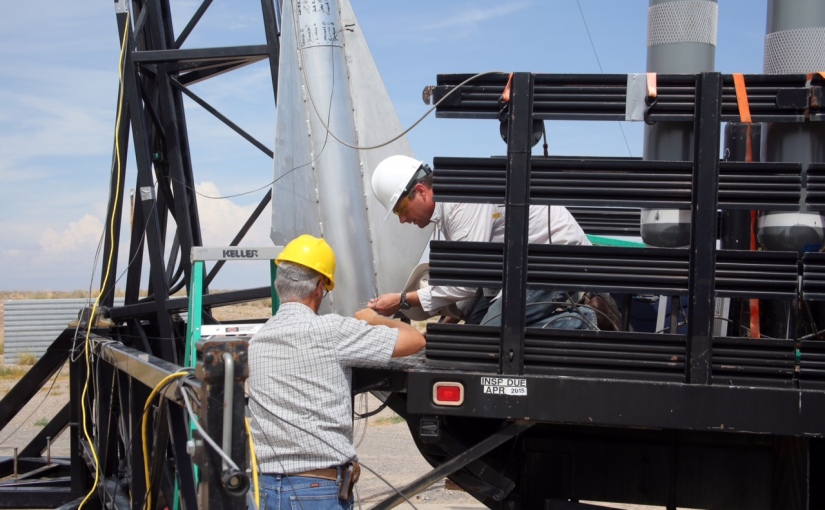
The Fill and Fire System completed set up with the addition of the Comm Readout Displays which allow the bunk house and the pad to see a digital readout of the temperature,  pressure, and weight for the vehicle on the pad during the launch preparation sequences. The full system was tested and minor glitches addressed which brought it to 100% working and readiness. Throughout the day the system was reported to work great and continued at 100%.

Marble Falls was originally scheduled to test a 0830, instead it made it to the pad at around 1200. The vehicle passed its final fill and fire tests and went vertical around 1230. The survey team set the angel at 85 degrees with an azimuth of 355. Six Nitrous bottles were loaded into the tank. At this point it almost over pressured and began to release venting liquid instead of gas. At 175 lbs and 900 PSI  the vehicle was determined ready for launch. Switches were good, and flame was good, but the injector failed to open and the rocket went into a still fire burn on the pad, continuing to burn for four minutes, until the bottom began leaking the nitrous.

Army rules forbid any contact during this time and for 30 minutes after the fire burned out. At that time the Oxidizer crew was allowed to approach and evaluate the vehicle. The rocket was too hot too touch delaying removal of it from the pad for another hour.

Minor damages were reported to the launch rail and trailer, but nothing that would affect or delay any future launches at this time. Instead it was just enough to give Captain Garrett something to do over the summer again.

At approximately 1400 Anahuac’s vehicle was brought to the pad and cleared for launch. At fill, one and a half bottles were loaded into the tank at which time it began leaking out from a vehicle malfunction, and Anahuac had to be scratched.

This concluded the tests for the day, setting today’s successful launch rate at zero. Any school that actually makes it this far is still a success for the simple fact that they attempted a launch of a vehicle of this size. They still have post analysis to do and challenges to over come to prevent these outcomes in the future.

Mother nature was reported to have attended the tests today as well and thrown her own challenges into the range for the crew to overcome, as well as find some humor in once they had passed. First a large dirt devil spawned right on top of the range and attempted to steal one of the large staging tents, causing a commotion as individuals scrambled after and reset it. Later, two birds were fighting on a transformer out by the pad, when a loud pop resounded, right after which one bird fell to the ground while the other made its escape and the power at the pad went down. Luckily they were using generators so this did not affect the pad and they continued as it was being fixed.

The crew spent fourteen hours at the range today, with an 8 hour launch window. Tomorrow they begin their day at 0900 with a shortened 6 hour launch window due to some other military tests scheduled for that morning early. Union Grove High School will be first followed by Booker T Washington High School. Both rockets are reported to be at 100% and waiting.

That concludes Monday’s WSMR Rocket update.

www.systemsgo.org as always is the place for more information on this program. Take the time to get your school involved, the future of your students will be greatly benefited. SystemsGo is a Texas-based STEM curriculum program.

Tune in again tomorrow for an update from Tuesday and a schedule of Wednesday’s launches at White Sands Missile Range this week.


Day 15-The Launch Pad Crew

Today’s blog is about the crew that runs the actual launch pad for the rocket tests. Most of this group is made up of past students that have gone through the SystemsGo program. They are all pursuing engineering careers at their respective universities. All three completed the program at Fredericksburg High School and ended that time there with a successful Goddard level rocket launch at White Sands Missile Range (WSMR).

Being at the pad, is both exciting and dangerous. Personnel here have the responsibility of loading each vehicle onto the rail, going for fill and relaying the go ahead for ignition.

These future engineers come back each year for several reasons. First and foremost they all enjoy what they are doing out there. Second as engineering students in college, this is a hands on opportunity to work in the field and have this addition for their resume`s. Lastly, they are big proponents of the program, and know firsthand what it has done for them and what it can do for students in the future so they want to help out and keep the program running, so that others will continue to have this opportunity. Most if not all of this crew will be traveling to WSMR later this summer to help run the launch of the Goddard level rockets being tested there as well.

These students include: Cade Ottmers, Annisa Kneese, and Chelsea Burow.

This year, Annisa brought a group of engineering students from Texas A&M to observe the program here first hand, and  though I do not have all their names,  I wanted to mention them because they also helped at the pad on Sunday. This gave them firsthand experience in what is being done.

Andrew Matthes, the program instructor at FHS, and retired teacher, Ned Butler, also provided assistance, instruction, and monitored safety at the pad throughout the weekend. They help insure that all procedures and checklists are followed to provide the most successful test of each vehicle.

The program wouldn’t be as successful as it is without the willingness and effort of the individuals at the pad. Each vehicle is literally in their hands in the last few moments before the test.  They check for any final issues that might prevent launch, and stand by with each vehicle as it begins fill and watching for signs that the rocket is a go for launch. For this I applaud their hard work and resilience. This year alone they had a 100% launch rate, meaning that every vehicle that made it through the Stages 1, 2, and  3 and down to the pad, left the rail at launch. Congratulations Launch Pad Crew!

Thank each one of you for all you do and are willing to do to help each vehicle complete its launch. You are an outstanding bunch, and so detrimental to the program’s success on launch days.

www.systemsgo.org as always is the place for more information on this program. Take the time to get your school involved, the future of your students will be greatly benefited.