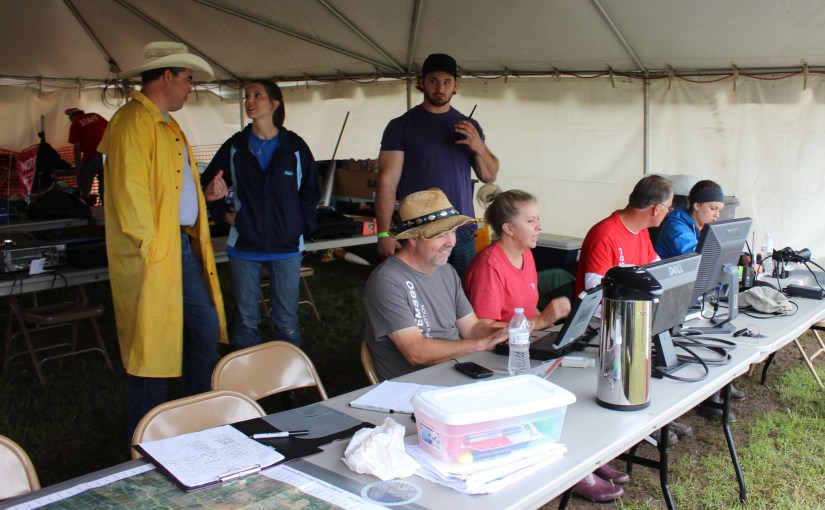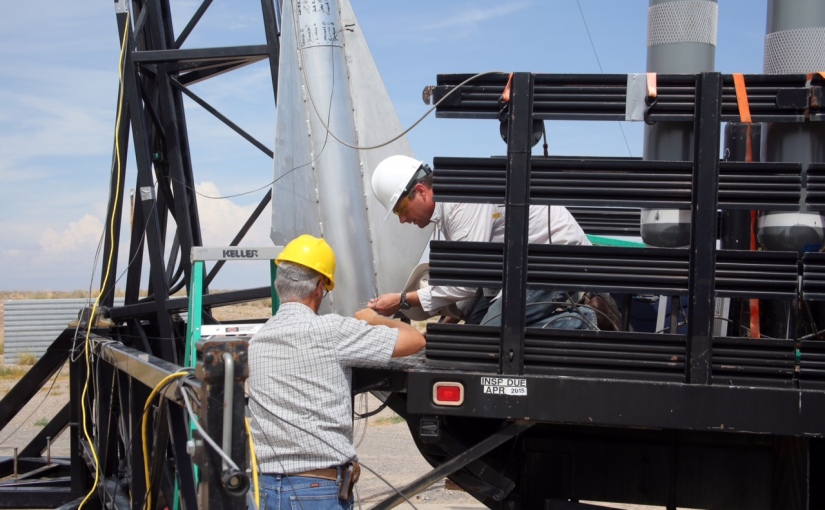
Day 60- Rockets at WSMR- Launch Day 2-Update

This morning started around 0900 on WC 50 range at WSMR. Earlier start was not available due to actual military testing scheduled for today. Two schools, Union Grove and Booker T Washington were on the schedule with a 6 hour window for completion.

The SystemsGo team spent the first hour plus, conducting readiness checks on the Nitrous tanks making sure they were switched out for full ones, making sure the Pad was completely operational, and safety testing the Fill and Fire system to be sure it continued at 100%. During this time, students evaluated their rocket and checked to be sure their vehicle was completely prepared for launch.

Between 1030 and 1100 all systems were deemed ready as was Union Grove’s rocket so it was moved to the launch rail. It went vertical around 1145 and commenced fill. As the third Nitrous tank was filling into the rocket, a small piece at the top of the Estes motor in the injection system froze, and collapsed causing Nitrous to vent. At this point the launch had to abort. The problem was easily fixed and the rocket was readied for a second attempt after Union Grove if time allowed.

It took approximately two hours to remove Union Grove’s rocket and put Booker T Washington’s rocket  on the rail, switch out Nitrous tanks, and wait on the survey teams to provide a new azimuth and angel for the rail for the new launch. During this time another thunderstorm was fast approaching. At 1420 they began fill, as the third tank was loading the Army reported lightning ten miles out. Fill was completed and the rocket was ready to fire so the teams all went to the bunk house and began countdown. Twelve seconds from launch the Army called abort due too high winds that would have affected the rocket’s projections.  After another 45 minutes to one hour, they were given the go for launch again and restarted the countdown at one minute and 30 seconds (90 seconds). Rain continued throughout this time.

The initial launch went well. The rocket ignited and left the rail. It traveled 30 to 40 feet up where the bolts at the top of the nozzle cracked, the rocket lost control, and nose-dived into the range between 180 to 200 feet from the launch rail. It continued burning on the ground, and continued storming so it was allowed to stay where it was and burn out. The Army took over monitoring it until they deemed it safe to approach.

This rocket was caring a NASA payload in the form of a container that was filled with lava rocks meant to represent moon rocks. The purpose of the payload was to test the container and evaluate how it would hold up to space flight and impact at  landing. The container was crushed and the rocks strewn all over the crash site. It was determined that the container would not hold up as part of the nose cone.

The decision to abort for the day was made because of continued heavy rain, lightning, and wind in the storm. Two hours elapsed before the storm let up and they were able to get out on the range, retrieve the rocket and rocks, and pack up for the day. This also meant that Union Grove would not get another shot at launch for today, bumping them to after Alamo Heights tomorrow time permitting.

On another outstanding note, the new Fill and Fire system has been tested and found 100% operational in sunshine or rain. Congratulations to Robert Dever, the system designer.

Wednesday’s schedule includes two vehicles for Alamo Heights High School and now a second attempt for Union Grove if the window of opportunity is still available. Range time begins at 0400 with a final eight-hour window. Launch times begin at 0800.

After launches are complete, the team will pack up all equipment and clean up the site, and the schools will load all vehicles, clean up and take down all staging areas including tents and materials and return the bunk house and  pad to pre-SystemsGo arrival WSMR standards.

Thursday all SystemsGo teams and participating schools will return home.

That concludes Tuesday’s WSMR Rocket update.

www.systemsgo.org as always is the place for more information on this program. Take the time to get your school involved, the future of your students will be greatly benefited. SystemsGo is a Texas-based STEM curriculum program.

Tune in again tomorrow for an update from Wednesday’s final day of  launches at White Sands Missile Range this week.


Day 59-Rockets at WSMR -Launch Day 1-Update

Monday was another long day for the SystemsGo team, students from Marble Falls and Anahuac High Schools, and WSMR officials as they commenced the first day of tests.  Start time on the range at 0400 was with no electricity due to lightning strikes the evening before, but this was quickly corrected.

The Fill and Fire System completed set up with the addition of the Comm Readout Displays which allow the bunk house and the pad to see a digital readout of the temperature,  pressure, and weight for the vehicle on the pad during the launch preparation sequences. The full system was tested and minor glitches addressed which brought it to 100% working and readiness. Throughout the day the system was reported to work great and continued at 100%.

Marble Falls was originally scheduled to test a 0830, instead it made it to the pad at around 1200. The vehicle passed its final fill and fire tests and went vertical around 1230. The survey team set the angel at 85 degrees with an azimuth of 355. Six Nitrous bottles were loaded into the tank. At this point it almost over pressured and began to release venting liquid instead of gas. At 175 lbs and 900 PSI  the vehicle was determined ready for launch. Switches were good, and flame was good, but the injector failed to open and the rocket went into a still fire burn on the pad, continuing to burn for four minutes, until the bottom began leaking the nitrous.

Army rules forbid any contact during this time and for 30 minutes after the fire burned out. At that time the Oxidizer crew was allowed to approach and evaluate the vehicle. The rocket was too hot too touch delaying removal of it from the pad for another hour.

Minor damages were reported to the launch rail and trailer, but nothing that would affect or delay any future launches at this time. Instead it was just enough to give Captain Garrett something to do over the summer again.

At approximately 1400 Anahuac’s vehicle was brought to the pad and cleared for launch. At fill, one and a half bottles were loaded into the tank at which time it began leaking out from a vehicle malfunction, and Anahuac had to be scratched.

This concluded the tests for the day, setting today’s successful launch rate at zero. Any school that actually makes it this far is still a success for the simple fact that they attempted a launch of a vehicle of this size. They still have post analysis to do and challenges to over come to prevent these outcomes in the future.

Mother nature was reported to have attended the tests today as well and thrown her own challenges into the range for the crew to overcome, as well as find some humor in once they had passed. First a large dirt devil spawned right on top of the range and attempted to steal one of the large staging tents, causing a commotion as individuals scrambled after and reset it. Later, two birds were fighting on a transformer out by the pad, when a loud pop resounded, right after which one bird fell to the ground while the other made its escape and the power at the pad went down. Luckily they were using generators so this did not affect the pad and they continued as it was being fixed.

The crew spent fourteen hours at the range today, with an 8 hour launch window. Tomorrow they begin their day at 0900 with a shortened 6 hour launch window due to some other military tests scheduled for that morning early. Union Grove High School will be first followed by Booker T Washington High School. Both rockets are reported to be at 100% and waiting.

That concludes Monday’s WSMR Rocket update.

www.systemsgo.org as always is the place for more information on this program. Take the time to get your school involved, the future of your students will be greatly benefited. SystemsGo is a Texas-based STEM curriculum program.

Tune in again tomorrow for an update from Tuesday and a schedule of Wednesday’s launches at White Sands Missile Range this week.
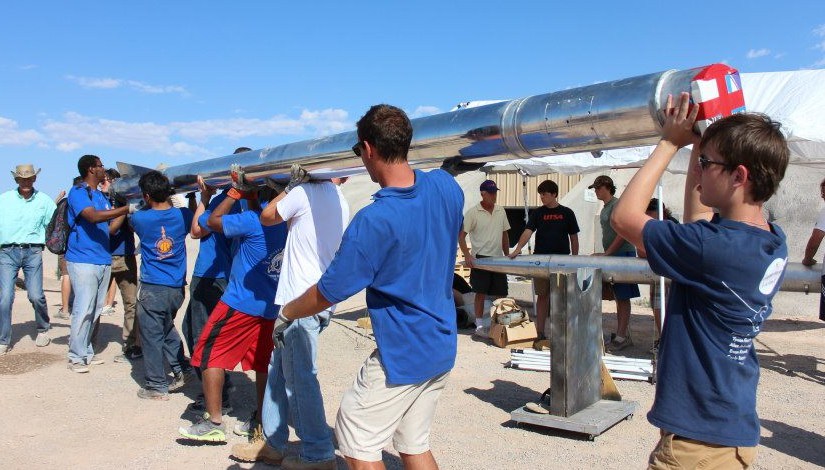
 

Day 58-Rockets at WSMR Setup Day

SystemsGo had a productive first day today in spite of a long night on the road getting in around 0200 and a short night of sleep. They were at the range bright and early Sunday morning to set up for the launches and finish and evaluate rockets.

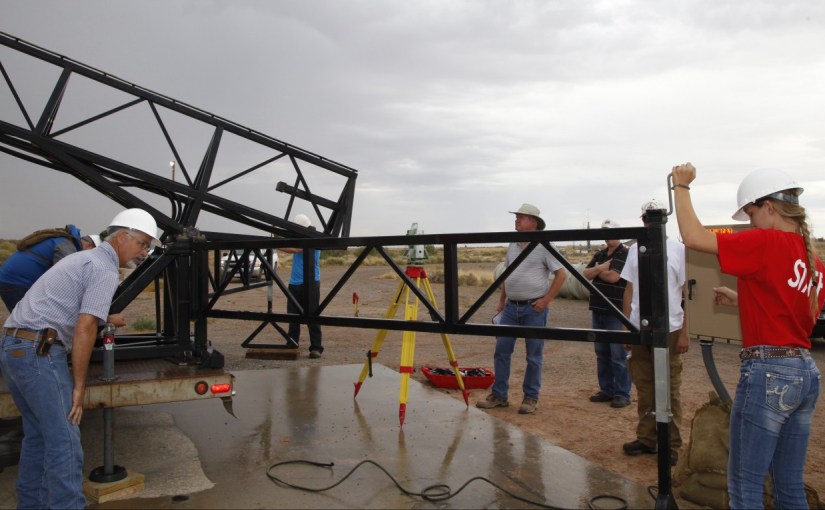
The SystemsGo team split into groups.  Captain Garrett and Steve Burow headed up the group at the pad setting up the launch rail. Robert Dever and Randy Kuhlmann set up the Fill and Fire system and proceeded with on-site testing. Brett Williams and Chelsea Burow rolled out all the cabling and connected the electrical systems and after which they helped Andrew Matthes who was overseeing the student groups with final checks and problem solving on rockets.

The first four schools for this Goddard level program were there with their rockets ready for leak and readiness tests. These tests are standard operating procedure used to create safeguards and ensure a successful launch as long as there are no internal parameters that cause the rocket to fail. No rocket will launch without passing these tests. An initial fail does not mean that the rocket is scratched for launch, only that the school has a short window of time in which to correct the issue so that it may be retested, pass and proceed to launch. Time constraints do not allow for continuous testing so the vehicle must pass quickly or be pulled from the launch sequence.

Marble Falls first test showed a minor problem, they were able to fix the issue and passed their second test. They are ready to launch and are scheduled as the first school for tomorrow morning at 0830.

Anahuac is scheduled to launch second tomorrow, but they are currently still working to resolve an issue shown in their test.

Union Grove is scheduled as first launch on Tuesday morning. They passed all their leak and readiness tests and are on standby for launch from 1200 to 1600 Monday in the event that Anahuac is not ready, or extra time allows.

Booker T Washington passed their leak test. They are scheduled as the second launch on Tuesday and are currently still finishing some last minute adjustments.

Set up and systems tests also went well. The new Fill and Fire system tested at 100% minus the Comm Readout Displays because a thunderstorm and lightning in the area prevented them from setting up that part of the system. This display allows mission control and the pad to communicate by sight through a constantly evolving digital readout in order to better coordinate launch sequences without the delay of radio communications, allowing for more safety and efficiency during the Fill and Fire, and count down stages. This last component will be set up early Monday morning and will complete its readiness check before the first launch, putting the full system at 100%.

A few members of the SystemsGo team got drenched in the fast approaching storm while they were down at the pad trying to put Marble Falls’ rocket on the rail so that it would be ready for launch Monday morning. Instead it was covered and left to be raised on the rail early Monday morning.

The Army has allotted an eight-hour window for testing tomorrow. The day begins at 0400 at the range for the SystemsGo team to accomplish these last necessities left from set up today. Then at 0600 the survey team shows up provide angel and azimuth settings for the launches to ensure they perform in a set area of the range for safety and recovery. Then if everything is in perfect order, Marble Falls will test their rocket launching at 0830. Anahuac or Union Grove will follow as quickly in succession as readiness allows.

www.systemsgo.org as always is the place for more information on this program. Take the time to get your school involved, the future of your students will be greatly benefited. SystemsGo is a Texas based STEM curriculum program.

Tune in again tomorrow for an update from Monday and a schedule of Tuesday’s launches at White Sands Missile Range this week.


Day 56 – Rockets at White Sands Missile Range

While the more public focus of SystemsGo Rockets 2015, the launches of the Tsiolkovsky (1 pound/1 mile), and Oberth (Transonic) rockets may have come to a close for this year, the program has not finished for the year. The SystemsGo Rocket program now transitions to Goddard level rockets. These rockets and their subsequent launches at WSMR (White Sands Missile Range) are the culmination of all the skills the students have learned  throughout their years in the STEM program. This is their final senior project for those schools that participate in this level of the SystemsGo program.

By now these students have spent a minimum of 2 years, some three, and as the program expands with new STEM requirements in education, as many as four years will have been spent following and learning in this system of education. They have spent countless hours both in and out of class.

The year is divided by semester into two project bases. The first semester deals with early design phases including payload, performance, and vehicle configuration. Once the payload and an initial vehicle design concept have been developed the student project team begins developing a flight profile. This is used to predict what will happen during testing, including vehicle stresses and flight dynamics. By semester’s end, a test vehicle configuration should be fairly realized.

Semester two is the culmination of everything the students have learned in the first semester, and the continuation of using life and work skills to manufacture their test vehicle, perform a test and analyze their test vehicle findings. Success for this project is determined by two things.

1. Was the rocket finished by the scheduled date and delivered to the pad for testing?

2. How was the rocket’s flight performance in relation to its design parameters?

This translates to the students manufacturing a rocket from scratch; usually weighing in at between 250 to 450 lbs; to reach high altitudes and Mach 3 to Mach 4 velocities. This project is what all the previous years’ effort have been building up.

At this point, in order to achieve their goal, one large working team, divides into several smaller teams with designated goals for each part of design and development for the vehicles’ creation, propulsion, and testing. These component teams include:

Nose cone

Avionics/payload

Oxidizer tank

Injection

Fuel Grain

Nozzle

Engine case/forward skirt/fins

Each team first creates a workable timeline and then begins researching all necessities and questions concerning their team’s component. Questions they encounter may include function, simplicity, mass, etc. Students present their findings in the form of mathematical calculations for their design and these are reviewed and critiqued by aerospace professionals. Students must find their own solutions to any problems presented to them by these professionals.  Once a mathematical argument and a design drawing have been created, the team starts another research phase into the materials to build their component. In this phase students must be able to show critical thinking skills while studying different materials and their costs, safety, ease with which to work and whether they can be ordered in within time constraints. After the design is developed and reviewed and the correct materials determined, a Critical Design Review (CDR) is presented to the other teams for acceptance. If approved the team then begins development of the component, acquiring materials and enlisting any help they may need from local industry. If it is declined then the team redesigns it until the component is accepted by the entire group. If the original time line is kept each team’s component will be finished by the deadline. To ensure this each team must undergo a Flight Readiness Review (FRR) showing that their project is 100% ready. Once all components have demonstrated a 100% readiness, then the complete vehicle can be constructed  into a full standing rocket. SystemsGo calls this their “‘all-up’ configuration.” At this point, Standard Operating Procedures (SOP) must be developed and adhered to in order to test their rocket. To do this, students must be in communication with the launch facility, create support teams, and prepare necessary paperwork. Final preparations for the launch also include students working together to make sure the components are all prepped and ready, or working in mission control, meteorology, safety and other areas needed at the launch.

Next the rocket is tested and hopefully undergoes a successful launch. After this a Post Mission Analysis is done to evaluate the complete performance of the vehicle. This marks the end of the of the  program.

The knowledge base the students acquire through this program include: as quoted from the SystemsGo website: design and development, critical thinking, fabrication/machining, problem solving, teamwork, communication, analysis/application, documentation,  presentation, research, time/project management, budgets/purchasing, public relations, and computer skills in RockSim, Excel, Microsoft Word and PowerPoint.

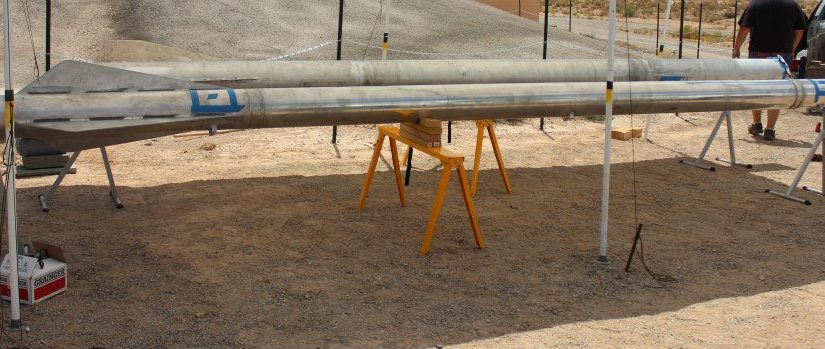
These rockets which usually stand between 20 to 25 feet and range from 8 to 10 inches in diameter are an amazing sight to behold if for no other reason than that they are built by high school students, not professional aerospace engineers. They are built by the future of these industries. Many of these students go on to become engineers, machinists, scientists, physicists, mathematicians, and countless other business professionals. This STEM based program teaches them skills they can apply to life and use to continue into their future learning and job markets.  If you have a student in the STEM program at your school who is excited about what they are doing, take interest, get involved and don’t miss the chance to see what they is happening first hand whenever possible. You are watching the future in something we can all be proud. These students are doing truly amazing things.

This article was intended to be a synopsis of the program in hopes that others may take interest and pay attention to what these students are achieving, so that more schools might implement the program for their students. It is well worth the time an effort involved. What better way to learn than to have the students apply what they are learning first hand and achieve a workable goal. The teacher is the instructor, guide, mentor, and timeline manager, but  the  project’s success or failure is in the students’ hands. They are the project managers that do all that is needed to see that this vehicle makes it to the pad and then into the sky. If your student makes it to this level, don’t miss out, you want to see this monster fly. It is a proud moment you won’t forget, and even more importantly, neither will your student. Their future begins here, don’t miss out on the chance to support their dreams.

I hope I have done the program justice, as I tried to describe it in a way that might be understood by all and draw some interest. My husband Steve, said I should just say, “Kids make really bad a$$ rockets and launch them at White Sands Missile Range.”

Well he has a point and that is the just of it, but it is really a whole lot more than that!

www.systemsgo.org as always is the place for more information on this program. Take the time to get your school involved, the future of your students will be greatly benefited.

Tune again tomorrow for a schedule of the upcoming launches at White Sands Missile Range this week, and hopefully some daily high lights from the group.

Day 41-June 19-21, Fredericksburg Area Festival and Event Update

To start, the house has really been quiet since both the girls are back at their places again. We had a wonderful visit and I already can’t wait to see them both again. Of course that will be about 6 months for Kasey, possibly Christmas time.

Chelsea will be in and out some during the summer months. She will actually be in for the Goddard rocket shoot at WSMR in July. Of course she won’t be here much. Hopefully I will get to go along this year, but I am still not sure at this point. The Goddard level rockets are the “big dogs” of this program, hence why they have to haul them to a missile range in New Mexico to test them.

I will probably be doing an informational piece on them closer to the actual date, but if you just can’t wait, as always the address is: www.systemsgo.org

Looking ahead a bit to the rest of the week, there are a whole lot of things going on in Fredericksburg, Stonewall and our great area this week and weekend. The Chamber Calendar is full. Here is a calendar copy and recap.

6/18/2015 Summer Farmers Market “Get Fresh, Buy Local”
6/19/2015 Annual Stonewall Peach JAMboree and Rodeo
6/19/2015 Fredericksburg Trade Days
6/19/2015 Fredericksburg Theater Company presents “Evita”
6/20/2015 Father’s Day Food and Wine Pairing at Rancho Ponte Vineyard
6/20/2015 Thomas Michael Riley Music Festival in Luckenbach
6/20/2015 Cooking Class at Urban Herbal
6/21/2015 Fredericksburg’s Weinstrasse Father’s Day Event

This calendar can be found here: http://www.fredericksburg-texas.com/events/

The next four days really have a little something for almost everyone. Thursday, the Farmer’s Market has lots of fresh items from vegetables, fruits, cheeses, canned good, Gulf Shrimp, pizzas, live music and a relaxed atmosphere to enjoy while you shop. For more information on this weekly summer event here is the address: http://www.fbgfarmersmarket.com/

Friday evening, The Fredericksburg Theater Company begins their summer production of “Evita”, a musical production by Andrew Lloyd Weber and Tim Rice. This story portrays a rag to riches story of an Argentina First Lady. Show dates are Friday and Saturday at 7:30 pm, Sunday at 2:00 pm, and July 4th at 3:00 pm. The theater is located at 1668 S HWY 87. Tickets are $29/Adults and $12/children. For more information call 830-997-3588 or go online at http://www.fredericksburgtheater.org/

For Friday through Sunday, the direction for fun, food, entertainment, festivals, wine and shopping is definitely east. East US Highway 290 houses the locations for most of the places to be and see for the weekend. The Stonewall Peach Jamboree, The Thomas Michael Riley Music Festival, and the Fredericksburg Trade Days begin Friday.

The Fredericksburg Trade Days runs Friday and Saturday, from 9:00 am to 6:00 pm and Sunday from 9:00 to 4:00 pm. Parking is $5 and good for the whole weekend. The venue is located 7 miles East on US Highway 290 across from the Wildseed Farms.  There are over 350 vendors of all kind.  Food, music and refreshments for adults and children are available.  For more information: http://www.fbgtradedays.com/

Luckenbach, Texas hosts the Thomas Michael Riley Music Festival starting Friday at 5:00 pm to 11:45 pm, Saturday from 1:00 pm to 11:45 pm, and continuing on Sunday from 1:00 pm to 5:00 pm. Tickets are $20 for Friday or Saturday night, Sunday afternoon is free.  Twelve different performers, including Larry Joe Taylor, The Wolf Sisters, Jamie Richards, and Cooder Graw will take the stage on hourly intervals ending Friday and Sunday evenings with Thomas Michael Riley. A complete schedule is available at http://www.luckenbachtexas.com/ or http://www.thomasmichaelriley.com/8thannualmusicfestival.html

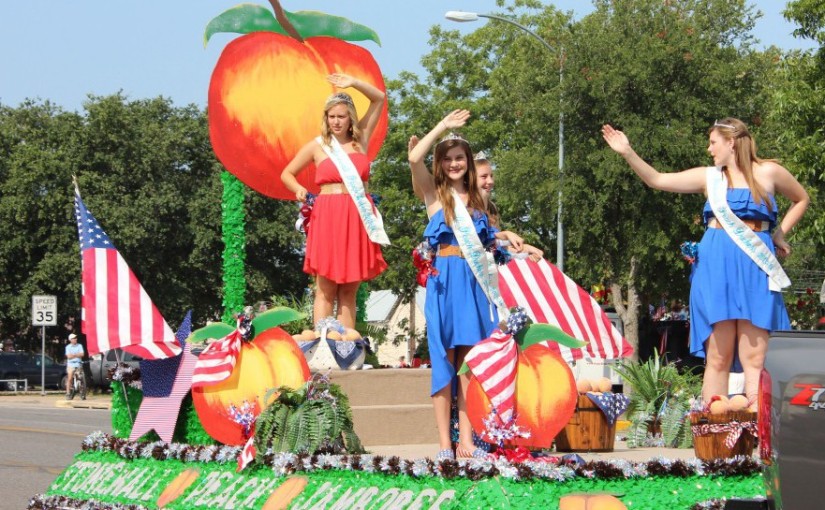
Stonewall hosts its 54th Annual Peach Jamboree Friday and Saturday. This is a family fun event with nightly CPRA Ram Rodeo and dance featuring Jody Nix on Friday and John Conlee on Saturday. Tickets are $15 Friday, $20 Saturday or a weekend pass for $30. Children ages 3-12 are $5. Entrance to the grounds on Saturday during the day is free. There is a parade, mutton bustin’, Peach Queen Contest, baking preserves, and salsa contest, 42 tournament, washer pitching, Kids patch, BBQ, peach eating and numerous other activities for your daytime entertainment. Rodoes begin at 6:00 pm both nights followed by the dance.  For more information call 830-644-2735 or http://www.stonewalltexas.com/

Saturday from 1:00 pm to 3:00 pm there is a Father’s Day Food and Wine Paring at Rancho Ponte Vineyard at 315 Ranch Road 1376. Cost is $90 and includes demonstration and three food and wine parings with Chef Rachel Ponte. For more information http://www.ranchoponte.com/

Also on Saturday, located at 407 Whitney Street, Urban Herbal presents a cooking class on “Farm Fresh class of Salad, Quiche and Tart”. Reserve your seat in advance. Class starts at 11:00 am at a cost of $75. This recipe session will also include a wine paring for your new do it yourself easy menu. For more information call 830-456-9667 or online at http://www.urbanherbal.com/

If you are at a loss as to what to get Dad for Father’s Day, and he is a wine lover, then, Inwood Estates, Mendelbaum Cellars, and 4.0 Cellars have an event that’s “just for Dad.” They are hosting a mini wine tour event, called Fredericksburg Weinstrasse Father’s Day Event, with wine tastings, food paring and live music. Tickets are $35 and include all three wineries. Visit between noon and 4:00 pm and receive a 19 oz. crystal Bordeaux glass. For more information call 830-997-2304 or visit http://www.fredericksburgweinstrasse.com/

There is an event and entertainment for all ages in Gillespie County and the Fredericksburg, Stonewall area this weekend. Hope to see you at one or perhaps all of them. Have a great weekend.


Day 20-Rocket Recovery Teams

What would a rocket launch be without a bunch of crazy, fun-loving, competitive people willing to trompe through water, mud, trees, tall grass, and thick underbrush in order to see who can recover the most rockets and bring them back to smiling students? And let’s not forget encounter, pigs, snakes, ants, wasps, bees, chiggers, mosquitos, cows, cup eating donkeys, and any manor of small animals that run out from under foot unexpectedly.

This crews hardest job, is not locating and recovering the rockets, but instead getting the compass to give an accurate azimuth, (sometimes they stick), and inputting the coordinates in the Garman in time to beat the other team to the location.

Finding the rockets depends a lot on good coordinates, a good sense of direction, good eye balling of where you saw it go down, and a whole lot of pure luck.

A perfect launch and recovery deployment can put the vehicle almost back in easy distance and sight to find. On the other hand a high altitude deployment can carry the rocket for a long time, making what  looks like right over there, end up to be a few pastures over, which entails a whole lot of walking and searching. And of course a ballistic landing means searching and digging.

No matter the circumstances, each rocket is a valuable learning tool for each class, and the ultimate goal of these teams is to recover all of it they can, and return it to those students.

Quite honestly, the recovery teams, probably have the most fun, and least stressful job of the group. Most of them are repeat crew members from year to year and wouldn’t miss it given the chance.

They all work closely with the Rocket Cops Crew, who also lend their ears, eyes, and communications to the teams on the ground. Officer Braxton Roemer coordinates the recovery teams.

This years’ teams included: Team 1, Jeff and Tina Landis; Team 2, Jerry and Judith Luckenbach; Team 3, Barry and Ann Bradley; Team 4, Steve and Ginger Burow; Team 5, Todd and Troy Kneese; Team 6, Guy Chadwick, Brett Burow, and Brittany Beisert ; Team 7, Freddie Kruse. There was also a 3 person team from Alpha Search and Recovery out of Houston that was here to observe, and helped in place of Team 7 on Sunday.

This group works and plays hard the whole weekend. They love to have fun while out there searching and recovering rockets. They are each here because they want to help SystemsGo and the students be successful and they all take that very seriously.

Thank you recovery teams for being a vital and important part of the project. This year this group had 97% recovery rate for all the rockets launched. Congratulations and thank you all for all your hard work.

www.systemsgo.org as always is the place for more information on this program. Take the time to get your school involved, the future of your students will be greatly benefited.

Day 18-Stage 1 & 2-Flight Readiness Crew

Today I want to continue my series of thank yous for all those that helped with the SystemsGo Rockets 2015 launches. I still have a few groups to send these out to, so bear with me, I am trying not to leave anyone out. Each and every participant, is a vital necessity to keeping the program operating to the best possible potential.

The crew in the spot light today, is the group that each school’s students meet up with first. This group sets up shop at the Willow City Fire Station, and the Willow City School and Community Center.

This is where the work begins to qualify each vehicle for flight. Small repairs that are needed and can still be made at this point in order to prepare it for flight are also done here.

The crews at Stage 1 and 2 have the responsibility of determining if the vehicle can be tested safely, and if it is completely ready. They have to determine if the guidelines and specifications given to the classes ahead of time have been met correctly. They do this by following a check list called the “Flight Readiness Review.”

Each vehicle must pass this set of checks and balances to be approved to move on to Stage 3 and ultimately to the launch pad. This crew also has the occasional unpleasant job of having to inform a group that a vehicle has been declined for flight due to simply not being ready or that it has some factor that has caused it to be deemed unsafe to fly at this time.

This doesn’t happen often, but it does happen. They try their best to help and correct whatever can be corrected, so that all vehicles will get their opportunity to fly. They never want to disappoint the students, these guys want more than anything to help and see everyone get to a successful test. But, safety and readiness have to come first.

They probably have one of the hardest and sometimes unpopular positions there, but at the same time it is very rewarding for them when the can safely approve the rockets for the next stage. When all the rockets for the day have moved past Stage 1 and 2, then this crew comes to mission control to see where they can further assist the group for the rest of the day.

They have a long day because they usually have schools waiting as early as 5:00 in the morning to have their rockets checked.

This group really deserves a big thank you for all they do. This year’s Stage 1 and 2 operatives were, Captain Gene Garrett, Doug Kimball, Pete Jenson, Harold Vanick, David Miller, and Danny Bell. Great job, gentlemen on another successful year.

www.systemsgo.org as always is the place for more information on this program. Take the time to get your school involved, the future of your students will be greatly benefited.

Day 16- Stage 3/ Mission Control Crews

Stage 3 and Mission Control are located under a big tent on the main site on Hillview Ranch. Stage 3 is  where all vehicles receive their last  readiness check and flight approval as well as where deployment charges, and GPS units are added. This is the last step before the student engineers take the vehicle to the pad for testing.

Mission Control is located at the pad side of the same tent. This crew controls the electrical system that ignites each vehicle after it has gone to the pad, become vertical on the rail, and completed fill. They coordinate all radio communications for recovery, traffic, the pad, and stages 1 and 2. Mapping coordinates for locating  and recovering the rockets, watching weather, communicating with the FAA, and NASA, and tracking GPS all happen from here as well.

This group of individuals is SystemsGo’s version of the NASA flight control room. It is the vital heart beat of the project. Most of the crew consists of engineers, retired military, computer experts, teachers and SystemsGo personnel. Without these crew members to complete and run operations not one rocket would be able to test. Thanking them for all their hard work, doesn’t even seem ample, they are so important to the making this whole project fly and work together so smoothly and efficiently. Great job crew you are definitely the boss!

Crew member for this outstanding group for Rockets 2015 included Scott Netherland, Robert Dever, Brett Williams, Randy Kuhlmann, Margaret Williams, Jody Kneese, Molly Williams, Austin Walter, and those whose last names escape me, Randy’s friend, Nick, Margaret’s friend, Cody, Jessica, and Patrick.

Because I hate to publish this without all the surnames and regret doing so; I have contacted a few people and asked and had no luck;  I am asking that whomever reads this and knows those names, either comment with the names or PM me on Facebook and I will update the blog with the names.

Some of you may wonder why I am going through this series of articles, thanking all these people in each station of the event. SystemsGo , already thanks all of us, and we know that we are appreciated and needed to help them make this a success, but I am not SystemsGo. I am a parent of two of the former students that went through this program, and a volunteer for it. I am doing this helper to helper because this program has meant so much to both of my girls, and they have benefited from the program and gone on to continue in their career paths because of what they learned here.

I have seen firsthand how SystemsGo’s program of learning can benefit students and enliven their learning and future education. I am here because I want to ensure the continued success of SystemsGo and the STEM and rocket program. I am honored to be a volunteer here and wouldn’t miss it except under uncontrollable duress. It is for that reason that I want to thank all the other volunteers. Many of them like me have had students in the program in the past, but many have not, and yet they are here. They see the benefit and want to help and for that I want to thank them.

I believe we are here to support the future of all students through this program. By supporting SystemsGo and helping these events be possible for our youth we are nurturing young minds in ways that were never available when we were in school. This system of learning helps to better prepare our youth for the business and career world. And more than anything, it inspires them to want to do more and to succeed in what they attempt. It teaches them that there is success even in failure, and that each is only another opportunity to do better.

Thank you all for this exciting time working together to touch the lives of students all across Texas.

www.systemsgo.org as always is the place for more information on this program. Take the time to get your school involved, the future of your students will be greatly benefited.


Day 15-The Launch Pad Crew

Today’s blog is about the crew that runs the actual launch pad for the rocket tests. Most of this group is made up of past students that have gone through the SystemsGo program. They are all pursuing engineering careers at their respective universities. All three completed the program at Fredericksburg High School and ended that time there with a successful Goddard level rocket launch at White Sands Missile Range (WSMR).

Being at the pad, is both exciting and dangerous. Personnel here have the responsibility of loading each vehicle onto the rail, going for fill and relaying the go ahead for ignition.

These future engineers come back each year for several reasons. First and foremost they all enjoy what they are doing out there. Second as engineering students in college, this is a hands on opportunity to work in the field and have this addition for their resume`s. Lastly, they are big proponents of the program, and know firsthand what it has done for them and what it can do for students in the future so they want to help out and keep the program running, so that others will continue to have this opportunity. Most if not all of this crew will be traveling to WSMR later this summer to help run the launch of the Goddard level rockets being tested there as well.

These students include: Cade Ottmers, Annisa Kneese, and Chelsea Burow.

This year, Annisa brought a group of engineering students from Texas A&M to observe the program here first hand, and  though I do not have all their names,  I wanted to mention them because they also helped at the pad on Sunday. This gave them firsthand experience in what is being done.

Andrew Matthes, the program instructor at FHS, and retired teacher, Ned Butler, also provided assistance, instruction, and monitored safety at the pad throughout the weekend. They help insure that all procedures and checklists are followed to provide the most successful test of each vehicle.

The program wouldn’t be as successful as it is without the willingness and effort of the individuals at the pad. Each vehicle is literally in their hands in the last few moments before the test.  They check for any final issues that might prevent launch, and stand by with each vehicle as it begins fill and watching for signs that the rocket is a go for launch. For this I applaud their hard work and resilience. This year alone they had a 100% launch rate, meaning that every vehicle that made it through the Stages 1, 2, and  3 and down to the pad, left the rail at launch. Congratulations Launch Pad Crew!

Thank each one of you for all you do and are willing to do to help each vehicle complete its launch. You are an outstanding bunch, and so detrimental to the program’s success on launch days.

www.systemsgo.org as always is the place for more information on this program. Take the time to get your school involved, the future of your students will be greatly benefited.


Day 14-A Thank You to our Rocket Cops

This is my second edition of thank yous, and probably won’t be the last because it takes so many people to put on a production of this magnitude. Today’s shout out goes to our 3 Rocket Cops that help us each year.

Officer 95, Braxton Roemer, Officer 93, Chris Ayala, and Officer Shane Purvis, better known as Spotter Hill. Sorry Shane I just couldn’t remember your number so I am remiss to have to leave it out. We all referred to you as Spotter Hill most often through the weekend so that is what I tend to remember.

These officers gave of their time and talents to come head up and help our recovery efforts as well as keep everyone safe. Officer Roemer was our recovery team leader out in the field, assigning us our positions as well as keeping us coordinated and located out in the pastures as we hunted down rockets. He handled our radio communications, and assisted in rocket disarmament.

Officer Ayala provided additional ground support in recovery, front gate operations and traffic control. He commanded the gate in order to keep everyone safe and traffic stopped during testing.

Officer Purvis maintained position on top of Spotter Hill, with a bird’s-eye view of the area. He was quite often the only eye on the rockets at times when altitude and distance took them from the rest of recovery’s view.

I am quite sure that there is plenty more that went on behind the scenes with these gentlemen that I may not be aware of, and for that let me just say that all that they did was needed and appreciated by all the rest of the crew. They are a wonderful group of law enforcement officers, and we were privileged to have them with us.

Thank each one of you for spending these four days with the students, the rest of the volunteers, and the whole SystemsGo group.

We all enjoy working with each one of you, the SystemsGo Rocket Cops!

www.systemsgo.org as always is the place for more information on this program. Take the time to get your school involved, the future of your students will be greatly benefited.