
April 1st is tomorrow, so time is becoming a factor for the Fredericksburg STEM Academy as launch dates approach for the junior and senior groups. There are no fools here though, just several groups of future engineers working hard to meet their timelines. With March behind them there is only a little over 6 weeks left for the junior group until Rockets 2017 and their May 18th test date. The seniors have approximately 60 days as Redbird 18 is scheduled for completion two weeks before school ends to allow for preliminary systems tests.
More on these groups and their current status reports will be later in the article.
Sophomores are currently taking mid-term exams. This is due to the new schedule for classes this year which puts a full year’s curriculum into one standard semester. They have been busy using AutoCAD to create multi view drawings of objects. Dimensioning and tolerancing of these drawings will be learned next, followed by isometric drawings and 3D modeling. The students have been printing models of their multiview drawings using the newly installed 3D printer. All 3 3D printers available now are working well.
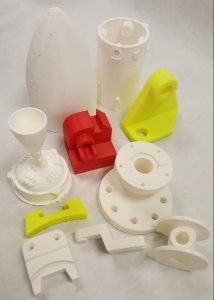 The student aide, Colby Marthaler has also been using the 3D printers to print all the parts necessary to create a model of the Falcon 9 Rocket SpaceX uses to transport satellites and the Dragon spacecraft into orbit.
Juniors had CDR’s (Critical Design Reviews) due for their rockets by March 30. Unfortunately they are just getting to them. Students will have to be studious in order to meet their May 18th launch date due to being behind schedule at this time. The payload for this rocket is a rapid growth slime mold. They have designed the payload in order to create a controlled experiment in which they should be able to determine how flight impacts the mold’s growth, negatively or positively.
The design criteria for their rocket is a one pound payload and breaking the speed of sound therefore achieving a transonic state. Currently neither criteria has been met so the group has more work to do to accomplish their goals by their launch date.
Their mid-term which is a LabVIEW development project has come along well. They are creating a workable program which requires specific methods and functions in order to attain a goal of designing and fabricating a micro test stand for Estes motors. They will be connecting a (DAQ) Data Acquisition unit to a computer and registering it to that computer in order to read sensors, and programming a control and DAQ Virtual Instrument in LabView in order to run the test stand.
March began with more fuel grain tests at test stand. Two tests were completed in the first week alone, consisting of many hours of work to accomplish each. A temperature sensor indicated a high enough value in order to cause a programmed shut down on the first test that week. After investigation, it was found that a ‘electrical noise’ caused an anomaly which gave the sensor its reading, and that it was in fact not outside normal operating parameters. The actual test did not experience any temperature concerns.
The same fuel grain was able to be used again in a 20 second burn, which allowed students to achieve a cumulative 40 second burn on one fuel grain. The shut down was disabled for the second burn, allowing the data to still record the temperatures caused by the ‘electrical noise’, but not to stop the burn test and it was a full success without any further exceptions.
Mr. Matthes was very pleased with these burns and stated , “All data was processed and showed again the test stand was producing verifiable data similar to theoretical expectations.”
Students began another round of testing this week. Six new fuel grains will be tested accounting for three tests each of two different fuel types students have been working on. The hope is that they will cycle through smoothly due to the fuel grains being prepped prior to testing.
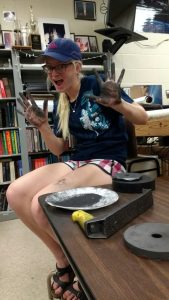 Here Hannah Boubel is working with graphite in order to make ablative, which is a sacrificial material in the pre and post combustion chamber so the burn does not penetrate the liner and steel test cell.
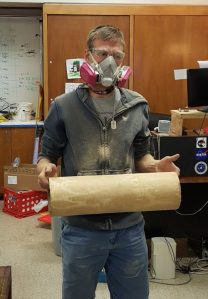 In this photo, Sterling Weatherford is preparing a fuel grain for installation in to the test cell.
Along with test stand work, the students have been hard at work on Rebird 18, their Goddard level rocket slated to launch at White Sands Missile Range on June 27th. Students have already contracted with Heartland Enterprises and SRM Manufacturing for fabrications and parts have been supplied to them.
At this point in the process students are learning true cause and effect, and just how it can affect their outcomes. The entire success of the vehicle from this point forward is contingent on the group not only working as a team as a whole, but also for each individual team to stay on top of their work and outcome. Many of the components are dependent on the progress of the others. Delays on one team’s element directly affects the next team creating delays down the line and strained time schedules. Individual testing is conducted on each piece as it is finished. Full up integration and testing of any systems that allow for ground based testing is scheduled for two weeks from the end of school when the rocket is due to be complete.
“They are well on their way to a successful vehicle. The seniors will not have the luxury of adopting senioritis as there is still significant and mutually dependent work to be accomplished,” Mr. Matthes reported. “These next 60 days will be a true test of their team work, peer loyalty and persistence. ”
As the end of the school year approaches, these students are becoming more and more adept in their learning and knowledge as young and capable engineers. Their end of year rockets will be a testament to that learning, time and ability.
According to Mr. Matthes, “Students are becoming ‘plagued’ with knowledge and experience: the more they know and become aware of, the more they have to take into consideration and the more challenging the process becomes. However, it also makes for conditions more aligned with success. Additionally, if we consider these students products of FHS and the FHS Engineering, then they should be welcomed by a market hungry for what they have to offer.”
If you follow this program and like to view the launches, Rockets 2017 will be held at the Stewart Ranch in Willow City, Texas on the weekend of May 18-21, 2017. This testing site is open to the public. Please watch the SystemsGo website and this blog for upcoming information on the event. The FHS junior group will be testing their rockets on Thursday, May 18, 2017.
The senior group is tentatively scheduled to launch their Goddard level rocket at White Sands Missile Range (WSMR) in New Mexico the week of June 26-30. The current schedule for that event is as follows:
Sunday, Jun 25th Travel Day
Monday, Jun 26th T-1 and Site Set up/Rocket Prep at WC-50
Tuesday, Jun 27th Launch Day One (Three Rockets – Fredericksburg, Union Grove, Alamo Heights)
Wednesday, Jun 28th Launch Day Two (Three Rockets – Anahuac, Booker T. #1, Booker T. #2)
Thursday, Jun 29th Contingency Day
Friday, Jun 30th Travel Day
There are also launches in Houston for schools in that area the weekend of May 12-14, 2017. New for this year the Hobbs, New Mexico group of schools will launch 1/1 rockets in Jal, New Mexico on April 27, 2017, this site will also be open to public viewing.
This article is the sixth in a series, new for this school year ’16/’17 of monthly updates that will follow the Fredericksburg STEM Academy/Rocket program. This school is a participant of the SystemsGo STEM program. This series of articles is intended to support, encourage, and challenge students in the program as they share their working status and accomplishments throughout the year in the program. These publications will be available for tags and re-posting.
www.systemsgo.org as always is the place for more information on this program. You may also email them at info@systemsgo.org . Take the time to get your school involved, the future of your students will be greatly benefited.

 Sophomores Gloria Burns and Eston Cooke with Dr. Brian Evans.
 Here juniors, Harrison Spisak and Jacob Weinecke make their presentations their burn model to Dr. Evans.
 Corbin Smajstrla and Dr. Evans at the board.
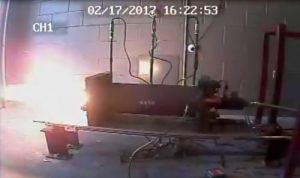 A still photo from the burn test.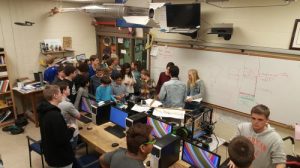
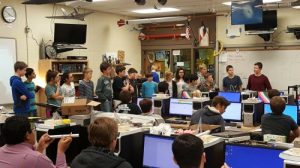 The 7th grade GT class presentation.
 On the Wings of Angels