Day 58-Rockets at WSMR Setup Day

SystemsGo had a productive first day today in spite of a long night on the road getting in around 0200 and a short night of sleep. They were at the range bright and early Sunday morning to set up for the launches and finish and evaluate rockets.

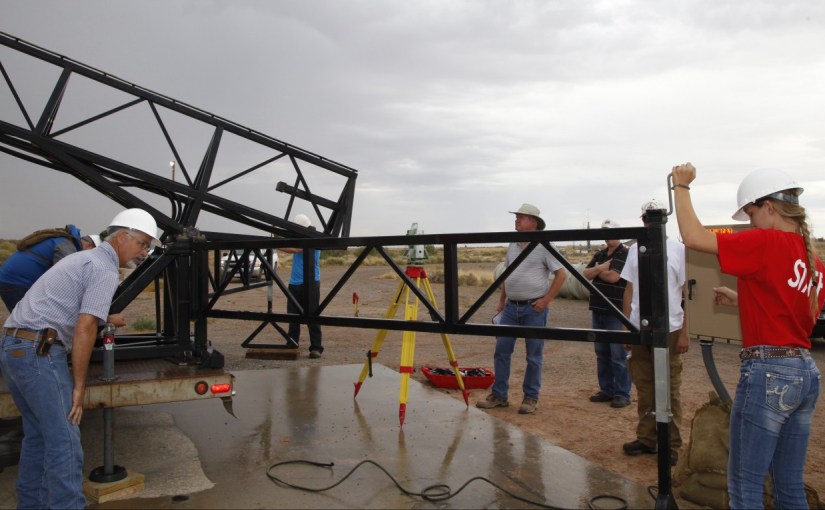
The SystemsGo team split into groups.  Captain Garrett and Steve Burow headed up the group at the pad setting up the launch rail. Robert Dever and Randy Kuhlmann set up the Fill and Fire system and proceeded with on-site testing. Brett Williams and Chelsea Burow rolled out all the cabling and connected the electrical systems and after which they helped Andrew Matthes who was overseeing the student groups with final checks and problem solving on rockets.

The first four schools for this Goddard level program were there with their rockets ready for leak and readiness tests. These tests are standard operating procedure used to create safeguards and ensure a successful launch as long as there are no internal parameters that cause the rocket to fail. No rocket will launch without passing these tests. An initial fail does not mean that the rocket is scratched for launch, only that the school has a short window of time in which to correct the issue so that it may be retested, pass and proceed to launch. Time constraints do not allow for continuous testing so the vehicle must pass quickly or be pulled from the launch sequence.

Marble Falls first test showed a minor problem, they were able to fix the issue and passed their second test. They are ready to launch and are scheduled as the first school for tomorrow morning at 0830.

Anahuac is scheduled to launch second tomorrow, but they are currently still working to resolve an issue shown in their test.

Union Grove is scheduled as first launch on Tuesday morning. They passed all their leak and readiness tests and are on standby for launch from 1200 to 1600 Monday in the event that Anahuac is not ready, or extra time allows.

Booker T Washington passed their leak test. They are scheduled as the second launch on Tuesday and are currently still finishing some last minute adjustments.

Set up and systems tests also went well. The new Fill and Fire system tested at 100% minus the Comm Readout Displays because a thunderstorm and lightning in the area prevented them from setting up that part of the system. This display allows mission control and the pad to communicate by sight through a constantly evolving digital readout in order to better coordinate launch sequences without the delay of radio communications, allowing for more safety and efficiency during the Fill and Fire, and count down stages. This last component will be set up early Monday morning and will complete its readiness check before the first launch, putting the full system at 100%.

A few members of the SystemsGo team got drenched in the fast approaching storm while they were down at the pad trying to put Marble Falls’ rocket on the rail so that it would be ready for launch Monday morning. Instead it was covered and left to be raised on the rail early Monday morning.

The Army has allotted an eight-hour window for testing tomorrow. The day begins at 0400 at the range for the SystemsGo team to accomplish these last necessities left from set up today. Then at 0600 the survey team shows up provide angel and azimuth settings for the launches to ensure they perform in a set area of the range for safety and recovery. Then if everything is in perfect order, Marble Falls will test their rocket launching at 0830. Anahuac or Union Grove will follow as quickly in succession as readiness allows.

www.systemsgo.org as always is the place for more information on this program. Take the time to get your school involved, the future of your students will be greatly benefited. SystemsGo is a Texas based STEM curriculum program.

Tune in again tomorrow for an update from Monday and a schedule of Tuesday’s launches at White Sands Missile Range this week.

 

Day 57-Rockets on the Road to WSMR

The SystemsGo team had a rough start to their day. They were scheduled to leave Fredericksburg at 10:00 this morning, but due to the final touches and tests on the new Fill and Fire system taking much longer than originally thought, the team didn’t leave until 4:20 this afternoon.  This system has been ready for some time, but engineers are always thinking of ways to further improve their product to ensure that it is always better than first envisioned. That coupled with all the new safeguards and the new Comm Readout Display on a brand new system meant that final touches recently decided upon caused thoroughness and perfection to be a bit time extensive, but most definitely worth the time and delay. It should prove to be an awesome system.

It is going to be a really long night tonight as well as a long day setting up out at the range tomorrow. This group will be running on very little sleep before they have to hit the road to the range in the morning. Hopefully set up will go really well tomorrow so they can call it an early evening and catch up on the sleep they are losing tonight.

By the time they finally got on the road, the two engineers, Robert and Randy that were working on the Fill and Fire had already spent about 32 hours straight working. Add that to the rest of the group driving all night and it just might be an exhausted and definitely all business and no nonsense group to deal with for more reasons than just to get the job done. I really feel for the group and wish them safe travels and a productive trip and day tomorrow.

They were leaving Fort Stockton shortly before 9:00 pm after a short break for food. They seem to be making good time for three pick-up trucks pulling a box trailer of equipment, a trailer with the large wire wheels and three rockets, and another trailer with the launch rail, and launch equipment.

Tomorrow’s schedule is mostly setup and prep for the first launches to begin on Monday. Five schools are scheduled to launch at White Sands this week. They include, Marble Falls High School, Anahuac High School, Union Grove High School, Booker T Washington High School, and Alamo Heights High School.

I will post updates to things in WSMR as they are available this week, hopefully daily.

www.systemsgo.org as always is the place for more information on this program. Take the time to get your school involved, the future of your students will be greatly benefited.

Tune again tomorrow for a schedule of Monday’s launches at White Sands Missile Range this week.

12:51: The group just left El Paso after another short stop. They are still making good time.
2:00 AM The group arrived safely in Alamogordo and is catching what sleep they can before an early morning start.

Day 56 – Rockets at White Sands Missile Range

While the more public focus of SystemsGo Rockets 2015, the launches of the Tsiolkovsky (1 pound/1 mile), and Oberth (Transonic) rockets may have come to a close for this year, the program has not finished for the year. The SystemsGo Rocket program now transitions to Goddard level rockets. These rockets and their subsequent launches at WSMR (White Sands Missile Range) are the culmination of all the skills the students have learned  throughout their years in the STEM program. This is their final senior project for those schools that participate in this level of the SystemsGo program.

By now these students have spent a minimum of 2 years, some three, and as the program expands with new STEM requirements in education, as many as four years will have been spent following and learning in this system of education. They have spent countless hours both in and out of class.

The year is divided by semester into two project bases. The first semester deals with early design phases including payload, performance, and vehicle configuration. Once the payload and an initial vehicle design concept have been developed the student project team begins developing a flight profile. This is used to predict what will happen during testing, including vehicle stresses and flight dynamics. By semester’s end, a test vehicle configuration should be fairly realized.

Semester two is the culmination of everything the students have learned in the first semester, and the continuation of using life and work skills to manufacture their test vehicle, perform a test and analyze their test vehicle findings. Success for this project is determined by two things.

1. Was the rocket finished by the scheduled date and delivered to the pad for testing?

2. How was the rocket’s flight performance in relation to its design parameters?

This translates to the students manufacturing a rocket from scratch; usually weighing in at between 250 to 450 lbs; to reach high altitudes and Mach 3 to Mach 4 velocities. This project is what all the previous years’ effort have been building up.

At this point, in order to achieve their goal, one large working team, divides into several smaller teams with designated goals for each part of design and development for the vehicles’ creation, propulsion, and testing. These component teams include:

Nose cone

Avionics/payload

Oxidizer tank

Injection

Fuel Grain

Nozzle

Engine case/forward skirt/fins

Each team first creates a workable timeline and then begins researching all necessities and questions concerning their team’s component. Questions they encounter may include function, simplicity, mass, etc. Students present their findings in the form of mathematical calculations for their design and these are reviewed and critiqued by aerospace professionals. Students must find their own solutions to any problems presented to them by these professionals.  Once a mathematical argument and a design drawing have been created, the team starts another research phase into the materials to build their component. In this phase students must be able to show critical thinking skills while studying different materials and their costs, safety, ease with which to work and whether they can be ordered in within time constraints. After the design is developed and reviewed and the correct materials determined, a Critical Design Review (CDR) is presented to the other teams for acceptance. If approved the team then begins development of the component, acquiring materials and enlisting any help they may need from local industry. If it is declined then the team redesigns it until the component is accepted by the entire group. If the original time line is kept each team’s component will be finished by the deadline. To ensure this each team must undergo a Flight Readiness Review (FRR) showing that their project is 100% ready. Once all components have demonstrated a 100% readiness, then the complete vehicle can be constructed  into a full standing rocket. SystemsGo calls this their “‘all-up’ configuration.” At this point, Standard Operating Procedures (SOP) must be developed and adhered to in order to test their rocket. To do this, students must be in communication with the launch facility, create support teams, and prepare necessary paperwork. Final preparations for the launch also include students working together to make sure the components are all prepped and ready, or working in mission control, meteorology, safety and other areas needed at the launch.

Next the rocket is tested and hopefully undergoes a successful launch. After this a Post Mission Analysis is done to evaluate the complete performance of the vehicle. This marks the end of the of the  program.

The knowledge base the students acquire through this program include: as quoted from the SystemsGo website: design and development, critical thinking, fabrication/machining, problem solving, teamwork, communication, analysis/application, documentation,  presentation, research, time/project management, budgets/purchasing, public relations, and computer skills in RockSim, Excel, Microsoft Word and PowerPoint.

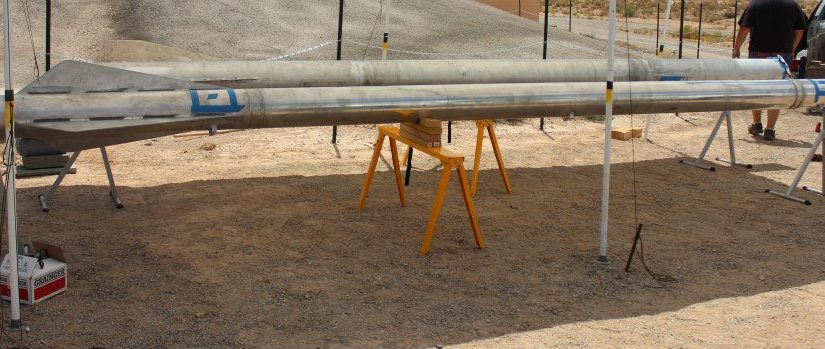
These rockets which usually stand between 20 to 25 feet and range from 8 to 10 inches in diameter are an amazing sight to behold if for no other reason than that they are built by high school students, not professional aerospace engineers. They are built by the future of these industries. Many of these students go on to become engineers, machinists, scientists, physicists, mathematicians, and countless other business professionals. This STEM based program teaches them skills they can apply to life and use to continue into their future learning and job markets.  If you have a student in the STEM program at your school who is excited about what they are doing, take interest, get involved and don’t miss the chance to see what they is happening first hand whenever possible. You are watching the future in something we can all be proud. These students are doing truly amazing things.

This article was intended to be a synopsis of the program in hopes that others may take interest and pay attention to what these students are achieving, so that more schools might implement the program for their students. It is well worth the time an effort involved. What better way to learn than to have the students apply what they are learning first hand and achieve a workable goal. The teacher is the instructor, guide, mentor, and timeline manager, but  the  project’s success or failure is in the students’ hands. They are the project managers that do all that is needed to see that this vehicle makes it to the pad and then into the sky. If your student makes it to this level, don’t miss out, you want to see this monster fly. It is a proud moment you won’t forget, and even more importantly, neither will your student. Their future begins here, don’t miss out on the chance to support their dreams.

I hope I have done the program justice, as I tried to describe it in a way that might be understood by all and draw some interest. My husband Steve, said I should just say, “Kids make really bad a$$ rockets and launch them at White Sands Missile Range.”

Well he has a point and that is the just of it, but it is really a whole lot more than that!

www.systemsgo.org as always is the place for more information on this program. Take the time to get your school involved, the future of your students will be greatly benefited.

Tune again tomorrow for a schedule of the upcoming launches at White Sands Missile Range this week, and hopefully some daily high lights from the group.

Day 20-Rocket Recovery Teams

What would a rocket launch be without a bunch of crazy, fun-loving, competitive people willing to trompe through water, mud, trees, tall grass, and thick underbrush in order to see who can recover the most rockets and bring them back to smiling students? And let’s not forget encounter, pigs, snakes, ants, wasps, bees, chiggers, mosquitos, cows, cup eating donkeys, and any manor of small animals that run out from under foot unexpectedly.

This crews hardest job, is not locating and recovering the rockets, but instead getting the compass to give an accurate azimuth, (sometimes they stick), and inputting the coordinates in the Garman in time to beat the other team to the location.

Finding the rockets depends a lot on good coordinates, a good sense of direction, good eye balling of where you saw it go down, and a whole lot of pure luck.

A perfect launch and recovery deployment can put the vehicle almost back in easy distance and sight to find. On the other hand a high altitude deployment can carry the rocket for a long time, making what  looks like right over there, end up to be a few pastures over, which entails a whole lot of walking and searching. And of course a ballistic landing means searching and digging.

No matter the circumstances, each rocket is a valuable learning tool for each class, and the ultimate goal of these teams is to recover all of it they can, and return it to those students.

Quite honestly, the recovery teams, probably have the most fun, and least stressful job of the group. Most of them are repeat crew members from year to year and wouldn’t miss it given the chance.

They all work closely with the Rocket Cops Crew, who also lend their ears, eyes, and communications to the teams on the ground. Officer Braxton Roemer coordinates the recovery teams.

This years’ teams included: Team 1, Jeff and Tina Landis; Team 2, Jerry and Judith Luckenbach; Team 3, Barry and Ann Bradley; Team 4, Steve and Ginger Burow; Team 5, Todd and Troy Kneese; Team 6, Guy Chadwick, Brett Burow, and Brittany Beisert ; Team 7, Freddie Kruse. There was also a 3 person team from Alpha Search and Recovery out of Houston that was here to observe, and helped in place of Team 7 on Sunday.

This group works and plays hard the whole weekend. They love to have fun while out there searching and recovering rockets. They are each here because they want to help SystemsGo and the students be successful and they all take that very seriously.

Thank you recovery teams for being a vital and important part of the project. This year this group had 97% recovery rate for all the rockets launched. Congratulations and thank you all for all your hard work.

www.systemsgo.org as always is the place for more information on this program. Take the time to get your school involved, the future of your students will be greatly benefited.

Day 19-Keeping Rockets Live

Three people devote their time out at these launches, to keeping Rockets live. They even have a trailer out there that houses a broadcasting “mission control” to ensure that all live streaming and uplinks stay active.

Zack Pooser is the main force behind allowing internet communications to go out on live streaming to everyone with a desire to watch that cannot be there. His broadcasting control trailer keeps the launch site connected.

Phil Houseal provides daily interviews with staff, students, visitors, Embry Riddle University reps, and volunteers, giving short insights to those watching as to how this program works, who is involved in it and why. He catches the stories behind the scenes that might not otherwise be heard or told about each type of experience and involvement for those in the program in one way or another.

Joyce Bk Abbey is the voice of rockets. She is the voice everyone hears commanding the attention of spectators before, during and after each launch, whether on site or watching on Livestream. She engages the students as they wait and watch for their vehicle to lift off and be recovered.

This crew of individuals is responsible for keeping rockets open for all to see during these launch weekends. They do a wonderful job of sharing this experience with everyone. They are rockets’ broadcasting extraordinaire.

Thank you all for all your hard work. 

www.systemsgo.org as always is the place for more information on this program. Take the time to get your school involved, the future of your students will be greatly benefited.


Day 18-Stage 1 & 2-Flight Readiness Crew

Today I want to continue my series of thank yous for all those that helped with the SystemsGo Rockets 2015 launches. I still have a few groups to send these out to, so bear with me, I am trying not to leave anyone out. Each and every participant, is a vital necessity to keeping the program operating to the best possible potential.

The crew in the spot light today, is the group that each school’s students meet up with first. This group sets up shop at the Willow City Fire Station, and the Willow City School and Community Center.

This is where the work begins to qualify each vehicle for flight. Small repairs that are needed and can still be made at this point in order to prepare it for flight are also done here.

The crews at Stage 1 and 2 have the responsibility of determining if the vehicle can be tested safely, and if it is completely ready. They have to determine if the guidelines and specifications given to the classes ahead of time have been met correctly. They do this by following a check list called the “Flight Readiness Review.”

Each vehicle must pass this set of checks and balances to be approved to move on to Stage 3 and ultimately to the launch pad. This crew also has the occasional unpleasant job of having to inform a group that a vehicle has been declined for flight due to simply not being ready or that it has some factor that has caused it to be deemed unsafe to fly at this time.

This doesn’t happen often, but it does happen. They try their best to help and correct whatever can be corrected, so that all vehicles will get their opportunity to fly. They never want to disappoint the students, these guys want more than anything to help and see everyone get to a successful test. But, safety and readiness have to come first.

They probably have one of the hardest and sometimes unpopular positions there, but at the same time it is very rewarding for them when the can safely approve the rockets for the next stage. When all the rockets for the day have moved past Stage 1 and 2, then this crew comes to mission control to see where they can further assist the group for the rest of the day.

They have a long day because they usually have schools waiting as early as 5:00 in the morning to have their rockets checked.

This group really deserves a big thank you for all they do. This year’s Stage 1 and 2 operatives were, Captain Gene Garrett, Doug Kimball, Pete Jenson, Harold Vanick, David Miller, and Danny Bell. Great job, gentlemen on another successful year.

www.systemsgo.org as always is the place for more information on this program. Take the time to get your school involved, the future of your students will be greatly benefited.

Day 16- Stage 3/ Mission Control Crews

Stage 3 and Mission Control are located under a big tent on the main site on Hillview Ranch. Stage 3 is  where all vehicles receive their last  readiness check and flight approval as well as where deployment charges, and GPS units are added. This is the last step before the student engineers take the vehicle to the pad for testing.

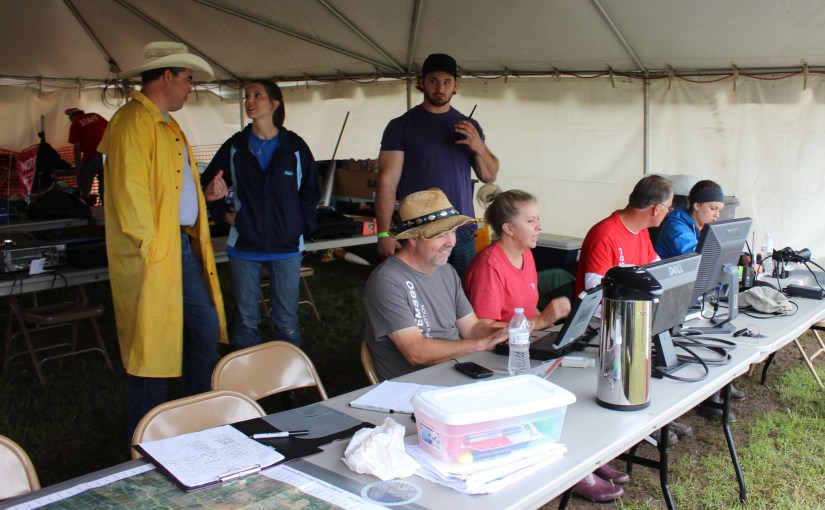
Mission Control is located at the pad side of the same tent. This crew controls the electrical system that ignites each vehicle after it has gone to the pad, become vertical on the rail, and completed fill. They coordinate all radio communications for recovery, traffic, the pad, and stages 1 and 2. Mapping coordinates for locating  and recovering the rockets, watching weather, communicating with the FAA, and NASA, and tracking GPS all happen from here as well.

This group of individuals is SystemsGo’s version of the NASA flight control room. It is the vital heart beat of the project. Most of the crew consists of engineers, retired military, computer experts, teachers and SystemsGo personnel. Without these crew members to complete and run operations not one rocket would be able to test. Thanking them for all their hard work, doesn’t even seem ample, they are so important to the making this whole project fly and work together so smoothly and efficiently. Great job crew you are definitely the boss!

Crew member for this outstanding group for Rockets 2015 included Scott Netherland, Robert Dever, Brett Williams, Randy Kuhlmann, Margaret Williams, Jody Kneese, Molly Williams, Austin Walter, and those whose last names escape me, Randy’s friend, Nick, Margaret’s friend, Cody, Jessica, and Patrick.

Because I hate to publish this without all the surnames and regret doing so; I have contacted a few people and asked and had no luck;  I am asking that whomever reads this and knows those names, either comment with the names or PM me on Facebook and I will update the blog with the names.

Some of you may wonder why I am going through this series of articles, thanking all these people in each station of the event. SystemsGo , already thanks all of us, and we know that we are appreciated and needed to help them make this a success, but I am not SystemsGo. I am a parent of two of the former students that went through this program, and a volunteer for it. I am doing this helper to helper because this program has meant so much to both of my girls, and they have benefited from the program and gone on to continue in their career paths because of what they learned here.

I have seen firsthand how SystemsGo’s program of learning can benefit students and enliven their learning and future education. I am here because I want to ensure the continued success of SystemsGo and the STEM and rocket program. I am honored to be a volunteer here and wouldn’t miss it except under uncontrollable duress. It is for that reason that I want to thank all the other volunteers. Many of them like me have had students in the program in the past, but many have not, and yet they are here. They see the benefit and want to help and for that I want to thank them.

I believe we are here to support the future of all students through this program. By supporting SystemsGo and helping these events be possible for our youth we are nurturing young minds in ways that were never available when we were in school. This system of learning helps to better prepare our youth for the business and career world. And more than anything, it inspires them to want to do more and to succeed in what they attempt. It teaches them that there is success even in failure, and that each is only another opportunity to do better.

Thank you all for this exciting time working together to touch the lives of students all across Texas.

www.systemsgo.org as always is the place for more information on this program. Take the time to get your school involved, the future of your students will be greatly benefited.


Day 15-The Launch Pad Crew

Today’s blog is about the crew that runs the actual launch pad for the rocket tests. Most of this group is made up of past students that have gone through the SystemsGo program. They are all pursuing engineering careers at their respective universities. All three completed the program at Fredericksburg High School and ended that time there with a successful Goddard level rocket launch at White Sands Missile Range (WSMR).

Being at the pad, is both exciting and dangerous. Personnel here have the responsibility of loading each vehicle onto the rail, going for fill and relaying the go ahead for ignition.

These future engineers come back each year for several reasons. First and foremost they all enjoy what they are doing out there. Second as engineering students in college, this is a hands on opportunity to work in the field and have this addition for their resume`s. Lastly, they are big proponents of the program, and know firsthand what it has done for them and what it can do for students in the future so they want to help out and keep the program running, so that others will continue to have this opportunity. Most if not all of this crew will be traveling to WSMR later this summer to help run the launch of the Goddard level rockets being tested there as well.

These students include: Cade Ottmers, Annisa Kneese, and Chelsea Burow.

This year, Annisa brought a group of engineering students from Texas A&M to observe the program here first hand, and  though I do not have all their names,  I wanted to mention them because they also helped at the pad on Sunday. This gave them firsthand experience in what is being done.

Andrew Matthes, the program instructor at FHS, and retired teacher, Ned Butler, also provided assistance, instruction, and monitored safety at the pad throughout the weekend. They help insure that all procedures and checklists are followed to provide the most successful test of each vehicle.

The program wouldn’t be as successful as it is without the willingness and effort of the individuals at the pad. Each vehicle is literally in their hands in the last few moments before the test.  They check for any final issues that might prevent launch, and stand by with each vehicle as it begins fill and watching for signs that the rocket is a go for launch. For this I applaud their hard work and resilience. This year alone they had a 100% launch rate, meaning that every vehicle that made it through the Stages 1, 2, and  3 and down to the pad, left the rail at launch. Congratulations Launch Pad Crew!

Thank each one of you for all you do and are willing to do to help each vehicle complete its launch. You are an outstanding bunch, and so detrimental to the program’s success on launch days.

www.systemsgo.org as always is the place for more information on this program. Take the time to get your school involved, the future of your students will be greatly benefited.


Day 14-A Thank You to our Rocket Cops

This is my second edition of thank yous, and probably won’t be the last because it takes so many people to put on a production of this magnitude. Today’s shout out goes to our 3 Rocket Cops that help us each year.

Officer 95, Braxton Roemer, Officer 93, Chris Ayala, and Officer Shane Purvis, better known as Spotter Hill. Sorry Shane I just couldn’t remember your number so I am remiss to have to leave it out. We all referred to you as Spotter Hill most often through the weekend so that is what I tend to remember.

These officers gave of their time and talents to come head up and help our recovery efforts as well as keep everyone safe. Officer Roemer was our recovery team leader out in the field, assigning us our positions as well as keeping us coordinated and located out in the pastures as we hunted down rockets. He handled our radio communications, and assisted in rocket disarmament.

Officer Ayala provided additional ground support in recovery, front gate operations and traffic control. He commanded the gate in order to keep everyone safe and traffic stopped during testing.

Officer Purvis maintained position on top of Spotter Hill, with a bird’s-eye view of the area. He was quite often the only eye on the rockets at times when altitude and distance took them from the rest of recovery’s view.

I am quite sure that there is plenty more that went on behind the scenes with these gentlemen that I may not be aware of, and for that let me just say that all that they did was needed and appreciated by all the rest of the crew. They are a wonderful group of law enforcement officers, and we were privileged to have them with us.

Thank each one of you for spending these four days with the students, the rest of the volunteers, and the whole SystemsGo group.

We all enjoy working with each one of you, the SystemsGo Rocket Cops!

www.systemsgo.org as always is the place for more information on this program. Take the time to get your school involved, the future of your students will be greatly benefited.

Day 13- Hill view Ranch (The Rocket Ranch) & Willow City – A Big Thank you

Today’s blog is going to be short. It is really just a big shout out to Camey Stewart, the owner of Hillview Ranch, and Willow City and the owners of the surrounding ranches, the Willow City Volunteer Fire Department, and the Willow City School.

First a huge thank you to Ms. Camey Stewart for the use of her ranch each year where the event is actually used as a launch site. This event couldn’t happen without you and your generosity toward SystemsGo and the rocket project as a whole. It takes a big heart to allow this on your property and all that it entails. I know the place takes a bit of a beating each year and this year with the rain, it was probably more than usual. I know that it is greatly appreciated by all. You are a blessing to this educational program.

Second Willow City and most of its residents as a whole. What a fantastic community to allow all these schools to come out, and hold this event in your area.  You are all helping to further the lives and educations of all these students and their futures in the fields of science, technology, engineering and math. The fact that the community allows them to come out and have a place to launch rockets, and have the ability to hunt for them and recover them so that each group can complete their projects through the post analysis phase is truly phenomenal. Just having the permissions of the land owners in the area to allow recovery teams come onto their property and search and recover rockets is a big thing in itself.

Third, the Willow City Volunteer Fire Department for both allowing the use of their fire station for Stage 1 rocket inspection, and to supply a truck and volunteers at the launch site and fire house for assistance as needed. Your group is such a vital part of the group. I know you are greatly appreciated, and what’s a day spent watching rockets and smiling students worth anyway? I know for myself as a volunteer it is well worth the time and effort and having you there as support and help makes it that much more.

Also to the Willow City School House/community Center for allowing Stage 2 rocket inspection on your site. Providing the parking and facilities there as well is always a great plus. It amazes me each year as I drive by to the ranch at how full your site is with buses and students even in the early hours.

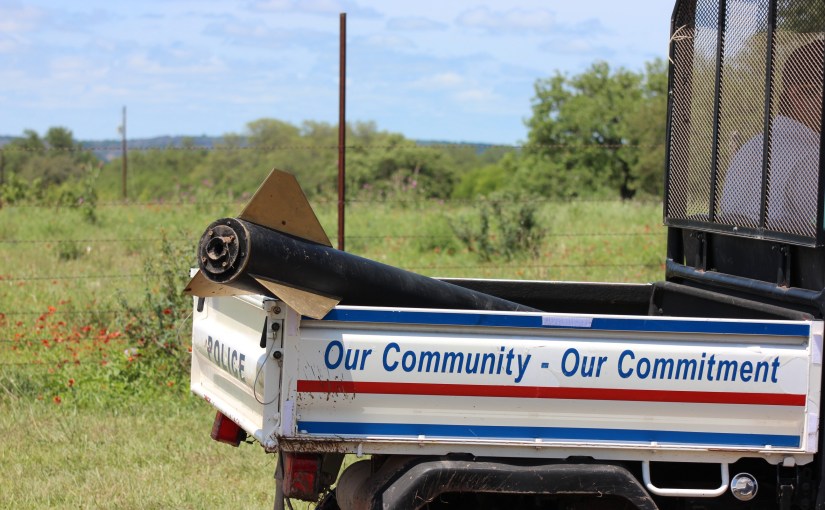
I can’t give enough praise to all of our friends and neighbors in this area that give so much of themselves, their time, like I already mentioned, just the permissions to be there to this outstanding educational program. The Slogan on the police mule in the featured picture says it all, “Our Community, Our Commitment”, and this community has definitely made a lasting commitment to our students’ education and future.

Lastly, as just one of many volunteers to SystemsGo, I want to say thank you to you for developing this program for our students. I personally have had two daughters go through it and continue on in things that it inspired in their futures. I couldn’t be prouder of each o of them, and I couldn’t be happier that they had this opportunity. Also, thank you SystemsGo for allowing myself and my family to be a continued part of the volunteer staff.

SystemsGo is igniting the lives of students across Texas! Thank you all!

www.systemsgo.org as always is the place for more information on this program. Take the time to get your school involved, the future of your students will be greatly benefited.