This morning started around 0900 on WC 50 range at WSMR. Earlier start was not available due to actual military testing scheduled for today. Two schools, Union Grove and Booker T Washington were on the schedule with a 6 hour window for completion.
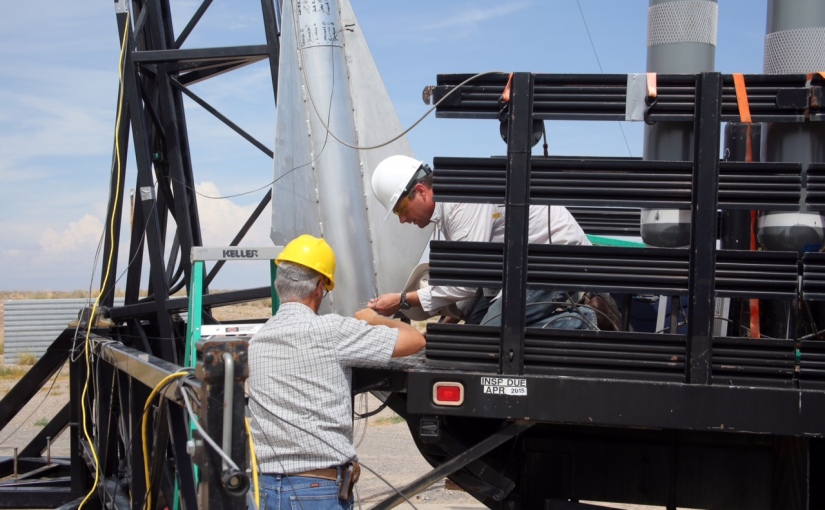
The SystemsGo team spent the first hour plus, conducting readiness checks on the Nitrous tanks making sure they were switched out for full ones, making sure the Pad was completely operational, and safety testing the Fill and Fire system to be sure it continued at 100%. During this time, students evaluated their rocket and checked to be sure their vehicle was completely prepared for launch.
Between 1030 and 1100 all systems were deemed ready as was Union Grove’s rocket so it was moved to the launch rail. It went vertical around 1145 and commenced fill. As the third Nitrous tank was filling into the rocket, a small piece at the top of the Estes motor in the injection system froze, and collapsed causing Nitrous to vent. At this point the launch had to abort. The problem was easily fixed and the rocket was readied for a second attempt after Union Grove if time allowed.
It took approximately two hours to remove Union Grove’s rocket and put Booker T Washington’s rocket on the rail, switch out Nitrous tanks, and wait on the survey teams to provide a new azimuth and angel for the rail for the new launch. During this time another thunderstorm was fast approaching. At 1420 they began fill, as the third tank was loading the Army reported lightning ten miles out. Fill was completed and the rocket was ready to fire so the teams all went to the bunk house and began countdown. Twelve seconds from launch the Army called abort due too high winds that would have affected the rocket’s projections. After another 45 minutes to one hour, they were given the go for launch again and restarted the countdown at one minute and 30 seconds (90 seconds). Rain continued throughout this time.
The initial launch went well. The rocket ignited and left the rail. It traveled 30 to 40 feet up where the bolts at the top of the nozzle cracked, the rocket lost control, and nose-dived into the range between 180 to 200 feet from the launch rail. It continued burning on the ground, and continued storming so it was allowed to stay where it was and burn out. The Army took over monitoring it until they deemed it safe to approach.
This rocket was caring a NASA payload in the form of a container that was filled with lava rocks meant to represent moon rocks. The purpose of the payload was to test the container and evaluate how it would hold up to space flight and impact at landing. The container was crushed and the rocks strewn all over the crash site. It was determined that the container would not hold up as part of the nose cone.
The decision to abort for the day was made because of continued heavy rain, lightning, and wind in the storm. Two hours elapsed before the storm let up and they were able to get out on the range, retrieve the rocket and rocks, and pack up for the day. This also meant that Union Grove would not get another shot at launch for today, bumping them to after Alamo Heights tomorrow time permitting.
On another outstanding note, the new Fill and Fire system has been tested and found 100% operational in sunshine or rain. Congratulations to Robert Dever, the system designer.
Wednesday’s schedule includes two vehicles for Alamo Heights High School and now a second attempt for Union Grove if the window of opportunity is still available. Range time begins at 0400 with a final eight-hour window. Launch times begin at 0800.
After launches are complete, the team will pack up all equipment and clean up the site, and the schools will load all vehicles, clean up and take down all staging areas including tents and materials and return the bunk house and pad to pre-SystemsGo arrival WSMR standards.
Thursday all SystemsGo teams and participating schools will return home.
That concludes Tuesday’s WSMR Rocket update.
www.systemsgo.org as always is the place for more information on this program. Take the time to get your school involved, the future of your students will be greatly benefited. SystemsGo is a Texas-based STEM curriculum program.
Tune in again tomorrow for an update from Wednesday’s final day of launches at White Sands Missile Range this week.

 On the Wings of Angels