SystemsGo New Mexico Blasts Off Its 2nd Year of Rocket Launches Tomorrow

Hello Rocket Fans, are you ready to #RideTheSky, cheering on your innovative, creative, intelligent students?! Well, tomorrow is the day! Rockets will be headed into the heavens in Jal, New Mexico. This is the second year for the SystemsGo New Mexico group and they are ready and up to the challenge, as they add Transonic vehicles to their launches for the first time at this venue. Last year they only attempted 1 pound/1 mile rockets so it will be another new learning curve for the students and volunteers at the site. No worries though, they have been training for this and the group has it all in hand.

Stage 1 and Stage 2 rocket check ins start at 1:00 today and run through 5:00 p.m. at Jal Elementary School. If your school’s rocket clears stage 2 today, Friday, it must remain at the elementary school overnight. Pick up time starts at 7:00 a.m. for these rockets.

Check out the new welcome sign at the site. That is pretty amazing!

The launch site at Phillips Hill Road will open for Stage 3 for rockets cleared on Friday evening only, at 7:30 a.m.  All others report to the elementary school for Stage 1 and 2 checks and clearing. Do not bring your rocket to the launch site unless it has been cleared at Stage 2.

Please note, schools that were here last year, both the Stage 1 & 2 facility and the launch site are in different places from last year. Be sure you have correct directions and the new map link: http://www.bringonthescience.com

Recovery teams you will have a briefing at the launch site at 7:30 a.m.

General admission to the launch site begins at 8:00 a.m. Rockets are scheduled to begin launching at 8:30 but no sooner. Of course, as I mentioned yesterday, they are subject to wind, weather and workmanship all of which can delay a launch. Better put in the immortal words of Mr. Brett Williams, “A hundred things have to go right for a successful launch, but it only takes one thing going wrong to prevent it.”  With that being said, take a seat, have patience, and just have fun. Be sure to bring some sideline entertainment. Books, cards, dominoes, and games are always good, or you can join in Rocket Trivia with Joyce  Bk Abbey,the voice of rockets, who will be there to MC the event.

An important reminder to the day’s events is that you DO need admittance tickets. You can pre-register for these at the following link: https://www.greateventseats.com/SystemsGo . When you register for these, you are also signing a waiver for entrance to the launch site. These are required to get in. You can obtain them at the gate, but it is discouraged as it slows down entrance for you and anyone behind you to the site and may result in you and anyone behind you missing your intended launch. Pre-registration is preferred.

Concessions will be available for purchase at the launch site.  Portable bathrooms will also be set up. As spectators though, remember your chairs, card tables, umbrellas, sun screen, jackets, blankets, and entertainment for down time between launches.

The current schedule of launches is  shown below and is available here: http://www.systemsgo.org/events/ .

Saturday, April 21, 2018
School Name / Teacher 1/1 Transonic
Hagerman HS
Andrew Rodriguez
1
Hobbs HS
Shawna Carter
5
Jal HS
Nathan Richard
1 1
Lake Arthur HS
Steve Goluska
1 1
Loving HS
David Janzen
2 1
Lovington HS
Michael Dodson
2 1
New Tech Odessa HS
Richard Lindner
2
7 Schools Launching
Totals 14 4
Total Rockets 18

Don’t forget, all volunteers, teachers, teams and admins are invited to Jal Country Club for a hamburger and hot dog cook out from 5:00 p.m. to 7:00 p.m. Dave Willden is your gracious host for this event.

Current weather conditions for Saturday show a bit of a warm up.  40 is the predicted low and 71 is the high. That is not too bad for the desert in April. Dress is layers, you may need a light jacket in the morning.

Good luck to the seven schools participating in this year’s New Mexico event. No matter the outcome of your launch, you have successfully designed, built and delivered a rocket to the pad for testing. In doing just that, you have learned more and will take with you more than some achieve in a life time.

Parents and spectators be sure you are ready with the cameras to catch the expressions on your students’ faces for two different events. The first is when their vehicle leaves the pad headed into the sky, and the second is when Recovery hands it back to them after launch and recovery. These are the faces of joy, excitement, and fulfillment  you want to see as much as you do that rocket soaring into the blue.

SystemsGo New Mexico has a Facebook page: https://www.facebook.com/SystemsGoNM/  , and also a twitter feed: https://twitter.com/SystemsGoNM . These are a good source of information.  Joyce Bk Abbey will be manning both and posting pictures and updates throughout the day in leu of Livestream which will not be available at this particular launch this year.

SystemsGo New Mexico is headed up by David Willden.

Please watch the SystemsGo website, SystemsGo Facebook page,  SystemsGo Twitter feed: https://twitter.com/SystemsGoNews and this blog for upcoming information on these events.

After completion another report will be posted here, featuring results, pictures and some editorial content cataloging the success of the event.

http://www.systemsgo.org as always is the place for more information on this program. You may also email them at info@systemsgo.org. Take the time to get your school involved, the future of your students will be greatly benefited.

Hope to see you at the launches! #ItISRocketScience #RideTheSky #Launcher01

2017/2018 Fredericksburg’s Engineering/Rocket Program-October/Early November Hi Lights

September  and October have come and gone and  we are now half way through November and the Fredericksburg High School Engineering Program is deep into their studies busy learning and working at all levels. Eight weeks have passed since our first Engineering Program update and the first semester is halfway through.
Since our last update, the Freshmen have created an electrical design for the NASA built and designed Orion space capsule. Keith Kunz from Teledyne was their audience for this presentation.  Teledyne works with offshore oil exploration developing and designing hard and software for their use.  As an audience for these presentations, individuals like Mr. Kunz, provide constructive criticism such as design strengths and weaknesses, areas that did not match the design logic, things that were overlooked, and skills of presentation.
Currently the Freshman are working on a bio-engineering project, which will be designed to help student, Cody Bearden, who has Spinal Muscular Atrophy, which keeps him confined to a wheelchair. It will be a hoverchair.   Yesterday they presented their project to a new audience, consisting of Tim Nolan, an  AirEvac pilot and previous Marin Corps helicopter pilot, Todd Keener a mechanical engineer, and Scott Netherland, Executive Director of SystemsGo .  Details on this presentation will be forthcoming in our next update.
Sophomore students are still working at their own pace in this year’s class. Due to this,  the further along the year rolls, the larger the gap is between the slowest and fastest student. Because of this some are already starting to learn Isometrics, which are 2D representations of 3D objects. The class as a whole is also studying Dimensioning.
“They are all making good progress, but having them self pace has led to some really taking off with AutoCAD,” states Mr. Matthes.
The Engineering program flew in Brian Evans from Space Propulsion Group out of Butte, Montana to conduct a two-day seminar for the Juniors and Seniors.
Pictured here are Juniors, Gloria Burns, Cooper McDonald and Eston Cooke with Mr. Evans: 
According to Mr. Matthes, “Students really enjoyed having insight from Mr. Evans.”
For the past two months, the Juniors have been learning new skills on Excel which allowed them to better understand the math of starting a new model. They have been creating spreadsheets for a hypothetical bakery where they used calculation, look ups and other functions in order to track materials, hours, and productivity.  Class time has been split between this project and the physics of flight.
Three weeks earlier, the class flew their Generation 1 rockets.  The parameters for this first flight, were just have a rocket on the pad to fly and served as a platform for them to learn and start asking questions on how to correct their flights.
These flights were of varying degrees of stability with some being completely unstable, some having a corkscrew affect and others displaying very straight flights. The instruction on stability follows this flight test and leads into the Generation 2 tests.
Last week Generation 2 rockets were finally launched.  They had been patiently waiting due to several scheduling conflicts with school college fair days and bad weather, windy days.
For this test they actually had to prove the stability of their rockets. This is accomplished by literally cutting the rockets in half.  Students are forced to be intentional about stabilizing their vehicles. The pictures below are from the Generation 2 flights.
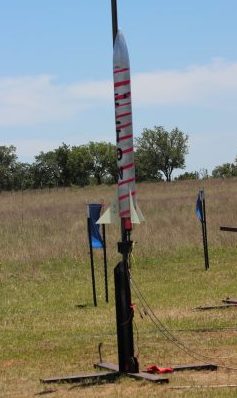
Here, Eduardo Memije and Gloria Burns load their G1 Rocket for launching.
In this photo, Deja Turkett and Bradley Plaza take their turn for launch.
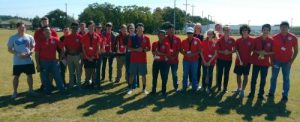
Here the whole Junior class group displays their rockets on launch day.
Currently they are splitting their class time between LabVIEW Programming which they have just begun and the continued study of the physics of flight. Next they will be studying fluids, aerodynamics and drag, and impulse, as well as factors affecting drag, this is all part of prepping for Generation 3 rockets.
According to Mr. Matthes, “Their next objective is to reach 1800 feet using RockSim to design the rockets.  They are assessed on the closeness of construction to design:  it is a tough mark to make without extreme precision.”
On Tuesday, Nov. 7, the Seniors traveled to Houston. After arrival, the group spent four hours at Space Center Houston. According to Mr. Matthes, the students, “had a blast!”

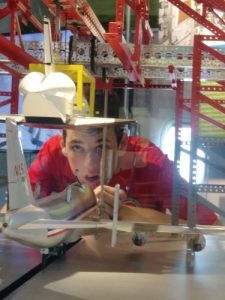
In this mock up, Evan Knapp mounts the Space Shuttle on top of the 747 that transports the shuttle back to Kennedy Space Center.

Corbin Smajstrla is seen here pumping iron on different planets where the gravity is not the same.
Chris Calzada (left) and Rebecca Sechrist (below) pose for pictures in space.
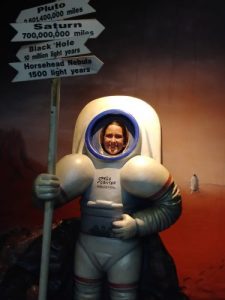
Evan Knapp maneuvers his EVA device back to the ISS as Chris Calzada and Harrison Spisak look on.

 Next the group visited Rocket Park so that the students could get a visual grasp on the enormity of the Saturn V Rocket that took men to the moon and back.
 Relaxing at the end of the day beneath the Apollo capsule on the Saturn V.
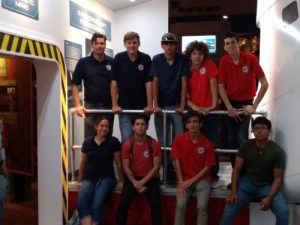
The entire travelling crew. Top row: Instructor Andrew Matthes, Harrison Spisak, Chris Calzada, Corbin Smajstrla, and Evan Knapp. Bottom row: Rebecca Sechrist, Pierce Vasquez, Joey Leal, and Sergio Walle.
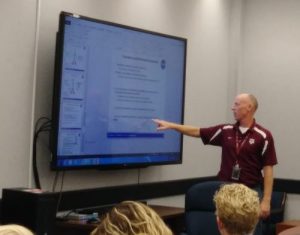
Later, Joyce Abbey, the voice of the SystemsGo launches, and Dave Ladrack, a longtime program friend and supporter, joined the students for dinner.
On Wednesday, Nov. 8, they arrived at Johnson Space Center along with nine other schools and met, Chris Madsen, pictured below, a Guidance, Navigation and Control (GNC) engineer in the flight dynamics department.
Mr. Madsen coordinated and oversaw the program for the students, and gave an overview of College Co-op opportunities. He encouraged the students to be involved and to acquire work experience while still in college.  All nine schools gave presentations of their flight models explaining the projected flights of their rockets to engineers and representatives from other schools who have also taken on a similar tasks.
After lunch the documentation students need in order to be cleared for flight at White Sand next summer, was discussed. Mr. Madsen used examples and an overview of his job in comparison so that students could see that what he does is similarly an extremely more complex version of what the students are building.
 Later that afternoon, FHS had a meeting to present preliminary design reviews of both the wind tunnel project and Redbird #19 to five engineers. This was  three hours of presentation and a question and answer session.
“It was a tremendous opportunity for the students and the feedback was excellent,” reported Mr. Matthes. “The trip was a success.”
Design progress has been made on Redbird #19 but many details still have to be worked out before it can be considered an integrated system.
Mr. Matthes feels that, “The input from this trip will be significantly helpful for drawing both flaws and considerations to light as they proceed forward. “
 The group has been working hard to pull together everything for the Redbird #19 presentation, this has made it necessary to put Teststand on hold for the past week.
Something new the Engineering Program is working on, is the N.E.W. Y.O.U. Event, short for National Engineers Week Youth Outreach United. This will be the first time the FHS Engineering Program will be hosting this event. The purpose of this event, is to expose students from 4th through 8th graders to engineering. They will participate in activities and interact with high school engineering students while learning in a fun and relaxed environment.
FHS Engineering Program has already been readying for the event with two separate planning meetings involving about 20 students in order to organize and divide tasks. Everything is moving along well and they anticipate a great event.
National Engineers Week will begin February 18th. The N.E.W.Y.O.U Event will be held the day before on Saturday, February 17th.  Forth through sixth graders will attend the morning session, and seventh and eighth graders will attend the afternoon/evening session.
This article is the second for the 2017/2018 school year in a series of monthly updates that will follow the Fredericksburg Engineering/Rocket program. This school is a participant of the SystemsGo STEM program. This series of articles is intended to support and encourage students in the program as they share their working status and accomplishments throughout the year in the program. These publications will be available for tags and re-posting.

www.systemsgo.org as always is the place for more information on this program. You may also email them at info@systemsgo.org . Take the time to get your school involved, the future of your students will be greatly benefited.


Rockets 2017-Houston, Done-Fredericksburg Launches Start Tomorrow in Willow City-Thursday Schedule Included

The SystemsGo team arrived home around 11:00 Sunday night from the Houston Rockets 2017 launches.  They had a good event with over with 39 rockets tested at the new location in Smith Point, south of Anahuac.  They transitioned to Willow City on Monday as launches begin there tomorrow, Thursday for Fredericksburg Rockets 2017.

Set up and preparations have been underway all week to insure a great event at Hillview Ranch again this year.

The schedule boasts 26 schools and 87 rockets for this year’s event.

Launches will be Thursday through Sunday between 8:30 and 5:30.  Phil  Houseal will be there providing Livestream from the site again this year so friends and family can watch the action online if they cannot be at the event. Joyce BK Abbey the voice of rockets will be keeping us informed and up to date throughout each day.

As in past years, Texas Concessions will be providing food, snacks, and refreshments. Restrooms will be available on site.

There are chances of rain all weekend, as well as sun and wind so be prepared for either while you are in attendance. Sunscreen, rain gear and a chair are recommended. Also be advised that weather will play a factor in launch time availability and may cause delays. Please be patient.

Please remember that since there is public access to this event, there are  registration tickets for order and those may be found on the SystemsGo website as well at this  link: https://www.greateventseats.com/events.php They are FREE, but REQUIRED.

Here is the link to the live stream again. https://livestream.com/systemsgo

A map to the site is on the SystemsGo website at the following link:

http://www.systemsgo.org/events/

But just in case here is a picture of the same map:

Pictures  will be available here in this blog and in Facebook albums for you to view at the end of each days launches, as well as during the day from Phil and SystemsGo on Facebook as well. Links to both our Facebook pages are below.

https://www.facebook.com/ginger.burow

https://www.facebook.com/SystemsGoEducation/

Here is the schedule of schools launching tomorrow.It boasts 7 schools and 22 rockets:

Thursday, May 18, 2017
School
Name
# 1st Level
Tsiolkovsky
# 2nd Level
Oberth
Birdville CTAL
Lynn Barrett
5 2
Fredericksburg High School
Andrew Matthes
2
Granger High School
Chaston Kubacak
1
Harleton HS
Karen Brasher
1 1
Hollenstein Career & Tech Center
Richard Griffith
2
Kingwood High School
Louis Mascolo
5 1
New Diana High School
Shawn Warden
1 1
7
Schools Launching
Totals 13 9
May 12th Total Rockets 22

I will post each days schedules in this blog. They can also be found in original format on the SystemsGo website Events page.

Good luck to all the schools and students.

Event details will be available here each day as the event unfolds in Willow City at Hillview Ranch. Reports featuring schedules, school names, results, pictures, and some editorial content will also be posted at the end of day. If I get a chance to do some updates during the event each day, then I will but don’t count on it. I work recovery so I am usually busy.

www.systemsgo.org as always is the place for more information on this program. You may also email them at info@systemsgo.org .Take the time to get your school involved, the future of your students will be greatly benefited

Have a great evening. I will see you at T minus 10 tomorrow morning.

#Rockets2017 #SystemsGo #Launcher01 #FredericksburgSTEMAcademy

Day 19-Keeping Rockets Live

Three people devote their time out at these launches, to keeping Rockets live. They even have a trailer out there that houses a broadcasting “mission control” to ensure that all live streaming and uplinks stay active.

Zack Pooser is the main force behind allowing internet communications to go out on live streaming to everyone with a desire to watch that cannot be there. His broadcasting control trailer keeps the launch site connected.

Phil Houseal provides daily interviews with staff, students, visitors, Embry Riddle University reps, and volunteers, giving short insights to those watching as to how this program works, who is involved in it and why. He catches the stories behind the scenes that might not otherwise be heard or told about each type of experience and involvement for those in the program in one way or another.

Joyce Bk Abbey is the voice of rockets. She is the voice everyone hears commanding the attention of spectators before, during and after each launch, whether on site or watching on Livestream. She engages the students as they wait and watch for their vehicle to lift off and be recovered.

This crew of individuals is responsible for keeping rockets open for all to see during these launch weekends. They do a wonderful job of sharing this experience with everyone. They are rockets’ broadcasting extraordinaire.

Thank you all for all your hard work. 

www.systemsgo.org as always is the place for more information on this program. Take the time to get your school involved, the future of your students will be greatly benefited.