Sunday is usually a light day at rockets, but not this year. Although we only had 5 schools, there were 16 rockets to launch. Out of those 15 made it to the air. The last one was still in stage 3 with some issues to be fixed, when nature decided we were done for the weekend and a storm rolled in with lightning and rain. Luckily many areas had been packing things they no longer needed so at least it wasn’t all left to do in the down pour. We all pretty much got soaked anyway, but hey that is Rockets, the weather is always a factor.
We had a total of 81 rockets launched for the weekend and found all but 14 according to recovery captain, Braxton Roemer, seen here quizzing kids and adults on late 80’s rock and pop music during a break in the action.
This gives the recovery group about a 92% recovery rate for the weekend. It could be 93 because Steve found one late yesterday afternoon but was unable to recover it due to severe lightning, but he knows where it is, so either someone will eventually go back for it, the land owner will find it and bring it in, or it will be Team Burow’s first find next year.
Yesterday, I let Steve go solo on recovery, and I joined my daughter, Chelsea, at the pad. I was able to watch first hand all that goes on to get these vehicles in the air. The pad crew makes it look easy, but it’s a little more complicated than what you might think. The original crew of Chelsea Burow,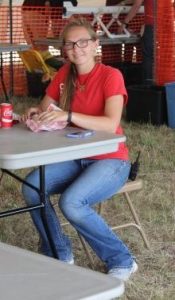 Anissa Kneese,
Josh Hampton, Bryan Heffner, and Cade Ottmers has had years of practice to get things right. This year they were even training some new recruits in the program, freshman, Troy Kneese,
  and senior, Jesse Cedillo.
 . Jesse will be attending Angelo State University in the fall for computer science.
It is a coordinated effort as rockets come to the pad, and they do pictures of the students with the rocket “set” on the rail. Afterwards, the students return to Mission Control so the pad crew can load the rocket properly and safely.
Crew members then attach the match and seat the motor onto the stem assembly, which is a two-part tube fit tightly together, which delivers Nitruos into the tank, and allows Gox to flow over the fuel grain to help with ignition. The stem is fed through the fuel grain and the bell of the motor into the tank of the rocket. This can be difficult as it has to go through very small opens inside the motor and has to be done totally by feel and knowledge of the different motors used in the vehicles, and the vehicle has to be level while doing this. It is no small task, but this group makes it look easy, most of the time. The consensus on the pad is the “L” motors are the worst to seat. There were quite a few L motors yesterday, but they managed them all. Jesse is seating a rocket in his photo above.
After this is achieved they do systems checks and then raise the rail, ready for launches. This is referred to as “going vertical”.
Pad members work in small groups throughout the pad attempting to load all 6 rails if enough vehicles are available. Occasionally it takes the whole crew at once to raise the rails on some of the larger or more complicated rockets.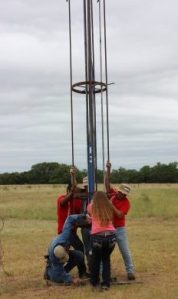
When launching begins and a vehicle is “Armed” (this is basically the altimeter is turned on and verified to be working) then all must clear the pad except the two members working to launch a particular rocket. Next they go for fill, after which the launch count down sequence is initiated. At this point the they run for cover in the bunkers.
After the rocket has cleared the pad everyone watches skyward and hopes for a good flight and successful deployment of the recovery system. Once the vehicle is confirmed down or determined to be too far away and has no chance of coming down near the pad, then the crew is back out to work the next one.
If a rocket fails to leave the rail, then the pad crew determines if it is something they can fix on the rail or if it has to be unloaded and returned to Stage 3. At which point the students and technicians will re-evaluate and determine if they can fix the vehicle for another attempt at launch, or abort.
The crew members are all past students of the program and know quite well what to look for if a rocket fails to launch. Most of the time it is minor things that can be fixed on the spot, but not always. Another factor that will cause a delay on the pad is empty fuel tanks. At that point they move to another rail while tanks are replaced.
This is just a small synopsis of what they do and not nearly all of their skills. They are an accomplished group and I really enjoyed my time there on Sunday. I helped where I could with several rockets, took pictures of students and their rockets, and the launches, and assisted in tearing down the 1 lb/1 ml rails and other aspects of the pad that were no longer needed as we were awaiting the arrival of the final Transonic launches.
Since most of you know that I am in Recovery out at rockets each year, I will let you know I didn’t shirk my duties completely. I recovered a nose cone, a rocket bottom ring, and two body tube shrapnel pieces from two different launches while working at the pad.
This marks the end of another great year of rockets for the smaller level vehicles. Rockets 2017 has only the Goddard level launches left which are coming up in late June. There is a fairly strong date, but I won’t be posting that until closer to time since they can still be subject to change at the Army’s need. I will keep everyone posted on that as information is available. Good luck to all those schools and safe travels when you go there. For more information as usual check their website at www.systemsgo.org .
I will be posting a final update on how the Fredericksburg STEM Academy’s junior class rocket did this past Thursday at Willow City. They are evaluating their data and then we will have more details.
The following is a link to the album of pictures from Sunday’s launch. Have a look, you and your school rocket just might be in there.
https://www.facebook.com/ginger.burow/media_set?set=a.1479975588690234.1073741892.100000334203350&type=3&pnref=story
Event details will be available here each day of any launch event. Daily reports featuring schedules, school names, results, pictures and some editorial content will also be posted.
www.systemsgo.org as always is the place for more information on this program. You may also email them at info@systemsgo.org .Take the time to get your school involved, the future of your students will be greatly benefited.
#SystemsGo #Rockets2017 #FredericksburgSTEMAcademy #Launcher01 #SystemsGoNewMexico



 On the Wings of Angels