Fredericksburg’s Engineering Rocket Program-Second Term Update #2 (February 16-April 13)

It is April and we have some catching up to do on the  FHS Engineering program. It has been two months since our last update and quite a bit has been happening on all levels.  Along with class work, launches start this month in Jal, New Mexico  on April 21 and Fredericksburg (Willow City) April 26-28 so time is becoming a factor for the Junior and senior groups.  Each group is working hard to meet their timelines. Rockets 2018 is the pinnacle event for the upper level groups, as their rocket projects are basically the final grade for the year.

The seniors have approximately 73 days until Redbird 19 is TENTATIVELY scheduled for testing at White Sands Missile Range, which is usually in the last week of June.  This date is still not a permanent date until the Army finalizes, closer to that time. Mr. Matthes will announce that date when it becomes readily available. Their completion date for  preliminary systems tests is usually two weeks before school ends. This would be May 18 which cuts them down to 59 days.

More on these groups and their current status reports will be later in the article.

Freshman participated in a field trip on March 1st, in which they visited Southwest Research Institute(SwRI), the Center for the Intrepid,  and the UTSA VIZlab.  At the Center for the Intrepid, the students were able to see biomedical equipment at work helping wounded Veterans in their recovery. Along with the engineering aspect of this, Mr. Matthes hoped that they took away a new respect for our military servicemen and women and the full extent of the sacrifices they make each day for our country’s safety.

Former FHS Engineering Alumni, Drake Horstman, was the students’ guide when they visited the UTSA VIZlab, toured the campus, engineering lab and community areas. During the visit, Drake, provided  entertainment and wisdom coupled with numerous stories about his experiences in the FHS Engineering Program. Inside the lab, the students were able to see several visual interaction devices.

At Southwest Research Institute, students learned technical information about engines, modifications and fuel efficiency. The content here was a little over their knowledge base,  and may have overwhelmed the students a little, according to Mr. Matthes. In spite of that, it was still a good visit for the students, and the coordinator at SwRI commented  about their behavior stating, “they are better than a lot of the college students who come through.”

These visits are designed to expose the students to different aspects in the engineering fields. The impressions they take from here will help them make decisions down the road on whether engineering is for them, and if so, help them determine a particular area of interest.

The Freshmen also participated in their first Critical Design Review (CDR). They were tasked with presenting solutions to fix the damaged launch tower for the Red Bird rockets. This gives them practice on presentation skills and feedback on designs for their project.

Mr. Matthes stated that, “the students may have felt “roasted” with constructive criticism and feedback. But, that they should know, that it is part of improvement and growth of design and not personal.” He mentioned that this was also discussed briefly at the end of the trip to SwRI, by the hosting engineer.

The sophomores have advanced well in the curriculum and are presently several weeks ahead of their  current deadlines. Their current focus is on dimensioning objects, denoting measurements and creating fabrication notes. Due to this, their proficiency has advanced well.

Mr. Matthes is quite impressed with the Juniors selection of a class name. Here is how he describes it,”The juniors named their class “Conatus” which translates from Latin, to impulse and means striving.  From a historical philosophy origin it relates to the nature of something to continue its existence.”

The pressure is on with an April 19th rocket completion date looming ever closer. The rocket must be completed one week prior to their April 26th launch, because after it is completed they must also complete a Flight Readiness Review which often uncovers errors and problems that must be resolved.  This week provides adequate time for those things to happen.

According to Mr. Matthes neither team has anything that quite resembles a rocket as of yet, but each is working through a pile of parts that arrived. Most were not ordered until the end of March which was quite late, but each group began working with tangible parts  the end of last week.

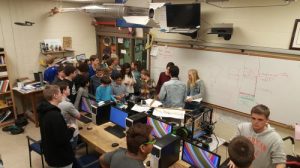
Team #2 decided to make use of Monday’s teacher in-service day, by putting in about four hours of work. Shown below from team #2 are clockwise starting from the bottom, Cooper McDonald, Gloria Burns, Ethan Scott, and Dawson Harkins as they take measurements off the back-end of the rocket and motor system.

Both teams do have a work in progress at this point.  According to Mr. Matthes, “Pressure makes diamonds and rockets.”

Incidentally, another incentive for each comes from SystemsGo. A flawless flight and perfect recovery may afford that team the chance to re-fly their vehicle with a different fuel grain in order to collect data for SystemsGo.

The miniature Teststand is an ongoing project for the juniors as well. They are using LabVIEW programming as a means to start ignition and measure thrust, as well as using 3D modeling in order to develop a unique physical Teststand model. The class is split into working groups of 3. According to Mr. Matthes, “They are on track to have this done by the end of school and I am excited to see what they come up with.”

Seniors are progressing well with Redbird 19, wind tunnel and the large Teststand development.

Construction is beginning on Redbird 19 now that parts are returning from Heartland Enterprises. According to Mr. Matthes the parts, “look beautiful, and most parts are in.” Now that parts are available there is a bullet list of accomplishments to be achieved including, overlaying the nose cone in fiberglass, creating a mold and then pouring the fuel grain, making a custom hose for the injection valve, testing  recovery chute deployment, integrating avionics into the vehicle, and Mr. Jenkins is in the process of manufacturing the payload.
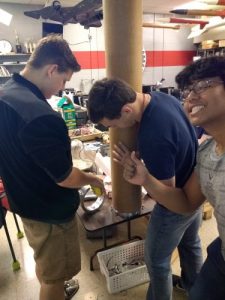
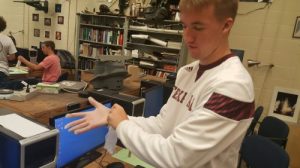
Here Harrison Spisak, Bryce Erwin, and Sergio Walle are checking the fit of the injector, nozzle and retaining ring in their fuel grain liner.

Currently wind tunnel is well underway, as students are receiving and ordering parts. The program is nearing completion and the electronics used for the drag testing measurement has arrived. Hunter Smith, a SpaceX programmer at the McGregor facility has been assisting Rebecca Sechrist through a Skype session. He has been providing analysis and comprehension in areas he has already assisted, as well as a starting point from which to move ahead. According to Mr. Matthes, “The students are making headway but must begin to make a push in order to finish this outstanding design by summer.”

Deadlines are quickly evolving for Teststand, as the group’s progress here is steady but slow. They have installed a flow meter to directly measure Nitrous oxide. Load cells which measure thrust have been changed out and fuel grains have also been readied for testing.

The stand itself is nearing a test ready state. New to this year’s stand are changes in the injection system. The new system will allow more controls of the flow. A parent plate has been designed by students and fabricated by another local machine shop, Kager Industries,  which will hold a smaller injection disc allowing students the ability to change out the disc which controls the rate of flow. The plate can be installed as soon as the 0.05″ holes have been drilled through. Next, the LabVIEW program will be fully tested on the stand.  Afterwards, a cold flow test will be conducted in order to measure the oxidizer flow rate and determine if the size and pattern of holes in the new disc are correct. If the cold flow tests are successful, then hot fire tests can begin.

The Baby Bird Teststand is still on hold until further notice.

SystemsGo hosted a BBQ dinner event for the neighbors in Willow City. Seniors, Bryce Erwin and Sergio Walle, pictured below,  spoke at the event. Their purpose was to educate attendees about the educational process of the program and how it relates to the upcoming launches, as well as to share their own experiences in the program.

Additionally, Harrison Spisak and Corbin Smajstrala spoke to the Morning Rotary last month on similar subjects.

Mr. Matthes would personally like to thank all four of these young men for committing to these events and participating in them. In both cases, participants and SystmesGo staff commended them on their exceptional performances.

This article is the fourth for the 2017/2018 school year in a series of periodic updates that will follow the Fredericksburg Engineering/Rocket program. This school is a participant of the SystemsGo STEM program. This series of articles is intended to support and encourage students in the program as they share their working status and accomplishments throughout the year in the program. These publications will be available for tags and re-posting.

www.systemsgo.org as always is the place for more information on this program. You may also email them at info@systemsgo.org . Take the time to get your school involved, the future of your students will be greatly benefited.

Fredericksburg’s STEM Academy/Rocket Program-Spring Term Update #2 (February 21-March 31)

April 1st is tomorrow, so time is becoming a factor for the Fredericksburg STEM Academy as launch dates approach for the junior and senior groups. There are no fools here though, just  several groups of future engineers working hard to meet their timelines. With March behind them there is only a little over 6 weeks left  for the  junior group until Rockets 2017 and their May 18th test date. The seniors have approximately 60 days as Redbird 18 is scheduled for completion two weeks before school ends to allow for preliminary systems tests.

More on these groups and their current status reports will be later in the article.

Sophomores are currently taking mid-term exams. This is due to the new schedule for classes this year which puts a full year’s curriculum into one standard semester. They have been busy using AutoCAD to create multi view drawings of objects. Dimensioning and tolerancing of these drawings will be learned next, followed by isometric drawings and 3D modeling. The students have been printing models of their multiview drawings using the newly installed 3D printer. All 3  3D printers available now are working well.

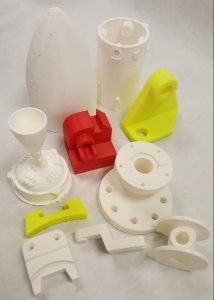
The student aide, Colby Marthaler  has also been using the 3D   printers to print all the parts necessary to create a model of the Falcon 9 Rocket SpaceX uses to transport satellites and the Dragon spacecraft into orbit.
Juniors had CDR’s (Critical Design Reviews) due for their rockets by March 30. Unfortunately they are just getting to them. Students will have to be studious in order to meet their May 18th launch date due to being behind schedule at this time. The payload for this rocket is a rapid growth slime mold. They have designed the payload in order to create a controlled experiment in which they should be able to determine how flight impacts the mold’s growth, negatively or positively.

The design criteria for their rocket is a one pound payload and breaking the speed of sound therefore achieving a transonic state. Currently neither criteria has been met so the group has more work to do to accomplish their goals by their launch date.

Their mid-term which is a LabVIEW development project has come along well. They are creating a workable program which requires specific methods and functions in order to attain a goal of designing and fabricating a micro test stand for Estes motors. They will be connecting  a (DAQ) Data Acquisition unit to a computer and registering it to that computer in order to read sensors, and programming a control and DAQ Virtual Instrument in LabView in order to run the test stand.

March began with more fuel grain tests at test stand. Two tests were completed in the first week alone, consisting of many hours of work to accomplish each. A temperature sensor indicated a high enough value in order to cause a programmed shut down on the first test that week.  After investigation, it was found that a ‘electrical noise’ caused an anomaly which gave the sensor its reading, and that it was in fact not outside normal operating parameters. The actual test did not experience any temperature concerns.

The same fuel grain was able to be used again in a 20 second burn, which allowed students to achieve a cumulative 40 second burn on one fuel grain.  The shut down was disabled for the second burn,  allowing the data to still record the temperatures caused by the ‘electrical noise’, but not to stop the burn test and it was a  full success without any further exceptions.

Mr. Matthes was very pleased with these burns and stated , “All data was processed and showed again the test stand was producing verifiable data similar to theoretical expectations.”

Students began another round of testing this week. Six new fuel grains will be tested accounting for three tests each of two different fuel types students have been working on. The  hope is that they will cycle through smoothly due to the fuel grains being prepped prior to testing.

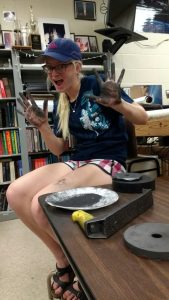
  Here Hannah Boubel is working with graphite in order to make ablative, which is a sacrificial material in the pre and post combustion chamber so the burn does not penetrate the liner and steel test cell.
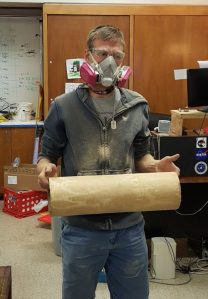
 In this photo,  Sterling Weatherford is preparing a fuel grain for installation in to the test cell.

Along with test stand work, the students have been hard at work on Rebird 18, their Goddard level rocket slated to launch at White Sands Missile Range on June 27th. Students have already contracted with Heartland  Enterprises and SRM Manufacturing for fabrications and parts have been supplied to them.

At this point in the process students are learning true cause and effect, and just how it can affect their outcomes.  The entire success of the vehicle from this point forward is contingent on the group not only working as a team as a whole, but also for each individual team to stay on top of their work and outcome. Many of the components are dependent on the progress of the others. Delays on one team’s  element directly affects the next  team creating delays down the line and strained time schedules.  Individual testing is conducted on each piece as it is finished.  Full up integration and testing of any systems that allow for ground based testing is scheduled for two weeks from the end of school when the rocket is due to be complete.

“They are well on their way to a successful vehicle.  The seniors will not have the luxury of adopting senioritis as there is still significant and mutually dependent work to be accomplished,” Mr. Matthes reported. “These next 60 days will be a true test of their team work, peer loyalty and persistence. ”

As the end of the school year approaches, these students are becoming more and more adept in their learning and knowledge as young and capable engineers. Their end of year rockets will be a testament to that learning, time and ability.

According to Mr. Matthes, “Students are becoming ‘plagued’ with knowledge and experience:  the more they know and become aware of, the more they have to take into consideration and the more challenging the process becomes.  However, it also makes for conditions more aligned with success.  Additionally, if we consider these students products of FHS and the FHS Engineering, then they should be welcomed by a market hungry for what they have to offer.”

If you follow this program and like to view the launches, Rockets 2017  will be held at the Stewart Ranch in Willow City, Texas on the weekend of May 18-21, 2017.  This testing site is open to the public. Please watch the SystemsGo website and this blog for upcoming information on the event. The FHS junior group will be testing their rockets on Thursday, May 18, 2017.

The senior group is tentatively scheduled to launch their Goddard level rocket at White Sands Missile Range (WSMR) in New Mexico the week of June 26-30. The current schedule for that event is as follows:

Sunday, Jun 25th             Travel Day

Monday, Jun 26th            T-1 and Site Set up/Rocket Prep at WC-50

Tuesday, Jun 27th            Launch Day One (Three Rockets – Fredericksburg, Union Grove, Alamo Heights)

Wednesday, Jun 28th     Launch Day Two (Three Rockets – Anahuac, Booker T. #1, Booker T. #2)

Thursday, Jun 29th          Contingency Day

Friday, Jun 30th                Travel Day

There are also launches in Houston for schools in that area the weekend of May 12-14, 2017. New for this year the Hobbs, New Mexico group of schools will launch 1/1 rockets in Jal, New Mexico on April 27, 2017, this site will also be open to public viewing.

This article is the sixth in a series, new for this school year ’16/’17 of monthly updates that will follow the Fredericksburg STEM Academy/Rocket program. This school is a participant of the SystemsGo STEM program. This series of articles is intended to support, encourage, and challenge students in the program as they share their working status and accomplishments throughout the year in the program. These publications will be available for tags and re-posting.

www.systemsgo.org as always is the place for more information on this program. You may also email them at info@systemsgo.org . Take the time to get your school involved, the future of your students will be greatly benefited.

Second Term Update #1 (January 9-February 21)-Fredericksburg’s STEM Academy/Rocket Program

January  is past and February is waning quickly, but the spring program is really building. There are big goals and events  for each class group. This semester is where their learning  hits the pad literally for the junior and senior groups as they build toward Rockets 2017 and their end of class projects.  There are three class groups this semester as the sophomore class begins study and the freshman class is complete until they re-enter the program as sophomores in January of 2018.

The freshman have moved on due to the new accelerated block schedule, but at the end of the semester they all agreed that communication skills were what they felt they had developed the most. They found themselves to be much more comfortable and  proficient  when speaking in public. Their final projects, the orange juice production plants went well as reported by Mr. Matthes. The students were all very excited about the class and course study, but not about having to wait a whole year to return to the STEM Academy.

The sophomores are just beginning their 5th week of studies since they are new to the program for this year. Their studies to this point included learning to hand draw multi-view drawings, interpreting 3D objects, and learning engineering lettering which they have recently completed. With these skills accomplished, they will be moving on to the ACC Auto CAD course within the next week.

These students have been using two older 3D printers  for these projects. The printers have a relatively small build space and so limit what the students can produce on them. The district has recently received a new larger 3D printer, the MakerBot Z18 which will be available later this month. This will be a benefit to these students as well as both upperclassmen groups as it will allow for much larger production pieces and will give them the ability to prototype designs.

While junior and senior classes will use this printer more often, the sophomores will be the first to learn how to use it. Even though their current course study will still be focused on smaller printing jobs, prototyping and future uses will necessitate knowing how to use the new printer.

Juniors began work on January 23, on their transonic rocket that they will launch in Willow City in May. They have begun the initial stages of the Design and Development processes. A timeline and a problem statement have been created, and they are about midway through the research process.

They have a Critical Design Review (CDR) due before spring break. Unfortunately they have not been able to narrow down the scope of their research as of yet. This keeps them spread out as  a team, and means they have to make up ground in order to make the pre-spring break CDR  deadline.

They are researching rapid growth organisms for a possible payload for the rocket, and hope to be able to study how flight affects their growth.

On Friday, February 17, the juniors along with sophomores, Gloria Burns and Eston Cooke joined the juniors as Brian Evans of Space Propulsion Group provided instruction on the basics of mathematical modeling. At the end of the presentation, juniors had the opportunity to present models they had developed and then also do trouble shooting on their profiles.

20170217_120050Sophomores Gloria Burns and Eston Cooke with Dr. Brian Evans.

The junior students were very receptive to Mr. Evans and his instruction, alleviating numerous roadblocks and enabling rapid progress in their modelling.

20170217_111700Here  juniors, Harrison Spisak and Jacob Weinecke make their presentations their burn model to Dr. Evans.

“Dr. Evans was down to earth and made  comprehension of something really difficult, easy.”-Corbin Smajstrla

“It was nice to have rocket science explained so it wasn’t rocket science.” -Evan Knapp

Juniors have been officially invited to begin learning and participation in fuel grain motor test burns, but currently seniors are the only ones conducting any test burns.

20170217_111026 Corbin Smajstrla and Dr. Evans at the board.
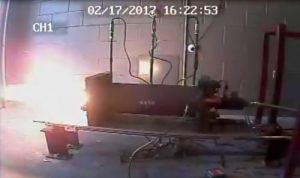
The seniors conducted their first hot fire test on Friday, February 17, while Dr. Evans from the Space Propulsion Group was in attendance. They accomplished a 10 second burn of Low Density Polyethylene (LDPE).

starboard-view A still photo from the burn test.

According to Mr. Matthes, ” The test was extremely successful with outstanding data acquisition that showed the motor preformed nominally, according to expected design parameters.  This was very exciting to have such a good, clean burn, good data, and fitting expected performance.”

Heartland Enterprises and SRM Manufacturing created a newly designed injector plate.  This allowed the class to keep their Friday deadline.  In spite of the piece needing to be manufactured quickly for the project,  these companies came through and the product was, “beautifully machined and performed with 10% of expectation regarding oxidizer mass flow rate,” stated Mr. Matthes.

On January 27, the Fredericsburg Middle School 7th grade GT(Gifted and Talented) group presented their payload for the Redbird #18 Rocket to the senior STEM class. It consisted of a group of sensors to measure UV Light, methane, acceleratometer, and barometric pressure.

20170127_142251 20170127_135355 The 7th grade GT class presentation.

New this school year, Mr. Matthes started requiring after school and extra curricular hour work on senior projects. When asked how this senior group was doing with this on their project, here is what he had to say about the group.

“There have been  a solid group of students who have been putting time in during study halls and some others who have been able to commit extended numbers of hours outside of school time to keep things moving forward.  These senior students have worked phenomenally.  They bit off a lot to accomplish this year and are on target to meet all of their expectations.  It is quite remarkable having the opportunity and privilege to work with them.  A substitute recently commented that during my absence, walking into the classroom after the passing period between classes was like walking into a full-fledged workforce environment where students were all fully engaged, scheduling, designing, problem solving, and just plain working without any instruction to do so.  I believe the skills these students have honed over the last 4 years through this program and all their other coursework has created a ‘product’ that any college, industry, and organization would wish to recruit.”

Keep up the great work, seniors, what an amazing and glowing endorsement.

If you follow this program and like to view the launches, Rockets 2017  will be held at the Stewart Ranch in Willow City, Texas on the weekend of May 18-21, 2017.  This testing site is open to the public. Please watch the SystemsGo website and this blog for upcoming information on the event. The FHS junior group will be testing their rockets on Thursday, May 18, 2017. The senior group is tentatively scheduled to launch their Goddard level rocket at White Sands Missile Range (WSMR) in New Mexico the week of June 26-30.  There are also launches in Houston for schools in that area the weekend of May 12-14, 2017. New for this year the Hobbs, New Mexico group of schools will launch 1/1 rockets in Jal, New Mexico on April 27, 2017, this site will also be open to public viewing.

The STEM Academy group was encouraged to attend the movie, “Hidden Figures” on Friday, February 10th at Fritztown Cinema. About 35 students from the program attended.  Here is what a few of them had to say about the movie:

“The movie was about African-American women breaking social barriers in the engineering community at NASA. It should be your talent, skills, and work ethic that decide your position at your workplace, not your ethnicity or gender. I found it to be a fun/feel good movie that was well-directed and enjoyable to watch. I found myself caring about the characters and rooting for them throughout the movie which means the characterization was done well.  My favorite part of the movie was the climax when they shot the marine into orbit. The entire movie was building up to this and it was worth the wait.”–John West

“I found “Hidden Figures” to be a very inspiring and thought-provoking film. The primary idea that I took away from the movie was to “look past the numbers.” During the film, NASA mathematicians had difficulty making complex calculations due to there being no existing method available to make them. The protagonist of the film “looked past the numbers” and was able to use her intuition to come up with calculations that fit the situation. In rocket science, numbers are nothing without a physical attribute to tie them to. My favorite part of the movie was when the machine that made quicker calculations than humans malfunctioned and the protagonist was brought in to confirm them. This invoked the idea that machines, although they may be faster, can never replace the need for an engineer.”–Jacob Weinecke

This article is the fifth in a series, new for this school year ’16/’17 of monthly updates that will follow the Fredericksburg STEM Academy/Rocket program. This school is a participant of the SystemsGo STEM program. This series of articles is intended to support, encourage, and challenge students in the program as they share their working status and accomplishments throughout the year in the program. These publications will be available for tags and re-posting.

www.systemsgo.org as always is the place for more information on this program. You may also email them at info@systemsgo.org . Take the time to get your school involved, the future of your students will be greatly benefited.

First Term Wrap Up (Nov. 18-Dec. 21)- Fredericksburg’s STEM/Rocket Program

December is nearly over and Winter break starts today, but before we send the Fredericksburg High School STEM Academy home for Christmas,  we need to review what they have been working on these last four weeks, and try to wrap up the fall program.  January starts the spring program loaded with really big goals and events that this past fall has been building toward.  Each group’s learning will be evident in the success of this coming semester’s projects.

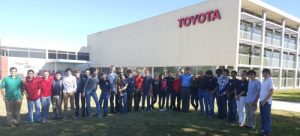
During the month of November the Freshman visited Toyota Manufacturing and Southwest Research Institute (SwRi).

20161121_140216The students were impressed with Toyota and how huge the plant itself is, as well as the difference in the type of automation used as compared to last month’s visit to Caterpillar. Toyota’s assembly line resemble Ford assembly lines. The components actually moved along on a line and each team had an assigned task as it moved by them. Caterpillar operated in stages where one team did several components before it moved to the next staging area.
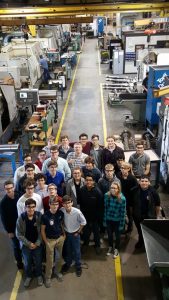
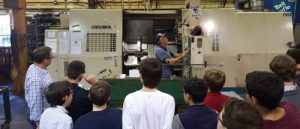
Mr. Matthes remarked that ” The delivery logistics of parts to the assembly line was phenomenal!”

On December 13, the Freshman group visited Fischer and Wieser, Heartland Enterprises, and UT Aeromechanical Lab.

Fischer and Wieser and Heartland are Fredericksburg companies. They both demonstrated automation on a small-scale as compared to companies like Toyota and Caterpillar. Fischer and Wieser explained the importance of loyal employees and a family like environment.

Heartland is similar in framework and belief on how they treat their employees. Where as many companies prefer to hire very experienced candidates from other companies, Heartland prefers to hire inexperienced people and train them in their ways of operation. They find that by doing this they keep a certain working quality and alleviate the bad habits that experience can sometimes bring with it which can be adverse to the companies current operating practices and quality control initiatives.

Below are pictures from Heartland Enterprises:

20161213_0959350 20161213_095101 Here, Alvin Culak, shows machine operations to students.
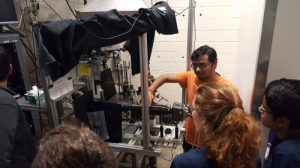
Students at UT Aeromechanical Lab and Flow Field Imaging Lab in Austin, were working on ablative testing for high velocity projectiles or vehicles,  and a research lab studying  hydrogen combustion and anomalies that may exist with it. These anomalies must be understood before hydrogen combustion can be considered for fuel. They are also studying wind tunnel testing designed to help discern the tendencies of shock  for use in ramjet and hyper velocity propulsion systems.

Below, candidates took time with the students to explain and exhibit their work.

20161213_125959 UT graduate student, Rakesh Ranjan, operates a swirl combustor at atmospheric pressure. For more information on this: http://research.ae.utexas.edu/FloImLab/highpressureflashback.php
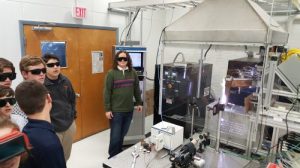
20161213_125140  UT graduate student, Benton Greene, demonstrated the Inductively Coupled Plasma torch. For more information on this: http://research.ae.utexas.edu/FloImLab/ControlofShockBoundaryLayerInteractionDistortionusingPulsedPlasmaJets.php
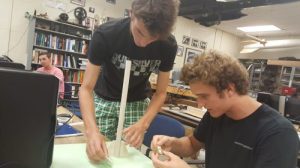
Another UT post-doctoral student, Leon Vanstone, not pictured, explained the experimental investigation of 3D shock wave/boundary interaction unsteadiness at the University of Texas at Austin High Speed Wind Tunnel Lab . For more information on this: https://utexas.box.com/s/n1kk9ozocyp8ozloo9dm9ujx23q6vuwj

Dr. Noel Clemens is the Principle Investigator for all experiments in the lab, and the primary decision maker. Jeremy Jagodzinski is the lab facilitator. He helps to support the research in the lab and also set up the visit for the students. Phillip Varghese oversees the Center for Aeromechanics Research which often collaberates with this lab.  Thank you to all of them for facilitating the tour.

Mr. Matthes stated that, “the students really loved the research facility.”

Aside from field trips to see first hand about automation and manufacturing, the freshman have been learning  about production/automation engineering. They are currently in the process of designing an orange juice production plant. Their product goal for the plant is to take raw material and produce packaged juice in palletized product bundles ready for sale. Jenny Weiser will be coming in January to see their presentations and evaluate and provide constructive criticism.

Sophomores will be entering the program for the second term, starting Jan. 23. ACC’s Auto CAD course will be their main focus learning to utilized specific skills and design elements.

The juniors flew their Generation 3 rockets recently. This provided several learning points that will be useful on their projects next semester. Students realized that even cutting edge design doesn’t always transfer well into the manufacturing ability of the vehicle. Failures in these construction and design frailties, resulted in irregular flight patterns. These mishaps translated into two days of Post Mission Analysis insuring that lessons from this would not carry over to next semester’s larger rocket project.

Here the juniors are building their G3 rockets.

20160921_1247120 20160921_124721 20160921_124732

In January, the juniors will begin work on their one pound/one mile vehicles to be tested out at Willow City in May. This is considered a sounding rocket designed to break the speed of sound without breaking a ceiling of 13,000 feet while carrying a one pound payload.

Seniors have been very busy, and experienced both successes and set backs on their projects recently.  Testing on fuels is expected to begin in January as they are nearly complete with updates on test stand.

After manufacturing pieces for their small motor test stand out of 2024 aluminum, they discovered that this metal type cannot be welded. This resulted in having to procure another high strength aerospace aluminum which is conducive to welding. Once they find this they will have to begin again the manufacturing of the fuel grain containment system.

“These were very important lessons learned for all, them and me,” stated Mr. Matthes.

Preliminary Design Reviews were conducted on their Goddard level rocket, last week. Due to the set backs on test stand, previously  discussed, the group lost time they should have had to work on their rocket design and therefore have a bit of ground to make up there in order to have those completed by January’s end.

This article is the fourth in a new series for this school year ’16/’17 of monthly updates that will follow the Fredericksburg STEM Academy/Rocket program. This school is a participant of the SystemsGo STEM program. This series of articles is intended to support, encourage, and challenge students in the program as they share their working status and accomplishments throughout the year in the program. These publications will be available for tags and re-posting.

www.systemsgo.org as always is the place for more information on this program. You may also email them at info@systemsgo.org . Take the time to get your school involved, the future of your students will be greatly benefited.

September Highlights- Fredericksburg’s STEM/Rocket Program

The school year is now into it’s seventh week. September has come and gone and the Fredericksburg High School STEM Academy has been working steady at all levels. Each group has new skills they are learning, goals they are working to achieve and events they are working towards.

Mr. Matthes says that, ” The Freshman are great! Already I have seen an improvement in their presentation skills. They have also been successful in finishing the structural engineering fix for the SystemsGo launch tower, and have followed up with a PMA (post mission analysis) and current event report.”

2nd-period-freshman-w-structures

This is the second period Freshman class with their structures. Students including in the picture, in no alphabetical order are as follows: Jowad Aysheh, Gloria Burns, Luke Duderstadt, Manuel Enciso, Jack Fox, Jack Gallagher, Jacob Hinterlach, Thomas Johnson, Troy Kneese, Aquilino Perez, Zoe Rivera, Darien Robles, Jessen Stableford, Noah Stotz, Deja Turkett, Alek Vasquez, Calissa Vollmar, Dalton Waters, Joshua Wienecke,  and Zachary Willis.

3rd-period-freshman-w-structures

This is the third period Freshman class with  their structures. Students including in the picture, in alphabetical order are as follows: Dylan Ahrens, Jarrett Beard, Jorge Giral, Blake Boubel, Chad Braden, Jacob Brown, Esten Cooke, Samuel Cowsar, Ryan Davis, Gavin Eckert, Tucker Elliot, Frank Fackovec, Cathryn Huff, Brendon Huynh, Abel Jaimes, Ryan Majors, Antonio Martinez, Tristan McDonald, Gabriela Moreno, Robert Sanchez, Landon Sparrow, Carl Wilger, Lane Wallendorf, and Landon West.

The freshman will be traveling to several companies to investigate how engineering plays a part in their industries. This will take place over the next three months in three separate trips. Included in these trips are: Caterpillar Manufacturing, Aqua Power Cutting, Soutwest Research Institute (SwRI), Toyota Manufacturing, and Center for the Intrepid, all out-of-town trips, and Fischer and Wieser, Heartland Enterprises, Ltd. , Swissomation, Kager Industries, and Rode’s Iron and Pipe locally.  During the month of October they will visit Caterpillar Manufacturing and Aqua Power Cutting.

The Juniors are currently working in the R&D (Research and Development) element of the curriculum after having completed building and launching their Generation 1 model rockets. During this phase they are working on modeling the motor burn.

gen-1-rockets

Junior class with the Generation 1 rockets.

Seniors are alternating between rocket history and  work on the test stand and testbed. They are currently in a break from the history but will rejoin it in a couple of weeks. Mean while they have  conducted successful CDR’s (critical design review) for test stand that generated positive and developmental feedback.  They have also had success updating the testbed. Wiring and programming issues have been corrected,  they were able to create a new tank system which will increase safety in the fill and weigh of nitrous operating systems, as well as succeeding in making the testbed more frictionless.  Their senior rocket is still in the works as they continue in the design  development of the vehicle.

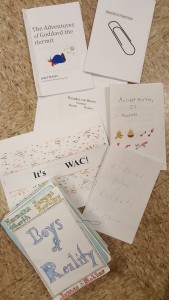
New this year, the seniors created rocket history children’s books.  Students will be doing recordings of themselves reading the books, and both the books and the audios will be sent to the Fredericksburg Elementary School where students there will be able to read the books and hear the high school authors read the books to them.

20161011_074947

According to Mr. Matthes, “Their rocket history children’s books were awesome!”

On November 7 & 8, the senior group has a chance to go to the NASA Johnson Space Center,  for flight profile reviews, grant updates, and a possible preliminary design review. Three students will go for sure, and those will be named at a later date.

Seniors, here is your challenge for the month, according to Mr Matthes, “If you complete the analysis of historic test data from the teststand then you will all be eligible to attend this trip. He would like to see that happen and take you all. Can you meet the challenge? Next month’s edition of this article series will publish the answer to this challenge. Now is your chance to show my readers and Mr. Matthes that you can meet the challenge.

This article is the second in a new series of monthly updates that will follow the Fredericksburg STEM Academy/Rocket program. This school is a participant of the SystemsGo STEM program. This series of articles is intended to support, encourage, and challenge students in the program as they share their working status and accomplishments throughout the year in the program. These publications will be available for tags and re-posting.

www.systemsgo.org as always is the place for more information on this program. You may also email them at info@systemsgo.org . Take the time to get your school involved, the future of your students will be greatly benefited.