Fredericksburg STEM Academy/Rocket Program-Launch Report from Rockets 2017 Willow City Launch Week and Red Bird #18 Update

The Fredericksburg STEM Academy junior class rocket completed a successful launch at Fredericksburg Rockets 2017 on Thursday. They were able to recover their vehicle intact and analyze data.

Unfortunately they did not achieve the speed of sound as hoped. Instead it reached 9300′ traveling 994′ per second, or 678  mph, which is 89% of Mach at  743 mph.

Here is the Fredericksburg STEM Academy team going over checks in Stage 3 before launch. 


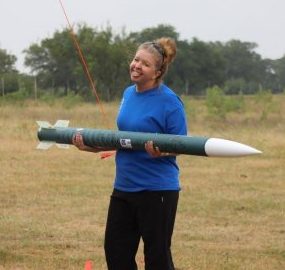
Rocket #52 as tagged by SystemsGo is seen here headed to the pad.
Here  it is vertical on Pad A going through final preparations for launch. 

And finally sailing skyward. 
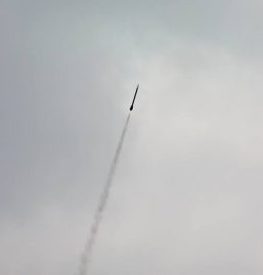
The payload of slime mold did show differences in growth.  The sample on board the vehicle grew less than its sister culture contained in a similar environment at the launch.  Students noted that the payload sample experienced some shock upon landing based on the its displacement.  The vehicle fared quite well.  The drogue deployed but the main parachute did not deploy. This was caused by the shear pins not giving way.  This function could have been tested prior to flight if they had finished their vehicle earlier leaving time to conduct additional testing.  Upon landing one fin chipped and another fin was dislodged from the vehicle but all were recovered.

Juniors present their Post Mission Analysis tomorrow, Thursday, June 1 at FISD’s Central Office board room beginning at 9:00.

This will conclude this year’s reports on the juniors. We will pick up with them next year as seniors when they begin their Goddard level project and attempt to launch at White Sands Missile Range.

Seniors are in decent shape on Red Bird #18.  The vehicle is undergoing final welding at SRM Manufacturing.  Nosecone is wrapping up well.  The current set back is the fuel grain.  After conducting extensive testing to get the correct percentage of the two constituents and creating multiple samples at those percentages, when the students mixed their full volume of HTPB (rubber) fuel, it set too quickly and they were unable to pour it.  Students created more samples yesterday of the same percentages but at different temperatures trying manipulate the cure time.  They are receiving a borrowed supply of one chemical from Alamo Heights High School to complete the fuel grain on a second attempt.

The seniors will also be presenting tomorrow, Thursday, June 1 at FISD’s Central Office board room beginning at 12:15.  They will giving a status update on the development of the Red Bird #18 rocket that is scheduled to launch at White Sands Missile Range in late June, as well as covering the progress and testing on the hybrid rocket motor test stand.

All are welcome to observe both presentations.

This article is the tenth in a series, new for this school year ’16/’17 of updates that have followed the Fredericksburg STEM Academy/Rocket program. This school is a participant of the SystemsGo STEM program. This series of articles is intended to support, encourage, and challenge students in the program as they share their working status and accomplishments throughout the year in the program. These publications will be available for tags and re-posting.

Subsequent updates will continue to follow the Senior/Graduates and the progress of the Red Bird #18 rocket through June and until after launch at WSMR in late June.

www.systemsgo.org as always is the place for more information on this program. You may also email them at info@systemsgo.org . Take the time to get your school involved, the future of your students will be greatly benefited.

#Rockets2017 #SystemsGo #FredricksburgSTEMAcademy #Launcher01

Babybird’s Successful Start Falls Just Short of Flight for Rockets 2017-Fredericksburg STEM Academy/Rocket Program-Spring Term Update #4

Hopes were that three successful tests on the new “junior test stand” nick named “Babybird” over the past weekend would result in the opportunity for the seniors in the Fredericksburg STEM Academy to fly a new Hybrid student developed rocket at Willow City.  The purpose of this teststand, as highlighted in the last update, was to test a fuel grain system designed and developed by the seniors to interface with the hyportek injector and tank. Their hope was to have 3 successful tests on this past weekend.

Saturday evening, May 6, they conducted their first ever test of the Babybird. Unfortunately according to Mr. Matthes, “the containment system experienced thermal damage which tables Babybird for this year”

Babybird may not send a rocket out this year, but she is not at her end. According to Mr. Matthes, “we will continue with the testing of it…The Baby bird still is important research that can be utilized by SystemsGo to increase the rigor of the Oberth level of the program to include motor design.”

Mr. Matthes congratulates the class on their hard work and efforts,  “Burn looks great though… well designed propulsion. Very curious to see the data which looked promising at a glance. Great job FHS Engineering Class of 2017!”

This article is the eighth in a series, new for this school year ’16/’17 of updates that will follow the Fredericksburg STEM Academy/Rocket program. This school is a participant of the SystemsGo STEM program. This series of articles is intended to support, encourage, and challenge students in the program as they share their working status and accomplishments throughout the year in the program. These publications will be available for tags and re-posting.

www.systemsgo.org as always is the place for more information on this program. You may also email them at info@systemsgo.org . Take the time to get your school involved, the future of your students will be greatly benefited.

#Rockets2017 #SystemsGo #FredericksburgSTEMAcademy #Launcher01

Fredericksburg’s STEM Academy/Rocket Program-Spring Term Update #3 (April 1-April 30)

May is here and time is running out for the Fredericksburg STEM Academy as launch dates approach for the junior and senior groups. Juniors have a  May 18th test date at Rockets 2017 in Willow City. While the seniors are down to less than 3 weeks as Redbird 18 is scheduled for completion two weeks before school ends to allow for preliminary systems tests.Due to delays in manufacturing, testing will have to occur in the process of construction as components come in. Final testing will be the week of June 19th prior to their test at WSMR the following week. It is slated to launch at White Sands Missile Range on June 27th.

During April the seniors tested Low Density polyethylene (LDPE) three times on teststand. Data on all tests was consistent and exemplary. Currently the injector plate is being drilled again to increase the oxidizer flow rate to the correct  value to provide for complete combustion.  Due to this testing is on hold. Lately they have been experimenting with different ablative arrangements. The ablative has  burned through slightly but not enough to damage the test cell.

Below is an actual video of an engine burn test.  This one of the first video’s with HD video quality and audio.  The regularly captured video does not have audio embedded.  This is good for them too as they do these tests for NASA and this gives them something  more to show of their work.

https://goo.gl/photos/78HwtXxx8rytjxSV7

Mr. Matthes had this to say about this particular burn,  “It looks pretty good but we’re only getting about 1/3 of the oxidizer we should be getting so it is fuel rich.  It will not be as orange when we get the oxidizer flow rate correct.  The hope is that it is a really clean plume with mach diamonds in the plume.”

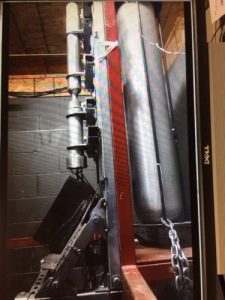
The senior’s “junior teststand” nick named “Baby Bird” is almost complete. They hope to conduct their first ever test on this new teststand possibly late this week. This teststand was created by the seniors starting last year during junior studies to test a fuel grain system designed and developed by them to interface with the hyportek injector and tank. They hope to have 3 successful tests on this teststand. If they achieve this, then they get to fly this new system at Willow City in last year’s rocket.  At this point,  they are getting fuel grains prepped.  Pictured below, are nozzles created for Baby Bird.

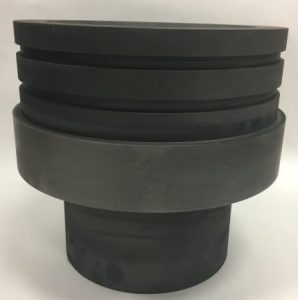
Redbird 18 still currently does not resemble a rocket, but they are making steady progress. The nozzle has been manufactured, seen here 

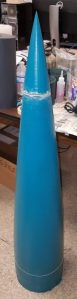
and  the nose cone mold is also back, seen here. 

Machining could only be created to within 8 inches of the tip, therefore they created the tip with 3D printing and epoxied it to the nose cone and are preparing it for fiberglass.

Other needed materials are in and have been sent out to Heartland Enterprises for machining.  Currently, Mr. Matthes says that the biggest test coming up will be next week when they pressure test the oxidizer tank.

Juniors are under pressure as the deadline for 100% completion of their rocket is May 11. Meeting this deadline will allow them time to complete their Flight Readiness Reviews (FRR) and be able to high light problems or errors that still exist. Components are coming in and weights on some are different than originally reflected in RockSim. Due to this they are updating their design to accommodate. Currently they are still on the wire between breaking the speed of sound and exceeding the 13,000 feet maximum allowable altitude. Breaking Mach means they also exceed altitude. Staying under 13,000 feet  means then they lose their shot at breaking Mach.

 Here Chris Calzada is working on RockSim trying to resolve the altitude velocity conundrum.
Meanwhile the Sophomores have been entrusted to work at their own pace to finish their last chapters and projects. Time remaining after completion of these is for 3D printing and modeling. Their learned skills in  isometric, creating section views, details and working drawing sets would now allow them to communicate effectively to a machine shop without the need for clarification.

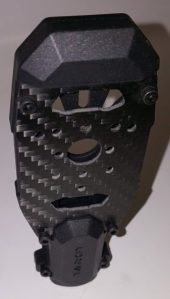
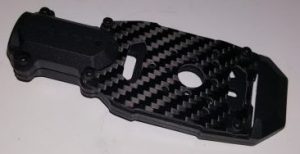
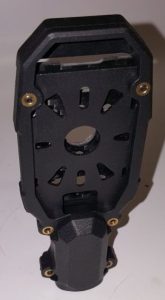
Paul Kucherka, a FISD maintenance man and school function videographer developed an issue with the quadcopter that he uses to video. A few of the sophomores are going to attempt to design and develop a new wiring harness that may provide the solution to Paul’s needs, hopefully by the end of the school year,  this would allow him to continue using this equipment for video. In order to do this, a few other sophomores have been creating the multiview of one of the quadcopter’s parts on the 3D printer. Pictured below is the original part they are attempting to recreate.

This article is the seventh in a series, new for this school year ’16/’17 of monthly updates that will follow the Fredericksburg STEM Academy/Rocket program. This school is a participant of the SystemsGo STEM program. This series of articles is intended to support, encourage, and challenge students in the program as they share their working status and accomplishments throughout the year in the program. These publications will be available for tags and re-posting.

www.systemsgo.org as always is the place for more information on this program. You may also email them at info@systemsgo.org . Take the time to get your school involved, the future of your students will be greatly benefited.

First Term Wrap Up (Nov. 18-Dec. 21)- Fredericksburg’s STEM/Rocket Program

December is nearly over and Winter break starts today, but before we send the Fredericksburg High School STEM Academy home for Christmas,  we need to review what they have been working on these last four weeks, and try to wrap up the fall program.  January starts the spring program loaded with really big goals and events that this past fall has been building toward.  Each group’s learning will be evident in the success of this coming semester’s projects.

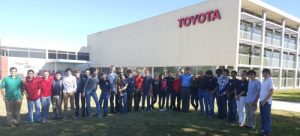
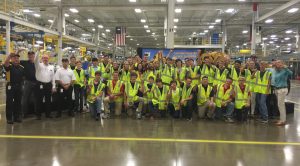
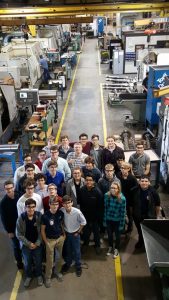
During the month of November the Freshman visited Toyota Manufacturing and Southwest Research Institute (SwRi).

20161121_140216The students were impressed with Toyota and how huge the plant itself is, as well as the difference in the type of automation used as compared to last month’s visit to Caterpillar. Toyota’s assembly line resemble Ford assembly lines. The components actually moved along on a line and each team had an assigned task as it moved by them. Caterpillar operated in stages where one team did several components before it moved to the next staging area.
Mr. Matthes remarked that ” The delivery logistics of parts to the assembly line was phenomenal!”

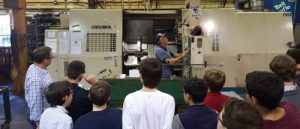
On December 13, the Freshman group visited Fischer and Wieser, Heartland Enterprises, and UT Aeromechanical Lab.

Fischer and Wieser and Heartland are Fredericksburg companies. They both demonstrated automation on a small-scale as compared to companies like Toyota and Caterpillar. Fischer and Wieser explained the importance of loyal employees and a family like environment.

Heartland is similar in framework and belief on how they treat their employees. Where as many companies prefer to hire very experienced candidates from other companies, Heartland prefers to hire inexperienced people and train them in their ways of operation. They find that by doing this they keep a certain working quality and alleviate the bad habits that experience can sometimes bring with it which can be adverse to the companies current operating practices and quality control initiatives.

Below are pictures from Heartland Enterprises:

20161213_0959350 20161213_095101 Here, Alvin Culak, shows machine operations to students.
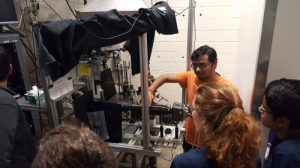
Students at UT Aeromechanical Lab and Flow Field Imaging Lab in Austin, were working on ablative testing for high velocity projectiles or vehicles,  and a research lab studying  hydrogen combustion and anomalies that may exist with it. These anomalies must be understood before hydrogen combustion can be considered for fuel. They are also studying wind tunnel testing designed to help discern the tendencies of shock  for use in ramjet and hyper velocity propulsion systems.

Below, candidates took time with the students to explain and exhibit their work.

20161213_125959 UT graduate student, Rakesh Ranjan, operates a swirl combustor at atmospheric pressure. For more information on this: http://research.ae.utexas.edu/FloImLab/highpressureflashback.php
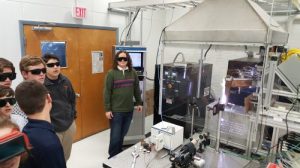
20161213_125140  UT graduate student, Benton Greene, demonstrated the Inductively Coupled Plasma torch. For more information on this: http://research.ae.utexas.edu/FloImLab/ControlofShockBoundaryLayerInteractionDistortionusingPulsedPlasmaJets.php
Another UT post-doctoral student, Leon Vanstone, not pictured, explained the experimental investigation of 3D shock wave/boundary interaction unsteadiness at the University of Texas at Austin High Speed Wind Tunnel Lab . For more information on this: https://utexas.box.com/s/n1kk9ozocyp8ozloo9dm9ujx23q6vuwj
Dr. Noel Clemens is the Principle Investigator for all experiments in the lab, and the primary decision maker. Jeremy Jagodzinski is the lab facilitator. He helps to support the research in the lab and also set up the visit for the students. Phillip Varghese oversees the Center for Aeromechanics Research which often collaberates with this lab.  Thank you to all of them for facilitating the tour.

Mr. Matthes stated that, “the students really loved the research facility.”

Aside from field trips to see first hand about automation and manufacturing, the freshman have been learning  about production/automation engineering. They are currently in the process of designing an orange juice production plant. Their product goal for the plant is to take raw material and produce packaged juice in palletized product bundles ready for sale. Jenny Weiser will be coming in January to see their presentations and evaluate and provide constructive criticism.

Sophomores will be entering the program for the second term, starting Jan. 23. ACC’s Auto CAD course will be their main focus learning to utilized specific skills and design elements.

The juniors flew their Generation 3 rockets recently. This provided several learning points that will be useful on their projects next semester. Students realized that even cutting edge design doesn’t always transfer well into the manufacturing ability of the vehicle. Failures in these construction and design frailties, resulted in irregular flight patterns. These mishaps translated into two days of Post Mission Analysis insuring that lessons from this would not carry over to next semester’s larger rocket project.

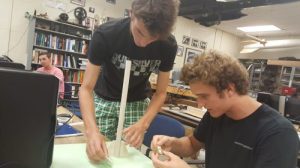
Here the juniors are building their G3 rockets.

20160921_1247120 20160921_124721 20160921_124732

In January, the juniors will begin work on their one pound/one mile vehicles to be tested out at Willow City in May. This is considered a sounding rocket designed to break the speed of sound without breaking a ceiling of 13,000 feet while carrying a one pound payload.

Seniors have been very busy, and experienced both successes and set backs on their projects recently.  Testing on fuels is expected to begin in January as they are nearly complete with updates on test stand.

After manufacturing pieces for their small motor test stand out of 2024 aluminum, they discovered that this metal type cannot be welded. This resulted in having to procure another high strength aerospace aluminum which is conducive to welding. Once they find this they will have to begin again the manufacturing of the fuel grain containment system.

“These were very important lessons learned for all, them and me,” stated Mr. Matthes.

Preliminary Design Reviews were conducted on their Goddard level rocket, last week. Due to the set backs on test stand, previously  discussed, the group lost time they should have had to work on their rocket design and therefore have a bit of ground to make up there in order to have those completed by January’s end.

This article is the fourth in a new series for this school year ’16/’17 of monthly updates that will follow the Fredericksburg STEM Academy/Rocket program. This school is a participant of the SystemsGo STEM program. This series of articles is intended to support, encourage, and challenge students in the program as they share their working status and accomplishments throughout the year in the program. These publications will be available for tags and re-posting.

www.systemsgo.org as always is the place for more information on this program. You may also email them at info@systemsgo.org . Take the time to get your school involved, the future of your students will be greatly benefited.

Fall Highlights (Oct. 1-Nov. 18)- Fredericksburg’s STEM/Rocket Program

It is mid November and time to  review once more all that the Fredericksburg High School STEM Academy has been working on throughout the past seven weeks.  Each group has new skills they are learning, goals they are working to achieve and events they are working towards.

During the month of October the Freshman visited Caterpillar Manufacturing,  where  Warren Houston, Caterpillar plant manager, acted as the groups’ host during their tour.  They also toured Aqua Power Cutting, where owner BJ Millard showed them around and gave demonstrations.  Mr. Millard’s two sons have both participated in the STEM Academy.

The following photo is from their visit to Caterpillar Manufacturing.

caterpillar-tour

On Monday November 21, they will visit  Toyota, Center for the Intrepid, and Southwest Research Institute (SwRi).

They have also been learning about Electrical Engineering. Keith Kunz a representative of Teledyne, formerly Real Time Systems, was on site Thursday, November 10 for subject presentations.

The juniors have been studying aerodynamic drag, resistance, and impulse momentum theory.  They are completing work on the test stand burn models and the associated fuel grain burn simulations. After this they will be moving on to new heights, attempting to reach 1900 feet on  C6-Estes motors in Generation 3 rockets.  These rockets are designed using the same RockSim software used to design rockets they will launch at Willow City next year. This is a lesson in design and construction and each must match identically their design.

The  whole senior group made a trip to  NASA Johnson Space Center on Monday and Tuesday, November 7 and 8. Only two were unable to attend, one due to family complications and the other was attending State Marching Contest on Monday with the FHS Band but joined the group later.

20161107_130320

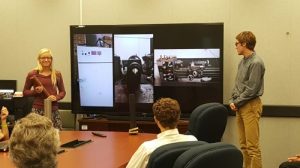
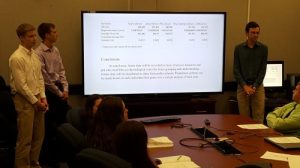
On Monday they collectively made a Grant Presentation to NASA. Mr. Matthes reports that, “they did wonderfully.”

20161107_144521  20161107_133653

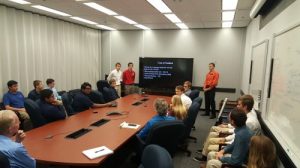
On Tuesday,  Ian  Kendrick,  Sterling Weaterford,  Nathan Bain and David Becker presented a flight readiness profile. “NASA was impressed with test-stand updates and the focus on analysis and improved data acquisition,” according to Mr. Matthes.

20161108_095221

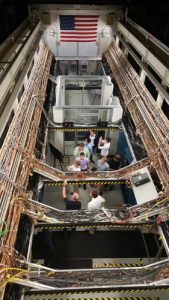
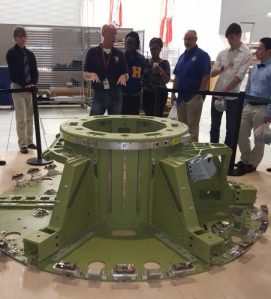
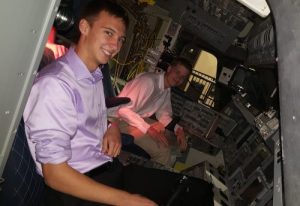
They also toured Johnson Space Center.

20161108_151017  20161108_123300

20161108_152416

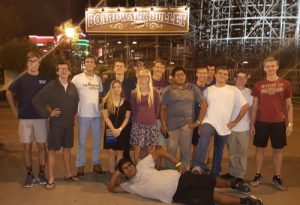
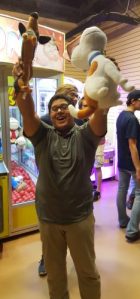
Students had time for fun while in Houston as well.  On Monday,  after dinner, students spent time at Kemah Boardwalk. Interestingly the “Crane Game” was the entertainment of the evening, pitting them against each other to see who could pluck the most stuffed animals.  Reportedly, Ricky Robles was the winner.

20161107_203459  20161107_205034  20161107_210602

Those not involved in Tuesday’s presentation went to Space Center Houston where a good time was had by all.

image2   image1

The STEM Academy would like to extend many thanks to Mr. Logan Minshew, FHS Counselor and CTE coordinator. He took the time to attend this field trip and drive the group.

In other senior news, even though there is still quite a bit more to be done on test-stand, they have made good strides and are progressing forward diligently. They are back at work with rocket design as well.

In a related note, Mr. Matthes reports that they held their first Engineering Advisory Committee meeting on Friday, November 11. Members present were Brian Evans (Space Propulsion Group), Jay Mallinckrodt (Heartland Enterprises), and Scott Netherland (SystemsGo). Mark Cornett, Allen Nance (Teledyne), Luke Morin (SRM Manufacturing), and Logan Minshew (FHS Career and Technology Coordinator) were unable to attend.

This article is the third in a new series of monthly updates that will follow the Fredericksburg STEM Academy/Rocket program. This school is a participant of the SystemsGo STEM program. This series of articles is intended to support, encourage, and challenge students in the program as they share their working status and accomplishments throughout the year in the program. These publications will be available for tags and re-posting.

www.systemsgo.org as always is the place for more information on this program. You may also email them at info@systemsgo.org . Take the time to get your school involved, the future of your students will be greatly benefited.