Fredericksburg STEM Academy/Rocket Program-Launch Report from Rockets 2017 Willow City Launch Week and Red Bird #18 Update

The Fredericksburg STEM Academy junior class rocket completed a successful launch at Fredericksburg Rockets 2017 on Thursday. They were able to recover their vehicle intact and analyze data.

Unfortunately they did not achieve the speed of sound as hoped. Instead it reached 9300′ traveling 994′ per second, or 678  mph, which is 89% of Mach at  743 mph.

Here is the Fredericksburg STEM Academy team going over checks in Stage 3 before launch. 


Rocket #52 as tagged by SystemsGo is seen here headed to the pad.
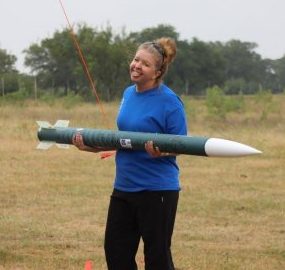
Here  it is vertical on Pad A going through final preparations for launch. 

And finally sailing skyward. 
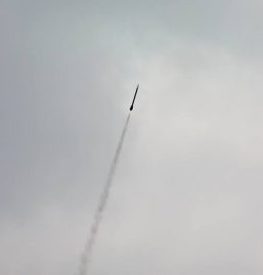
The payload of slime mold did show differences in growth.  The sample on board the vehicle grew less than its sister culture contained in a similar environment at the launch.  Students noted that the payload sample experienced some shock upon landing based on the its displacement.  The vehicle fared quite well.  The drogue deployed but the main parachute did not deploy. This was caused by the shear pins not giving way.  This function could have been tested prior to flight if they had finished their vehicle earlier leaving time to conduct additional testing.  Upon landing one fin chipped and another fin was dislodged from the vehicle but all were recovered.

Juniors present their Post Mission Analysis tomorrow, Thursday, June 1 at FISD’s Central Office board room beginning at 9:00.

This will conclude this year’s reports on the juniors. We will pick up with them next year as seniors when they begin their Goddard level project and attempt to launch at White Sands Missile Range.

Seniors are in decent shape on Red Bird #18.  The vehicle is undergoing final welding at SRM Manufacturing.  Nosecone is wrapping up well.  The current set back is the fuel grain.  After conducting extensive testing to get the correct percentage of the two constituents and creating multiple samples at those percentages, when the students mixed their full volume of HTPB (rubber) fuel, it set too quickly and they were unable to pour it.  Students created more samples yesterday of the same percentages but at different temperatures trying manipulate the cure time.  They are receiving a borrowed supply of one chemical from Alamo Heights High School to complete the fuel grain on a second attempt.

The seniors will also be presenting tomorrow, Thursday, June 1 at FISD’s Central Office board room beginning at 12:15.  They will giving a status update on the development of the Red Bird #18 rocket that is scheduled to launch at White Sands Missile Range in late June, as well as covering the progress and testing on the hybrid rocket motor test stand.

All are welcome to observe both presentations.

This article is the tenth in a series, new for this school year ’16/’17 of updates that have followed the Fredericksburg STEM Academy/Rocket program. This school is a participant of the SystemsGo STEM program. This series of articles is intended to support, encourage, and challenge students in the program as they share their working status and accomplishments throughout the year in the program. These publications will be available for tags and re-posting.

Subsequent updates will continue to follow the Senior/Graduates and the progress of the Red Bird #18 rocket through June and until after launch at WSMR in late June.

www.systemsgo.org as always is the place for more information on this program. You may also email them at info@systemsgo.org . Take the time to get your school involved, the future of your students will be greatly benefited.

#Rockets2017 #SystemsGo #FredricksburgSTEMAcademy #Launcher01

Fredericksburg’s STEM Academy/Rocket Program-Spring Term Update #3 (April 1-April 30)

May is here and time is running out for the Fredericksburg STEM Academy as launch dates approach for the junior and senior groups. Juniors have a  May 18th test date at Rockets 2017 in Willow City. While the seniors are down to less than 3 weeks as Redbird 18 is scheduled for completion two weeks before school ends to allow for preliminary systems tests.Due to delays in manufacturing, testing will have to occur in the process of construction as components come in. Final testing will be the week of June 19th prior to their test at WSMR the following week. It is slated to launch at White Sands Missile Range on June 27th.

During April the seniors tested Low Density polyethylene (LDPE) three times on teststand. Data on all tests was consistent and exemplary. Currently the injector plate is being drilled again to increase the oxidizer flow rate to the correct  value to provide for complete combustion.  Due to this testing is on hold. Lately they have been experimenting with different ablative arrangements. The ablative has  burned through slightly but not enough to damage the test cell.

Below is an actual video of an engine burn test.  This one of the first video’s with HD video quality and audio.  The regularly captured video does not have audio embedded.  This is good for them too as they do these tests for NASA and this gives them something  more to show of their work.

https://goo.gl/photos/78HwtXxx8rytjxSV7

Mr. Matthes had this to say about this particular burn,  “It looks pretty good but we’re only getting about 1/3 of the oxidizer we should be getting so it is fuel rich.  It will not be as orange when we get the oxidizer flow rate correct.  The hope is that it is a really clean plume with mach diamonds in the plume.”

The senior’s “junior teststand” nick named “Baby Bird” is almost complete. They hope to conduct their first ever test on this new teststand possibly late this week. This teststand was created by the seniors starting last year during junior studies to test a fuel grain system designed and developed by them to interface with the hyportek injector and tank. They hope to have 3 successful tests on this teststand. If they achieve this, then they get to fly this new system at Willow City in last year’s rocket.  At this point,  they are getting fuel grains prepped.  Pictured below, are nozzles created for Baby Bird.

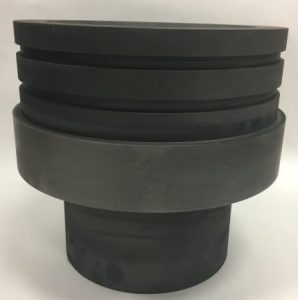
Redbird 18 still currently does not resemble a rocket, but they are making steady progress. The nozzle has been manufactured, seen here 

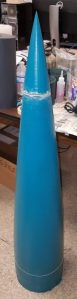
and  the nose cone mold is also back, seen here. 

Machining could only be created to within 8 inches of the tip, therefore they created the tip with 3D printing and epoxied it to the nose cone and are preparing it for fiberglass.

Other needed materials are in and have been sent out to Heartland Enterprises for machining.  Currently, Mr. Matthes says that the biggest test coming up will be next week when they pressure test the oxidizer tank.

Juniors are under pressure as the deadline for 100% completion of their rocket is May 11. Meeting this deadline will allow them time to complete their Flight Readiness Reviews (FRR) and be able to high light problems or errors that still exist. Components are coming in and weights on some are different than originally reflected in RockSim. Due to this they are updating their design to accommodate. Currently they are still on the wire between breaking the speed of sound and exceeding the 13,000 feet maximum allowable altitude. Breaking Mach means they also exceed altitude. Staying under 13,000 feet  means then they lose their shot at breaking Mach.

 Here Chris Calzada is working on RockSim trying to resolve the altitude velocity conundrum.
Meanwhile the Sophomores have been entrusted to work at their own pace to finish their last chapters and projects. Time remaining after completion of these is for 3D printing and modeling. Their learned skills in  isometric, creating section views, details and working drawing sets would now allow them to communicate effectively to a machine shop without the need for clarification.

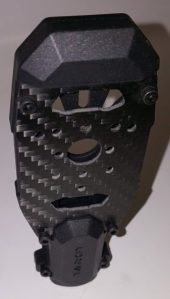
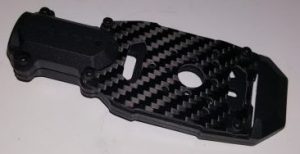
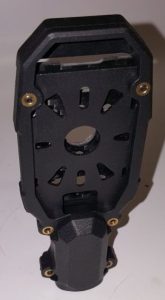
Paul Kucherka, a FISD maintenance man and school function videographer developed an issue with the quadcopter that he uses to video. A few of the sophomores are going to attempt to design and develop a new wiring harness that may provide the solution to Paul’s needs, hopefully by the end of the school year,  this would allow him to continue using this equipment for video. In order to do this, a few other sophomores have been creating the multiview of one of the quadcopter’s parts on the 3D printer. Pictured below is the original part they are attempting to recreate.

This article is the seventh in a series, new for this school year ’16/’17 of monthly updates that will follow the Fredericksburg STEM Academy/Rocket program. This school is a participant of the SystemsGo STEM program. This series of articles is intended to support, encourage, and challenge students in the program as they share their working status and accomplishments throughout the year in the program. These publications will be available for tags and re-posting.

www.systemsgo.org as always is the place for more information on this program. You may also email them at info@systemsgo.org . Take the time to get your school involved, the future of your students will be greatly benefited.

September Highlights- Fredericksburg’s STEM/Rocket Program

The school year is now into it’s seventh week. September has come and gone and the Fredericksburg High School STEM Academy has been working steady at all levels. Each group has new skills they are learning, goals they are working to achieve and events they are working towards.

Mr. Matthes says that, ” The Freshman are great! Already I have seen an improvement in their presentation skills. They have also been successful in finishing the structural engineering fix for the SystemsGo launch tower, and have followed up with a PMA (post mission analysis) and current event report.”

2nd-period-freshman-w-structures

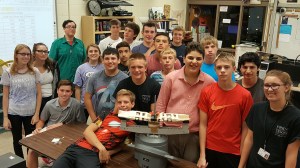
This is the second period Freshman class with their structures. Students including in the picture, in no alphabetical order are as follows: Jowad Aysheh, Gloria Burns, Luke Duderstadt, Manuel Enciso, Jack Fox, Jack Gallagher, Jacob Hinterlach, Thomas Johnson, Troy Kneese, Aquilino Perez, Zoe Rivera, Darien Robles, Jessen Stableford, Noah Stotz, Deja Turkett, Alek Vasquez, Calissa Vollmar, Dalton Waters, Joshua Wienecke,  and Zachary Willis.

3rd-period-freshman-w-structures

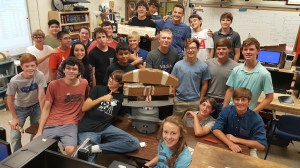
This is the third period Freshman class with  their structures. Students including in the picture, in alphabetical order are as follows: Dylan Ahrens, Jarrett Beard, Jorge Giral, Blake Boubel, Chad Braden, Jacob Brown, Esten Cooke, Samuel Cowsar, Ryan Davis, Gavin Eckert, Tucker Elliot, Frank Fackovec, Cathryn Huff, Brendon Huynh, Abel Jaimes, Ryan Majors, Antonio Martinez, Tristan McDonald, Gabriela Moreno, Robert Sanchez, Landon Sparrow, Carl Wilger, Lane Wallendorf, and Landon West.

The freshman will be traveling to several companies to investigate how engineering plays a part in their industries. This will take place over the next three months in three separate trips. Included in these trips are: Caterpillar Manufacturing, Aqua Power Cutting, Soutwest Research Institute (SwRI), Toyota Manufacturing, and Center for the Intrepid, all out-of-town trips, and Fischer and Wieser, Heartland Enterprises, Ltd. , Swissomation, Kager Industries, and Rode’s Iron and Pipe locally.  During the month of October they will visit Caterpillar Manufacturing and Aqua Power Cutting.

The Juniors are currently working in the R&D (Research and Development) element of the curriculum after having completed building and launching their Generation 1 model rockets. During this phase they are working on modeling the motor burn.

gen-1-rockets

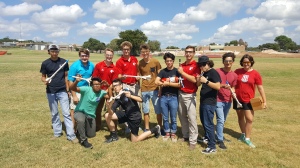
Junior class with the Generation 1 rockets.

Seniors are alternating between rocket history and  work on the test stand and testbed. They are currently in a break from the history but will rejoin it in a couple of weeks. Mean while they have  conducted successful CDR’s (critical design review) for test stand that generated positive and developmental feedback.  They have also had success updating the testbed. Wiring and programming issues have been corrected,  they were able to create a new tank system which will increase safety in the fill and weigh of nitrous operating systems, as well as succeeding in making the testbed more frictionless.  Their senior rocket is still in the works as they continue in the design  development of the vehicle.

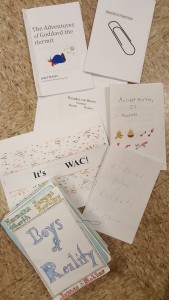
New this year, the seniors created rocket history children’s books.  Students will be doing recordings of themselves reading the books, and both the books and the audios will be sent to the Fredericksburg Elementary School where students there will be able to read the books and hear the high school authors read the books to them.

20161011_074947

According to Mr. Matthes, “Their rocket history children’s books were awesome!”

On November 7 & 8, the senior group has a chance to go to the NASA Johnson Space Center,  for flight profile reviews, grant updates, and a possible preliminary design review. Three students will go for sure, and those will be named at a later date.

Seniors, here is your challenge for the month, according to Mr Matthes, “If you complete the analysis of historic test data from the teststand then you will all be eligible to attend this trip. He would like to see that happen and take you all. Can you meet the challenge? Next month’s edition of this article series will publish the answer to this challenge. Now is your chance to show my readers and Mr. Matthes that you can meet the challenge.

This article is the second in a new series of monthly updates that will follow the Fredericksburg STEM Academy/Rocket program. This school is a participant of the SystemsGo STEM program. This series of articles is intended to support, encourage, and challenge students in the program as they share their working status and accomplishments throughout the year in the program. These publications will be available for tags and re-posting.

www.systemsgo.org as always is the place for more information on this program. You may also email them at info@systemsgo.org . Take the time to get your school involved, the future of your students will be greatly benefited.