
It is April and we have some catching up to do on the FHS Engineering program. It has been two months since our last update and quite a bit has been happening on all levels. Along with class work, launches start this month in Jal, New Mexico on April 21 and Fredericksburg (Willow City) April 26-28 so time is becoming a factor for the Junior and senior groups. Each group is working hard to meet their timelines. Rockets 2018 is the pinnacle event for the upper level groups, as their rocket projects are basically the final grade for the year.
The seniors have approximately 73 days until Redbird 19 is TENTATIVELY scheduled for testing at White Sands Missile Range, which is usually in the last week of June. This date is still not a permanent date until the Army finalizes, closer to that time. Mr. Matthes will announce that date when it becomes readily available. Their completion date for preliminary systems tests is usually two weeks before school ends. This would be May 18 which cuts them down to 59 days.
More on these groups and their current status reports will be later in the article.
Freshman participated in a field trip on March 1st, in which they visited Southwest Research Institute(SwRI), the Center for the Intrepid, and the UTSA VIZlab. At the Center for the Intrepid, the students were able to see biomedical equipment at work helping wounded Veterans in their recovery. Along with the engineering aspect of this, Mr. Matthes hoped that they took away a new respect for our military servicemen and women and the full extent of the sacrifices they make each day for our country’s safety.
Former FHS Engineering Alumni, Drake Horstman, was the students’ guide when they visited the UTSA VIZlab, toured the campus, engineering lab and community areas. During the visit, Drake, provided entertainment and wisdom coupled with numerous stories about his experiences in the FHS Engineering Program. Inside the lab, the students were able to see several visual interaction devices.
At Southwest Research Institute, students learned technical information about engines, modifications and fuel efficiency. The content here was a little over their knowledge base, and may have overwhelmed the students a little, according to Mr. Matthes. In spite of that, it was still a good visit for the students, and the coordinator at SwRI commented about their behavior stating, “they are better than a lot of the college students who come through.”
These visits are designed to expose the students to different aspects in the engineering fields. The impressions they take from here will help them make decisions down the road on whether engineering is for them, and if so, help them determine a particular area of interest.
The Freshmen also participated in their first Critical Design Review (CDR). They were tasked with presenting solutions to fix the damaged launch tower for the Red Bird rockets. This gives them practice on presentation skills and feedback on designs for their project.
Mr. Matthes stated that, “the students may have felt “roasted” with constructive criticism and feedback. But, that they should know, that it is part of improvement and growth of design and not personal.” He mentioned that this was also discussed briefly at the end of the trip to SwRI, by the hosting engineer.
The sophomores have advanced well in the curriculum and are presently several weeks ahead of their current deadlines. Their current focus is on dimensioning objects, denoting measurements and creating fabrication notes. Due to this, their proficiency has advanced well.
Mr. Matthes is quite impressed with the Juniors selection of a class name. Here is how he describes it,”The juniors named their class “Conatus” which translates from Latin, to impulse and means striving. From a historical philosophy origin it relates to the nature of something to continue its existence.”
The pressure is on with an April 19th rocket completion date looming ever closer. The rocket must be completed one week prior to their April 26th launch, because after it is completed they must also complete a Flight Readiness Review which often uncovers errors and problems that must be resolved. This week provides adequate time for those things to happen.
According to Mr. Matthes neither team has anything that quite resembles a rocket as of yet, but each is working through a pile of parts that arrived. Most were not ordered until the end of March which was quite late, but each group began working with tangible parts the end of last week.
Team #2 decided to make use of Monday’s teacher in-service day, by putting in about four hours of work. Shown below from team #2 are clockwise starting from the bottom, Cooper McDonald, Gloria Burns, Ethan Scott, and Dawson Harkins as they take measurements off the back-end of the rocket and motor system.

Both teams do have a work in progress at this point. According to Mr. Matthes, “Pressure makes diamonds and rockets.”
Incidentally, another incentive for each comes from SystemsGo. A flawless flight and perfect recovery may afford that team the chance to re-fly their vehicle with a different fuel grain in order to collect data for SystemsGo.
The miniature Teststand is an ongoing project for the juniors as well. They are using LabVIEW programming as a means to start ignition and measure thrust, as well as using 3D modeling in order to develop a unique physical Teststand model. The class is split into working groups of 3. According to Mr. Matthes, “They are on track to have this done by the end of school and I am excited to see what they come up with.”
Seniors are progressing well with Redbird 19, wind tunnel and the large Teststand development.
Construction is beginning on Redbird 19 now that parts are returning from Heartland Enterprises. According to Mr. Matthes the parts, “look beautiful, and most parts are in.” Now that parts are available there is a bullet list of accomplishments to be achieved including, overlaying the nose cone in fiberglass, creating a mold and then pouring the fuel grain, making a custom hose for the injection valve, testing recovery chute deployment, integrating avionics into the vehicle, and Mr. Jenkins is in the process of manufacturing the payload.
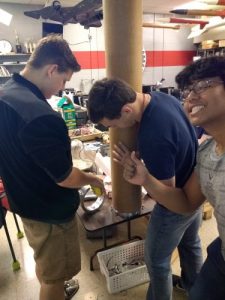
Here Harrison Spisak, Bryce Erwin, and Sergio Walle are checking the fit of the injector, nozzle and retaining ring in their fuel grain liner.
Currently wind tunnel is well underway, as students are receiving and ordering parts. The program is nearing completion and the electronics used for the drag testing measurement has arrived. Hunter Smith, a SpaceX programmer at the McGregor facility has been assisting Rebecca Sechrist through a Skype session. He has been providing analysis and comprehension in areas he has already assisted, as well as a starting point from which to move ahead. According to Mr. Matthes, “The students are making headway but must begin to make a push in order to finish this outstanding design by summer.”
Deadlines are quickly evolving for Teststand, as the group’s progress here is steady but slow. They have installed a flow meter to directly measure Nitrous oxide. Load cells which measure thrust have been changed out and fuel grains have also been readied for testing.
The stand itself is nearing a test ready state. New to this year’s stand are changes in the injection system. The new system will allow more controls of the flow. A parent plate has been designed by students and fabricated by another local machine shop, Kager Industries, which will hold a smaller injection disc allowing students the ability to change out the disc which controls the rate of flow. The plate can be installed as soon as the 0.05″ holes have been drilled through. Next, the LabVIEW program will be fully tested on the stand. Afterwards, a cold flow test will be conducted in order to measure the oxidizer flow rate and determine if the size and pattern of holes in the new disc are correct. If the cold flow tests are successful, then hot fire tests can begin.
The Baby Bird Teststand is still on hold until further notice.
SystemsGo hosted a BBQ dinner event for the neighbors in Willow City. Seniors, Bryce Erwin and Sergio Walle, pictured below, spoke at the event. Their purpose was to educate attendees about the educational process of the program and how it relates to the upcoming launches, as well as to share their own experiences in the program.


Additionally, Harrison Spisak and Corbin Smajstrala spoke to the Morning Rotary last month on similar subjects.
Mr. Matthes would personally like to thank all four of these young men for committing to these events and participating in them. In both cases, participants and SystmesGo staff commended them on their exceptional performances.
www.systemsgo.org as always is the place for more information on this program. You may also email them at info@systemsgo.org . Take the time to get your school involved, the future of your students will be greatly benefited.


 On the Wings of Angels