First Term Wrap Up (Nov. 18-Dec. 21)- Fredericksburg’s STEM/Rocket Program

December is nearly over and Winter break starts today, but before we send the Fredericksburg High School STEM Academy home for Christmas,  we need to review what they have been working on these last four weeks, and try to wrap up the fall program.  January starts the spring program loaded with really big goals and events that this past fall has been building toward.  Each group’s learning will be evident in the success of this coming semester’s projects.

During the month of November the Freshman visited Toyota Manufacturing and Southwest Research Institute (SwRi).
20161121_140216The students were impressed with Toyota and how huge the plant itself is, as well as the difference in the type of automation used as compared to last month’s visit to Caterpillar. Toyota’s assembly line resemble Ford assembly lines. The components actually moved along on a line and each team had an assigned task as it moved by them. Caterpillar operated in stages where one team did several components before it moved to the next staging area.

Mr. Matthes remarked that ” The delivery logistics of parts to the assembly line was phenomenal!”

On December 13, the Freshman group visited Fischer and Wieser, Heartland Enterprises, and UT Aeromechanical Lab.

Fischer and Wieser and Heartland are Fredericksburg companies. They both demonstrated automation on a small-scale as compared to companies like Toyota and Caterpillar. Fischer and Wieser explained the importance of loyal employees and a family like environment.

Heartland is similar in framework and belief on how they treat their employees. Where as many companies prefer to hire very experienced candidates from other companies, Heartland prefers to hire inexperienced people and train them in their ways of operation. They find that by doing this they keep a certain working quality and alleviate the bad habits that experience can sometimes bring with it which can be adverse to the companies current operating practices and quality control initiatives.

Below are pictures from Heartland Enterprises:
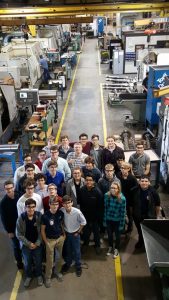
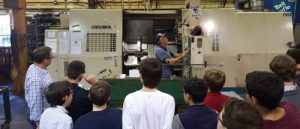
20161213_0959350 20161213_095101 Here, Alvin Culak, shows machine operations to students.

Students at UT Aeromechanical Lab and Flow Field Imaging Lab in Austin, were working on ablative testing for high velocity projectiles or vehicles,  and a research lab studying  hydrogen combustion and anomalies that may exist with it. These anomalies must be understood before hydrogen combustion can be considered for fuel. They are also studying wind tunnel testing designed to help discern the tendencies of shock  for use in ramjet and hyper velocity propulsion systems.

Below, candidates took time with the students to explain and exhibit their work.
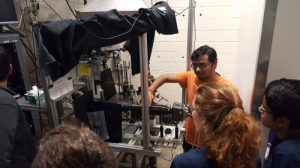
20161213_125959 UT graduate student, Rakesh Ranjan, operates a swirl combustor at atmospheric pressure. For more information on this: http://research.ae.utexas.edu/FloImLab/highpressureflashback.php
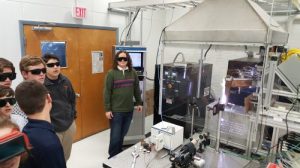
20161213_125140  UT graduate student, Benton Greene, demonstrated the Inductively Coupled Plasma torch. For more information on this: http://research.ae.utexas.edu/FloImLab/ControlofShockBoundaryLayerInteractionDistortionusingPulsedPlasmaJets.php

Another UT post-doctoral student, Leon Vanstone, not pictured, explained the experimental investigation of 3D shock wave/boundary interaction unsteadiness at the University of Texas at Austin High Speed Wind Tunnel Lab . For more information on this: https://utexas.box.com/s/n1kk9ozocyp8ozloo9dm9ujx23q6vuwj

Dr. Noel Clemens is the Principle Investigator for all experiments in the lab, and the primary decision maker. Jeremy Jagodzinski is the lab facilitator. He helps to support the research in the lab and also set up the visit for the students. Phillip Varghese oversees the Center for Aeromechanics Research which often collaberates with this lab.  Thank you to all of them for facilitating the tour.

Mr. Matthes stated that, “the students really loved the research facility.”

Aside from field trips to see first hand about automation and manufacturing, the freshman have been learning  about production/automation engineering. They are currently in the process of designing an orange juice production plant. Their product goal for the plant is to take raw material and produce packaged juice in palletized product bundles ready for sale. Jenny Weiser will be coming in January to see their presentations and evaluate and provide constructive criticism.

Sophomores will be entering the program for the second term, starting Jan. 23. ACC’s Auto CAD course will be their main focus learning to utilized specific skills and design elements.

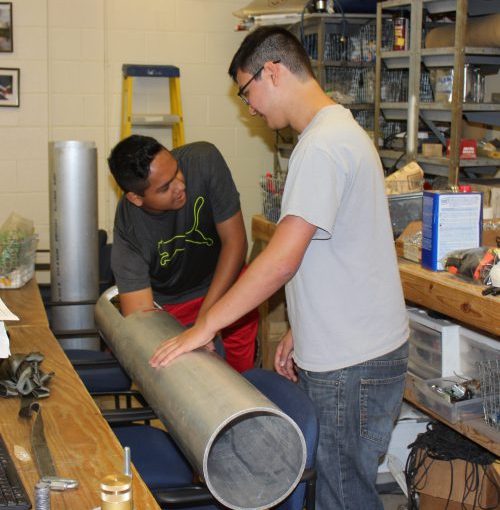
The juniors flew their Generation 3 rockets recently. This provided several learning points that will be useful on their projects next semester. Students realized that even cutting edge design doesn’t always transfer well into the manufacturing ability of the vehicle. Failures in these construction and design frailties, resulted in irregular flight patterns. These mishaps translated into two days of Post Mission Analysis insuring that lessons from this would not carry over to next semester’s larger rocket project.

Here the juniors are building their G3 rockets.
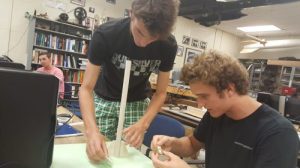
20160921_1247120 20160921_124721 20160921_124732

In January, the juniors will begin work on their one pound/one mile vehicles to be tested out at Willow City in May. This is considered a sounding rocket designed to break the speed of sound without breaking a ceiling of 13,000 feet while carrying a one pound payload.

Seniors have been very busy, and experienced both successes and set backs on their projects recently.  Testing on fuels is expected to begin in January as they are nearly complete with updates on test stand.

After manufacturing pieces for their small motor test stand out of 2024 aluminum, they discovered that this metal type cannot be welded. This resulted in having to procure another high strength aerospace aluminum which is conducive to welding. Once they find this they will have to begin again the manufacturing of the fuel grain containment system.

“These were very important lessons learned for all, them and me,” stated Mr. Matthes.

Preliminary Design Reviews were conducted on their Goddard level rocket, last week. Due to the set backs on test stand, previously  discussed, the group lost time they should have had to work on their rocket design and therefore have a bit of ground to make up there in order to have those completed by January’s end.

This article is the fourth in a new series for this school year ’16/’17 of monthly updates that will follow the Fredericksburg STEM Academy/Rocket program. This school is a participant of the SystemsGo STEM program. This series of articles is intended to support, encourage, and challenge students in the program as they share their working status and accomplishments throughout the year in the program. These publications will be available for tags and re-posting.

www.systemsgo.org as always is the place for more information on this program. You may also email them at info@systemsgo.org . Take the time to get your school involved, the future of your students will be greatly benefited.

September Highlights- Fredericksburg’s STEM/Rocket Program

The school year is now into it’s seventh week. September has come and gone and the Fredericksburg High School STEM Academy has been working steady at all levels. Each group has new skills they are learning, goals they are working to achieve and events they are working towards.

Mr. Matthes says that, ” The Freshman are great! Already I have seen an improvement in their presentation skills. They have also been successful in finishing the structural engineering fix for the SystemsGo launch tower, and have followed up with a PMA (post mission analysis) and current event report.”

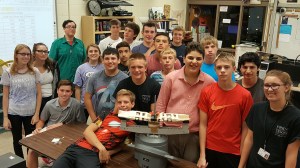
2nd-period-freshman-w-structures

This is the second period Freshman class with their structures. Students including in the picture, in no alphabetical order are as follows: Jowad Aysheh, Gloria Burns, Luke Duderstadt, Manuel Enciso, Jack Fox, Jack Gallagher, Jacob Hinterlach, Thomas Johnson, Troy Kneese, Aquilino Perez, Zoe Rivera, Darien Robles, Jessen Stableford, Noah Stotz, Deja Turkett, Alek Vasquez, Calissa Vollmar, Dalton Waters, Joshua Wienecke,  and Zachary Willis.

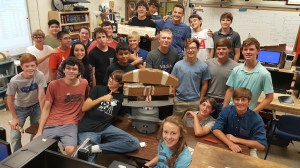
3rd-period-freshman-w-structures

This is the third period Freshman class with  their structures. Students including in the picture, in alphabetical order are as follows: Dylan Ahrens, Jarrett Beard, Jorge Giral, Blake Boubel, Chad Braden, Jacob Brown, Esten Cooke, Samuel Cowsar, Ryan Davis, Gavin Eckert, Tucker Elliot, Frank Fackovec, Cathryn Huff, Brendon Huynh, Abel Jaimes, Ryan Majors, Antonio Martinez, Tristan McDonald, Gabriela Moreno, Robert Sanchez, Landon Sparrow, Carl Wilger, Lane Wallendorf, and Landon West.

The freshman will be traveling to several companies to investigate how engineering plays a part in their industries. This will take place over the next three months in three separate trips. Included in these trips are: Caterpillar Manufacturing, Aqua Power Cutting, Soutwest Research Institute (SwRI), Toyota Manufacturing, and Center for the Intrepid, all out-of-town trips, and Fischer and Wieser, Heartland Enterprises, Ltd. , Swissomation, Kager Industries, and Rode’s Iron and Pipe locally.  During the month of October they will visit Caterpillar Manufacturing and Aqua Power Cutting.

The Juniors are currently working in the R&D (Research and Development) element of the curriculum after having completed building and launching their Generation 1 model rockets. During this phase they are working on modeling the motor burn.

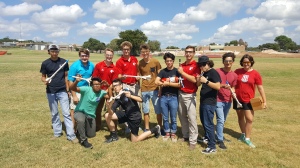
gen-1-rockets

Junior class with the Generation 1 rockets.

Seniors are alternating between rocket history and  work on the test stand and testbed. They are currently in a break from the history but will rejoin it in a couple of weeks. Mean while they have  conducted successful CDR’s (critical design review) for test stand that generated positive and developmental feedback.  They have also had success updating the testbed. Wiring and programming issues have been corrected,  they were able to create a new tank system which will increase safety in the fill and weigh of nitrous operating systems, as well as succeeding in making the testbed more frictionless.  Their senior rocket is still in the works as they continue in the design  development of the vehicle.

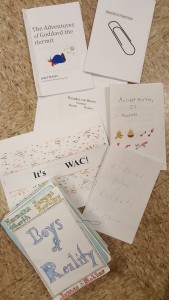
New this year, the seniors created rocket history children’s books.  Students will be doing recordings of themselves reading the books, and both the books and the audios will be sent to the Fredericksburg Elementary School where students there will be able to read the books and hear the high school authors read the books to them.

20161011_074947

According to Mr. Matthes, “Their rocket history children’s books were awesome!”

On November 7 & 8, the senior group has a chance to go to the NASA Johnson Space Center,  for flight profile reviews, grant updates, and a possible preliminary design review. Three students will go for sure, and those will be named at a later date.

Seniors, here is your challenge for the month, according to Mr Matthes, “If you complete the analysis of historic test data from the teststand then you will all be eligible to attend this trip. He would like to see that happen and take you all. Can you meet the challenge? Next month’s edition of this article series will publish the answer to this challenge. Now is your chance to show my readers and Mr. Matthes that you can meet the challenge.

This article is the second in a new series of monthly updates that will follow the Fredericksburg STEM Academy/Rocket program. This school is a participant of the SystemsGo STEM program. This series of articles is intended to support, encourage, and challenge students in the program as they share their working status and accomplishments throughout the year in the program. These publications will be available for tags and re-posting.

www.systemsgo.org as always is the place for more information on this program. You may also email them at info@systemsgo.org . Take the time to get your school involved, the future of your students will be greatly benefited.
Friday, SystemsGo’s Rockets 2016 Officially Ends as Team Travels Home and Transitions into Next Year Preps

At 7:30 a.m.  this morning, the SystemsGo team and Fredericksburg students traveled home from White Sands Missile Range, arriving safely in Fredericksburg around 5:30 p.m.

WSMR marks the end of another successful year with launches in Houston, Willow City included. The group helped test 90 Tchaikovsky and Oberth rockets and 7 Goddard level rockets for the Rockets 2016 season.

Now the volunteer staff returns to their daily lives and the SystemsGo team enjoys a much needed break before continuing with more schools, students and rockets. It won’t be long and the “launch season” will be back again with Rockets 2017. This coming season will start a little earlier with launches in April for the new New Mexico schools that will be coming online. It should prove to be an exciting year.

For now, SystemsGo transitions back to helping schools and teachers implement this STEM based program so that more students can participate in this system of learning.

That concludes Friday’s WSMR Rocket update.

www.systemsgo.org as always is the place for more information on this program. Take the time to get your school involved, the future of your students will be greatly benefited. SystemsGo is a Texas-based STEM curriculum program.
Team photo includes from left to right, (SystemsGo founder), Cade Ottmers, Brian Heffner, Josh Hampton, Chelsea Burow, Gene Garrett, Steve Burow, Randy Kuhlmann, Robert Dever, and Andrew Matthes (FHS STEM program instructor).

Thursday, Final WSMR Launch Day

Today was the final day of testing at WSMR for SystemsGo student programs. Fredericksburg was the only official launch scheduled, with two remaining test times for any retests needed. Unfortunately it was a sad day for Fredericksburg as well. Their rocket had ignition but the injector failed therefore it never left the pad.

At first they were going to allow them a second test time at 12:30 p.m. but after inspection it was determined that they did not have enough spare components to repair the vehicle and so the second test was scrubbed.

At that point the SystemsGo team, Fredericksburg students and WSMR personnel cleaned up West Center 50 and left, officially ending our White Sands Missile Range launch operations.

This evening the team gets some much-needed rest time before returning to Fredericksburg. Except for Chelsea and Steve they are returning to Lubbock this evening and then to Fredericksburg on Friday evening. The team and the Fredericksburg students spent the afternoon seeing the New Mexico Museum of Air and Space and the White Sands National Monument, where they met the challenge of climbing and sliding down the dunes.

Tomorrow is back to Texas and a long Fourth of July Holiday weekend.

There were four out of seven rockets that left the rail this year. Seven out of seven would have been even better but this is still a good end to the season. The thing to bear in mind is that with all these tests whether they leave the rail or not there is always and element of further knowledge to be obtained from what transpired with each vehicle. That deducing, understanding and learning from both what went right and what went wrong whether the vehicle launched of not, and all the education and skills each student learned to get it to this point is the true important lesson.

Thank you so much to White Sands Missile Range for all the support, man power, time, education, entertainment, information and fun you provided in order for SystemsGo and these four schools to come out and test their vehicles. Your continued support in this education of future generations is highly appreciated.

www.systemsgo.org as always is the place for more information on this program. You may also email them at info@systemsgo.org .Take the time to get your school involved, the future of your students will be greatly benefited.
The picture on this blog piece is of the Fredericksburg rocket team this morning prior to their vehicle test. It was provided by team member Zane Brown. Team members are from left to right: Katie Habecker, Link Millard, Dorian Jones, Garrett Ottmers, Nathan Weatherford, Alex Scudder, Zane Brown, and teacher, Andrew Matthes.

WSMR Rocket Launches Fast Approaching

The SystemsGo Rocket program now transitions to Goddard level rockets. These rockets and their subsequent launches at WSMR (White Sands Missile Range) are the culmination of all the skills the students have learned throughout their years in the STEM program. This is the final senior project for those schools that participate in this level of the SystemsGo program.

Launches are scheduled for June 27 through July 1. The group will travel out to WSMR on Sunday, June 26, and back home again on Saturday, July 2.

These launches have been anywhere from June to mid August in past years, with multiple rescheduling happening all the way up to time to leave because of Army necessity. Actually having a fairly concrete date this year means students have to be on their game and get their vehicles completed on a tight schedule. According to Fredericksburg’s STEM teacher, Andrew Matthes, their group has a deadline of today, Friday, June 10 to have their rocket completed and ready to travel. Other schools involved most likely have similar dead lines.

As of Wednesday, June 1, the class was reported by Mr. Matthes to be on schedule with final modifications being made in all areas, including the following:

  • The after section for the motor is at Rode’s Welding for attachment to the 10′ long Nitrous tank
  • Avionics is installing the payload in the forward skirt
  • Propulsion has had a successful pour of their HTPB fuel grain, and is now working on the fuel canister
  • Nose cone is completing the shoulder part which sticks into the airframe of the rocket
  • Fins are in the attachment stage of the aft motor section

Notice in the above list, that Rode’s Welding is mentioned. Part of the skills learned in this program is when and where to contract other professionals to finish a component. Most of the components of this vehicle are finished by the students, but when there is an area that requires a more professional skill base, the students have to know how to draw out specific design models and calculations and present them to a welder, machinist or other entity so that they are created according to the design they have drawn out for the completed vehicle.

There are 5 schools scheduled to launch 6 for sure, possibly 7 rockets. These schools include:

  • Alamo Heights (2)
  • Anahuac (1)
  • Booker T. Washington (1 for sure, possibly 2)
  • Fredericksburg (1)
  • Union Grove (1)

This year is unique in that the Army has some classified tests scheduled that involve the range (West Center 50), SystemsGo uses to launch. Therefore, instead of launching straight through and then leaving, there will be a break in the schedule on Wednesday, when the group will not be allowed access to the range. SystemsGo is looking into activities for the group to do on that open day.

When I checked in with Mr. Matthes and his class on their project status, this was the enthusiastic response they delivered.

Jacob Eckhardt, “We are cutting it close but we’re working on getting it done, full force.”

Mr. Matthes added, “with reduced workforce.”

This is a common malady of the program for the senior group. After school lets out it is  hard to keep them focused, but there is always a dedicated contingency of the team that usually stays on point and gets the vehicle completed and off to WSMR.  This is just a hazard of the launches being a summer trip after graduation. Even with this, 95% of the time, the project makes it to White Sands.

Today is 23 days out until the group leaves for WSMR. Watch this blog in upcoming weeks for more information and a launch schedule to be posted.

www.systemsgo.org as always is the place for more information on this program. You may also email them at info@systemsgo.org .Take the time to get your school involved, the future of your students will be greatly benefited.


Day 62- SystemsGo Team Ends Another Successful Year

The SystemsGo team traveled home from White Sands Missile Range in New Mexico today. They left Alamogordo around 0800 and arrived safely in Fredericksburg around 1845.

They have now completed another successful year with launches in Houston, Willow City, and WSMR. The group helped students attempt the launches of over 90 Tchaikovsky and Oberth rockets and 6 Goddard level rockets.

Now they take a short needed break before getting fired up for a new year with more schools, students and rockets. It won’t be long and the “launch season” will be back again.

SystemsGo transitions back to helping schools and teachers implement this STEM based program so that more students can participate in this system of learning.

That concludes Thursday’s WSMR Rocket update.

www.systemsgo.org as always is the place for more information on this program. Take the time to get your school involved, the future of your students will be greatly benefited. SystemsGo is a Texas-based STEM curriculum program.
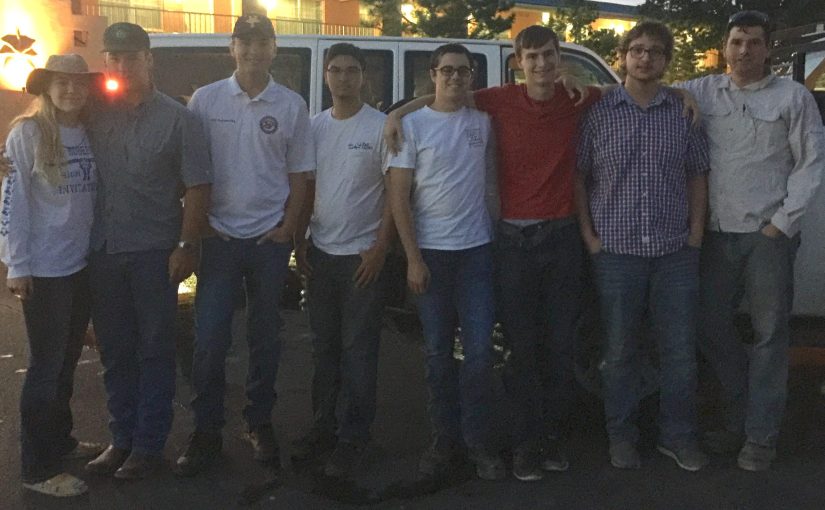
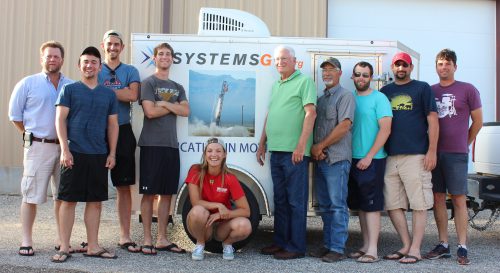
Team photo includes from left to right, Brett Williams (SystemsGo founder), Cade Ottmers, Brian Heffner, Josh Hampton, Chelsea Burow, Gene Garrett, Steve Burow, Randy Kuhlmann, Robert Dever, and Andrew Matthes (FHS STEM program instructor).