Goddard Teacher Training Day 3

Today’s lesson was concerning the Anatomy of a Rocket. Quite honestly this was not a good class to come into the middle of and expect to keep up.

The best example I can give of how this went is as follows. My family often plays a game at holidays, we call “Pass Around Pictionary.” To sum it up, each person has a piece of paper on which they draw a picture, then fold the paper to hide the picture, and then they pass it to the next person to describe the picture in words. This process continues going back and forth from picture to words each time the paper is passed, and each person can only see what the person before them drew or wrote and must describe using the opposite action.

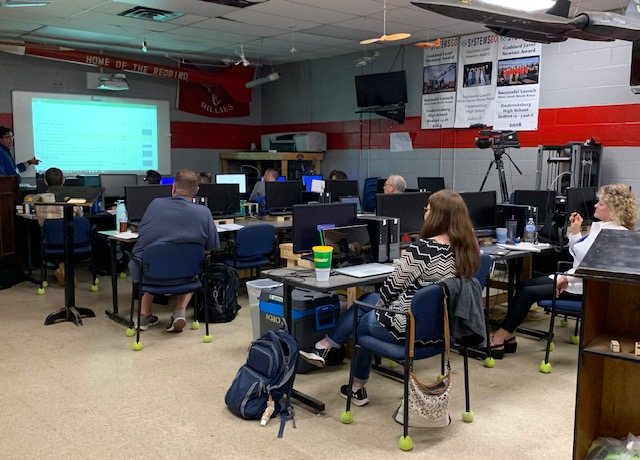
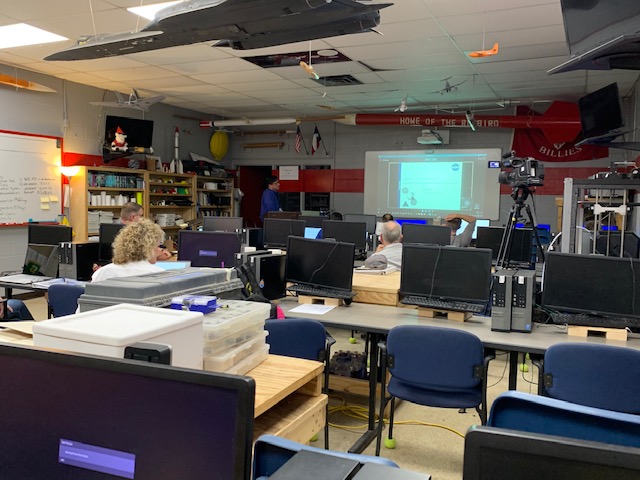
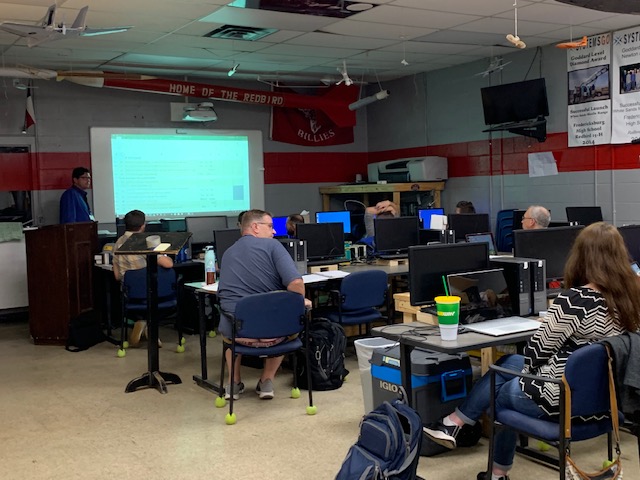
Now fast forward to today. I walk into a high level rocket training class just as the main lecture on how to design these vehicles has ended, and a student/teacher is selected to go to the board and draw/design a rocket with the help of his classmates. Not only are they drawing this vehicle as they go along, they are problem solving, designing, discussing parameters and components, and redrawing as the thought process changes and develops.

Here Conner Gorman from BCTAL steps up to the screen, at Mr. Matthes’ prodding for a volunteer, and Rhonda Baker, suggests that it is someone else’s time as she has already done board time earlier in the day.

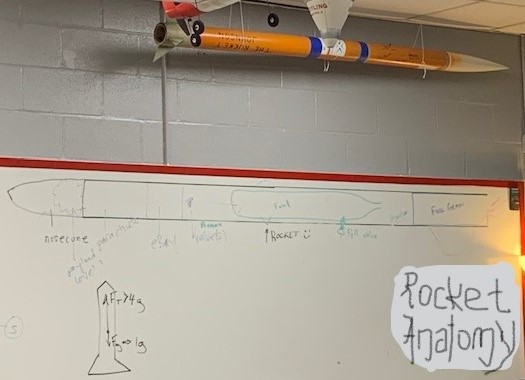
The drawing began simple enough so I tried to draw my own copy picture as they went along. Their board allowed for erasing and changing as they went along. I brought a notebook and an INK pen to class today. It worked well the last two days, but failed me miserably today. I finally gave up on trying to complete the drawing, and went to listing components that I knew were part of a rocket. Needless to say I went from drawing to writing, watching as their diagram continued to evolve.

Incidentally, here is what my drawing and notes looked like.

You engineers, teachers and people who really know all this stuff, you can stop laughing now.

This too had it’s downfalls, because even though I know a lot of the pieces that go into a rocket, it is mostly the big stuff, like nose cone, tank, fins and fuel grain, and some of the tiny things like O-rings, valves, nuts, bolts, etc.

We were now discussing all the large, small, tiny, unknown and very necessary items. Several factors that effect each of them, their sizes, configurations, placement possibilities, etc. Not to mention the abbreviations, acronyms, and formulas that were being used as descriptors. I definitely need to take this class from beginning to end!!!

Here, Mr. Gorman almost appears to look like I felt. Although for him, it was probably just a thinking process moment.

One thing is for sure, these teachers were being held to the same standard or higher that the high school students in the program are and they were having to perform, just as they will be directing their future students to do. They were designing and developing a diagram of a rocket that they could look back on later as a working example. Each one was analyzing the possibilities and determining the best, what kind, why that one, and how of it all.

They were thinking through things like injector ports, vents, nozzles, electronics bays and their placements on the vehicles and determining if the design was good. Contemplating if they might need to reach that component later and how they would?

The drawing developed, morphed, changed and was redrawn as questions were put forth and answered. It was amazing to be a part of, but nearly impossible to take notes on and keep track.

Even these pictures really do not do the material or the participation of the working minds, justice. I cannot wait to see where they are tomorrow! Here are two more that were part of their discussion. I will let you fill in the captions for these.
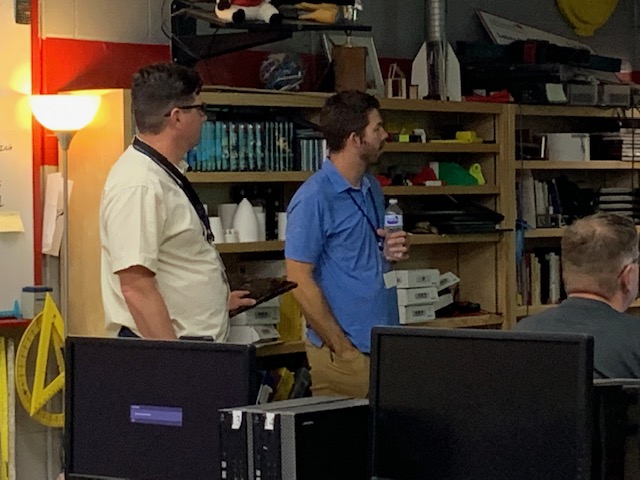
We did have a few new faces today. SystemsGo Executive Director, Scott Netherland; Board President, Doug Kimbrell; and past graduate of the program, Robert Sanchez were all in attendance. At the time that I was there, Scott and Doug were observing. Robert said he was fixing one of the school’s 3D printers so that he could use it to fix the other 3D printer.

Until tomorrow, if you are not dreaming of designing, building, launching and chasing rockets, you obviously have not hung out with this crew enough!

www.systemsgo.org as always is the place for more information on this program. You may also email them at info@systemsgo.org .Take the time to get your school involved, the future of your students will be greatly benefited.

#RideTheSky! #Rockets2022 RocketSeason!

Goddard Teacher Training Day 2

Teachers and others in the program probably already know this, but it was news to me. That was either because I have just missed it in conversation before today, or the fact just never came up. Maybe I should have known, but then I am not a teacher, just a crazy, addicted volunteer that loves and supports the program. The technical term is Rocket Junky! What didn’t I know, well the fact that they only do the Goddard level training every four years!!!!!

Doug Underwood, actually gave me that piece of information today. He is seen here with his materials laid out as the lecture resumes after their lunch break.

Not all schools participate in this level of the program. One reason is because these vehicles are expensive to build. It also requires extra travel for the students and schools, and the only window for launch is a month after the students have graduated and school has dismissed. Most schools stay at the Tsiolkovsky and Oberth levels. Therefore training every year is not always necessary or cost effective. That is my take on the why. Of course, SystemsGo may have more specific reasons for their why.

Either way, at first I was stunned and wondered, how can that be? But, knowing just what I do know, taking the things I have mentioned into account and the fact that not every school that does the Goddard program comes to WSMR to launch every year, it could be made sense of rather quickly.

Today the Goddard class was training on Propulsion. Engineering teacher, Andrew Matthes was manning the presentations, leading the discussions and taking questions again.

Here are a few things I heard in my 30 minutes in class today. Do not expect these session to be perfect and totally technically on because, I am not an engineer, though if I could go back and do this stuff I would. I am just a writer and volunteer for the program that loves to soak up all that I can like a sponge and throw it out there for the many more rocket junkies like me, including other students, teachers, rocket followers, etc. so that we may all have a piece of the action and involvement. First and foremost I love to bring more light to the program in any way I can. And have some fun with all I see, hear and learn.

That being said, here is my bit of today’s lessons. There was much discussion about the fuel grain and how it reacts with Nitrous and Oxygen. Specifically how the vapor off the surface of the fuel grain burns with the oxidizer to create combustion. Hot expanding gasses were a topic at this point, which brought forth a quote about hot gasses from the movie, October Sky!

I tried to locate the exact quote, and it did speak about the necessity of the nozzle in the design and how it directs the flow of hot gasses. Of course the comments in the movie went south after hot gasses.

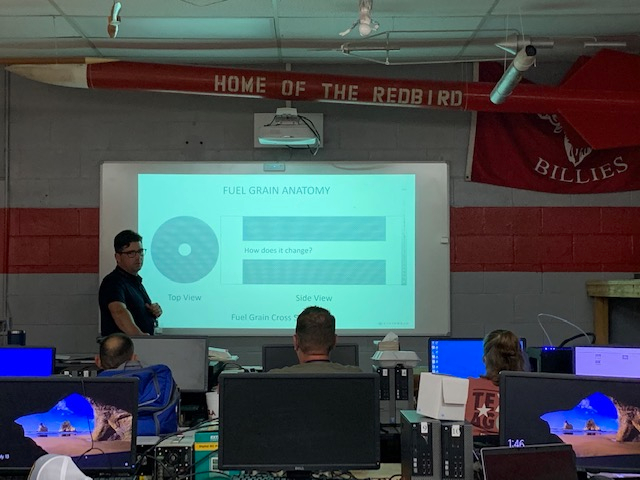
The class went on to discuss fuel grain flow designs. The first of which is pictured here:

This lead to discussions about expansion within the fuel grain, as well as pressure changes, flow rate changes and various other effects as it burns. One such example that is likely with a single port is that the port gets larger as it burns. This changes the Mass Flow Rate also causing the DOF to get larger.

Another comment mentioned was that with only one port, the expansion creates two separate sides to the fuel grain, kind of like two separate pieces of wood burning, which also changes the potential of the propulsion.

According to some in the class, “Two sticks burn better than one!” Chris McLeod, said that I definitely needed to include that comment in today’s blog, so there you have it.

The anatomy of fuel grains and what works well and does not,

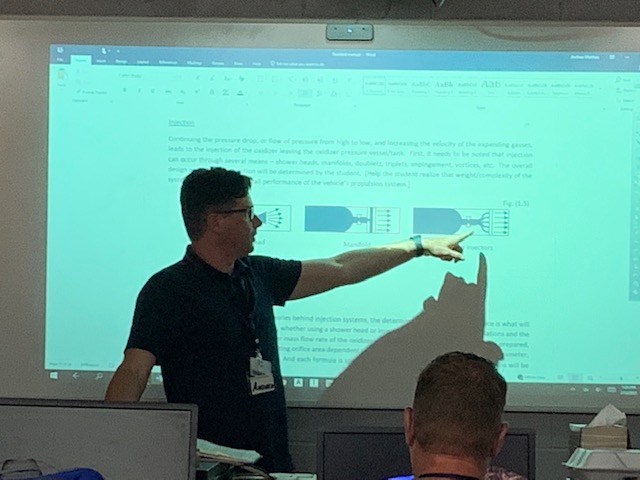
as well as nozzle designs were also touched on while I was present, as seen in the pictures shown above and below.

At the beginning of class the internet was down. Apparently it is an intermittent problem. Mr. Matthes made a call and it restored quickly. Jerry, the FISD, IT guy stopped by to check. He said the server had actual gone off momentarily. Some of you might remember him from Willow City a few years back. He brought his drones out to help aide recovery.

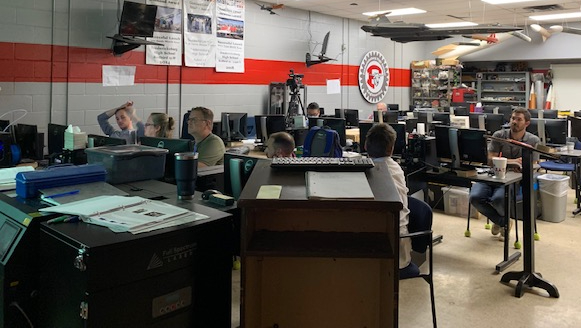
Yesterday, someone commented that they wanted to see who else was in attendance besides, Chris McLeod, so here maybe you can make out a few more people. Rhonda Baker is one you might know.

SystemsGo Program Director, Rebekah Hyatt was there when I first arrived, but left quickly to address some issues back at the office.

The same seven teachers were present for training again today. As previously noted they are from Birdville Career and Tech Center, RL Turner, Union Grove, Brazoswood, Booker T Washington, and Jal High Schools.

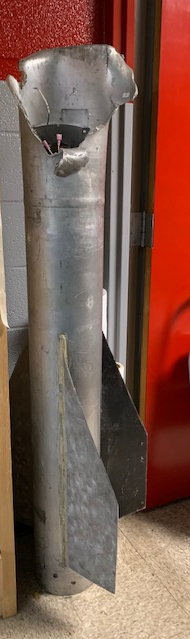
Today, most of the photos are already included, but I thought this one could be of some interest since the discussion is Goddard rockets. It is the aft end of an old Goddard vehicle. Not a clue if it belongs to a FHS Red Bird or some other school, but it is a prime example of how success often comes to you in pieces.

IMG_6753

Until tomorrow, if you are not dreaming of rockets, you obviously have not hung out with this crew enough!

www.systemsgo.org as always is the place for more information on this program. You may also email them at info@systemsgo.org .Take the time to get your school involved, the future of your students will be greatly benefited.

#RideTheSky! #Rockets2022 RocketSeason!

Goddard Teacher Training Day 1

Goddard training began today with FHS Engineer teacher, Andrew Matthes directing the class.

SystemsGo Program Director, Rebekah Hyatt, sitting in the back where she was able to add in information or examples as needed. SystemsGo Regional Director, Doug Underwood was also in attendance.

Seven teachers were present for training. Most were from schools around Texas including Birdville Career and Tech Center, RL Turner, Union Grove, Brazoswood, and Booker T Washington High Schools, and one from Jal High School in New Mexico.

I watched and listen for about 40 minutes today, during which, Chris Madsen, NASA JSC, Orion Entry GN&C Systems Manager skyped in to present The SystemsGo Goddard 6-DOF Inputs session of the training.

As I listened to discussions including center of mass, Roll, Yall and Pitch, metric and standard measurement uses, weight balance across the vehicle, just to mention a small fraction of the information being presented, I was really wishing I had brought a folder for notes and not just a camera. I definitely wish I could have stayed for the full presentation as this program and all they do, never ceases to amaze and fascinate me.

Here are a few more pics. Not too much different, but I will check in on them again tomorrow to see if there is more of interest to report.

IMG_6740 IMG_6733

www.systemsgo.org as always is the place for more information on this program. You may also email them at info@systemsgo.org .Take the time to get your school involved, the future of your students will be greatly benefited.

#RideTheSky! #Rockets2022 RocketSeason!

Rockets 2022-Begins With Teacher Training

Rockets 2021 has barely ended as the Team and students returned home from launches at White Sands Missile Range in New Mexico, on June 27th, and July already starts a new year.

Rockets 2022 begins with SystemsGo Teacher Training for the 2021/2022 school year.  22 Schools from Texas, New Mexico, and Colorado will be participating in training on all levels of the program at locations in both Texas and New Mexico.

July 12-16 kicks off these educational events at the Goddard level. FHS Program teacher, Andrew Matthes, will conduct this event in the Fredericksburg High School Engineering Department classroom.


Five teachers from Texas high schools, including Birdville Career and Tech Center, RL Turner, Union Grove, Brazoswood, and Booker T Washington High Schools, and one from Jal High School in New Mexico will attend and secure certification to teach the curriculum at their respective schools this fall. This first week of training encompasses the senior level rockets which launch at White Sands Missile Range. It is the final and highest level of the program. These vehicles are designed to reach 50,000 feet.

July 19-23, four schools will train on the Tsiolkovsky level at Artesia Administration Building in Artesia, New Mexico. Canon City High School from Colorado, and Logan, Elida, and Animas High Schools all from New Mexico will all train with Program Director, Rebekah Hyatt.  These classes are designed for Sophomore, Junior and Senior grade students whose projects are generally one pound/one mile rockets for launch at one of the spring launches.

The following weekend, July 24-25, two teachers will train on the Oberth level also at the Artesia Administration Building in Artesia, New Mexico. One is from the West Texas school of Fabens and the other from Canon City in Colorado.  Regional Coordinator, Doug Underwood, will conduct these trainings. July 31- August 1 he will be in Fredericksburg training Texas teachers on this same level.  Hollenstein, Georgetown and McGregor High Schools will be in attendance in Fredericksburg.  This level teaches students in the Junior and Senior years on the Transonic rockets, which are designed to break the speed of sound.

The next week will be back at Fredericksburg High School, where Program Director, Rebekah Hyatt continues training teachers on the Tsiolkovsky level of rockets. The Texas schools of Summer Creek, Hollenstein, Friendswood, Atascocita, Galena Park, Georgetown, and McGregor will attend this session in Fredericksburg.

The first week in August, PD Hyatt will also be conducting webinars for teachers needing the Intro to Engineering training. These teachers generally work with eighth and ninth graders just starting in the program, which teaches the Research Design and Development Loop as well as the history and basics of rocketry. These are two hour working web trainings that are scheduled as needed. Currently there is only one on Wednesday, August 4th, but a second may be added later.

Covid caused many schools and teachers to drop the program last year. Fortunately, many are returning this year and at least five new schools have been added. SystemsGo is glad to see this uptick in the program.

The more schools and teachers mean many more students involved, and with that many more potential career paths in the STEM fields.

www.systemsgo.org as always is the place for more information on this program. You may also email them at info@systemsgo.org .Take the time to get your school involved, the future of your students will be greatly benefited.

#RideTheSky! #Rockets2022 RocketSeason!

Saturday, Rockets 2021-WSMR Launch Day Report Mission Complete

Three schools tested rockets at White Sands Missile Range today. Brazoswood, Alamo Heights and Union Grove comprised that list. All three rockets left the rail. Some flights were not optimal but they were off the rail.

The big winner of the day, was first up, Brazoswood High School. They had a slow lift off but a good burn, eventually picking up speed and altitude for a beautiful flight, sailing off the rail. They flew to a considerable height and distance before landing somewhere down range. Unfortunately, WSMR, was not able to lock on radar due to technical issues and lost it before impact.  They are actively looking for it but had not located it by the time  we called mission complete for the day. 

Visual estimates by some WSMR personnel on the ground, put it over 30,000 feet. Our WSMR photographer, Mike says he thinks it is the best flight since Fredericksburg High School’s record of 36,000′. He has seen every launch the program has made over the past 22 years. Bare in mind this is only speculation at this point.

Unfortunately we will have to wait on actual information until they find the rocket. Either way it was an awesome flight! Congratulations Brazoswood and Chris McLeod, their teacher. Great first time up, as their new instructor. The opening picture for this blog today is the Brazoswood rocket at Stage 2 on Friday.

Alamo Heights was the second launch. They had problems with leaks in their Nitrous fill lines. Several attempts were made by SystemsGo personnel to correct this but it continued to fail.  One of the students from the team came in and continued work and was able to correct the issue.

At 12:31 the vehicle went for launch. It did ignite, but then barely left the rail.  It lost the nosecone right after lift off, but then laid over and flew horizontally, nose diving into the ground about  100 yards down the road from the pad where the altimeter bay housing dug into the ground. The impact sent the body tube away where it landed across the road another 30′ plus feet away.

This vehicle was the only and the easiest recovery of the day. Fortunately there was only minimal damage to the new launch rail. Alamo Heights was the first test for this new rail.

Union Grove was the third and final launch of the day. They made the call to continue launch even though SystemsGo could not confirm that the altimeter was armed and active. This meant no deployment of their recovery system. At this point this was an allowable concession in order to fly.

At 2:15 they filled and went for launch. They lifted off nicely but nosed over and continued down range flying horizontally instead of up. The rocket eventually dove into the ground quite a distance away. A chute with only the nosecone attached  was seen deploying as it hit. It tunneled across the ground for a while before it too was lost. Even though several on the ground were able to follow it to impact, WSMR has still not located and recovered it. The search will be ongoing.

Deputy Test Center Commander, Jerry Tyree, from White Sands Missile Range, visited the launch site today. He  brought family along to show them what we do here. It was a treat for SystemsGo staff, students and teachers whom he visited with at both locations.

Mission was called complete by WSMR at 5:16 p.m. today! This officially ended the Rockets 2021 season.

Thanks to White Sands Missile Range for once again allowing this program to be tested on the range. 

Tomorrow the SystemsGo team will be traveling home again. Some of the younger pad crew are staying around to see some of the sites in the area, including the White Sands Monument. 

Training for this year’s new rocket teachers in the program will take place the last three weeks in July.  

We will see you again next year for the Texas Rocket Trail 2022. In the upcoming year watch for interesting high lights from the program.

www.systemsgo.org as always is the place for more information on this program. You may also email them at info@systemsgo.org .Take the time to get your school involved, the future of your students will be greatly benefited.

#Rockets2021 #TexasRocketTrail #EyesonTheSkies

Rockets 2021, Friday, New Sites for Stage 2 and Launch site

The SystemsGo team and schools headed out at 6:30 am. Friday morning, with their first stop as Alamogordo High School. They set up under a pavilion next to the athletic department, where they completed Stage 2 checks for each rocket. This was a new experience for the group since this activity usually takes place under tents on the range. 

IMG_1712

IMG_1753

Career Technical Education Coordinator, Manny Klaasen, was there point of contact and support at the school. Ironically, she is a native Texan from the Dallas area. She moved to New Mexico 20 years ago to teach at the college on base at WSMR, and then later took a teaching job in town at AHS. AHS is a participant in the SystemsGo program, but still in the early stages, and in need of a new teacher for the program. There current one left during Covid. She is super excited to see this level of the program and host the Stage 2 event. 

IMG_1750

At 10:30 am. the set up crew headed out to ABC-1 to begin preparations for tomorrow’s launches. Only SystemsGo pad crews went at this time to set up the pad, rails, fill and fire system, and all other pertinent equipment for launches. They were met and assisted by several WSMR range personnel.

A quick correction to my previous posts is that Booker T Washington High School, actually aborted last week, so that only leaves three high schools here at WSMR. Those include, Alamo Heights, Union Grove, and Brazoswood. All three completed Stage 2 checks and loaded up to go down range by 2:15 pm. They were lead in by the rest of the SystemsGo Team from Stage 2, and met at the Tula Gate by WSMR personnel. At the site they underwent Stage 3 checks and were loaded with charges for launch. 

Brazosport and Alamo Heights were the first to complete all checks. Because of this the new launch order for Saturday is as follows:

  • Brazosport
  • Alamo Heights
  • Union Grove

The first two were loaded on the rails this evening before the group left for the day. SystemsGo now has two launch rails and both will be in operation tomorrow. A rocket was loaded onto each and then they will be tested in sequence with only time out for safety; including the return of the launch team as they will be required to evacuate during each launch; and swapping gas and electrical connections between the rails.

WSMR pushed launches to Saturday only. With only three rockets this should not be a problem. Although the Covid restrictions do pose some extra time issues.

Launches are to commence at 8:00 am. Saturday morning. All SystemsGo personnel and schools will be headed out to the range at 5:00 am.

Brazoswood High School is first to launch and Alamo Heights is next on the second rail. After both launches, WSMR personnel will attempt to locate and retrieve the rockets for the students while the third rocket is loaded onto the rail. After the third launch we will be mission complete and pack all equipment. The first two schools may leave after their rocket has been returned to them, or WSMR has determined that it cannot be returned at this time.

Realistically, this is a very tight launch sequence with little to no room for errors. As we know, errors can and do occasionally happen and can cause severe delays in the launch schedule and hinder time availability.

If we do not get all three launches done tomorrow, then they will have to abort because we no longer have Sunday time slots as allowed by WSMR.

We also had two visitors from Space Port America here today to observe so they could get a more realistic idea of what the SystemsGo program does, it’s capabilities and also it’s necessities for launches. In attendance were, Chas Miller, Space Port Engineer, and Susan Raitt, Business Development. They observed at both Stage 2 in town and ABC-1 on the range.

Andy Berger, from ESRA, Experimental Sounding Rocket Association, was also in attendance. He is from the Houston area. He helps plan and host rocket competitions designed to further promote rocketry and aerospace challenges.

The team and schools finally left the range and arrived back in Alamogordo for dinner, food shopping for tomorrow, and much needed showers and rest at around 8:00 pm.

Best of luck to all schools so that they may have a successful launches tomorrow.

Event details will continue to be available here. I will provide more information each morning as to how the schedule and other event details will progress for that day and how launches went for the schools testing that day. Pictures are not allowed on the range, but some pictures of teams getting ready to leave for the range with their vehicles might be available. If anything is available I will post it for your viewing pleasure.

www.systemsgo.org as always is the place for more information on this program. You may also email them at info@systemsgo.org. Take the time to get your school involved, the future of your students will be greatly benefited.

ROCKETS 2020 is Under Way!

SystemsGo Rockets 2020 is already in full swing. The group met, this past Friday, to line out details for the upcoming spring launches.  In attendance were SystemsGo team members, Rebekah Hyatt, Program Director; Scott Netherland, Executive Director; Gene Garrett, Board President; Doug Kimbrell, Board Vice President; Tara Kitchens, Executive Assistant;  Phil Houseal, Communications Director; with Kirk Moore, Regional Director for Southeast Texas;  and Doug Underwood, Regional Director for North Texas joining on video. Also in attendance were volunteers, George Burns, Jr., Steve Burow and Ginger Burow.

Necessities and logistics for all  Texas launch locations were discussed. Venues for lodging, and all needed equipment for each launch site were decided and individuals lined out to secure them . Travel plans were also lined out.

Dates for all events except White Sands Missile Range are as follows:

  • New Mexico (Jal) — April 21-22nd
  • North Texas (North of Mineral Well/Jack County) — April 24-25,  weather contingency day on the 26th
  • Central Texas (Stonewall) — April 30-May 1 & 2,  weather contingency day on May 3rd
  • Southeast Texas (Anahuac/Smith Point) — May 8, 9 &10,  weather contingency day May 11th

A note of importance for all schools this year is this change to launch equipment. The Closed Transonic Cage launch towers used in years past have been permanently retired. All rockets will be launched off the rail launch  towers. ALL rockets at ALL launch sites will need to be equipped with rail guides in order launch off these towers. Be sure all vehicles are properly equipped.  All schools have been notified of this change. Questions and concerns may be directed to info@systemsgo.org.

Current schedules for launches show a total of 189 vehicles expected for launch at the spring launch sites.

Excitement is building and plans are under way. Stay tuned for more updates as events get closer. More changes may be announced as plans and arrangements are completely finalized. Rockets will #RideTheSkies in about three months and this short piece is to put it back in mind so that all will be ready.

Event details will continue to be available here.

www.systemsgo.org as always is the place for more information on this program. You may also email them at info@systemsgo.org .Take the time to get your school involved; the future of your students will be greatly benefited.

Hope to see you at the launches! #RideTheSkies #texasrockettrail #Rockets2020


Sunday,Rockets 2019-Final Day at WSMR

Rockets 2019 at WSMR ended today much better than it began with two out of three rockets leaving the rail and achieving altitude. Fredericksburg High School, Anahuac High School, and Brazoswood High School all tested today. Brazoswood and Anahuac were each on their third attempt for the weekend.

Brazoswood was the top launch for the day and the final one ending the day on a high note. The 25’6″, 10″ diameter vehicle weighing in at 781 lbs fully fueled finally achieved lift off at 1:26 this afternoon after two prior unsuccessful attempts.

The rocket, named John Redden 1, after a senior member of the team that passed away of an aneurysm shortly before graduation, looked like fireworks at ignition as it blew Estes motors across the pad. Then it sailed skyward making a peak altitude of 12,859′ before nosing onto its side and sailing 5.1 miles down range to impact. The chute popped at impact.

73DA1B1A-B9A2-4DB1-A4BC-CD1B1E970E61

The first rocket to leave the rail today was “Panther 6”. Also on it’s third run for the weekend, the rocket built by Anahuac High School students, weighed in at 350 lbs, standing 23′ tall with an 8.6″ diameter. This vehicle had a “Rasberry Pi” GPS payload that a team of brothers designed and assembled. The older brother, 2018 graduate, Caleb Moore designed and 3D printed the plate to hold the payload, and the the younger, Joshua Moore, a 5th grader, assembled the GPS and did the soldering to connect it.

Panther 6 had a valve issue on the pad again today, but finally achieved lift off at 10:59 this morning. It made 1391′ traveling .3 miles down range before impact.

Both Anahuac and Brazoswood were very excited with their accomplishments. Brazoswood had hoped to break some of the standing records for height by other SystemsGo schools.  If that had happened, then student, Michael Bomar, who has a very full head of hair, and beard, had planned to allow his team mates to shave all hair from his head. Looks like he will be staying wild and woolly a while longer.

Fredericksburg’s Redbird #20 was the first test of the day, but did not leave the rail in flight. Shortly after ignition, as the vehicle began to ascend the rail, it exploded apart between the engine compartment and the main body of the rocket. The aft end stayed sitting on the load cell. The explosion blew the body to the right leaving it hanging from the rail by the top lug.  It was cocked off to the side at an angle just slightly above the end of the engine section.

This presented a challenge to the SystemsGo team and students to remove it from the rail. The students are still evaluating what casused the rocket’s accident.  When Mr. Matthes was asked what happened, he answered that it was no short answer but many factors that contributed and some were still being discussed.

Seven schools traveled to WSMR this year. One school returned home unable to launch leaving 6 to test. Literally half achieved flight and half did not.  Regardless, congratulations is in order for all students that came and attempted to launch. You made it to the rail, something that most schools in the program have yet to achieve. Whether your vehicle left the rail or not you and your teams are ahead of your peers. You came here high school grads with a rocket, you leave here, seasoned rocket scientists!

The mission was then called complete at 1:40. Cleaning and packing up of WC50 began,  as this was the official last day of testing for SystemsGo, students, and WSMR personnel.

Safe travels to all schools heading home, tomorrow. It is back to Texas for the SystemsGo team tomorrow as well. Tonight, the team enjoyed dinner, drinks, conversation and an early bed time.

www.systemsgo.org as always is the place for more information on this program. You may also email them at info@systemsgo.org .Take the time to get your school involved, the future of your students will be greatly benefited. minute

Saturday, Rockets 2019-WSMR Launch Day 2 Report and New Sunday Schedules

Four schools attempted launches at White Sands Missile Range today, but Union Grove High School was the only school to achieve lift off. They had a T-time of 10:00 a.m. Their vehicle named, “Lion 6″, weighed in at 474 lbs fueled, standing 20′ 10″ tall with a diameter of 8.625”.

Two payloads were on board, the first of which was a Arduino to record external temperature and pressure of the rocket. The second was a Texas Instruments board designed to measure temperature, axis of rotation, and pressure.  The recovery is a dual Raven 3 altimeter system. The main emphasis of recovery for the team was the nose cone an upper skirt.

Lion 6 was the first launch of the day. At T-0 the vehicle ignited but remained on the rail where it burned for 27 seconds. The team and those watching groaned as it seemed it would burn out on the rail. At 10:00:27 a.m. it left the rail in a blur that almost everyone missed seeing, because it happened so quickly. Radar and ops were  unable to get a lock on it. Due to this, there is no information on altitude, velocity, or distance, and absolutely no tracking. WSMR recovery teams will be looking for it, hoping that when it is recovered some data may be available from it.

This was Union Grove’s sixth time to test a vehicle at WSMR, but only the second  time to leave the rail. The last was three years ago in 2016. They are all very excited about this achievement.  They only wish they knew the vehicles altitude.

WSMR  Chief of Flight Safety Branch, Billy Johnson, tried to calculate a BEST GUESS for them, allotting for the fuel lost during the 27 second burn on the rail, and assuming that everything else about the flight was perfect. Now before I report this let me emphasize that this is only a guess with no real time data to support it right now. But when they find the rocket if they can acquire the information they need from its recording devices and he is correct, there is a possibility, and right now that is all this is, a possibility that the vehicle could have achieved 55,000 feet.

We may or may not every know if this is the case, but the vehicle’s projected altitude from RockSim was 60,161 so it would be in line with that.  That would make it a new record, but only if it can be confirmed with real facts in the future. It did make for some super happy students today!

The rest of the day’s tests included Anahuac High School, Marble Falls High School and Brazoswood High School

Anahuac was the second test at 11:33 a.m., but was quickly taken down without fueling due to a broken valve. They will make a second attempt tomorrow morning. Along with them will be Brazoswood which was on the rail and attempted launch twice, at 3:52 p.m. and 4:07 p.m. It had a miss-fire both times due to an electrical issue. They will try to correct the problem and test again tomorrow as well. Brazoswood was the final test for the day.

Marble Falls was the third test today. The vehicle made it’s first attempt at 1:12 p.m. at which time it had no ignition visible. This was a small voltage problem that was quickly corrected. The second test attempt was made at 1:41 p.m.. It resulted in a miss-fire, that ignited and burned out on the rail, quickly. After a standard safety wait time of 30 minutes, the rocket was vented and it was determined that the oxidizer failed to open. Unfortunately it will not be able to make a second attempt.

Tomorrow, Sunday,  launches will begin again at 8:00 a.m. in the morning. The schedule will be as follows:

    1. 08:00 a.m. Fredericksburg High School
    2. 10:00 a.m. Anahuac High School
    3. 12:00 p.m. Brazoswood High School

Booker T Washington was scheduled for tomorrow as well, but they were unable to have their vehicles ready, aborted and, since decided to go home.

Tomorrow will be another extremely early morning for the SystemsGo team and program participants form Fredericksburg High School, Brazoswood High School,  and Anahuac High School. They will all be headed  out to the WC50 range, at 5:00 a.m. to test.

Parents and others going to watch please Range Control gate in the dirt area at 7:00 a.m.

Mission was called complete by WSMR at 4:16 p.m. today!

Event details will continue to be available here. Information  will be available late tomorrow evening after all tests are complete and the range has been packed up. Pictures are not allowed on the range, but some pictures of teams getting ready to leave for the range with their vehicles might be available. If anything is available I will post it for your viewing pleasure.

www.systemsgo.org as always is the place for more information on this program. You may also email them at info@systemsgo.org .Take the time to get your school involved, the future of your students will be greatly benefited.

Friday’s Launch, an Ode to Rough Beginnings for Launch Day 1 at WSMR, Rockets 2019

Today was the perfect example of rough beginnings and a reminder that these are experimental vehicles, no matter how well the research, planning, development and projections are done.

Launches were to commence at 10:00 this morning. Union Grove High School was first up on the rail, but a leak was detected and they were bumped in order to fix the issue and keep the launches running as close to schedule as possible.

Next on the rail was Alamo Heights High School. There were several holds and the launch was delayed until after 11:22. The rocket was having an issue getting completely fueled which was slowing the launch.

Also Someone moved the cones at one of the barricades where the roads were shut down for the launch and proceeded to drive through. WSMR officials had to go secure the barricades and clear that section of the projected area again. This also delayed the launch.

During the delays, WSMR officials welcomed the parents and did a mini briefing for them in the Range Control auditorium, in lieu of the usual T-1 Briefing. During this time Alamo Heights students also gave their Student Rocket Presentations encompassing the details about and expectations of their vehicles.

Around 11:30 the decision was made that the rocket was as full as it was going to be able to achieve and therefore it was time to launch.

Before the launch I spoke with several of Alamo Heights students. According to them the vehicles name is Rocket with the R backwards like a Russian R. It is 20′ long with a diameter of 10″, weighing in at just over 600 lbs fully fueled. The payload was a Yeti cup with a Petri dish of penicillin and mold from a wallet. They intended to study the effects of radiation on both to see how it effected growth of the mold and if the penicillin became more potent.

Their recovery system was a mortar barrel system with 3 charges with a reefing system. The first charge released the nose cone, the second knocks the piston out of the barrel, deploying the third that releases the reefing lines. The vehicle also had a 3D printed nozzle which threaded into the  fuel grain which was poured directly into the tube with threading at each end to hold it in.

The vehicles projected height was 56,000′. Unfortunately it did not achieve that today. Instead it ignited and traveled up about 20′ above the rail, turned on its side and crashed to the ground just behind the two launch trailers, where it continued to burn until the engine and fuel grain completely burned out.

This made the area unapproachable for quite some time, until all flames could be put out and the rocket cooled enough to be safe to move and asses damages in the area. Unfortunately, this caused the cancellation of all other launches for the day.

SystemsGo and WSMR personnel stayed at the site to clean up, and assess and repair equipment in order to continue launches tomorrow.

There will be many things for students to evaluate and learn as to why this incident occurred, and how to prevent it in the future. SystemsGo may have some suggestions and evaluations of their own.

Currently the rocket has been recovered and SystemsGo is at the range replacing hydraulic lines on the launch trailer that were melted and working to get the switching running again.

Tomorrow will be another 10:00 am launch start. This will mean that personnel going to WC50 will be leaving for the range at 6:00 am.

Those going to watch the launches from Range Control will be heading out at 8:00 a.m. to meet our rep in the gravel lot outside the main gate by 9:00 a.m.

Tomorrow’s launch schedule is as follows:

  • 10:00 a.m. Union Grove High School
  • 12:00 a.m. Anahuac High School
  • 14:00 p.m. Marble Falls High School
  • 16:00 p.m. Brazoswood High School

If it is a perfect day and all goes well with no exceptions with each launch, then only Fredericksburg High School’s and Booker T Washington High School’s two rockets would be left for Sunday.

Realistically, this is a very tight launch sequence with little to no room for errors. As we saw today, errors can and do occasionally happen and can cause severe delays in the launch schedule and hinder time availability.

If we do not get all four launches tomorrow, then they will carry over into Sunday time slots as allowed by WSMR.

Sunday is a contingency day if needed in which four more vehicles could launch, otherwise we will travel home that day.

Best of luck to all schools so that they may have a successful launches tomorrow.

Event details will continue to be available here. I will provide more information each morning as to how the schedule and other event details will progress for that day and how launches went for the schools testing that day. Pictures are not allowed on the range, but some pictures of teams getting ready to leave for the range with their vehicles might be available. If anything is available I will post it for your viewing pleasure.

www.systemsgo.org as always is the place for more information on this program. You may also email them at info@systemsgo.org. Take the time to get your school involved, the future of your students will be greatly benefited.