Thursday, Final WSMR Launch Day

Today was the final day of testing at WSMR for SystemsGo student programs. Fredericksburg was the only official launch scheduled, with two remaining test times for any retests needed. Unfortunately it was a sad day for Fredericksburg as well. Their rocket had ignition but the injector failed therefore it never left the pad.

At first they were going to allow them a second test time at 12:30 p.m. but after inspection it was determined that they did not have enough spare components to repair the vehicle and so the second test was scrubbed.

At that point the SystemsGo team, Fredericksburg students and WSMR personnel cleaned up West Center 50 and left, officially ending our White Sands Missile Range launch operations.

This evening the team gets some much-needed rest time before returning to Fredericksburg. Except for Chelsea and Steve they are returning to Lubbock this evening and then to Fredericksburg on Friday evening. The team and the Fredericksburg students spent the afternoon seeing the New Mexico Museum of Air and Space and the White Sands National Monument, where they met the challenge of climbing and sliding down the dunes.

Tomorrow is back to Texas and a long Fourth of July Holiday weekend.

There were four out of seven rockets that left the rail this year. Seven out of seven would have been even better but this is still a good end to the season. The thing to bear in mind is that with all these tests whether they leave the rail or not there is always and element of further knowledge to be obtained from what transpired with each vehicle. That deducing, understanding and learning from both what went right and what went wrong whether the vehicle launched of not, and all the education and skills each student learned to get it to this point is the true important lesson.

Thank you so much to White Sands Missile Range for all the support, man power, time, education, entertainment, information and fun you provided in order for SystemsGo and these four schools to come out and test their vehicles. Your continued support in this education of future generations is highly appreciated.

www.systemsgo.org as always is the place for more information on this program. You may also email them at info@systemsgo.org .Take the time to get your school involved, the future of your students will be greatly benefited.

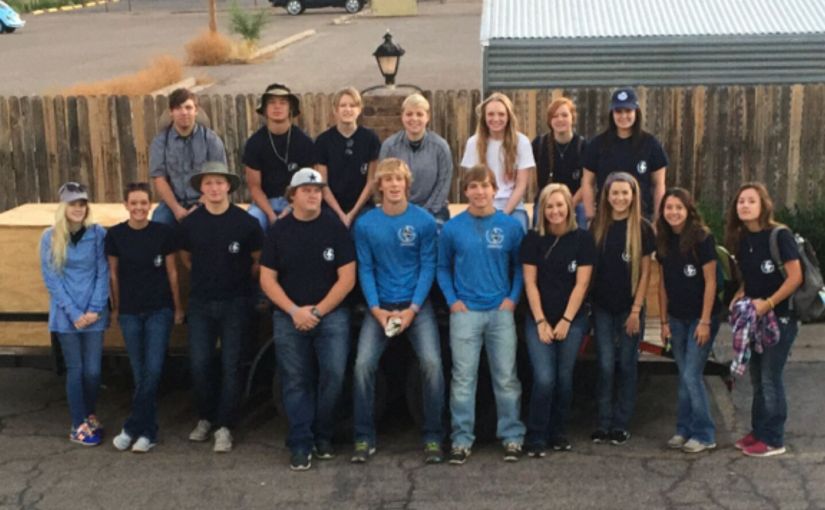
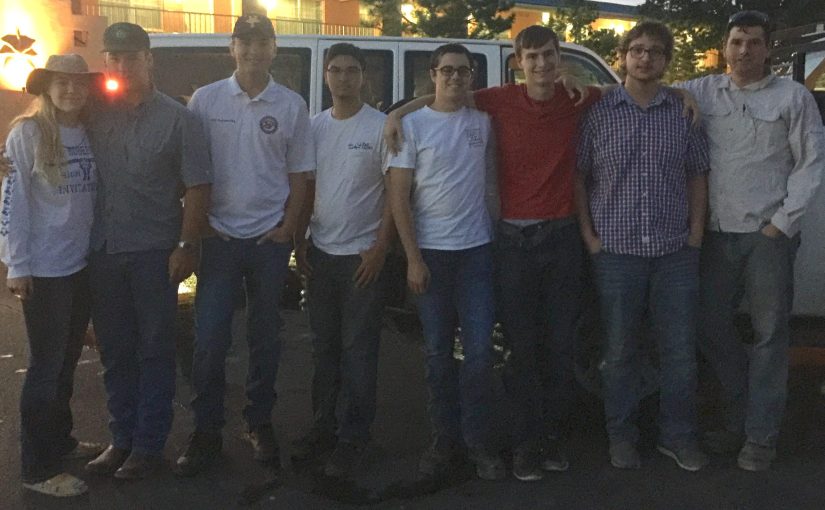
The picture on this blog piece is of the Fredericksburg rocket team this morning prior to their vehicle test. It was provided by team member Zane Brown. Team members are from left to right: Katie Habecker, Link Millard, Dorian Jones, Garrett Ottmers, Nathan Weatherford, Alex Scudder, Zane Brown, and teacher, Andrew Matthes.

Late Update to Wednesday, Launch Day 2 at WSMR

This is just a quick update to my earlier post. Booker T Washington has decided not to go for a retest on either of their failed rockets today. That means Fredericksburg is tomorrow’s only attempted launch test. It’s T time is 8:30 a.m.

Wednesday, Launch Day 2 at WSMR

The Anahuac rocket left the rail this year at 8:36 a.m. It traveled 171 meters (appx. 576.27’).  The Estes motor blew out at ignition as the rocket started its lift off. This caused the rocket to spiral upward and eventually nose over and continue into the range a few hundred yards to the right of the launch rail, digging a crater and leaving dust for some distance. The Anahuac teachers were prepared and blew party horns to celebrate as soon as the vehicle came to rest. Congratulations Anahuac on your first successful launch!!!!!

The next two T times were both held by Booker T Washington High School. Both of these rockets were carrying a payload consisting of a PVC container with space pebbles that they were testing to see how they would react upon reentry to the earth’s surface.

Unfortunately it was not a good day for Booker T. They achieved success in making it to the pad, but flight was not to be. Neither vehicle left the pad.

On the 11:00 a.m. test of Golden 5 the Junior class rocket, the valve froze shut not allowing the Nitrous Oxide to mix with the fuel at ignition resulting in a small puff of smoke and a misfire.

The 2:15 p.m. test of their Senior class rocket, failed due to a fault in the ignition wire  which resulted in no ignition and the system venting out the Nitrous. There is no word at this time as to whether either vehicle will be able to retest in one of tomorrow’s two available retest T’s. Even if one of the vehicles can be repaired in time there may not be more Nitrous available for them to conduct any additional testing.

At this time, the 8:30 a.m. T time is scheduled for Fredericksburg’s Red Bird #17 rocket. If no other retesting occurs, then the mission will be complete, then clean up and pack up will end the day for SystemsGo, students, and WSMR personnel.

Good luck to Fredericksburg and tomorrow and safe travels to all schools heading home.

Tomorrow’s test schedule is as follows:

  • 8:30 a.m. Fredericksburg
  • 11:00 a.m. Retest (1)
  • 2:00 p.m. Retest (2)

Event details will continue to be available here. I will provide more information each morning as to how the schedule and other event details will progress for that day and how launches went for the schools testing that day. Pictures are not allowed on the range, but some pictures of teams getting ready to leave for the range with their vehicles might be available. If anything is available I will post it for your viewing pleasure.

www.systemsgo.org as always is the place for more information on this program. You may also email them at info@systemsgo.org .Take the time to get your school involved, the future of your students will be greatly benefited.

The picture was provided by parent, Teresa Moore, of the Anahuac High School Rocket team after their launch here at WSMR. Students pictured are (not in order) Anne-Marie Henry, Madalyn Orozco, Maria Magana, Kaitelynn Innerarity, Mason Duhon, Shon Patton, Dante Nguyen, Beau Cendejas, Austin Hodges, Meghan Thomas, Zack Rose, and Caleb Moore.

Tuesay, First Launch Day at WSMR

Today was a great success for the SystemsGo program as they met and/ or exceeded three T times with three rockets off the rails. The action started off well with a T time of 8:30 a.m. for Alamo Heights Heights School. They began the day with their smaller rocket built for extra height. It left the rail well, had a beautiful flight and reached a total height of 10086′. At this point the paper phenolic cover around the fuel grain burned off causing the body tube to melt through developing a hole with a side burn after which it rolled over and returned to the range in a ballistic fall. Reports from WSMR have it plugged into the range 970′ from the launch site in lawn dart fashion. This was not totally unexpected since a recovery system was not part of the vehicle.

The 11:00 a.m. T time for Union Grove’s launch meant that SystemsGo had to load the vehicle on the rail, fill and be ready to fire within two and a half hours. This was met and exceeded as their rocket left the rail at 10:59. The rocket had a great lift off but not far into the flight, the engine case blew apart dumping the motor and fuel grain. Preliminary reports are that the nozzle came off causing engine explosion. Their nose cone and shoot deployed, but the shoot did not open. Their max height was 600′.  This was actually the first time that Union Grove High School has left the rail in what is now their third attempt at WSMR. This is a great triumph for them. They are now their school’s first flight at WSMR.  Great job, Union Grove students.

Alamo Heights had a second rocket launch today with a T time of 2:00 p.m. SystemsGo did great work and exceeded this sending them off the rail at 1:48. This rocket only made 180′ after clearing the rail. The same paper phenolic fuel grain cover caused a hole to melt through the rocket at which point it began tumbling end over end back to the range.

Congratulations to both schools, at having achieved getting a rocket off the rail at WSMR. Post Flight Analysis on all these vehicles should prove to be enlightening and educational.

Tomorrow’s schedule is tentative because at this point the scheduled schools’ rockets are not pad ready. They are all going out to the range at 5:00 a.m. to complete work on them and hopefully keep the tight schedule for the day. The following is the schedule at this time:

Wednesday launch order:

  • 8:30 a.m. Anahuac
  • 11:00 a.m. Booker T. Washington (1)
  • 2:00 p.m. Booker T. Washington (2)

Event details will continue to be available here. I will provide more information each morning as to how the schedule and other event details will progress for that day and how launches went for the schools testing that day. Pictures are not allowed on the range, but some pictures of teams getting ready to leave for the range with their vehicles might be available. If anything is available I will post it for your viewing pleasure.

www.systemsgo.org as always is the place for more information on this program. You may also email them at info@systemsgo.org .Take the time to get your school involved, the future of your students will be greatly benefited.

The picture was provided by parent, Lori Davis of the Union Grove High School Rocket team after their launch here at WSMR.

Monday, T-1 Briefing and Set up Day at WSMR Results in Slight Schedule Change

SystemsGo and the participating schools had a productive first day at White Sands Missile Range (WSMR) today. They started the day with the T-1 Briefing. This is basically WSMR rules and regulations for the range. It covers all basic information such as weather conditions, wind speeds, airspace schedules and logistics.

WSMR personnel made introductions so all involved would know who they are and who to contact for help from the base. After the T-1 brief they teased that it was the “dumbed down” version for civilians. At the end Scott Netherland introduced the SystemsGo team and specified their roles with the organization.

By 10:30 they were headed down range to West Center 50 launch site. This is where the schools, SystemsGo, and WSMR personnel spent the afternoon getting ready for tomorrow’s launches. All equipment and rockets had to be set up and completed to meet the Tuesday testing schedule. Everything went well and it was a very productive day albeit a little long and quite hot.

Union Grove had a small problem with their vehicle that kept it from passing the pressure tests so in order to be sure that the schedule would stay on course tomorrow, they moved  Alamo Height’s smaller rocket into the first launch window for tomorrow morning, because they had to have one on the rail and ready tonight to keep the schedule. Union was able to fix their problem and pass the second round of pressure tests so they will resume as the second launch in the morning.

Because of this tomorrow launch schedule is as follows:

  • 8:30 a.m. Alamo Heights High School (1)
  • 11:00 a.m. Union Grove High School
  • 3:00 p.m. Alamo Heights High School (2)

Due to the 8:30 T time tomorrow will be an early day for SystemsGo team and schools. They will be leaving for the range by 5:30 a.m. Alamo Heights parents going to Range Control to view the launches will be leaving at 6:15 a.m. Subsequently parents with Union Grove will be heading to Range Control by 9:00 a.m.

If it is a perfect day and all goes well with no exceptions with each launch, then the tests should be complete by 3:00 p.m. Realistically this is a very tight launch sequence with little to no room for errors. As long as each rocket that loads the rail leaves without any issues at ignition this schedule will hold and therefore the next days will follow as currently scheduled. If one vehicle has to be taken down from the rail then the next launch window will be lost and the schedule will have to shift.

Therefore let us all hope and pray for the best for each school so that they may have a successful launch tomorrow and that all schedules hold true.

Here is the current preview of the launches scheduled for Wednesday. Tomorrow’s blog will have a final schedule for the day based on Tuesday’s test success.

  • Wednesday launch order: Anahuac, Booker T. Washington (1), Booker T. Washington (2)

Event details will continue to be available here. I will provide more information each morning as to how the schedule and other event details will progress for that day and how launches went for the schools testing that day. Pictures are not allowed on the range, but some pictures of teams getting ready to leave for the range with their vehicles might be available. If anything is available I will post it for your viewing pleasure.

www.systemsgo.org as always is the place for more information on this program. You may also email them at info@systemsgo.org .Take the time to get your school involved, the future of your students will be greatly benefited.

Sunday Rockets Headed to White Sands-Day 1-Report and Monday Early Information

The SystemsGo team rolled out of Fredericksburg at just before 9:00 a.m. this morning to head out to White Sands Missile Range (WSMR) in New Mexico and arrived at Alamogordo around 5:30 this evening. Travel went well, and two schools, Alamo Heights and Booker T. Washington met us there.

Tomorrow is an informational and set up day. SystemsGo personnel and only student and teacher participants from the schools head out at 6:00 a.m. for T-1 briefing  and afterwards setup at West Center 50 launch site.

Event details will continue to be available here. I will provide more information each morning as to how the schedule and other event details will progress for that day and how launches went for the schools testing the previous day. Pictures are not allowed on the range, but some pictures of teams getting ready to leave for the range with their vehicles might be available. If anything is available I will post it for your viewing pleasure.

www.systemsgo.org as always is the place for more information on this program. You may also email them at info@systemsgo.org .Take the time to get your school involved, the future of your students will be greatly benefited.

Team photo includes from left to right, Ginger Burow, Scott Netherland, Randy Kuhlmann, Steve Burow, Brian Heffner, Gene Garrett, Andrew Matthes ,Rebecca Hyatt, and Josh Hampton. Not available for this picture, Chelsea Burow.

2 More Days- Here’s What’s Happening for WSMR

The SystemsGo team and schools leave for New Mexico to launch rockets at White Sands Missile Range (WSMR) on Sunday, June 26. That is two days from today. The list and schedules have been finalized and packing is underway.

The schedule will proceed as follows:

  • Sunday will be their travel day to Alamogordo, NM to the hotel.
  • Monday morning will be T-1 briefing
  • Monday afternoon they will travel to West Center 50 Range and do site set up and rocket prep
  • Tuesday launch order: Union Grove, Alamo Heights (1), Alamo Heights(2)
  • Wednesday launch order: Anahuac, Booker T. Washington (1), Booker T. Washington (2)
  • Thursday launch order: Fredericksburg, Make up #1, Make up #2
  • Friday will be travel back home for each group.
  • If for any reason tests run late on Tuesday and Fredericksburg is delayed then they will shift to first on Wednesday and subsequent launches will shift as needed.

The final list of schools participating in this year’s WSMR tests is:

  • Alamo Heights High School
  • Anahuac High School
  • Booker T. Washington High School
  • Fredericksburg High School
  • Union Grove High School

Parents be sure your child and yourselves if you are already on the approved list with SystemsGo, and attending, has proper identification with them. State driver’s license, federal pass port, or state id card are required for access to the base. Also be sure they have medical insurance information with them in case of an emergency.

Please be advised that WSMR is an Army base and does not allow spectators in to view these launches. Only the students, personnel, and parents who have been previously approved through SystmsGo and added to the list may enter the base with the group. Please do not drive to White Sands and attempt to enter on your own, or expect to do so with the group, because you will be turned away.

Event details will continue to be available here. I will provide information as made available to me from team members on site as to how launches have gone for those schools testing on that particular day. Pictures are not allowed on the range, but some pictures of teams getting ready to leave for the range with their vehicles might be available. If anything is available and passed on, I will post it for your viewing pleasure.

www.systemsgo.org as always is the place for more information on this program. You may also email them at info@systemsgo.org .Take the time to get your school involved, the future of your students will be greatly benefited.

9 More Days- Here’s What WSMR Rockets are all About

Nine days from today, the SystemsGo team and schools leave for New Mexico to launch rockets at White Sands Missile Range (WSMR). The list of schools attending and schedules will be posted next Friday. They are mostly available now, but there may be minor changes so I will hold off until then for a more accurate posting.

I do know that Fredericksburg rocket group has run into some major snags with their vehicle and that if they cannot overcome them quickly, then they will have to make a decision on whether or not to abort within the next few days. This is a big decision to have to make because a lot of man hours, time and money have been poured into this year long project. The magnitude of this may be hard for some to fathom so here is a synopsis of what the Goddard level rockets that launch at WSMR are all about.

These rockets and their subsequent launches at WSMR (White Sands Missile Range) are the culmination of all the skills the students have learned  throughout their years in the STEM program. This is their final senior project for those schools that participate in this level of the SystemsGo program.

By now these students have spent a minimum of 2 years, most of them four years learning in this system of education. They have spent countless hours both in and out of class.

The year is divided by semester into two project bases. The first semester deals with early design phases including payload, performance, and vehicle configuration. Once the payload and an initial vehicle design concept have been developed the student project team begins developing a flight profile. This is used to predict what will happen during testing, including vehicle stresses and flight dynamics. By semester’s end, a test vehicle configuration should be fairly realized.

Semester two is the culmination of everything the students have learned in the first semester, and the continuation of using life and work skills to manufacture their test vehicle, perform a test and analyze their test vehicle findings. Success for this project is determined by two things.

1. Was the rocket finished by the scheduled date and delivered to the pad for testing?

2. How was the rocket’s flight performance in relation to its design parameters?

This translates to the students manufacturing a rocket from scratch; usually weighing in at between 250 to 450 lbs; to reach high altitudes and Mach 3 to Mach 4 velocities. This project is what all the previous years’ effort have been building up.

At this point, in order to achieve their goal, one large working team, divides into several smaller teams with designated goals for each part of design and development for the vehicles’ creation, propulsion, and testing. These component teams include:

Nose cone

Avionics/payload

Oxidizer tank

Injection

Fuel Grain

Nozzle

Engine case/forward skirt/fins

Each team first creates a workable timeline and then begins researching all necessities and questions concerning their team’s component. Questions they encounter may include function, simplicity, mass, etc. Students present their findings in the form of mathematical calculations for their design and these are reviewed and critiqued by aerospace professionals. Students must find their own solutions to any problems presented to them by these professionals.

Once a mathematical argument and a design drawing have been created, the team starts another research phase into the materials to build their component. In this phase students must be able to show critical thinking skills while studying different materials and their costs, safety, ease with which to work and whether they can be ordered in within time constraints. After the design is developed and reviewed and the correct materials determined, a Critical Design Review (CDR) is presented to the other teams for acceptance. If approved the team then begins development of the component, acquiring materials and enlisting any help they may need from local industry. If it is declined then the team redesigns it until the component is accepted by the entire group.

If the original time line is kept each team’s component will be finished by the deadline. To ensure this each team must undergo a Flight Readiness Review (FRR) showing that their project is 100% ready. Once all components have demonstrated a 100% readiness, then the complete vehicle can be constructed  into a full standing rocket. SystemsGo calls this their “‘all-up’ configuration.” At this point, Standard Operating Procedures (SOP) must be developed and adhered to in order to test their rocket. To do this, students must be in communication with the launch facility, create support teams, and prepare necessary paperwork. Final preparations for the launch also include students working together to make sure the components are all prepped and ready, or working in mission control, meteorology, safety and other areas needed at the launch.

Next the rocket is tested and hopefully undergoes a successful launch. After this a Post Mission Analysis is done to evaluate the complete performance of the vehicle. This marks the end of the of the  program.

The knowledge base the students acquire through this program include: as quoted from the SystemsGo website: design and development, critical thinking, fabrication/machining, problem solving, teamwork, communication, analysis/application, documentation,  presentation, research, time/project management, budgets/purchasing, public relations, and computer skills in RockSim, Excel, Microsoft Word and PowerPoint.

These rockets which usually stand between 20 to 25 feet and range from 8 to 10 inches in diameter are an amazing sight to behold if for no other reason than that they are built by high school students, not professional aerospace engineers. They are built by the future of these industries. Many of these students go on to become engineers, machinists, scientists, physicists, mathematicians, and countless other business professionals. This STEM based program teaches them skills they can apply to life and use to continue into their future learning and job markets.  If you have a student in the STEM program at your school who is excited about what they are doing, take interest, get involved and don’t miss the chance to see what they is happening first hand whenever possible. You are watching the future in something we can all be proud. These students are doing truly amazing things.

This is also why we watch these groups so closely. We want to see that every group that aspires to reach WSMR does, but it is fully dependent on them doing all that it requires to get there.

This article was intended to be a synopsis of the program in hopes that others may take interest and pay attention to what these students are achieving, so that more schools might implement the program for their students. It is well worth the time an effort involved. What better way to learn than to have the students apply what they are learning first hand and achieve a workable goal. The teacher is the instructor, guide, mentor, and timeline manager, but  the  project’s success or failure is in the students’ hands. They are the project managers that do all that is needed to see that this vehicle makes it to the pad and then into the sky. If your student makes it to this level, don’t miss out, you want to see this monster fly. It is a proud moment you won’t forget, and even more importantly, neither will your student. Their future begins here, don’t miss out on the chance to support their dreams.

I hope I have done the program justice, as I tried to describe it in a way that might be understood by all and draw some interest.

www.systemsgo.org as always is the place for more information on this program. Take the time to get your school involved, the future of your students will be greatly benefited.

Tune in again next week for a schedule of the upcoming launches at White Sands Missile Range that following week, and hopefully some daily high lights from the group.
WSMR Report-17 More Days

Today marks 17 days until the SystemsGo team and schools head to New Mexico to launch rockets at White Sands Missile Range (WSMR). Already the schedule has changed since this time last week. Luckily the dates haven’t changed only brought the return date to Friday now instead of Saturday.

The classified tests WSMR had scheduled for Wednesday have been canceled allowing launches to continue on Wednesday instead of having a down day on that date. Sorry folks, that means no scheduled sight-seeing after all, but at least you will be home with more of your July 4th weekend in tact for fun.

I will not be posting the actual launch schedule for the schools until next week once we are positive there are no more changes and all schools slated to go are on board for sure. Fredericksburg is still feverishly working on the completion of their rocket. At this point no other schools on the list have given indication that any critical problems could cause them to abort.

Parents if you will be joining your child on this trip, and if they have a vehicle to launch, then you should be, then please get your identifying information in to your child’s teacher immediately. Only those on the list with information in ahead of time will be allowed on the base to observe the launches. Do not miss out on this it is definitely a trip in which you should participate.

Event details will continue to be available here. As schools and schedules finalize I will provide an updated list of  those schools traveling to WSMR and the launch schedule. The week of the launches I will provide information as made available to me from team members on site as to how launches have  gone for those schools testing on that particular day. Pictures are not allowed on the range, but maybe some pictures of teams getting ready to leave for the range with their vehicles might be available. If anything is available and passed on, I will post it for your viewing pleasure.

www.systemsgo.org as always is the place for more information on this program. You may also email them at info@systemsgo.org .Take the time to get your school involved, the future of your students will be greatly benefited.

WSMR Rocket Launches Fast Approaching

The SystemsGo Rocket program now transitions to Goddard level rockets. These rockets and their subsequent launches at WSMR (White Sands Missile Range) are the culmination of all the skills the students have learned throughout their years in the STEM program. This is the final senior project for those schools that participate in this level of the SystemsGo program.

Launches are scheduled for June 27 through July 1. The group will travel out to WSMR on Sunday, June 26, and back home again on Saturday, July 2.

These launches have been anywhere from June to mid August in past years, with multiple rescheduling happening all the way up to time to leave because of Army necessity. Actually having a fairly concrete date this year means students have to be on their game and get their vehicles completed on a tight schedule. According to Fredericksburg’s STEM teacher, Andrew Matthes, their group has a deadline of today, Friday, June 10 to have their rocket completed and ready to travel. Other schools involved most likely have similar dead lines.

As of Wednesday, June 1, the class was reported by Mr. Matthes to be on schedule with final modifications being made in all areas, including the following:

  • The after section for the motor is at Rode’s Welding for attachment to the 10′ long Nitrous tank
  • Avionics is installing the payload in the forward skirt
  • Propulsion has had a successful pour of their HTPB fuel grain, and is now working on the fuel canister
  • Nose cone is completing the shoulder part which sticks into the airframe of the rocket
  • Fins are in the attachment stage of the aft motor section

Notice in the above list, that Rode’s Welding is mentioned. Part of the skills learned in this program is when and where to contract other professionals to finish a component. Most of the components of this vehicle are finished by the students, but when there is an area that requires a more professional skill base, the students have to know how to draw out specific design models and calculations and present them to a welder, machinist or other entity so that they are created according to the design they have drawn out for the completed vehicle.

There are 5 schools scheduled to launch 6 for sure, possibly 7 rockets. These schools include:

  • Alamo Heights (2)
  • Anahuac (1)
  • Booker T. Washington (1 for sure, possibly 2)
  • Fredericksburg (1)
  • Union Grove (1)

This year is unique in that the Army has some classified tests scheduled that involve the range (West Center 50), SystemsGo uses to launch. Therefore, instead of launching straight through and then leaving, there will be a break in the schedule on Wednesday, when the group will not be allowed access to the range. SystemsGo is looking into activities for the group to do on that open day.

When I checked in with Mr. Matthes and his class on their project status, this was the enthusiastic response they delivered.

Jacob Eckhardt, “We are cutting it close but we’re working on getting it done, full force.”

Mr. Matthes added, “with reduced workforce.”

This is a common malady of the program for the senior group. After school lets out it is  hard to keep them focused, but there is always a dedicated contingency of the team that usually stays on point and gets the vehicle completed and off to WSMR.  This is just a hazard of the launches being a summer trip after graduation. Even with this, 95% of the time, the project makes it to White Sands.

Today is 23 days out until the group leaves for WSMR. Watch this blog in upcoming weeks for more information and a launch schedule to be posted.

www.systemsgo.org as always is the place for more information on this program. You may also email them at info@systemsgo.org .Take the time to get your school involved, the future of your students will be greatly benefited.