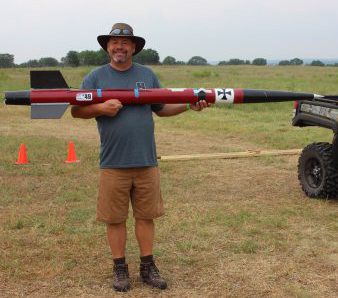
April 29, 2023, Rockets 2023 North Texas/Jacksboro Friday Launch Update Final Day Report

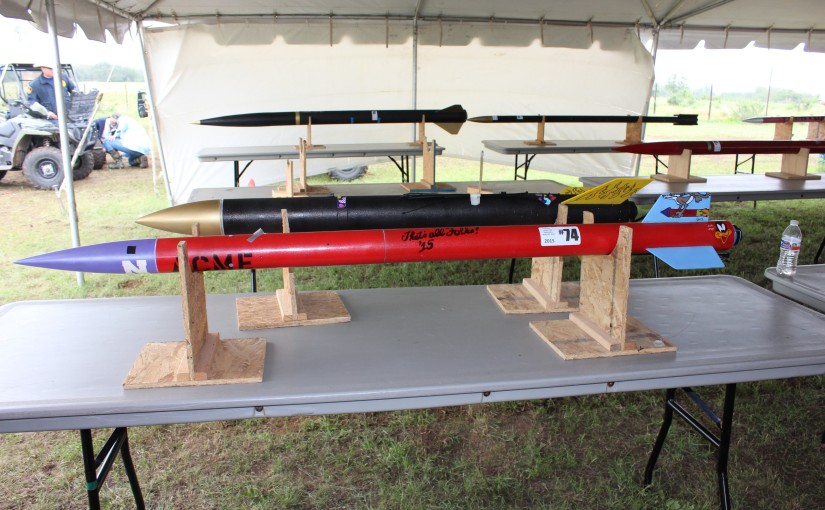
Friday, Day 2, the final day for North Texas Rockets 2023 launch series was mission complete by  this afternoon, by  with all rockets launched by 2:45p.m. Eighteen rockets from four different schools left the rails today. These schools included Buinger HS, University HS, BCTAL, and RL Turner HS.

Weather for Friday was partly cloudy for most of the day with a threat of severe storms by 3:00 p.m. High winds ushered in a front that was supposed to bring  rain, hail and severe storms.

First launches blasted off shortly after 11:03 this morning. This was  earlier than on Thursday. After the first volley, the pad kept the rockets flying in a fairly continuous  set each time the rails were full so that they could send all vehicles skyward before the storms could shut down flights. Out of 18 rockets launched, only 4  were unrecoverable, most of which were Transonics that just chose to disappear without a trace.

It was one of the fastest launch sequences I have ever participated in working. After the last rockets were recovered the Team tore down the whole site and packed it away in the storage units for NTX until next year, and then had some much needed pizza and down time. By the time this was all accomplished it was still after 10:00p.m.

In the morning the crew heads home and prepares to start the next sequence at the Central Texas/Stonewall launches this coming week.

Pictures are from today are on SystemsGo Facebook page, as well as my Facebook page. They can be found here:

https://www.facebook.com/SystemsGoEducation/

https://www.facebook.com/ginger.burow

North Texas was the second launch in the 2023 series, and is followed by launches in Central Texas/Stonewall and Southeast Texas/Smith Point. 

The launch dates, locations, and schools are always listed for your convenience at http://www.systemsgo.org/events/ .

A live feed for each launch will be provided and will be available at www.systemsgo.org as each launch date arrives.

More event details will be available here in upcoming days as events get closer. Daily reports featuring schedule links, school names, results, pictures and some editorial content will be posted during the events if information is available.

Please watch the SystemsGo website, SystemsGo Facebook page,  SystemsGo Twitter feed: https://twitter.com/SystemsGoNews and this blog for upcoming information on theses events.

www.systemsgo.org as always is the place for more information on this program. You may also email them at info@systemsgo.org . Take the time to get your school involved, the future of your students will be greatly benefited.

Hope to see you at the launches!

#RidetheSkies, #EyesontheSkies #ItisRocketscience #SystemsGoRocketTrail #TexasRocketTrail


Fredericksburg’s STEM Academy/Rocket Program-Spring Term Update #2 (February 21-March 31)

April 1st is tomorrow, so time is becoming a factor for the Fredericksburg STEM Academy as launch dates approach for the junior and senior groups. There are no fools here though, just  several groups of future engineers working hard to meet their timelines. With March behind them there is only a little over 6 weeks left  for the  junior group until Rockets 2017 and their May 18th test date. The seniors have approximately 60 days as Redbird 18 is scheduled for completion two weeks before school ends to allow for preliminary systems tests.

More on these groups and their current status reports will be later in the article.

Sophomores are currently taking mid-term exams. This is due to the new schedule for classes this year which puts a full year’s curriculum into one standard semester. They have been busy using AutoCAD to create multi view drawings of objects. Dimensioning and tolerancing of these drawings will be learned next, followed by isometric drawings and 3D modeling. The students have been printing models of their multiview drawings using the newly installed 3D printer. All 3  3D printers available now are working well.

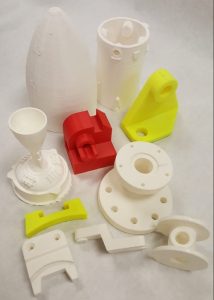
The student aide, Colby Marthaler  has also been using the 3D   printers to print all the parts necessary to create a model of the Falcon 9 Rocket SpaceX uses to transport satellites and the Dragon spacecraft into orbit.

Juniors had CDR’s (Critical Design Reviews) due for their rockets by March 30. Unfortunately they are just getting to them. Students will have to be studious in order to meet their May 18th launch date due to being behind schedule at this time. The payload for this rocket is a rapid growth slime mold. They have designed the payload in order to create a controlled experiment in which they should be able to determine how flight impacts the mold’s growth, negatively or positively.

The design criteria for their rocket is a one pound payload and breaking the speed of sound therefore achieving a transonic state. Currently neither criteria has been met so the group has more work to do to accomplish their goals by their launch date.

Their mid-term which is a LabVIEW development project has come along well. They are creating a workable program which requires specific methods and functions in order to attain a goal of designing and fabricating a micro test stand for Estes motors. They will be connecting  a (DAQ) Data Acquisition unit to a computer and registering it to that computer in order to read sensors, and programming a control and DAQ Virtual Instrument in LabView in order to run the test stand.

March began with more fuel grain tests at test stand. Two tests were completed in the first week alone, consisting of many hours of work to accomplish each. A temperature sensor indicated a high enough value in order to cause a programmed shut down on the first test that week.  After investigation, it was found that a ‘electrical noise’ caused an anomaly which gave the sensor its reading, and that it was in fact not outside normal operating parameters. The actual test did not experience any temperature concerns.

The same fuel grain was able to be used again in a 20 second burn, which allowed students to achieve a cumulative 40 second burn on one fuel grain.  The shut down was disabled for the second burn,  allowing the data to still record the temperatures caused by the ‘electrical noise’, but not to stop the burn test and it was a  full success without any further exceptions.

Mr. Matthes was very pleased with these burns and stated , “All data was processed and showed again the test stand was producing verifiable data similar to theoretical expectations.”

Students began another round of testing this week. Six new fuel grains will be tested accounting for three tests each of two different fuel types students have been working on. The  hope is that they will cycle through smoothly due to the fuel grains being prepped prior to testing.

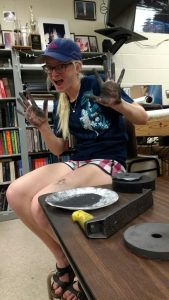
  Here Hannah Boubel is working with graphite in order to make ablative, which is a sacrificial material in the pre and post combustion chamber so the burn does not penetrate the liner and steel test cell.

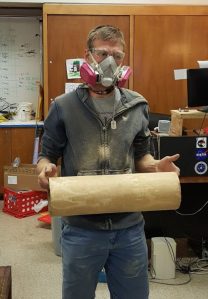
 In this photo,  Sterling Weatherford is preparing a fuel grain for installation in to the test cell.

Along with test stand work, the students have been hard at work on Rebird 18, their Goddard level rocket slated to launch at White Sands Missile Range on June 27th. Students have already contracted with Heartland  Enterprises and SRM Manufacturing for fabrications and parts have been supplied to them.

At this point in the process students are learning true cause and effect, and just how it can affect their outcomes.  The entire success of the vehicle from this point forward is contingent on the group not only working as a team as a whole, but also for each individual team to stay on top of their work and outcome. Many of the components are dependent on the progress of the others. Delays on one team’s  element directly affects the next  team creating delays down the line and strained time schedules.  Individual testing is conducted on each piece as it is finished.  Full up integration and testing of any systems that allow for ground based testing is scheduled for two weeks from the end of school when the rocket is due to be complete.

“They are well on their way to a successful vehicle.  The seniors will not have the luxury of adopting senioritis as there is still significant and mutually dependent work to be accomplished,” Mr. Matthes reported. “These next 60 days will be a true test of their team work, peer loyalty and persistence. ”

As the end of the school year approaches, these students are becoming more and more adept in their learning and knowledge as young and capable engineers. Their end of year rockets will be a testament to that learning, time and ability.

According to Mr. Matthes, “Students are becoming ‘plagued’ with knowledge and experience:  the more they know and become aware of, the more they have to take into consideration and the more challenging the process becomes.  However, it also makes for conditions more aligned with success.  Additionally, if we consider these students products of FHS and the FHS Engineering, then they should be welcomed by a market hungry for what they have to offer.”

If you follow this program and like to view the launches, Rockets 2017  will be held at the Stewart Ranch in Willow City, Texas on the weekend of May 18-21, 2017.  This testing site is open to the public. Please watch the SystemsGo website and this blog for upcoming information on the event. The FHS junior group will be testing their rockets on Thursday, May 18, 2017.

The senior group is tentatively scheduled to launch their Goddard level rocket at White Sands Missile Range (WSMR) in New Mexico the week of June 26-30. The current schedule for that event is as follows:

Sunday, Jun 25th             Travel Day

Monday, Jun 26th            T-1 and Site Set up/Rocket Prep at WC-50

Tuesday, Jun 27th            Launch Day One (Three Rockets – Fredericksburg, Union Grove, Alamo Heights)

Wednesday, Jun 28th     Launch Day Two (Three Rockets – Anahuac, Booker T. #1, Booker T. #2)

Thursday, Jun 29th          Contingency Day

Friday, Jun 30th                Travel Day

There are also launches in Houston for schools in that area the weekend of May 12-14, 2017. New for this year the Hobbs, New Mexico group of schools will launch 1/1 rockets in Jal, New Mexico on April 27, 2017, this site will also be open to public viewing.

This article is the sixth in a series, new for this school year ’16/’17 of monthly updates that will follow the Fredericksburg STEM Academy/Rocket program. This school is a participant of the SystemsGo STEM program. This series of articles is intended to support, encourage, and challenge students in the program as they share their working status and accomplishments throughout the year in the program. These publications will be available for tags and re-posting.

www.systemsgo.org as always is the place for more information on this program. You may also email them at info@systemsgo.org . Take the time to get your school involved, the future of your students will be greatly benefited.

What’s All This About Rockets?????

You may have noticed that this blog has a yearly burst of articles that follow a non-profit business, known as SystemsGo, and the related high school rocket program, where students build and launch rockets at various locations around Texas, and well as White Sands Missile Range in New Mexico. While this looks really fun and interesting, what is it all about and how has it benefited education and our students’ futures?

This is the beginning of a series of articles about just how it has shaped the lives of individuals that have participated in the program. First off it is part of an educational push to get more students into what is known as the STEM program of learning, and then out into the work force in related fields. You may have seen or heard TV and radio commercials backing the STEM initiative. One such example is the US NAVY. They carry radio and TV commercials stating the benefits of the Science, Technology, Engineering and Mathematics curriculums and the necessities of these skills to jobs in the military and the civilian work force.

The SystemsGo program teaches all of these core classes as well as teaching business applications with it. It helps students learn their strengths and weaknesses in these areas and how to work individually and as a team in order to accomplish a large project. They learn how to manage time and project teams, do project and work analysis, order supplies and inventory items for the project, write documentation and proposals for the project, as well as doing the actual STEM based project elements.

This program began in Fredericksburg High School in 1996, making this its 20th year since its implementation. The following spring the first Red Bird Rocket was sent skyward. In 1999, the first Goddard level Red Bird Rocket was launched at White Sands Missile Range in New Mexico. Since its humble beginnings it has grown from one small town school to currently 48 Texas schools, large and small. Starting next year, 7 New Mexico schools will also begin in the program with their own launch site in New Mexico, participating at the smaller launch levels beginning with Tsiolkovsky(1 pound/1 mile high) next year and  then adding Oberth(achieving transonic velocity under 1300′) hopefully the following year. Of all these schools,  9 are trained and 5 are actively participating at the Goddard(35 pound payload attempting to reach 80,000 to 100,000′-WSMR) level.

This equivolates to more than 10,000 students that have gone through the program, and by my personal estimates, that may be closer to 15,000. Because records from before 2007 are not available, and records after that time are not complete that estimate is known to be on the low-end.  At a rate of  17 students per class per grade level in a 4 year program across 48 schools that equals 3264 students a year learning this valuable academic skill set to better their futures. That is a lot of our college age and current work force that have been impacted by the SystemsGo Rocket program.

If even half of these students followed a STEM career path, that is a bigger success story than any other school sponsored program, and this program is academic based. This is not to throw punches at other extra curricular programs, they all have benefits to the individuals involved in them, but on average, the number of success stories from this program versus the number from two of the bigger programs, ei. athletics and band are quite impressive.

The following are purely observational statistics not exact documented statistics but they do give you an idea.  Out of my three children, 2 have been in the rocket program, 2 have been in athletics, and all three were in band in high school and this is what I observed from their years as well as this year.

For example, the high school band here has approximately 135 students in it. That averages out to about 33 per grade group. Of those 33 students 1-5 may pursue music into college and a career. Out of the whole four-year group, 20 might be music majors. While that is still good it still not a quarter of the group.

Athletics has an even larger student base. I don’t know exact numbers but a close estimate across the board girls and boys, there are close to 300 students involved plus or minus a few that may be in more than one sport. That translates to about 75 students per grade class. Out of that 75 students spread across 19 sports if at least one from each sport goes on to a career in the athletic field.  That is still less than 1/3 of the student base involved.

An average class in the STEM program is usually around 17.  This year’s class had 14. That is about 68 students in any given school year that are in the program. These are much smaller numbers than athletics or band, but by comparison, this academic based program has a much higher rate of students, that not only pursue higher learning in one of these fields, but also achieve a career in their chosen field. Out of the 14 from this year’s class, I was able to get information on 8 of them, and 6 of those are pursuing a STEM related field. On average, 1/2 to 3/4 of the students from any one graduating rocket class go on to  pursue a STEM related career. Those that do not, still state that what they learned from this program helped them to choose their career path and taught them many skills that will carry on into their future work place needs.

There is record of  SystemsGo alumni working at NASA  Stennis and Johnson Space Centers, SpaceX, Ball Engineering, Elon Musk’s Solar City, FMC Technologies, United Space Alliance, Real Time Systems, Ameristar, Lockheed Martin Missile and Fire Systems, Orbital Sciences Corporation, Bradley Arant Boult Cummings LLP, Halliburton, Rutgers Demmings, Petro Engineering, Department of Defense, US Airforce, and the US Navy.  These are just the handful that they have been able to follow, and a few of these employers have several SystemsGo alumni working for them. Not only that several alumni come back each year to help SystemsGo with their launches and some are regular team members.

These students are successful members of the workforce and it all started with this rocket program.  Each student starts out the program curious and hoping to do something really challenging and fun, and they definitely get all that and more. By the time they reach their junior and senior years in the program and begin building rockets, they are also building their futures, discovering who they are, what their strengths are,  and what they are truly interested in doing in those futures. This program is a proven method of helping them achieve the knowledge base, skills, and the interest in careers that will help them accomplish success.  Students from this program go into college ahead of the curve with experience that is learned and achieved, not just taught. Science, Technology, Mathematics and Engineering are the big jobs of not only today, but the future. These students are ready to go out and meet the challenges of these careers.

So the next time you see these rockets in the news and someone asks, “What’s all this about rockets?” Tell them that it is about the future of our world. Tell them that with each rocket built, these students make their small mark in history and it drives them to move forward to make their bigger mark in the future. These are the technological innovators to watch, because they go on to good jobs and strive to accomplish great things. These are student success stories. And if they are asked,

“How did the SystemsGo/Rocket program influence your career path?”

See for yourself, here are just three past students’ answers:

“I did not go directly from high school into an engineering program in college, but being exposed to the ideas and concepts of engineering in the Principles of Technology (precursor to the SystemsGo program) led me there eventually. I learned about my current employer through volunteering with SystemsGo and after I graduated applied for a job with Real Time Systems; I was hired.”–Robert Deaver, FHS graduate 1998.

“Through the two years I was in the Rocket Program, I was able to work with several groups of people on projects. And not only one piece of the rocket, but coordinating, scheduling, and planning with other members to make sure everything was working together. During my second year, I realized that I did not love to do all of the calculations and theory to construct the rocket, but instead more enjoyed dealing with the people and management side of the project. This led me to choose business management and business finance as my dual major so I could help support these people who did work on projects but not actually do the engineering to create the product.”–Derrick Loth, FHS graduate 2012

“Before taking the rocket program classes in high school, I had no idea I was interested in engineering. I learned about the many different engineering paths, and I fell in love with problem solving. I am now working toward my degree in Mechanical Engineering thanks to SystemsGo.”–Anissa Kneese, FHS graduate 2014.

SystemsGo is currently working toward having a better data base of its Alumni which will help keep more accurate numbers  of students and alumni and follow them into their careers so that even more parents, students, and teachers can see the benefits of this program and the results it can achieve. STEM is our future so get involved and encourage your school and students to get involved in this hands on, “education in motion” system of learning.

In future articles, I will be sharing interviews with past SystemsGo students on how the program affected them and influenced their career choices. If you are or if you know a student that would like to participate in sharing their information and stories here please message me either on this blog or in a PM on Facebook with contact information and I will get back to you.

www.systemsgo.org as always is the place for more information on this program. You may also email them at info@systemsgo.org .Take the time to get your school involved, the future of your students will be greatly benefited.
Rockets 2016-Saturday Report & Sunday Schedule

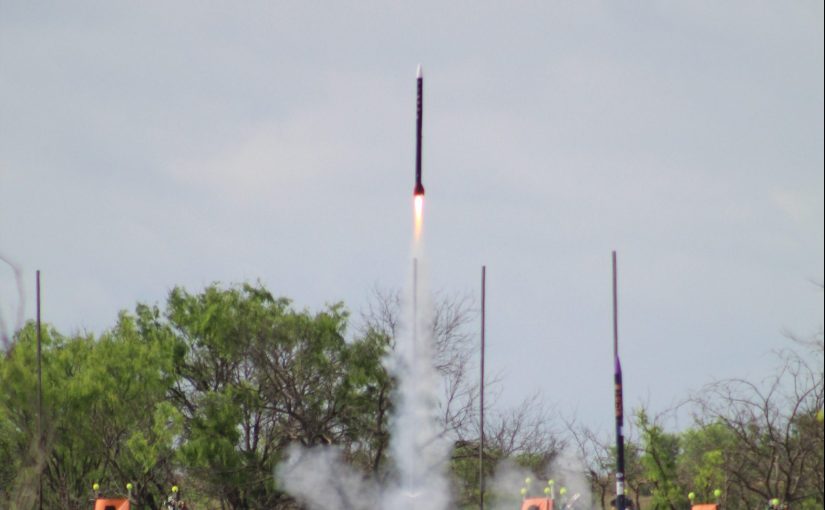
Stewart’s Hillview Ranch boasted a very packed lawn today as Rockets 2016 continued into its third day of launches. Seven schools launched today for a total of 20 launches.

Our recovery teams ran an 80% recovery rate today bringing in 16 of those 20. Overall the teams are running about 79% for the weekend  with 52 of 67 found. After final launches tomorrow the teams will have a chance to go out and hunt down more of the missing rockets. Of course there are a few that are not expected to be found any time soon since they went so far that there was not real line of sight to follow on them. For those we count on good neighbors to return them to SystemsGo if they locate them on their properties out of our viewing and hunting area. Each vehicle has SystemsGo contact information on it just for this reason. There are a few Transonics from the first two days that fall into that category, but we hope to locate a good portion of the missing 15 by the end of the day  tomorrow.

The launches went smoothly and quickly again today, very little down time. All crews were kept busy, with the only real break happening due to rain showers late in the afternoon. With this recovery crew there is no such thing as being bored. If you are then you aren’t using  your imagination, wit and blank radio space wisely.

Kasy Burow and James Drury were our third and fourth for Team 4 again today, and they made the day entertaining. They also taught Team 3 yesterday that there is no way to beat a team to rockets in their own front yard, whether you are at your spot when they fall or not. I always thought Steve was competitive in this recovery action, but I think the kids might have him beat.

I learned a valuable lesson about my camera battery today. Just because it used to make it through the event on one charge, doesn’t mean that a year later it still will. I ended up having to charge it half way through the day and so missed a lot of the action. I still managed 200 pictures though. Of course they will have to be narrowed down before posting as usual. But the moral is lesson learned, charge the battery whether you think it needs it or not.

Phil Houseal caught up with me today out at the launches for an interview. We talked about how long my family has been involved in this program. A good six years for sure. The first year helping Chelsea with her rocket and watching it launch and from then on helping in recovery here, Houston, and New Mexico.

Before our own involvement in the program we watched it and became interested because Josh Jung, and Melissa Jung our niece and nephew went through the early years. By the time they completed it and Josh started returning as a rep and volunteer from SpaceX, we were hooked and couldn’t wait for our children to take interest and be part of the engineering curriculum. Both girls, Chelsea and Kasey Burow did and are pursuing career paths in engineering fields. Brett is not in the program, but has helped with recovery in past years.

Now Chelsea is the one that returns each year to help with the launches in all three venues. Of course, this year she is missing Willow City because of college finals. She will be in Houston next weekend though.

I can’t believe we are down to one day and 4 rockets left to the Fredericksburg edition of Rockets 2016.  I want a job doing this for a living, chasing rockets and then writing about it  each day. Life is perfect. Anyone know where I can find one?

Below is the launch schedule for tomorrow, Sunday. There are 2 schools launching a total of 4 rockets tomorrow.

Sunday, May 15, 2016
School
Name
# 1st Level
Tsiolkovsky
# 2nd Level
Oberth
Manor High School
Will Davis
2
RL Turner High School (Carrollton)
Bill Richardson
1 1
Schools Launching  2
Totals 3 1
May 15th Total Rockets 4


The following is a link to the album of pictures from today’s launch. Have a look you and your school rocket just might be in there.

https://www.facebook.com/ginger.burow/media_set?set=a.1138090906212039.1073741863.100000334203350&type=3&pnref=story

Good luck to all the schools launching on Saturday. I will update the blog after we complete our day again tomorrow. Here is the link to the live stream again.

http://livestream.com/accounts/3165037/events/5379565

Please remember that although there is no charge for the event, and these launches are open to public viewing, parking and seating is limited due to safety requirements. For this reason, SystemsGo has a provided a link for you to pre-order tickets for those in your party. This also provides SystemsGo with a way to monitor the number of people in attendance each year. This is in no way meant to discourage your attendance, but is instead to help them provide a great experience for students and spectators, while doing all possible to monitor safety issues and attendance numbers at any one time during the launches.

https://www.greateventseats.com/events.php?lID=92

Event details will be available here each day of the event. Daily reports featuring schedules, school names, results, pictures and some editorial content will also be posted.

www.systemsgo.org as always is the place for more information on this program. You may also email them at info@systemsgo.org .Take the time to get your school involved, the future of your students will be greatly benefited.

Fredericksburg/SystemsGo’s STEM Program Launches More than Rockets

As Fredericksburg Rockets 2016 counts down 2 more days until launch, this now 20-year-old program boasts much more than just building and blasting rockets skyward. This Science, Technology, Engineering, and Math (STEM) program has bolstered the careers of many Texas young adults.

Hands on learning experience in STEM career basics like Engineering and Technology, Engineering Design and Presentation, Advanced Engineering Design and Presentation, Engineering Design and Problem Solving, and research and development, in a course setting that  promotes project application has inspired many of our Fredericksburg students, as well as students across the state of Texas to follow a career in the STEM or business fields. Rockets may have been the catalyst that helped to teach them these skills along with other fundamental work place uses including teamwork, critical thinking, analysis, testing, leadership, innovation, invention, individual accountability, and work place compatibility, but the program itself was the deciding factor that created a lasting interest for these individuals to pursue related career fields.

Many students have gone through the program in the last 20 years,  just here in Fredericksburg, let alone schools all across Texas that have been using this same model from SystemsGo.  Unfortunately there is no recorded number to tell us how many, but just at an average of 17 students per class per grade level, that is approximately 1100 students here in Fredericksburg alone. Multiply that by 43 active schools currently on the list of participants that have joined the program over the last 20 years, and that is a lot of Texas students whose lives have been impacted by the program. New Mexico schools may soon be joining this program as well so that number will increase even more as the program expands outside of Texas.

The following, is just a handful of individuals, some from the early years of the  program and some from more recent years. All of them credit the SystemsGo program for encouraging them and helping them to achieve where they are today.

Robert Deaver: FHS graduate 1998, BS  in Electrical Engineering at University of Texas at San Antonio, MS in Computer Engineering at University of Tennessee. He was in the SystemsGo program in the first two years of it beginning and worked on the  design, construction and flights of Redbird 1 and Redbird 2. He is currently an Electronics Engineer at Real Time Systems in Fredericksburg and a Team member of SystemsGo. Previously he worked at IBM and Dell.

Josh Jung: FHS graduate 1999, BS in Aerospace and Aeronautical Engineering at Purdue University. He spent sophomore through senior years in the SystemsGo program working five Redbird rockets including:

  • RB-2: 8″ diam, 15′ tall, M-engine, 3 experimental recovery systems
  • RB-3: 2.5″ diam, 6.5′ tall, K-engine, Mach -1 rocket
  • RB-6: 3.5″ diam, 6′ tall, Mach-2 rocket (summer project)
  • RB-7H: 8″ diam, 20′ tall, hybrid engine, WSMR first attempt
  • RB-8H: 8″ diam, 27′ tall, hybrid engine, WSMR flight (upgraded the RB-7H)

Josh is currently the Director of the Falcon 9 Stage Test at SpaceX. He has previously been the Director of Ground Support Equipment, and Director of the Texas Test Site also at SpaceX.

Melissa Jung: FHS graduate 2001, undergraduate studies in Engineering at University of Illinois, ACOG in San Antonio, Recruit Training Command in Great Lakes Illinois. She was in the SystemsGo program her sophomore through senior years.

Melissa is currently working as an Avionics Electronics specialist on airplanes in the US Navy stationed in  Norfolk, VA. Previously she worked as a patrol officer in the Fredericksburg Police Department.

Chelsea Burow: FHS graduate 2012, currently working on her BS at Texas Tech University in Physics with a Mechanical Engineering minor . Chelsea was in the SystemsGo program her junior and senior year. Their group built and launched RB-12.

She is unsure about her plans after graduation, but is looking into places like SpaceX, NASA, and SystemsGo. She continues to help with the SystemsGo launches to current date.

Derrick Loth: FHS graduate 2012, currently working on a dual major in Business Finance and Business Management at Texas Tech University. He was in the SystemsGo program his junior and senior years. He was part of the team that built and launched RB-12.

He graduates May 2016 and plans to work for the FDIC as a Federal Bank Examiner.

Kasey Burow: FHS graduate 2013, attended Basic Training at the Recruit Training Command in Great Lakes, IL.  She was in the SystemsGo program her sophomore through senior years.

She is currently in the US Navy stationed at the Norfolk Naval  Station in Norfolk,VA. She is an Aviation Structural Mechanic on Sea Dragon helicopters in Helmineron 12 & 14.

Austin Walters: FHS graduate 2014, attends the University of Texas at San Antonio, and is working on a dual Bachelors in  Aerospace and Mechanical Engineering. He was in the first full 4 year program offered by SystemsGo at FHS. He helped build and launch RB-15.

He plans to work for one of the Aerospace companies like SpaceX after graduation.

Anissa Kneese: FHS graduate 2014, currently attending Texas A&M. She is studying Mechanical Engineering. She was  also in the first full 4 year SystemsGo program at FHS. She also helped build and launch RB-15.

She would like to work for one of the Aerospace companies after graduation. She continues to help at each year’s SystemsGo rocket launches.

While trying to find information on individuals for this piece I found the following link by Shaun Pyka done somewhere around the 2012-2013 school year. It show cases a slide show of many more past students and where they were at the time.  Some of the work information may not be current anymore, but is still gives a good idea of how much this program has impacted the lives of its students.

http://slidegur.com/doc/1128314/shaun-pyka—systemsgo

More event details will be available here in upcoming days as launch dates get closer. Daily reports featuring schedules, school names, results, pictures and some editorial content will be posted during the events.

www.systemsgo.org as always is the place for more information on this program. You may also email them at info@systemsgo.org .Take the time to get your school involved, the future of your students will be greatly benefited.