Day 62- SystemsGo Team Ends Another Successful Year

The SystemsGo team traveled home from White Sands Missile Range in New Mexico today. They left Alamogordo around 0800 and arrived safely in Fredericksburg around 1845.

They have now completed another successful year with launches in Houston, Willow City, and WSMR. The group helped students attempt the launches of over 90 Tchaikovsky and Oberth rockets and 6 Goddard level rockets.

Now they take a short needed break before getting fired up for a new year with more schools, students and rockets. It won’t be long and the “launch season” will be back again.

SystemsGo transitions back to helping schools and teachers implement this STEM based program so that more students can participate in this system of learning.

That concludes Thursday’s WSMR Rocket update.

www.systemsgo.org as always is the place for more information on this program. Take the time to get your school involved, the future of your students will be greatly benefited. SystemsGo is a Texas-based STEM curriculum program.

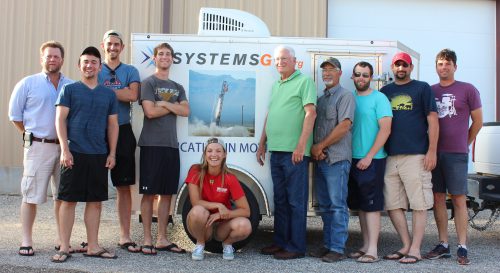
Team photo includes from left to right, Brett Williams (SystemsGo founder), Cade Ottmers, Brian Heffner, Josh Hampton, Chelsea Burow, Gene Garrett, Steve Burow, Randy Kuhlmann, Robert Dever, and Andrew Matthes (FHS STEM program instructor).

Day 59-Rockets at WSMR -Launch Day 1-Update

Monday was another long day for the SystemsGo team, students from Marble Falls and Anahuac High Schools, and WSMR officials as they commenced the first day of tests.  Start time on the range at 0400 was with no electricity due to lightning strikes the evening before, but this was quickly corrected.

The Fill and Fire System completed set up with the addition of the Comm Readout Displays which allow the bunk house and the pad to see a digital readout of the temperature,  pressure, and weight for the vehicle on the pad during the launch preparation sequences. The full system was tested and minor glitches addressed which brought it to 100% working and readiness. Throughout the day the system was reported to work great and continued at 100%.

Marble Falls was originally scheduled to test a 0830, instead it made it to the pad at around 1200. The vehicle passed its final fill and fire tests and went vertical around 1230. The survey team set the angel at 85 degrees with an azimuth of 355. Six Nitrous bottles were loaded into the tank. At this point it almost over pressured and began to release venting liquid instead of gas. At 175 lbs and 900 PSI  the vehicle was determined ready for launch. Switches were good, and flame was good, but the injector failed to open and the rocket went into a still fire burn on the pad, continuing to burn for four minutes, until the bottom began leaking the nitrous.

Army rules forbid any contact during this time and for 30 minutes after the fire burned out. At that time the Oxidizer crew was allowed to approach and evaluate the vehicle. The rocket was too hot too touch delaying removal of it from the pad for another hour.

Minor damages were reported to the launch rail and trailer, but nothing that would affect or delay any future launches at this time. Instead it was just enough to give Captain Garrett something to do over the summer again.

At approximately 1400 Anahuac’s vehicle was brought to the pad and cleared for launch. At fill, one and a half bottles were loaded into the tank at which time it began leaking out from a vehicle malfunction, and Anahuac had to be scratched.

This concluded the tests for the day, setting today’s successful launch rate at zero. Any school that actually makes it this far is still a success for the simple fact that they attempted a launch of a vehicle of this size. They still have post analysis to do and challenges to over come to prevent these outcomes in the future.

Mother nature was reported to have attended the tests today as well and thrown her own challenges into the range for the crew to overcome, as well as find some humor in once they had passed. First a large dirt devil spawned right on top of the range and attempted to steal one of the large staging tents, causing a commotion as individuals scrambled after and reset it. Later, two birds were fighting on a transformer out by the pad, when a loud pop resounded, right after which one bird fell to the ground while the other made its escape and the power at the pad went down. Luckily they were using generators so this did not affect the pad and they continued as it was being fixed.

The crew spent fourteen hours at the range today, with an 8 hour launch window. Tomorrow they begin their day at 0900 with a shortened 6 hour launch window due to some other military tests scheduled for that morning early. Union Grove High School will be first followed by Booker T Washington High School. Both rockets are reported to be at 100% and waiting.

That concludes Monday’s WSMR Rocket update.

www.systemsgo.org as always is the place for more information on this program. Take the time to get your school involved, the future of your students will be greatly benefited. SystemsGo is a Texas-based STEM curriculum program.

Tune in again tomorrow for an update from Tuesday and a schedule of Wednesday’s launches at White Sands Missile Range this week.


Day 56 – Rockets at White Sands Missile Range

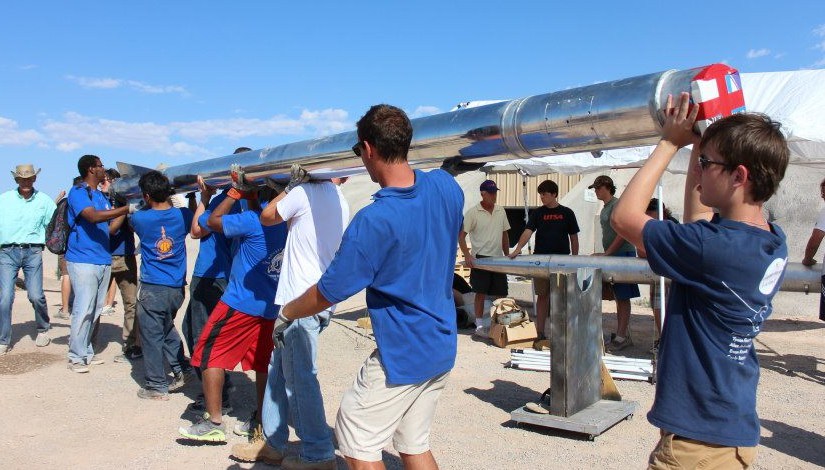
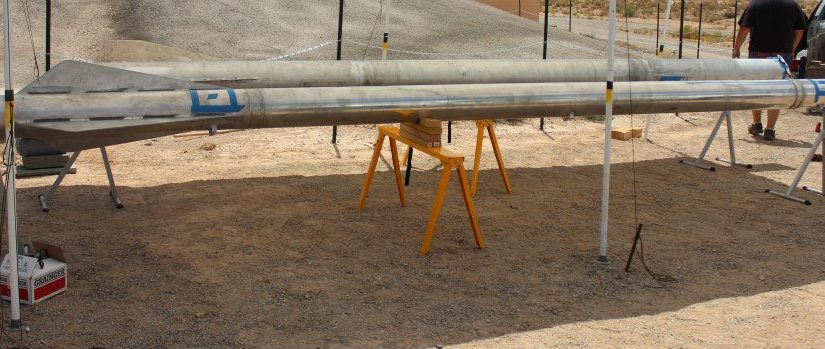
While the more public focus of SystemsGo Rockets 2015, the launches of the Tsiolkovsky (1 pound/1 mile), and Oberth (Transonic) rockets may have come to a close for this year, the program has not finished for the year. The SystemsGo Rocket program now transitions to Goddard level rockets. These rockets and their subsequent launches at WSMR (White Sands Missile Range) are the culmination of all the skills the students have learned  throughout their years in the STEM program. This is their final senior project for those schools that participate in this level of the SystemsGo program.

By now these students have spent a minimum of 2 years, some three, and as the program expands with new STEM requirements in education, as many as four years will have been spent following and learning in this system of education. They have spent countless hours both in and out of class.

The year is divided by semester into two project bases. The first semester deals with early design phases including payload, performance, and vehicle configuration. Once the payload and an initial vehicle design concept have been developed the student project team begins developing a flight profile. This is used to predict what will happen during testing, including vehicle stresses and flight dynamics. By semester’s end, a test vehicle configuration should be fairly realized.

Semester two is the culmination of everything the students have learned in the first semester, and the continuation of using life and work skills to manufacture their test vehicle, perform a test and analyze their test vehicle findings. Success for this project is determined by two things.

1. Was the rocket finished by the scheduled date and delivered to the pad for testing?

2. How was the rocket’s flight performance in relation to its design parameters?

This translates to the students manufacturing a rocket from scratch; usually weighing in at between 250 to 450 lbs; to reach high altitudes and Mach 3 to Mach 4 velocities. This project is what all the previous years’ effort have been building up.

At this point, in order to achieve their goal, one large working team, divides into several smaller teams with designated goals for each part of design and development for the vehicles’ creation, propulsion, and testing. These component teams include:

Nose cone

Avionics/payload

Oxidizer tank

Injection

Fuel Grain

Nozzle

Engine case/forward skirt/fins

Each team first creates a workable timeline and then begins researching all necessities and questions concerning their team’s component. Questions they encounter may include function, simplicity, mass, etc. Students present their findings in the form of mathematical calculations for their design and these are reviewed and critiqued by aerospace professionals. Students must find their own solutions to any problems presented to them by these professionals.  Once a mathematical argument and a design drawing have been created, the team starts another research phase into the materials to build their component. In this phase students must be able to show critical thinking skills while studying different materials and their costs, safety, ease with which to work and whether they can be ordered in within time constraints. After the design is developed and reviewed and the correct materials determined, a Critical Design Review (CDR) is presented to the other teams for acceptance. If approved the team then begins development of the component, acquiring materials and enlisting any help they may need from local industry. If it is declined then the team redesigns it until the component is accepted by the entire group. If the original time line is kept each team’s component will be finished by the deadline. To ensure this each team must undergo a Flight Readiness Review (FRR) showing that their project is 100% ready. Once all components have demonstrated a 100% readiness, then the complete vehicle can be constructed  into a full standing rocket. SystemsGo calls this their “‘all-up’ configuration.” At this point, Standard Operating Procedures (SOP) must be developed and adhered to in order to test their rocket. To do this, students must be in communication with the launch facility, create support teams, and prepare necessary paperwork. Final preparations for the launch also include students working together to make sure the components are all prepped and ready, or working in mission control, meteorology, safety and other areas needed at the launch.

Next the rocket is tested and hopefully undergoes a successful launch. After this a Post Mission Analysis is done to evaluate the complete performance of the vehicle. This marks the end of the of the  program.

The knowledge base the students acquire through this program include: as quoted from the SystemsGo website: design and development, critical thinking, fabrication/machining, problem solving, teamwork, communication, analysis/application, documentation,  presentation, research, time/project management, budgets/purchasing, public relations, and computer skills in RockSim, Excel, Microsoft Word and PowerPoint.

These rockets which usually stand between 20 to 25 feet and range from 8 to 10 inches in diameter are an amazing sight to behold if for no other reason than that they are built by high school students, not professional aerospace engineers. They are built by the future of these industries. Many of these students go on to become engineers, machinists, scientists, physicists, mathematicians, and countless other business professionals. This STEM based program teaches them skills they can apply to life and use to continue into their future learning and job markets.  If you have a student in the STEM program at your school who is excited about what they are doing, take interest, get involved and don’t miss the chance to see what they is happening first hand whenever possible. You are watching the future in something we can all be proud. These students are doing truly amazing things.

This article was intended to be a synopsis of the program in hopes that others may take interest and pay attention to what these students are achieving, so that more schools might implement the program for their students. It is well worth the time an effort involved. What better way to learn than to have the students apply what they are learning first hand and achieve a workable goal. The teacher is the instructor, guide, mentor, and timeline manager, but  the  project’s success or failure is in the students’ hands. They are the project managers that do all that is needed to see that this vehicle makes it to the pad and then into the sky. If your student makes it to this level, don’t miss out, you want to see this monster fly. It is a proud moment you won’t forget, and even more importantly, neither will your student. Their future begins here, don’t miss out on the chance to support their dreams.

I hope I have done the program justice, as I tried to describe it in a way that might be understood by all and draw some interest. My husband Steve, said I should just say, “Kids make really bad a$$ rockets and launch them at White Sands Missile Range.”

Well he has a point and that is the just of it, but it is really a whole lot more than that!

www.systemsgo.org as always is the place for more information on this program. Take the time to get your school involved, the future of your students will be greatly benefited.

Tune again tomorrow for a schedule of the upcoming launches at White Sands Missile Range this week, and hopefully some daily high lights from the group.

Day 49-Summer Farm Fun Like it Used to Be!

My week was fun and nostalgic for me.

My son has been spending his summer cutting, raking and baling hay. He has wanted to learn this for a long time and just so happened that his girlfriend’s dad needed some help this summer. God bless that rain.

Of course on the down side of this is the place they have been at this week, has rattle snakes, and he has killed two, three foot ones himself, and seen several others. The rattles are currently decorating my kitchen table. There was a small piece of snake on one that he cut off and tried to give to our cats to eat, but they were not having any of that. Seems even in small chunks they know what that is and to stay away from it.

We have made hay at our place this year for the first year in a few as well. My dad baled 109 total and is hoping for another cutting. The first 50 made it to the barn right after they were cut a couple of weeks ago because they were on the barn side of the property, but the other 59 only made it to the edge of the field before it rained again. These were the fields on the other side of the property. We are now in the process of moving them in.

What is fun about all this you may ask? Well, I am glad you did, and if you didn’t, it doesn’t matter because I am going to tell you anyway.

As a girl growing up out here, we raised turkeys (about 100,000 a year), cattle (40 head), and hay (sometimes 1,000 square per cutting, two cuttings a year when things were good). Because of this we were always hauling something, usually turkeys, feed, poop, or hay throughout the months from February to October. Back then I drove tractors and trucks and drug trailers and grain auger trailers for various activities around the farm.

Since the turkey plant burned in 1999, they have become a complete thing of the past. In case you haven’t noticed, I am not lamenting that very much, at least not for me, but my kids could have used a healthy dose of it some of those summers they complained of having nothing to do.  They could have enjoyed dust so thick you can’t see,  poop slung in your mouth, eyes, hair, face, other places by a flopping turkey, staying up all night loading out birds during a thunderstorm, getting up at 3:00 am to unload baby  birds; albeit, they were at least cute at that stage (the turkeys, not the kids, kids are not cute when they are woke up at 3:00 in the morning, trust me I remember, I was one of them).

The whole ranch smelled like crap all the time because dad used turkey poop for fertilizer on his hay fields. He used to say that nasty smell smelled like money. I told him he needed to wash his wallet more often, in bleach or some sort of industrial cleaner. He probably should have burned the wallet and got a new one each year.

Because of all this, tractors, truck and trailers were part of my daily routine. In fact I think it was a requirement of being in my dad’s family. Mom always said that dad should have married a man and had three boys, but instead he married her and had one boy and two girls which were quickly converted to a country wife and two tomboys. If there was a boy or man around that could do something out there, then we three ladies, and I use that term loosely, had better be able to do it too, or better. What about my brother? Well, he was/is a guy so that was just a given.

My dad taught all of us to drive tractors to haul feed to the pens, pick-up trucks to haul turkeys, feed, hay, fence posts, and whatever else needed hauling around the farm, and to pull trailers to haul hay out of the fields, as well as grain trailers to feed turkeys in the range  pens. We drove manual and automatic transmission vehicles. It was farm life, and just part of what we did. Trust me, there are many stories that can go along with these activities as well, but they are for another time.

Anyway, as I seem to have taken the long way around to the story of my week, the point is, I used to drive tractors for my dad and help with hay as a youth, but there really hasn’t been much call for me to do so in quite some time. The turkeys went away, and hay bales went from square to round. So the only real call to drive a tractor is when hay is being moved or cows are being fed.  Due to this, I haven’t driven the tractor in probably 27 years give or take.  Usually my dad, my husband or my son does whatever things need to be done that requires a tractor. Of course, I plan to change that because with my son working and not always around, and my dad getting up there in years, he’s 85, and my husband being on call for his job, it may mean that occasionally I will be the only one around to do what needs to be done.

It would seem I have gotten side “tractored” again, pardon the pun, but I couldn’t help myself. Of course that in a way is exactly what I did. In preparation to move the bales to the barn, we walked over to the field where the tractor had been left after moving the bales off to the side, so that the field could be fertilized. From there, Steve drove and I rode standing up on the side all the way back across the pasture and over to the barn. It was a blast. I haven’t done that in so long I can’t even remember the last time. I don’t know what it is, but there is something so mentally relaxing about just riding along on a tractor.  I have to laugh at myself too, because the song, “She Thinks My Tractor’s Sexy,” kept running through my head.

That was just such an enjoyable, relaxing evening. I am ready to do it again.

Last night, Steve borrowed Bryan Moellering’s larger tractor to load the bales onto Steve’s goose neck trailer, and then my dad used his tractor to load them into the barn after we brought them over and literally push rolled them off the trailer. That is a task that sounds easier than it is. Thank goodness Steve parked the trailer on a downhill slope to let gravity help. Even with that it took some doing. It’s kind of funny, because you think big round object, it should roll. Fifteen hundred pounds doesn’t roll easy, round or not. Once it hits the ground, there is no budging it, especially if it is a little dip. Nope, it is just not happening. Thank goodness for the tractor.

My phone camera does not do selfie’s because the camera is on the wrong side, so I could not get a picture of Steve and I riding on the tractor across the pasture Wednesday evening. Therefore, I took a picture of White Lightning loaded down with eight bales of hay as we moved them last evening. I wish I could have also captured the eight deer that were further down the field past the hay bales grazing, totally uncaring about us and all the noise we were making. Anyway, Lightning gets the prize, he gets to be my story cover photo, and he worked hard and has more to do, so he deserves it.

The fun begins again this evening as Steve gets off work, and then I will catch up to him when I get off. I am just a bail guide in the field when he is loading them on the trailer, and a pusher when we are unloading, but it’s fun. It reminds me of the old days of summer from my youth. Kids miss out on so much not having 100’s of square bales to haul each summer. We would haul the hay, and then go jump in the creek afterwards. Now that was a summer day!
Day 41-June 19-21, Fredericksburg Area Festival and Event Update

To start, the house has really been quiet since both the girls are back at their places again. We had a wonderful visit and I already can’t wait to see them both again. Of course that will be about 6 months for Kasey, possibly Christmas time.

Chelsea will be in and out some during the summer months. She will actually be in for the Goddard rocket shoot at WSMR in July. Of course she won’t be here much. Hopefully I will get to go along this year, but I am still not sure at this point. The Goddard level rockets are the “big dogs” of this program, hence why they have to haul them to a missile range in New Mexico to test them.

I will probably be doing an informational piece on them closer to the actual date, but if you just can’t wait, as always the address is: www.systemsgo.org

Looking ahead a bit to the rest of the week, there are a whole lot of things going on in Fredericksburg, Stonewall and our great area this week and weekend. The Chamber Calendar is full. Here is a calendar copy and recap.

6/18/2015 Summer Farmers Market “Get Fresh, Buy Local”
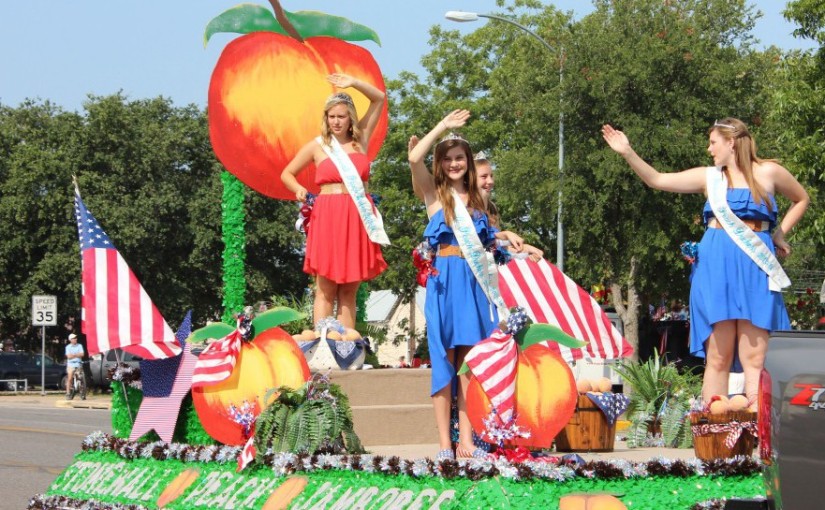
6/19/2015 Annual Stonewall Peach JAMboree and Rodeo
6/19/2015 Fredericksburg Trade Days
6/19/2015 Fredericksburg Theater Company presents “Evita”
6/20/2015 Father’s Day Food and Wine Pairing at Rancho Ponte Vineyard
6/20/2015 Thomas Michael Riley Music Festival in Luckenbach
6/20/2015 Cooking Class at Urban Herbal
6/21/2015 Fredericksburg’s Weinstrasse Father’s Day Event

This calendar can be found here: http://www.fredericksburg-texas.com/events/

The next four days really have a little something for almost everyone. Thursday, the Farmer’s Market has lots of fresh items from vegetables, fruits, cheeses, canned good, Gulf Shrimp, pizzas, live music and a relaxed atmosphere to enjoy while you shop. For more information on this weekly summer event here is the address: http://www.fbgfarmersmarket.com/

Friday evening, The Fredericksburg Theater Company begins their summer production of “Evita”, a musical production by Andrew Lloyd Weber and Tim Rice. This story portrays a rag to riches story of an Argentina First Lady. Show dates are Friday and Saturday at 7:30 pm, Sunday at 2:00 pm, and July 4th at 3:00 pm. The theater is located at 1668 S HWY 87. Tickets are $29/Adults and $12/children. For more information call 830-997-3588 or go online at http://www.fredericksburgtheater.org/

For Friday through Sunday, the direction for fun, food, entertainment, festivals, wine and shopping is definitely east. East US Highway 290 houses the locations for most of the places to be and see for the weekend. The Stonewall Peach Jamboree, The Thomas Michael Riley Music Festival, and the Fredericksburg Trade Days begin Friday.

The Fredericksburg Trade Days runs Friday and Saturday, from 9:00 am to 6:00 pm and Sunday from 9:00 to 4:00 pm. Parking is $5 and good for the whole weekend. The venue is located 7 miles East on US Highway 290 across from the Wildseed Farms.  There are over 350 vendors of all kind.  Food, music and refreshments for adults and children are available.  For more information: http://www.fbgtradedays.com/

Luckenbach, Texas hosts the Thomas Michael Riley Music Festival starting Friday at 5:00 pm to 11:45 pm, Saturday from 1:00 pm to 11:45 pm, and continuing on Sunday from 1:00 pm to 5:00 pm. Tickets are $20 for Friday or Saturday night, Sunday afternoon is free.  Twelve different performers, including Larry Joe Taylor, The Wolf Sisters, Jamie Richards, and Cooder Graw will take the stage on hourly intervals ending Friday and Sunday evenings with Thomas Michael Riley. A complete schedule is available at http://www.luckenbachtexas.com/ or http://www.thomasmichaelriley.com/8thannualmusicfestival.html

Stonewall hosts its 54th Annual Peach Jamboree Friday and Saturday. This is a family fun event with nightly CPRA Ram Rodeo and dance featuring Jody Nix on Friday and John Conlee on Saturday. Tickets are $15 Friday, $20 Saturday or a weekend pass for $30. Children ages 3-12 are $5. Entrance to the grounds on Saturday during the day is free. There is a parade, mutton bustin’, Peach Queen Contest, baking preserves, and salsa contest, 42 tournament, washer pitching, Kids patch, BBQ, peach eating and numerous other activities for your daytime entertainment. Rodoes begin at 6:00 pm both nights followed by the dance.  For more information call 830-644-2735 or http://www.stonewalltexas.com/

Saturday from 1:00 pm to 3:00 pm there is a Father’s Day Food and Wine Paring at Rancho Ponte Vineyard at 315 Ranch Road 1376. Cost is $90 and includes demonstration and three food and wine parings with Chef Rachel Ponte. For more information http://www.ranchoponte.com/

Also on Saturday, located at 407 Whitney Street, Urban Herbal presents a cooking class on “Farm Fresh class of Salad, Quiche and Tart”. Reserve your seat in advance. Class starts at 11:00 am at a cost of $75. This recipe session will also include a wine paring for your new do it yourself easy menu. For more information call 830-456-9667 or online at http://www.urbanherbal.com/

If you are at a loss as to what to get Dad for Father’s Day, and he is a wine lover, then, Inwood Estates, Mendelbaum Cellars, and 4.0 Cellars have an event that’s “just for Dad.” They are hosting a mini wine tour event, called Fredericksburg Weinstrasse Father’s Day Event, with wine tastings, food paring and live music. Tickets are $35 and include all three wineries. Visit between noon and 4:00 pm and receive a 19 oz. crystal Bordeaux glass. For more information call 830-997-2304 or visit http://www.fredericksburgweinstrasse.com/

There is an event and entertainment for all ages in Gillespie County and the Fredericksburg, Stonewall area this weekend. Hope to see you at one or perhaps all of them. Have a great weekend.