Today the class began learning the Design and Development Loop, and its application this process to rocketry. They first developed a Problem Statement, which identified the initial task, build a rocket.
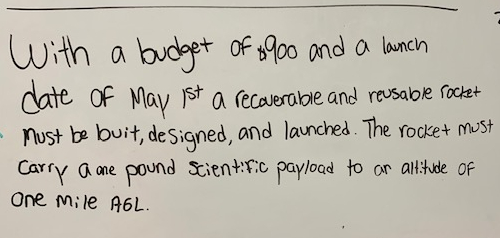
As seen here on the board, their problem statement is:
With a budget of $900 and launch date of May 1st a recoverable and reusable rocket must be built, designed, and launched. The rocket must carry a one pound scientific payload to an altitude of one mile AGL(above ground level).
Next they used a brainstorming session to develop a list of components needed to create and launch this rocket:
- fire wadding
- proof of altitude
- timeline/budget
- body tube
- nosecone
- launch lugs
- engine
- ignition
- rail
- fins
- motor mount
- recovery system
- payload
- launch area
- components
- rail
This was the beginning point they used to narrow down specific component groups they believed were related and should be grouped together. Next they identified individual team members to work that specific group :
- ignition/engine/motor mount–Mel/Amy
- recovery–Dan/Brian
- fins/lugs/body/nosecone/(fire wadding)/compartments–Derek/Johnathan
- payload/proof of altitude–Bryant/Nicole
Each team set out with their component and began research. They were given 2 hours to go on an in depth fact finding mission. Here are just a few of the many problems before them to address:
- What are their options for each component?
- What materials are available to them?
- Is the chosen material within their budget?
- Does a particular option make a difference in over all success over another option?
- What kind of Impulse will it take to get the rocket to a mile high?
These were just starting points. They began with reasonable assumptions of what they believed they needed, and then began to hone in on actualities through research, further brainstorming, and generating alternative solutions.
The teams were allowed and encouraged to discuss options and ideas in order to determine how each team’s component would work with the rest. The idea was to design a vehicle together so that it would not fail.
By 4:00 p.m. each team would have to present their idea and be able to prove why they chose this option. Their idea would have to pass a Preliminary Design Review(PDR), in order to establish the operational effectiveness of their chosen system.
During the short time I was there and able to listen in on their brainstorming, I heard questions about phenolic resin, fiber carbon bodies(quickly pitched due to expense), nose cone shape and sizing, chute deployment ideas, and payload weights and options. At the time that I left, the payload had been determined to be chocolate ice cream with the stipulation that Rebekah and I would get to share it if it survived.
These teachers have not actually built these vehicles before, so they are in the same place their future students will be. They are expected to do everything the way they will be instructing their students to do, only the students will actually build the physical rocket and will have a semester in which to do it, instead of a day.
It is a very in depth learning experience. The program is designed to enable the students to think through the process themselves in order to figure out what has to be done and accomplish it.
Until tomorrow, if you are not dreaming of rockets, you obviously have not hung out with this crew enough! And it is time you do!
www.systemsgo.org as always is the place for more information on this program. You may also email them at info@systemsgo.org .Take the time to get your school involved, the future of your students will be greatly benefited.

#RideTheSky! #Rockets2022 RocketSeason!


 On the Wings of Angels