This week’s classes are back at Fredericksburg High School, where Program Director, Rebekah Hyatt continues training teachers on the Tsiolkovsky level of rockets. The Texas schools of Summer Creek, Hollenstein, Friendswood, Atascocita, Galena Park, Georgetown, and McGregor are in attendance.
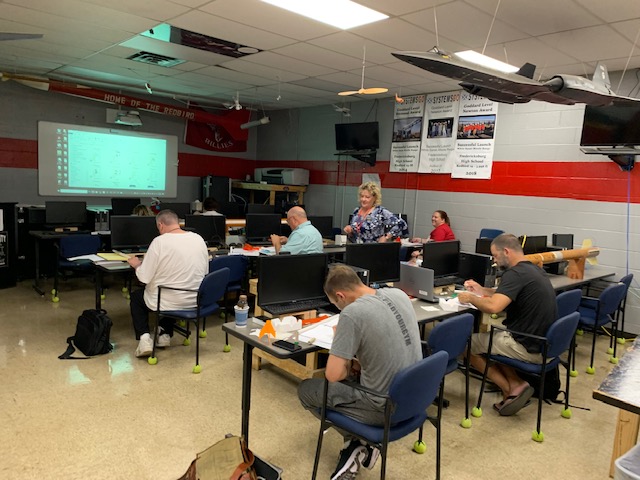
This level of the program is designed for Sophomore, Junior and Senior grade students whose projects are generally one pound/one mile rockets for launch at one of the spring launches. Before the students, whether high schoolers or these teacher students, can get to the 1/1 rockets they spend time building 3 different levels of small-scale rockets. These are Generation rockets. They help the students understand all the components of a rocket, how they fit together, in what order, and why each piece is important, as well as how each works within the vehicle.
At the point I came in for my 40 minutes of class, today, PD Hyatt, had just handed out all the pieces of a Generation 1 rocket. The teacher students, were not told what any of the pieces were, nor their use within the rocket. They had to identify them, and their use, and design a rocket using all of them. They also had to explain how Newton’s 3 laws of motion applied to their assembly of the rocket. Lastly it must fly.

I made a list of the components on the students desk, and actually did quite well identifying each one. Body tube, nose cone, parachute, streamers/reefing for chute, motor sleeve, motor, fins, and ignition were the easy pieces for me. The anti-flamable paper, 3 rings (I figured one was an engine block), and the funny plastic nipple threw me off. The paper is to prevent the chute from burning, the other two rings for centering, and the nipple, well a launch lug.

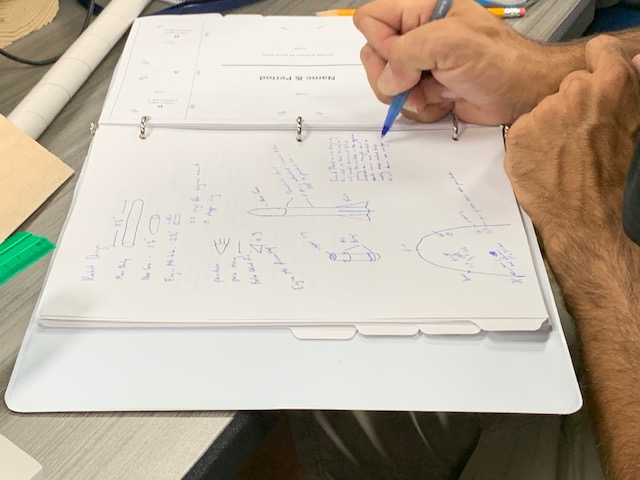
One of the teachers said he was not concerned about the whole thing burning at launch. Rebekah explained that rapid, unplanned disassembly, was not the desired outcome at this point, or really at any of the levels of the program. Although it does happen despite designing it not to do so.

Right before I left for the day, Rebekah brought out a launch rail for these rockets. Several teachers were still having problems with how to align and assembly their vehicle parts. She explained that their rocket would have to mount on this rail and come all the way down to the base in order to connect to the DC igniter. Many were perplexed at this.
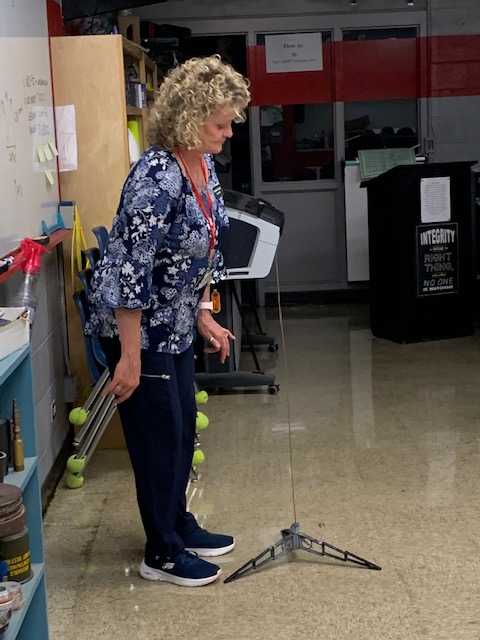
I had to leave at this point, but they did complete their rockets and launch them that afternoon. Rebekah reported that it went well. There is a video but the file did not come through, so watch for it possibly on SystemsGo’s Facebook page.
After their launch they started on the Generation 2 rockets. This started with PD Hyatt chopping their G1’s in half. They were then told to redesign them using the bottom half, which included over large fins still intact from the original body piece that was left. The chore now is to make this new vehicle stable. I cannot wait to see how this plays out tomorrow.
Discussions on Stability, Vector, Demensional Analysis, and Conservation of Energy will be part of this new rocket.
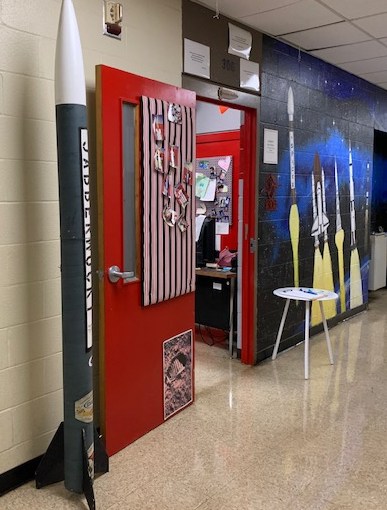
The Jabberwocky greeted me as I entered and left the classroom today. Standing tall here at the doorway, a sentinel of what is yet to come for this class group.

Until tomorrow, if you are not dreaming of rockets, you obviously have not hung out with this crew enough!
www.systemsgo.org as always is the place for more information on this program. You may also email them at info@systemsgo.org .Take the time to get your school involved, the future of your students will be greatly benefited.

#RideTheSky! #Rockets2022 RocketSeason!


 On the Wings of Angels