Anatomy of a Rocket was the continued subject today in Goddard class. Yesterday encompassed the aft end of the vehicle, where as today it was the forward section. Concentrations on Nosecones, Recovery, Payload and Fins were primary discussions, as per Mr. Matthes. Interestingly, one of those components does not belong on the forward section of a rocket. I do believe that would be a slight design flaw. This leads me to believe that it was obviously the end of the aft section before beginning the forward section. No pun intended.
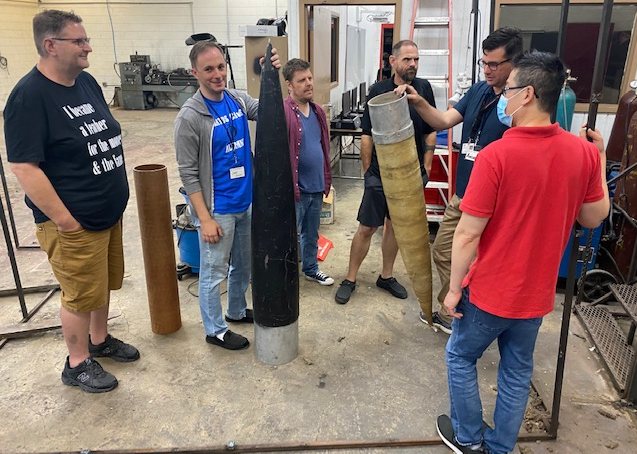
Earlier in the day during the discussion on nosecones, the group took a short field trip to the FHS Engineering storage room. Here they looked at various examples of nosecones that FHS has used on past rockets.
Chris McLeod, told me about this part of the day. He stated that I had missed the best part, and that he knew it was hard to get good pictures of them working on the screen. He then supplied the picture from this field trip, and I used it as the feature for this article. Thank you, Chris!
When I entered the discussion today, they were at the end of examples of chute configurations and deployment options. Below is what greeted me on the screen. They had already come to the consensus that option C was what they were going to include in their diagram.
Recovery had been a big part of the discussion earlier and Chris Madsen, NASA JSC, had conferenced in to aid in this conversation.

There was still some discussions about tethering, reefing, and chording. Mr. Matthes, brought up a chute drawing from earlier in the day to discuss more options and ideas on how to best accomplish these necessities.

Placement of the main and drogue chutes in reference to the avionics and electronics bay, and an antenna system for tracking, recovery and telemetry of the rocket were discussed. The antenna is being implemented since radar tracking is not always a reliable medium. Having this antenna onboard will aid in these areas supplying a secondary system instead of just the radar. Attaching this antenna so that it stays intact during flight and chute deployment seemed to be the more difficult part of adding it to the design.
At this point, the class transitioned to the screen calling on a new volunteer to draw the forward section of their vehicle. Michael Dodson, the teacher from Lovington High School in New Mexico, took on this task.

First they listed the main components that needed to be included:
- Tank
- Pressure gauge, pressure release valve, pressure release vent
- Payload
- Recovery-shock chords, Main, piston system, drogue
- Avionics
- Bulkheads
Just like Wednesday, the drawing kept evolving as they discussed what parts were needed and where their placement would be. Payload was added next. As per what the actual payload would be, I did not hear that answer. Although, 5 pounds of Playdough was mentioned as an option. At the Tsiolkovsky and Oberth levels it has been used, although not 5 pounds.
Playdough is not appropriate as a payload at the Goddard level. It was mentioned by the group as a kind of inside joke and therefore mentioned here to get the attention of certain individuals. You know who you are. We have to lighten the technical mood and have a little fun.

As the thought process stalled, Mr. Matthes, chided the teachers about having a deadline of 5 pm. tomorrow to complete their rocket. He razzed them about not putting in after hours time like the high school students do, to get the work done. During this time Mr. Dodsen added a frontal view of the recovery compartment to the drawing.

Doug Kimbrell and Doug Underwood sat at the back offering suggestions to the class and combing through material on the computer for ideas.

The class continued their brainstorming as I slipped out again for the day, my 40 minutes of class at it’s end.

Until tomorrow, if you are not dreaming of designing, building, launching and chasing rockets, you obviously have not hung out with this crew enough!
www.systemsgo.org as always is the place for more information on this program. You may also email them at info@systemsgo.org .Take the time to get your school involved, the future of your students will be greatly benefited.

#RideTheSky! #Rockets2022 RocketSeason!


 On the Wings of Angels