January is past and February is waning quickly, but the spring program is really building. There are big goals and events for each class group. This semester is where their learning hits the pad literally for the junior and senior groups as they build toward Rockets 2017 and their end of class projects. There are three class groups this semester as the sophomore class begins study and the freshman class is complete until they re-enter the program as sophomores in January of 2018.
The freshman have moved on due to the new accelerated block schedule, but at the end of the semester they all agreed that communication skills were what they felt they had developed the most. They found themselves to be much more comfortable and proficient when speaking in public. Their final projects, the orange juice production plants went well as reported by Mr. Matthes. The students were all very excited about the class and course study, but not about having to wait a whole year to return to the STEM Academy.
The sophomores are just beginning their 5th week of studies since they are new to the program for this year. Their studies to this point included learning to hand draw multi-view drawings, interpreting 3D objects, and learning engineering lettering which they have recently completed. With these skills accomplished, they will be moving on to the ACC Auto CAD course within the next week.
These students have been using two older 3D printers for these projects. The printers have a relatively small build space and so limit what the students can produce on them. The district has recently received a new larger 3D printer, the MakerBot Z18 which will be available later this month. This will be a benefit to these students as well as both upperclassmen groups as it will allow for much larger production pieces and will give them the ability to prototype designs.
While junior and senior classes will use this printer more often, the sophomores will be the first to learn how to use it. Even though their current course study will still be focused on smaller printing jobs, prototyping and future uses will necessitate knowing how to use the new printer.
Juniors began work on January 23, on their transonic rocket that they will launch in Willow City in May. They have begun the initial stages of the Design and Development processes. A timeline and a problem statement have been created, and they are about midway through the research process.
They have a Critical Design Review (CDR) due before spring break. Unfortunately they have not been able to narrow down the scope of their research as of yet. This keeps them spread out as a team, and means they have to make up ground in order to make the pre-spring break CDR deadline.
They are researching rapid growth organisms for a possible payload for the rocket, and hope to be able to study how flight affects their growth.
On Friday, February 17, the juniors along with sophomores, Gloria Burns and Eston Cooke joined the juniors as Brian Evans of Space Propulsion Group provided instruction on the basics of mathematical modeling. At the end of the presentation, juniors had the opportunity to present models they had developed and then also do trouble shooting on their profiles.
 Sophomores Gloria Burns and Eston Cooke with Dr. Brian Evans.
The junior students were very receptive to Mr. Evans and his instruction, alleviating numerous roadblocks and enabling rapid progress in their modelling.
 Here juniors, Harrison Spisak and Jacob Weinecke make their presentations their burn model to Dr. Evans.
“Dr. Evans was down to earth and made comprehension of something really difficult, easy.”-Corbin Smajstrla
“It was nice to have rocket science explained so it wasn’t rocket science.” -Evan Knapp
Juniors have been officially invited to begin learning and participation in fuel grain motor test burns, but currently seniors are the only ones conducting any test burns.
 Corbin Smajstrla and Dr. Evans at the board.
The seniors conducted their first hot fire test on Friday, February 17, while Dr. Evans from the Space Propulsion Group was in attendance. They accomplished a 10 second burn of Low Density Polyethylene (LDPE).
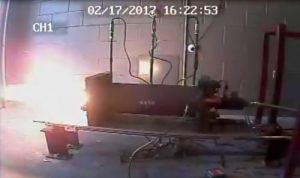 A still photo from the burn test.
According to Mr. Matthes, ” The test was extremely successful with outstanding data acquisition that showed the motor preformed nominally, according to expected design parameters. This was very exciting to have such a good, clean burn, good data, and fitting expected performance.”
Heartland Enterprises and SRM Manufacturing created a newly designed injector plate. This allowed the class to keep their Friday deadline. In spite of the piece needing to be manufactured quickly for the project, these companies came through and the product was, “beautifully machined and performed with 10% of expectation regarding oxidizer mass flow rate,” stated Mr. Matthes.
On January 27, the Fredericsburg Middle School 7th grade GT(Gifted and Talented) group presented their payload for the Redbird #18 Rocket to the senior STEM class. It consisted of a group of sensors to measure UV Light, methane, acceleratometer, and barometric pressure.
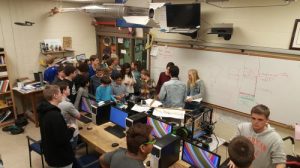
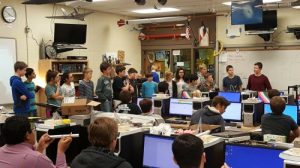 The 7th grade GT class presentation.
New this school year, Mr. Matthes started requiring after school and extra curricular hour work on senior projects. When asked how this senior group was doing with this on their project, here is what he had to say about the group.
“There have been a solid group of students who have been putting time in during study halls and some others who have been able to commit extended numbers of hours outside of school time to keep things moving forward. These senior students have worked phenomenally. They bit off a lot to accomplish this year and are on target to meet all of their expectations. It is quite remarkable having the opportunity and privilege to work with them. A substitute recently commented that during my absence, walking into the classroom after the passing period between classes was like walking into a full-fledged workforce environment where students were all fully engaged, scheduling, designing, problem solving, and just plain working without any instruction to do so. I believe the skills these students have honed over the last 4 years through this program and all their other coursework has created a ‘product’ that any college, industry, and organization would wish to recruit.”
Keep up the great work, seniors, what an amazing and glowing endorsement.
If you follow this program and like to view the launches, Rockets 2017 will be held at the Stewart Ranch in Willow City, Texas on the weekend of May 18-21, 2017. This testing site is open to the public. Please watch the SystemsGo website and this blog for upcoming information on the event. The FHS junior group will be testing their rockets on Thursday, May 18, 2017. The senior group is tentatively scheduled to launch their Goddard level rocket at White Sands Missile Range (WSMR) in New Mexico the week of June 26-30. There are also launches in Houston for schools in that area the weekend of May 12-14, 2017. New for this year the Hobbs, New Mexico group of schools will launch 1/1 rockets in Jal, New Mexico on April 27, 2017, this site will also be open to public viewing.
The STEM Academy group was encouraged to attend the movie, “Hidden Figures” on Friday, February 10th at Fritztown Cinema. About 35 students from the program attended. Here is what a few of them had to say about the movie:
“The movie was about African-American women breaking social barriers in the engineering community at NASA. It should be your talent, skills, and work ethic that decide your position at your workplace, not your ethnicity or gender. I found it to be a fun/feel good movie that was well-directed and enjoyable to watch. I found myself caring about the characters and rooting for them throughout the movie which means the characterization was done well. My favorite part of the movie was the climax when they shot the marine into orbit. The entire movie was building up to this and it was worth the wait.”–John West
“I found “Hidden Figures” to be a very inspiring and thought-provoking film. The primary idea that I took away from the movie was to “look past the numbers.” During the film, NASA mathematicians had difficulty making complex calculations due to there being no existing method available to make them. The protagonist of the film “looked past the numbers” and was able to use her intuition to come up with calculations that fit the situation. In rocket science, numbers are nothing without a physical attribute to tie them to. My favorite part of the movie was when the machine that made quicker calculations than humans malfunctioned and the protagonist was brought in to confirm them. This invoked the idea that machines, although they may be faster, can never replace the need for an engineer.”–Jacob Weinecke
This article is the fifth in a series, new for this school year ’16/’17 of monthly updates that will follow the Fredericksburg STEM Academy/Rocket program. This school is a participant of the SystemsGo STEM program. This series of articles is intended to support, encourage, and challenge students in the program as they share their working status and accomplishments throughout the year in the program. These publications will be available for tags and re-posting.
www.systemsgo.org as always is the place for more information on this program. You may also email them at info@systemsgo.org . Take the time to get your school involved, the future of your students will be greatly benefited.


 On the Wings of Angels